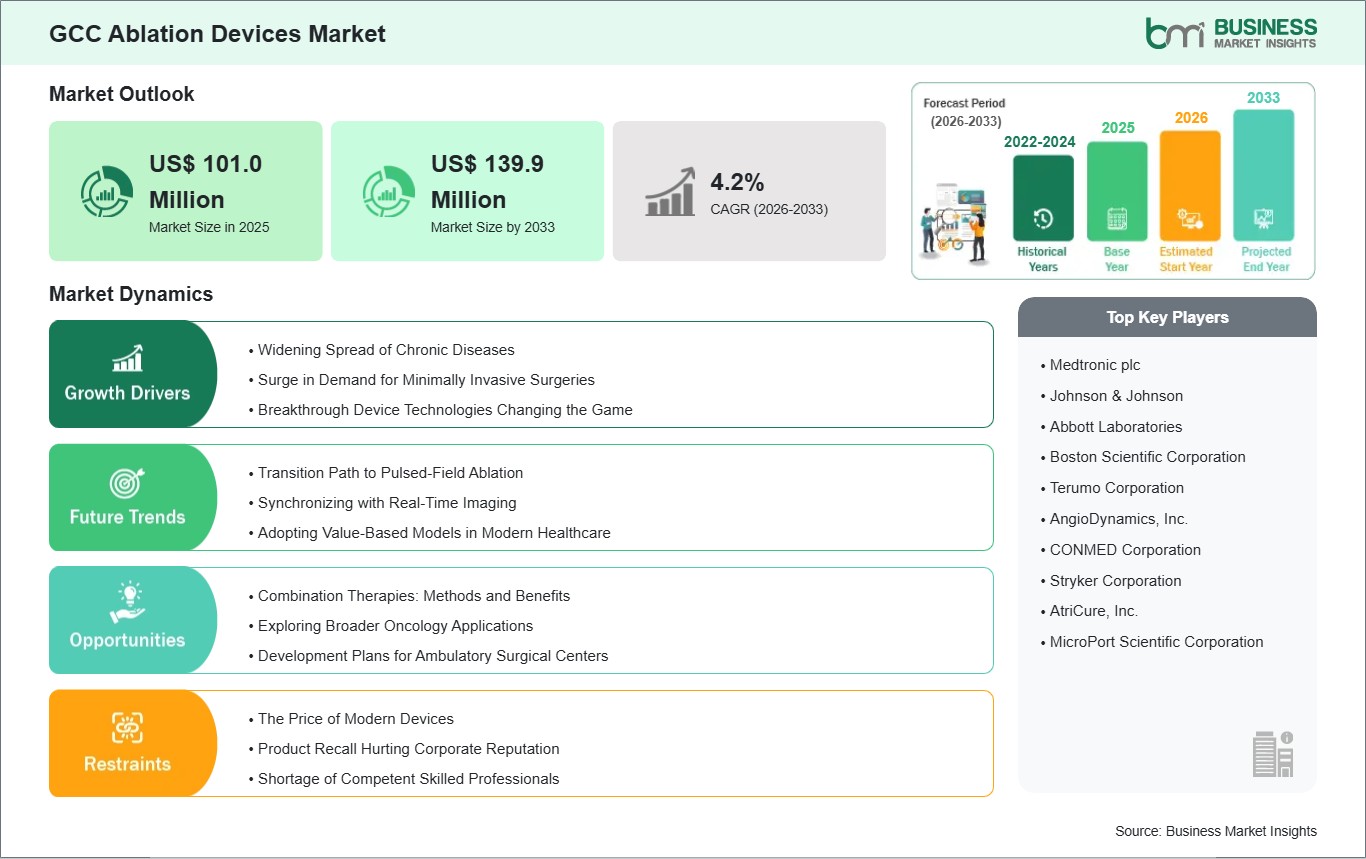
The GCC Ablation Devices market size is expected to reach US$ 139.9 million by 2033 from US$ 101.0 million in 2025. The market is estimated to record a CAGR of 4.2% from 2026 to 2033.
Across the Gulf Cooperation Council (GCC) countries, healthcare providers are incorporating ablation technologies into treatment pathways for cardiac, oncologic, and other specialty applications. This adoption is supported by expanding hospital networks, modernized medical infrastructure, and government initiatives aimed at improving healthcare delivery and technological capabilities. Patients are demonstrating greater awareness of advanced therapeutic options, driving demand for procedures that are less invasive and offer shorter hospital stays. There is a notable shortage of highly trained specialists capable of performing complex ablation procedures, and inconsistencies in regulatory and reimbursement frameworks can impede uniform adoption. Smaller or less urbanized markets experience slower uptake due to limited access to advanced medical facilities. The regional healthcare ecosystem is oriented toward high-technology solutions and patient-centric care, where governments and private institutions are investing strategically to expand procedural capabilities and improve clinical outcomes.

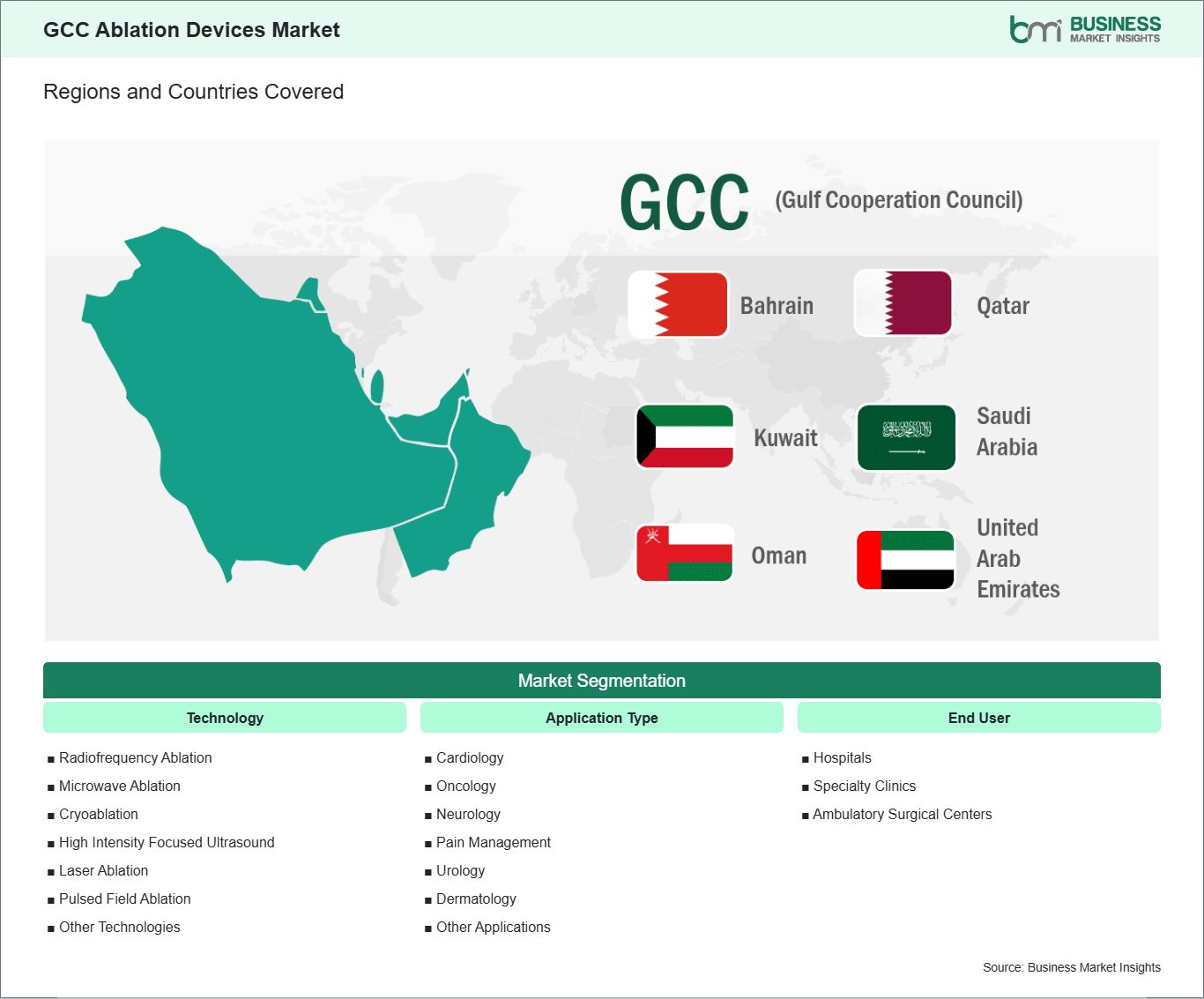
Key segments that contributed to the derivation of the GCC Ablation Devices market analysis are technology type, application, and end user.
The region is experiencing a rise in chronic health conditions, including cardiovascular disorders, cancer, metabolic diseases, and gastrointestinal disorders. This trend has led to increased reliance on ablation devices as minimally invasive alternatives to conventional treatments. Hospitals and specialty clinics are expanding interventional services to address the growing patient population requiring precise and effective therapies. The demand for ablation procedures is amplified by an aging population and lifestyle changes that contribute to the prevalence of chronic conditions.
Healthcare providers are adopting advanced mapping systems, energy-based catheters, and guided imaging tools to ensure procedural accuracy and optimize patient outcomes. These technologies offer the advantage of reducing recurrence rates and shortening recovery periods, which aligns with the region’s growing focus on patient-centered care.
Ablation techniques are being applied in oncology, pain management, and gastrointestinal treatments. Interventional procedures are preferred due to their minimally invasive nature, ability to preserve healthy tissue, and potential to shorten hospital stays. Clinics are combining procedural expertise with patient comfort, making ablation a cornerstone of treatment for chronic conditions. The widening prevalence of these diseases continues to stimulate the adoption of ablation devices, creating opportunities for market expansion and specialized services tailored to diverse therapeutic areas.
Combination therapies that integrate ablation with pharmacological treatments or imaging technologies are being adopted in the region. In cardiology, combining ablation procedures with medication and advanced mapping systems enhances precision, reduces recurrence rates, and supports personalized care. These hybrid approaches allow clinicians to manage complex arrhythmias, minimizing the need for repeat interventions and improving long-term outcomes.
In oncology, ablation is paired with complementary therapies to improve tumor control while preserving surrounding healthy tissue. Integrating ablation with systemic or localized treatments enables more targeted therapy, offering flexibility in treatment planning based on tumor type, size, and patient condition. This multimodal strategy allows healthcare providers to address challenging cases without resorting to invasive surgical options.
Combination methods are applied in pain management, gynecology, and other chronic conditions. Ablation procedures alongside hormonal or pharmaceutical treatments provide more comprehensive symptom relief and reduce the frequency of repeat interventions. The use of combination therapies reflects a focus on maximizing procedural outcomes while minimizing invasiveness and recovery time. These integrative treatment approaches are driving adoption and encouraging technological advancements.

The GCC Ablation Devices market demonstrates steady growth, with size and share analysis highlighting evolving trends and competitive dynamics among key players. The report evaluates important subsegments categorized within technology type, application, and end user, highlighting their respective contributions to overall market performance.
By technology type, the radiofrequency ablation subsegment dominated the market in 2025. Its adoption is driven by its proven clinical efficacy, precise tissue targeting capabilities, consistent procedural outcomes, and strong safety profile across multiple therapeutic areas, making it a cornerstone technology in minimally invasive treatment approaches.
In terms of application, the cardiology subsegment dominated the market in 2025. This leadership is attributed to the rising prevalence of cardiac arrhythmias in the adult population, increasing awareness of catheter-based rhythm management procedures, and greater accessibility of advanced ablation therapies for patients requiring long-term cardiac care.
Based on end user, the hospitals subsegment dominated the market in 2025. Hospitals remain the primary distribution channel due to their comprehensive cardiac care facilities, access to trained electrophysiologists and specialized technicians, advanced imaging and mapping infrastructure, and ability to provide immediate, life-saving interventional procedures.
| Report Attribute | Details |
|---|---|
| Market size in 2025 | US$ 101.0 Million |
| Market Size by 2033 | US$ 139.9 Million |
| CAGR (2026 - 2033) | 4.2% |
| Historical Data | 2022-2024 |
| Forecast period | 2026-2033 |
| Segments Covered | By Technology
|
|
Regions and Countries Covered
| |
| GCC | UAE, Bahrain, Saudi Arabia, Oman, Qatar, Kuwait |
| Market leaders and key company profiles |
|
The "GCC Ablation Devices Market Size and Forecast (2022–2033)" report provides a detailed analysis of the market covering below areas:
The geographical scope of the GCC Ablation Devices market report is divided into: Saudi Arabia, the United Arab Emirates (UAE), Qatar, Kuwait, Bahrain, and Oman. Saudi Arabia held the largest share in 2025.
Saudi Arabia has prioritized minimally invasive procedures, integrating ablation therapies across cardiac, oncologic, and specialty care centers. Major cities such as Riyadh, Jeddah, and Dammam act as central hubs for complex interventional procedures, supported by state-of-the-art hospitals and specialized clinical teams. Efforts to train and retain skilled healthcare professionals have strengthened the country’s capacity to perform advanced ablation procedures, while patient demand for effective, less invasive treatments continues to rise. Government initiatives aimed at modernizing healthcare services, expanding specialty care centers, and promoting technological adoption have reinforced Saudi Arabia’s leadership position. Challenges remain in ensuring consistent access to advanced treatments in smaller cities and rural areas, as well as in standardizing clinician expertise. Despite these hurdles, Saudi Arabia’s strategic investments in healthcare infrastructure, professional training, and advanced technologies have solidified its dominance in the market, making it a central hub for innovation and high-quality patient care in the region.

The GCC Ablation Devices market is evaluated by gathering qualitative and quantitative data post primary and secondary research, which includes important corporate publications, association data, and databases. A few of the key developments in the GCC Ablation Devices market are:
The GCC Ablation Devices Market is valued at US$ 101.0 Million in 2025, it is projected to reach US$ 139.9 Million by 2033.
As per our report GCC Ablation Devices Market, the market size is valued at US$ 101.0 Million in 2025, projecting it to reach US$ 139.9 Million by 2033. This translates to a CAGR of approximately 4.2% during the forecast period.
The GCC Ablation Devices Market report typically cover these key segments-
The historic period, base year, and forecast period can vary slightly depending on the specific market research report. However, for the GCC Ablation Devices Market report:
The GCC Ablation Devices Market is populated by several key players, each contributing to its growth and innovation. Some of the major players include:
The GCC Ablation Devices Market report is valuable for diverse stakeholders, including:
Essentially, anyone involved in or considering involvement in the GCC Ablation Devices Market value chain can benefit from the information contained in a comprehensive market report.
Please tell us your area of interest
(Market Segments/ Regions and Countries/ Companies)