Market Summary
Executive Summary and Market Analysis
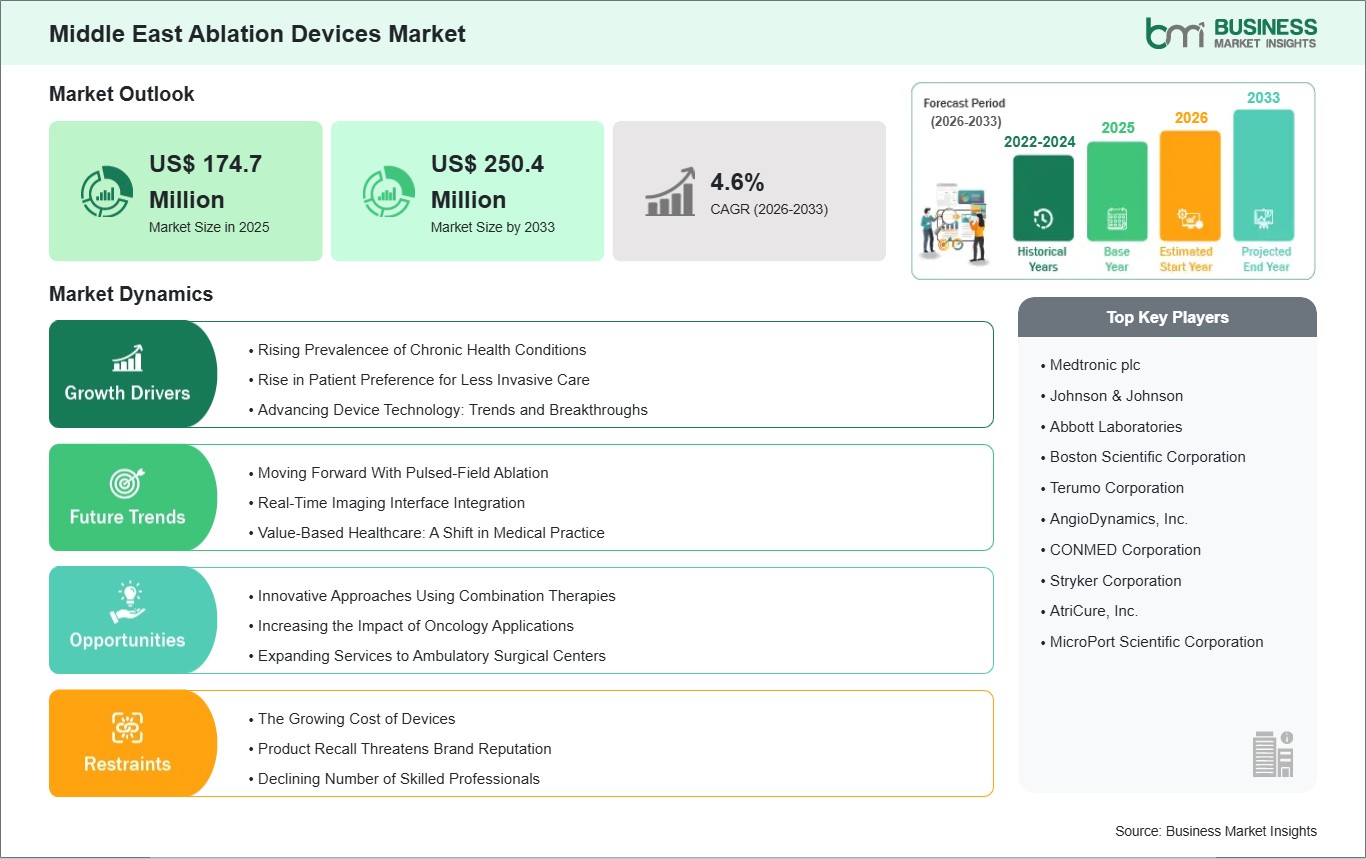
There is an increasing preference for therapies that reduce hospital stays, procedural risks, and recovery times. Healthcare modernization initiatives in key countries are strengthening hospital infrastructure, enabling the introduction of advanced ablation technologies and specialized procedural suites. Urban centers are benefiting from these investments, as hospitals and private clinics integrate high-tech solutions to improve patient outcomes. Rising awareness among patients regarding less invasive interventions is driving adoption.
The market faces constraints, including uneven access to specialized procedures in smaller cities or rural regions and a limited pool of trained clinicians proficient in advanced ablation techniques. Regulatory frameworks vary across countries, which can delay the introduction of new devices. Despite these challenges, the Middle East ablation devices market continues to move toward higher adoption of technologically advanced therapies, with governments and private healthcare providers investing strategically to enhance procedural capabilities, patient care quality, and access to minimally invasive solutions.
Segment Analysis
Middle East Ablation Devices Market Segmentation
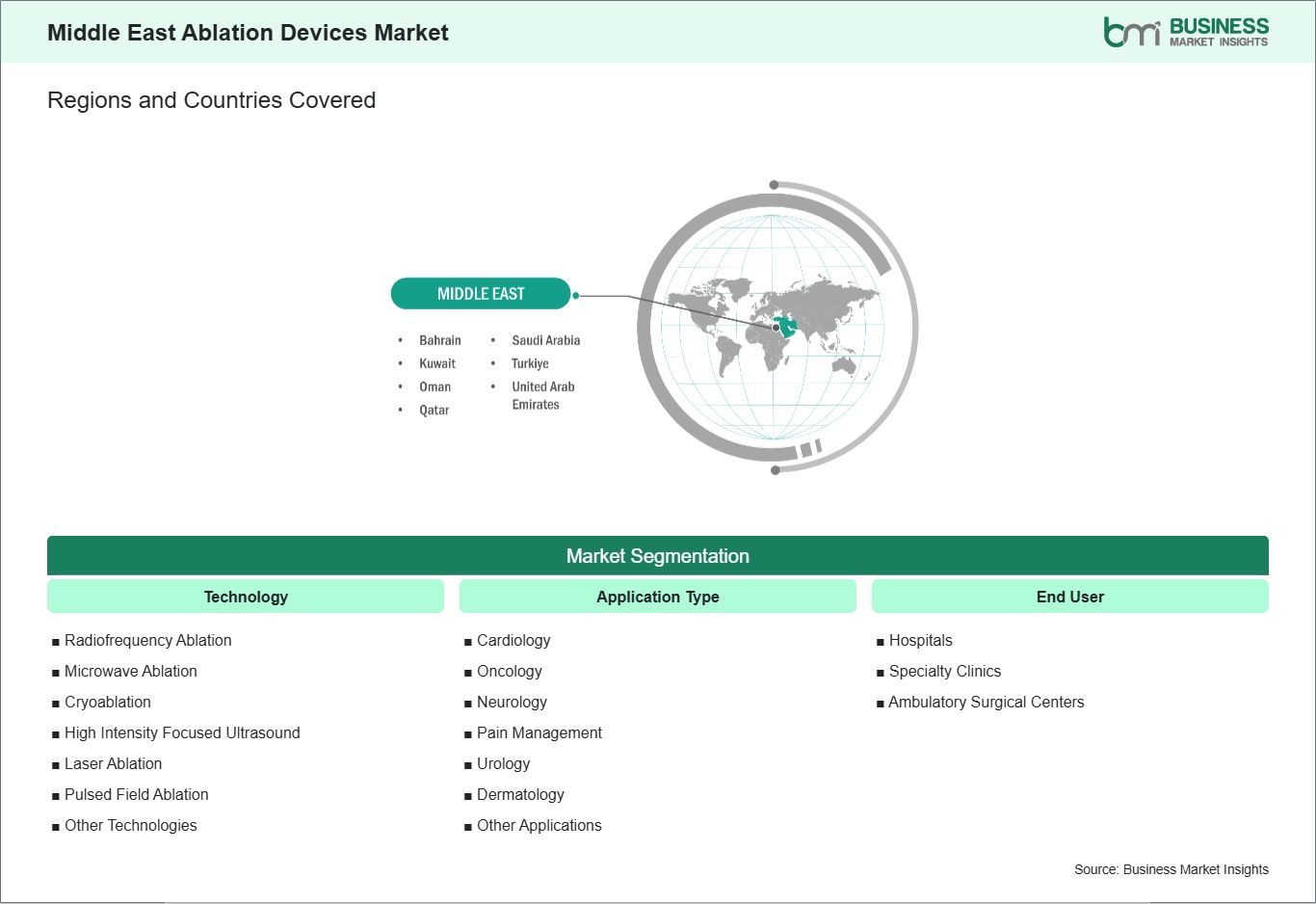
Key segments that contributed to the derivation of the Middle East Ablation Devices market analysis are technology type, application, and end user.
- By technology type, the ablation devices market is segmented into radiofrequency ablation, microwave ablation, cryoablation, high-intensity focused ultrasound, laser ablation, pulsed field ablation, and others. The radiofrequency ablation segment dominated the market in 2025.
- Based on application, the ablation devices market is classified into cardiology, oncology, neurology, pain management, urology, dermatology, and others. The cardiology segment dominated the market in 2025.
- In terms of end user, the ablation devices market is categorized into hospitals, specialty clinics, and ambulatory surgical centers. The hospitals segment dominated the market in 2025.
Market Forces
Middle East Ablation Devices Market Drivers and Opportunities
Rising Prevalence of Chronic Health Conditions
Lifestyle transitions, urban development, and changing dietary patterns have contributed to a higher incidence of cardiovascular diseases, metabolic disorders, and various forms of cancer. As healthcare systems shift toward long-term disease management, minimally invasive procedures such as ablation are becoming more widely adopted for their ability to deliver targeted treatment with shorter recovery periods and reduced procedural risks.
The growing prevalence of arrhythmias and other rhythm-related conditions is encouraging healthcare providers to expand electrophysiology services and integrate catheter-based ablation into routine cardiac care. Rather than relying solely on long-term pharmaceutical management, clinicians are utilizing procedural interventions that offer improved symptom control and enhanced quality of life for patients with chronic heart conditions.
Thermal ablation techniques are being incorporated into treatment pathways for tumors affecting organs such as the liver, kidney, and lung, particularly in cases where surgery may not be the preferred option. Minimally invasive ablation procedures are gaining traction in the management of thyroid nodules and related conditions. These trends reflect a broader regional movement toward advanced, patient-centered care models that emphasize precision and efficiency.
Innovative Approaches Using Combination Therapies
In oncology, ablation is often integrated with systemic treatments and advanced imaging guidance to enhance accuracy and improve treatment outcomes. This multidisciplinary approach enables clinicians to target diseased tissue more effectively while minimizing impact on surrounding healthy structures, reinforcing the role of ablation within comprehensive cancer care frameworks.
In cardiology, combination approaches are strengthening the clinical value of ablation devices. Procedural interventions are paired with pharmacological management and advanced cardiac mapping technologies to improve rhythm stabilization and reduce recurrence rates. By integrating device-based therapy with medication and diagnostic tools, healthcare providers are developing more holistic treatment pathways for patients with complex cardiac conditions.
Combination strategies are emerging in endocrine and pain management applications. Ablation procedures are supported by follow-up monitoring, hormone regulation therapies, and rehabilitative care programs to ensure sustained clinical benefits. This integrative model reflects the region’s ongoing healthcare modernization efforts, where innovation extends beyond standalone procedures to include coordinated, multi-modal treatment solutions that enhance patient outcomes and system-wide efficiency.
Size and Share Analysis
Middle East Ablation Devices Market Size and Share Analysis
The Middle East Ablation Devices market demonstrates steady growth, with size and share analysis highlighting evolving trends and competitive dynamics among key players. The report evaluates important subsegments categorized within technology type, application, and end user, highlighting their respective contributions to overall market performance.
By technology type, the radiofrequency ablation subsegment dominated the market in 2025. Its adoption is driven by its proven clinical efficacy, precise tissue targeting capabilities, consistent procedural outcomes, and strong safety profile across multiple therapeutic areas, making it a cornerstone technology in minimally invasive treatment approaches.
In terms of application, the cardiology subsegment dominated the market in 2025. This leadership is attributed to the rising prevalence of cardiac arrhythmias in the adult population, increasing awareness of catheter-based rhythm management procedures, and greater accessibility of advanced ablation therapies for patients requiring long-term cardiac care.
Based on end user, the hospitals subsegment dominated the market in 2025. Hospitals remain the primary distribution channel due to their comprehensive cardiac care facilities, access to trained electrophysiologists and specialized technicians, advanced imaging and mapping infrastructure, and ability to provide immediate, life-saving interventional procedures.
Report Coverage
Middle East Ablation Devices Market Report Coverage and Deliverables
The "Middle East Ablation Devices Market Size and Forecast (2022–2033)" report provides a detailed analysis of the market covering below areas:
- Middle East Ablation Devices market size and forecast at regional and country levels for all market segments covered under the scope
- Middle East Ablation Devices market trends, as well as drivers, restraints, and opportunities
- Middle East Ablation Devices market analysis covering key trends, regional framework, major players, regulations, and recent developments
- Industry landscape and competition analysis covering market concentration, heat map analysis, prominent players, and recent developments for the Middle East Ablation Devices market
- Detailed company profiles, including SWOT analysis
Geographic Insights
Middle East Ablation Devices Market Geographic Insights
The geographical scope of the Middle East Ablation Devices market report is divided into: the UAE, Saudi Arabia, Bahrain, Oman, Kuwait, Qatar, and Turkiye. Turkiye held the largest share in 2025.
Major cities such as Istanbul, Ankara, and Izmir serve as hubs for cardiac, oncologic, and specialty ablation therapies, supported by hospitals equipped with modern procedural suites and highly trained multidisciplinary teams. The country has prioritized integrating ablation devices into clinical pathways, improving the availability of complex interventional procedures across private and public hospitals. Patient demand for less invasive therapies with faster recovery times has driven investments in state-of-the-art equipment and professional training programs. Healthcare modernization initiatives focus on expanding access to advanced procedures and fostering innovation, strengthening the country’s market leadership. Challenges persist in extending these services to smaller cities and rural areas, as well as maintaining consistent clinical expertise across facilities. Turkiye’s robust infrastructure, emphasis on professional development, and adoption of advanced procedural technologies have established it as the leading Middle East market for ablation devices.
Industry Activity
Recent Developments
The Middle East Ablation Devices market is evaluated by gathering qualitative and quantitative data post primary and secondary research, which includes important corporate publications, association data, and databases. A few of the key developments in the Middle East Ablation Devices market are:
- In January 2024, Imricor Medical Systems announced that it received Medical Device Marketing Authorization (MDMA) from the Saudi Food & Drug Authority (SFDA), enabling the company to begin commercialization of its real-time iCMR cardiac ablation products in Saudi Arabia through its distributor FMS.
- In July 2023, Imricor Medical Systems announced that it signed a landmark distribution agreement with Al Faisaliah Medical Systems (FMS), granting FMS exclusive rights to market and sell Imricor’s iCMR cardiac ablation products in Saudi Arabia, marking Imricor’s formal entry into the Middle East ablation devices market.
Trust & Transparency
Research Methodology
The market analysis combines proprietary research with secondary data from government agencies, company disclosures, regulatory filings, industry databases and expert interviews. Market estimates are validated through data triangulation, cross-market benchmarking and analyst
review.
View Full Research Methodology
Key Sources Referred:
The World BankWorld Health Organization (WHO)Center for Disease Control and Prevention (CDC)Food and Drug Administration (FDA)European Database on Medical Devices (EUDAMED)European Society of Cardiology (ESC)American College of Cardiology (ACC)American Heart Association (AHA)Company WebsitesCompany Annual ReportsCompany Investor Presentations