
Next Gen Military Avionics Market Outlook: Size, Share, Trends, Growth Analysis, Competitive Landscape & Forecast, 2026-2033

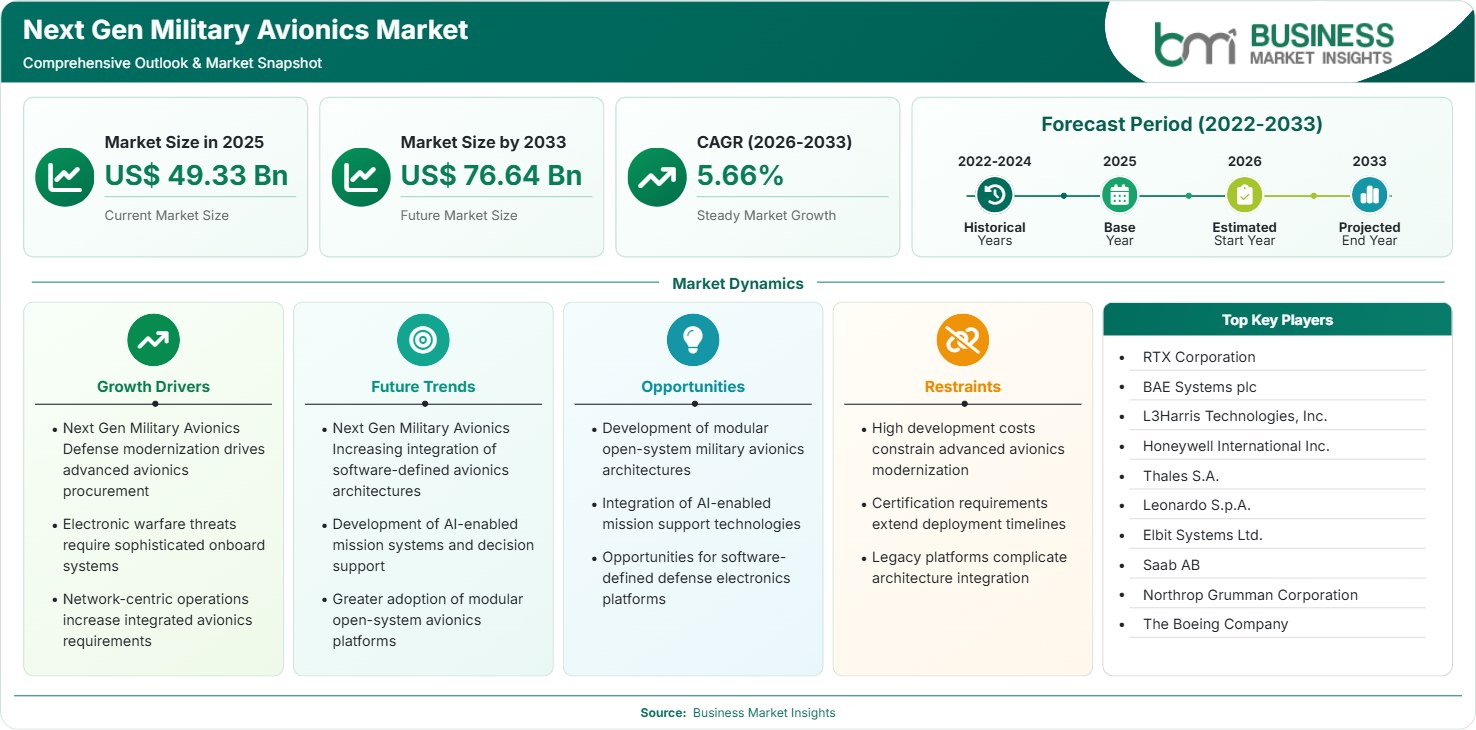
The Next Gen Military Avionics Market size was valued at US$ 49.33 Billion in 2025 and is projected to reach US$ 76.64 Billion by 2033, growing at a CAGR of 5.66% during 2026–2033, driven by fleet modernization, modular architectures, contested-spectrum operations, autonomous platforms, secure connectivity, and multi-domain integration.

Report Coverage
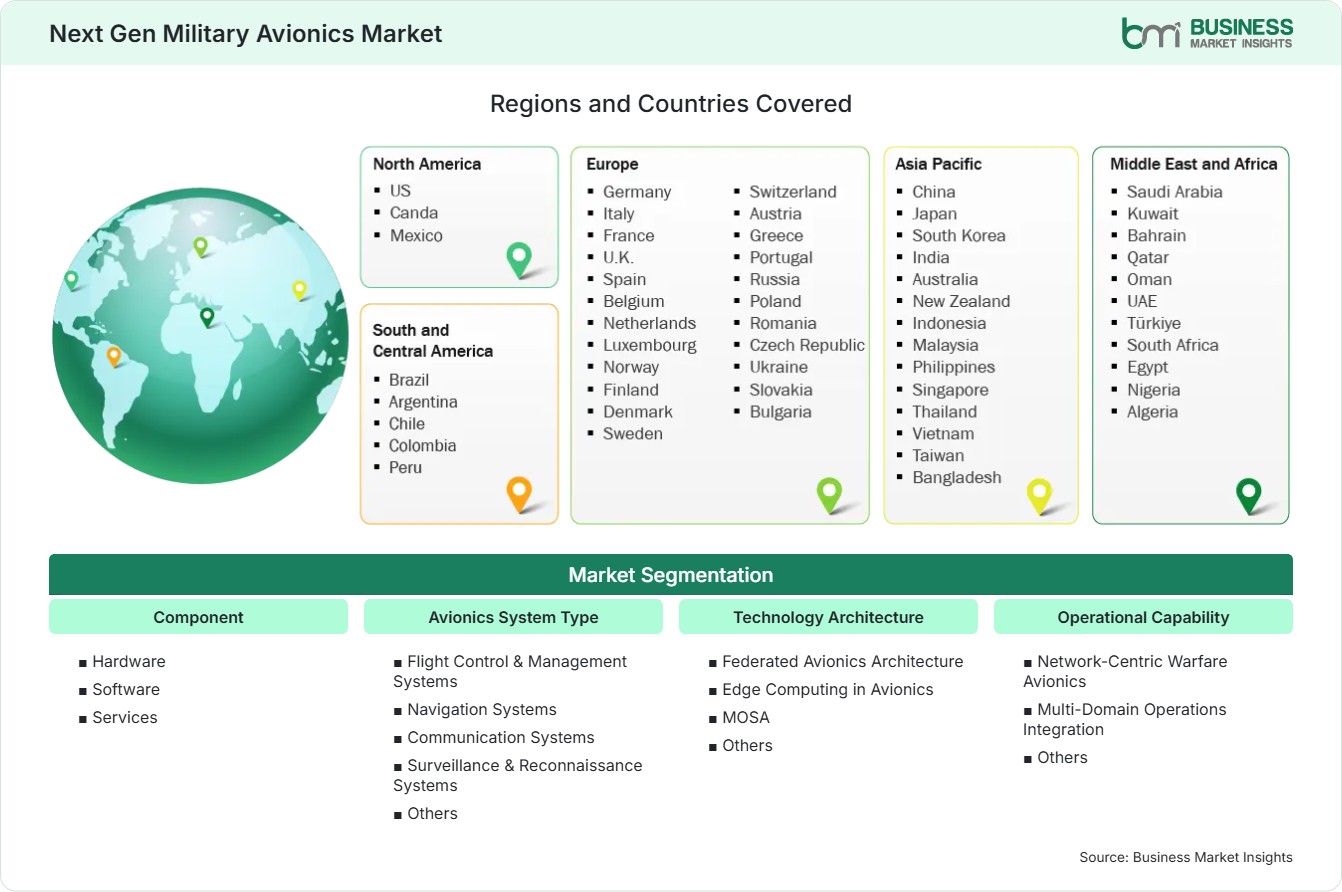
  • Component: Hardware, Software, Services
  • Avionics System Type: Flight Control & Management Systems, Navigation Systems, Communication Systems, Surveillance & Reconnaissance Systems, Others
  • Technology Architecture: Federated Avionics Architecture, Edge Computing in Avionics, MOSA, Others
  • Operational Capability: Network-Centric Warfare Avionics, Multi-Domain Operations Integration, Others
  • Installation Type: Line Fit, Retrofit, Mid-Life Upgrade Programs
US$ 49.33 Bn Market size in 2025
US$ 76.64 Bn Market Size by 2033
5.66% CAGR, 2026 - 2033
2026-2033 Forecast Period

AI Overview

Next Gen Military Avionics Market Summary

  • North America Region: As per the Next Gen Military Avionics Market report, North America holds a 42%–46% share in 2025 and grows at a 5.1%–5.8% CAGR through 2033, driven by aircraft modernization, MOSA adoption, secure communications, electronic warfare, autonomous systems, and lifecycle upgrades. The US remains the regional demand center, supported by fighter, helicopter, tanker, transport, and autonomous aircraft modernization, with a 5.0%–5.7% CAGR through 2033.
  • Fastest Growing Region: Asia Pacific holds a 22%–26% share in 2025 and advances at a 6.5%–7.3% CAGR, supported by indigenous aircraft programs, surveillance modernization, electronic warfare, unmanned systems, secure networking, and replacement of legacy avionics across expanding military fleets.
  • Leading Segment: Hardware holds a 57%–61% share in 2025 and expands at a 5.2%–5.9% CAGR, supported by mission computers, displays, processors, navigation equipment, communications terminals, sensors, replacement cycles, and integration requirements across modernized aircraft.
  • High Growth Segment: MOSA holds a 15%–19% Next Gen Military Avionics Market share in 2025 and expands at a 7.0%–7.8% CAGR, supported by modular procurement, rapid technology insertion, software portability, interoperability, lifecycle affordability, competitive sourcing, and evolving mission requirements across aircraft platforms.
  • Key Market Opportunity: Open architectures create recurring upgrade revenue by separating mission software from hardware, enabling faster capability insertion, cross-platform interoperability, predictive sustainment, competitive component sourcing, and adaptable mission systems.
  • Major Market Players: RTX Corporation, BAE Systems plc, L3Harris Technologies, Inc., Honeywell International Inc., Thales S.A., Leonardo S.p.A., Elbit Systems Ltd., Saab AB, Northrop Grumman Corporation, and The Boeing Company.
Strategic Insights

Next Gen Military Avionics Market: Strategic Insights

Next Gen Military Avionics Market Strategic Framework
FREE PDF
Request your free sample
Request free sample
Stakeholder View

Key Takeaways

  • The Next Gen Military Avionics Market increasingly operates through ecosystems connecting prime contractors, avionics specialists, software developers, sensor suppliers, communications providers, and sustainment organizations.
  • Retrofit and mid-life upgrades offer attractive economics because operators can extend aircraft service lives while introducing modern computing, communications, navigation, electronic warfare, and mission-management capabilities.
  • Edge computing, AI-assisted sensor fusion, modular open systems, software-defined radios, digital engineering, and cybersecurity-by-design are reshaping avionics development and technology-refresh strategies.
  • Asia Pacific provides a compelling investment environment because of rising defense expenditure, indigenous aerospace programs, fleet modernization, technology-transfer requirements, and growing demand for localized support.
  • Mission software, electronic warfare, secure communications, autonomy, and sensing remain attractive because common technologies can support several platforms and generate recurring upgrade revenue.
  • Suppliers combining reusable architectures, certification expertise, cybersecurity capabilities, and installed-fleet access can capture greater lifecycle value than suppliers focused solely on individual hardware components.
Geographic Outlook

Next Gen Military Avionics Market Regional Highlights

North America Next Gen Military Avionics Market

North America Next Gen Military Avionics Market represents 42%–46% share in 2025 and records a 5.1%–5.8% CAGR through 2033. The United States drives regional demand through fighter, helicopter, transport, tanker, and autonomous aircraft modernization. Canada adds surveillance and interoperability requirements. The regional industrial base combines major defense primes, specialist avionics manufacturers, certification infrastructure, and extensive sustainment capabilities. Demand favors modular systems accommodating new processors, sensors, communications standards, and mission applications without extensive aircraft redesign, supporting recurring hardware, software, integration, engineering, and lifecycle-service revenues.

  • Fighter and rotary-wing modernization prioritizes mission computers, displays, navigation, electronic warfare, and secure communications, creating recurring requirements across extensive installed fleets.
  • Secure networking increases demand for tactical data links, distributed sensing, resilient communications, and interoperable mission systems connecting airborne and joint-force assets.
  • Retrofit programs remain attractive because operators seek longer service lives while addressing obsolete processors, displays, radios, navigation equipment, and aircraft interfaces.
  • Autonomous aircraft require edge computing, resilient communications, navigation assurance, sensor fusion, and mission-management software capable of supporting distributed operations.

US Next Gen Military Avionics Market

The US Next Gen Military Avionics Market represents approximately 88%–93% of North American demand in 2025 and expands at a 5.0%–5.7% CAGR through 2033. Procurement focuses on survivability, contested communications, autonomous teaming, electronic warfare, and modernization of aging fleets. The domestic industrial base provides deep certification, integration, testing, and sustainment capabilities. Modular open architectures are increasingly important because they allow technology insertion without complete aircraft redesign. Fleet sustainment contracts create long-duration revenue opportunities across engineering, diagnostics, repairs, upgrades, training, cybersecurity, and lifecycle management.

  • Army aviation modernization demonstrates the value of modular avionics by enabling third-party technologies and faster insertion without replacing complete aircraft architectures.
  • Airborne electronic warfare and reconnaissance programs increase demand for high-bandwidth connectivity, mission processing, electronic support measures, sensor fusion, and resilient data transport.
  • Large aircraft fleets create extensive retrofit potential as operators address obsolete electronics while preserving airframes, existing infrastructure, and previous platform investments.

Europe Next Gen Military Avionics Market

Europe Next Gen Military Avionics Market represents a 27%–31% share in 2025 and grows at a 5.8%–6.6% CAGR through 2033. Germany, the United Kingdom, France, Italy, and Spain remain leading markets, while Poland and Sweden provide high-growth opportunities. European military expenditure reached US$864 billion in 2025, supporting modernization across combat aircraft, helicopters, transports, and surveillance platforms. Sovereignty objectives encourage domestic technology development and localized sustainment. NATO interoperability strengthens demand for secure communications, identification, sensor fusion, standardized interfaces, electronic warfare, and mission systems capable of operating across multinational fleets.

  • Germany combines substantial procurement requirements with advanced industrial capabilities, supporting mission computing, communications, electronic warfare, and combat-aircraft modernization.
  • France and Italy provide demand across combat aircraft, helicopters, surveillance platforms, sensors, communications, and multinational aerospace development programs.
  • Poland represents a high-growth opportunity as accelerated aircraft procurement increases requirements for interoperable navigation, displays, communications, mission computers, and electronic warfare.
  • Sweden contributes advanced demand through indigenous combat-air capabilities, distributed sensing, electronic warfare, resilient communications, and crewed-uncrewed teaming technologies.

Asia Pacific Next Gen Military Avionics Market

Asia Pacific accounts for 22%–26% Next Gen Military Avionics Market share in 2025 and posts the fastest regional growth at 6.5%–7.3% through 2033. China, Japan, India, South Korea, and Australia are leading demand centers, while India, South Korea, Indonesia, and selected Southeast Asian markets offer high-growth opportunities. Asia and Oceania military expenditure reached US$681 billion in 2025, increasing 8.1% year over year. Procurement emphasizes indigenous aircraft, maritime surveillance, long-range sensing, electronic warfare, secure communications, and autonomous systems, supporting demand for localized technology, engineering, and sustainment.

  • India is expanding indigenous aerospace capabilities, increasing demand for mission computers, navigation, radar interfaces, electronic warfare, communications, and locally supportable avionics.
  • Japan emphasizes advanced air capabilities and interoperability, supporting secure networking, precision navigation, electronic warfare, resilient communications, and integrated mission systems.
  • South Korea combines indigenous fighter development with airborne surveillance requirements, supporting modular computing, sensor fusion, communications, electronic warfare, and mission-management technologies.
  • Australia is expanding networked and autonomous capabilities, creating opportunities in long-range communications, ISR integration, electronic warfare, navigation, and cross-domain connectivity.

Rest of World Next Gen Military Avionics Market

South and Central America Next Gen Military Avionics Market remains a smaller but strategically relevant market, with Brazil leading aerospace capability and modernization of fighters, transports, helicopters, and surveillance aircraft. Local industrial participation supports opportunities for suppliers combining advanced avionics with engineering and sustainment. Colombia and Chile provide selective retrofit opportunities where fleet availability and mission flexibility are priorities. Demand remains more upgrade-focused than new-platform driven, creating opportunities in cockpit modernization, navigation, communications, surveillance, mission computing, and electronic warfare.

The Middle East and Africa Market benefits from high-value aircraft programs, surveillance requirements, electronic warfare priorities, and fleet modernization. Saudi Arabia, the United Arab Emirates, Israel, and Türkiye remain major capability developers, while Morocco offers growing retrofit potential. Customers increasingly seek sovereign maintenance, localized support, secure networking, and customized mission systems, strengthening opportunities for suppliers with certification, integration, and lifecycle-management expertise.

  • Brazil provides a leading Latin American opportunity through indigenous aerospace development, multinational programs, aircraft modernization, and long-term avionics support requirements.
  • Saudi Arabia and the United Arab Emirates favor advanced surveillance, communications, electronic warfare, mission management, and networked capabilities integrated with sophisticated aircraft.
  • Israel remains technology-intensive, with avionics, electronic warfare, autonomous systems, electro-optics, and sensor fusion closely aligned with demanding operational requirements.
  • Türkiye is expanding indigenous aerospace electronics, creating opportunities in modular architectures, mission computers, sensors, secure communications, electronic warfare, and domestic sustainment.
Global Market Geography
FREE PDF
Request your free sample
Request free sample
Segment Analysis

Next Gen Military Avionics Market Segmentation

Component

Hardware represents 57%–61% share in 2025 and grows at a 5.2%–5.9% CAGR, retaining leadership because aircraft require certified processors, displays, sensors, navigation, communications, and interfaces. Software and services increasingly capture lifecycle value through upgrades, cybersecurity, integration, diagnostics, and sustainment. The Next Gen Military Avionics Market scope increasingly encompasses complete capability ecosystems.

  • Hardware: Mission computers, displays, sensors, navigation units, radios, processors, and interfaces require ruggedization, certification, high reliability, and compatibility with open architectures.
  • Software: Mission applications, operating environments, data fusion, autonomy, cybersecurity, and decision-support functions enable faster capability insertion without equivalent hardware replacement.
  • Services: Integration, maintenance, engineering, diagnostics, training, upgrades, and lifecycle support generate recurring revenue as operators extend fleet service lives.

Avionics System Type

Flight control and management systems remain foundational, while communications, navigation, surveillance, and reconnaissance increasingly converge through integrated mission architectures. The Next Gen Military Avionics Market expands at a 5.0%–6.2% CAGR as aircraft become connected nodes within multi-domain networks. Procurement favors interoperable subsystems capable of secure data exchange and rapid mission reconfiguration across different aircraft and operational environments.

  • Flight Control & Management Systems: Digital flight controls and integrated management functions improve aircraft handling, automation, pilot workload, mission flexibility, and compatibility with advanced operational environments.
  • Navigation Systems: Inertial, satellite-assisted, terrain-referenced, and resilient navigation technologies support precision operations despite jamming, spoofing, and degraded positioning.
  • Communication Systems: Secure radios, tactical data links, satellite communications, and software-defined connectivity enable distributed command, control, information exchange, and coordinated operations.
  • Surveillance & Reconnaissance Systems: Radar, electro-optical, infrared, signals intelligence, and electronic support systems provide persistent sensing supported by onboard processing and data fusion.

Technology Architecture

Federated architectures remain relevant across legacy fleets, but modular and distributed approaches are gaining ground because customers seek shorter integration cycles and greater technology independence. The architecture segment records a 6.0%–7.2% CAGR as open interfaces, edge processing, and software portability become procurement priorities. Next Gen Military Avionics Market trends increasingly favor reusable computing and standardized interfaces.

  • Federated Avionics Architecture: Separate subsystem computing remains practical for legacy aircraft and incremental upgrades where certification and limited redesign constrain architectural change.
  • Edge Computing in Avionics: Local processing reduces latency and bandwidth requirements, supporting autonomy, sensor fusion, electronic warfare, and rapid threat classification.
  • MOSA: Modular interfaces enable competitive component replacement, reusable software, and faster capability insertion while reducing lifecycle dependence on individual suppliers.

Operational Capability

Network-centric warfare avionics remain important as aircraft increasingly operate as distributed information nodes. Multi-domain integration provides higher growth potential because customers require synchronized information across air, land, sea, space, and cyber environments. The segment expands at a 6.2%–7.4% CAGR, supported by secure networking, sensor fusion, edge processing, and collaborative autonomous operations.

  • Network-Centric Warfare Avionics: Integrated communications, data links, sensors, and mission computers allow aircraft to share targeting, positioning, surveillance, and threat information.
  • Multi-Domain Operations Integration: Cross-domain architectures combine airborne and external data sources, improving coordinated responses, information availability, and decision speed under contested conditions.

Installation Type

Line-fit installations remain essential for new aircraft, while retrofit and mid-life upgrades create recurring opportunities across installed fleets. The installation segment expands at a 5.5%–6.5% CAGR as operators prioritize service-life extension and capability refresh. Mid-life programs are particularly attractive because avionics can be modernized without replacing entire aircraft, preserving platform investments while improving mission effectiveness and operational availability.

  • Line Fit: Factory-installed avionics enable architecture optimization from aircraft design stages, supporting integrated mission systems, standardized interfaces, and lower installation complexity.
  • Retrofit: Retrofit kits address obsolete electronics and new operational requirements while minimizing airframe modification, acquisition cost, and fleet downtime.
  • Mid-Life Upgrade Programs: Comprehensive upgrades combine hardware replacement, software modernization, connectivity improvements, cybersecurity, and mission-system integration during scheduled refurbishment.
Market Forces

Next Gen Military Avionics Market Dynamics

Key Market Drivers

Fleet Modernization and Avionics Obsolescence

The Next Gen Military Avionics Market is transitioning toward software-defined mission systems integrating sensing, processing, navigation, communications, and electronic warfare. Modular architectures accelerate technology refreshes across long-service aircraft, while edge computing enables faster sensor fusion, autonomy, and threat assessment. Hardware remains dominant due to continued demand for certified processors, displays, navigation, communications, and interfaces. Rising procurement across Asia Pacific, Europe, the Middle East, and Latin America is strengthening demand for interoperable, cybersecure, upgradeable avionics and lifecycle support.

Contested-Spectrum Operations and Resilient Connectivity

Resilient avionics is increasingly in demand due to electronic warfare, jamming, spoofing, cyber threats, and degraded communication capabilities. The aircraft must perform navigation, sensing, communication, and mission coordination in the event of a disruption. There is an increased need for protected navigation, secure tactical data links, software-defined radio, electronic support systems, and distributed computing. Next Gen Military Avionics Market Growth is driven by demand for a flexible architecture capable of processing multiple data streams and operating in the presence of interference. These requirements also create recurring opportunities for software updates, cybersecurity enhancements, and technology upgrades as threat environments and operational priorities evolve.

Autonomy, Sensor Fusion, and Edge Processing

Automated and optionally piloted aircraft are altering the role of avionics from cockpit aids to distributed, machine-based decision-making. The aircraft has to gather large volumes of sensor data, process the information locally, evaluate the threats, and send only selected data. Edge computing eliminates latency and bandwidth dependency, whereas sensor fusion enhances situational awareness. Concepts for unmanned airborne surveillance illustrate how the convergence of automated platforms, radar, mission computing, and secure communication is evolving. Such needs are now also surfacing in the domains of ISR, electronic warfare, collaborative combat, and automated logistics. Such needs would favor high-performance processors, artificial intelligence-powered software, secure communication, and open interface standards.

Key Market Opportunities

Modular Open Architecture Retrofit Ecosystems

Through the MOSA approach, avionics modernization can shift from platform-specific engineering to modular product families. The operators will be able to exchange specific modules without redesigning the entire system for an airplane, and the suppliers will be able to maintain their software and interfaces that are common across multiple programs. According to Next Gen Military Avionics Market forecasts, opportunities will be available not only in hardware but also in integration, certification, cybersecurity, diagnostics, training, and upgrades. Investment should therefore be made in suppliers with aircraft certifications, open-interface experience, and access to installed fleets.

Secure Multi-Domain Mission Networks

The convergence of airborne, terrestrial, maritime, space, and cyber domains is creating opportunities for suppliers of secure mission networking solutions. Modern aircraft increasingly require seamless exchange of sensor, targeting, navigation, and mission data across diverse forces. Key opportunities include secure data transport, gateways, mission computing, interoperability software, and cybersecurity. Recurring revenue can come from waveform updates, network certification, diagnostics, and software releases. Growing sovereign defense ambitions across Europe, Asia Pacific, and the Middle East further support demand for flexible, locally maintainable architectures.

Avionics for Unmanned and Collaborative Aircraft

New opportunities arise in terms of the addressable market for avionics beyond the cockpit due to drones. There is a need for small processors, sensors, communication links, navigational equipment, and mission equipment for persistent ISR, airborne early warning, electronic warfare, decoy operations, autonomous logistics, and combat missions. The potential market in the Next Gen Military Avionics Market encompasses not only unmanned aircraft but also crewed aircraft, as future aircraft will need to integrate autonomous team members and share sensor data. Companies offering products with small size, weight, power, and cost, as well as military cybersecurity solutions, can target growing market segments. The product approach should include common computer modules, scalable sensor interfaces, and software portability.

Market Restraints and Challenges

Certification Complexity and Integration Risk

Factor: Safety-critical avionics need qualification, verification, cybersecurity evaluation, EM compliance testing, environmental testing, and platform integration. Changes to software, processors, sensors, and communications architecture tend to be harder to qualify when introduced into existing interfaces. Impact: The programs could be prolonged, engineering costs could rise, and users could postpone upgrades if the risk of downtime or certification issues is much higher than the benefit of doing so. Open architecture will help avoid problems during integration, but will not eliminate the need for platform qualification. This is why suppliers require skills in systems engineering, digital testing, configuration management, and certification. Small tech companies may find it difficult to use any civilian technology on the battlefield, whereas big contractors could exploit their flight-test capabilities.

Supply Chain Vulnerability and Specialized Electronics Dependence

Factor: The military avionics systems use advanced technology, including processors, sensors, communication systems, semiconductor components, and reliable manufacturing sites. Restrictions due to export controls, geopolitical tensions, obsolescence, and manufacturing concentration could cause delays or redesigns. Impact: This factor could lead to longer procurement times, higher inventory levels, and additional qualification requirements if replacement components are required. Hence, the military is now focusing on reliable suppliers, local manufacturing, component tracking, and the availability of components throughout their life cycle. The high-performance computing and secure communications systems are especially vulnerable, as replacement could result in non-certified or non-secure components. Suppliers that employ the second-source approach and design for substitution are better positioned.

Company Analysis

Competitive Landscape

The Next Gen Military Avionics Market analysis indicates competition beneath a concentrated prime-contractor layer. Competitive advantage increasingly depends on architecture ownership, certification depth, software integration, installed-fleet access, cybersecurity, and lifecycle support rather than individual component performance.

Company Name

Overview

Products and Services relevant to this market

RTX Corporation

Major aerospace and defense supplier with broad avionics, sensors, communications, mission systems, and sustainment capabilities.

Flight displays, mission computing, navigation, communications, electronic systems, modular architecture solutions, integration, repair, and lifecycle support.

BAE Systems plc

Defense electronics specialist with extensive expertise in electronic warfare, communications, identification, mission systems, and aircraft modernization.

Avionics, electronic warfare, tactical data systems, mission computing, integration, testing, maintenance, and upgrades.

L3Harris Technologies, Inc.

Diversified defense technology provider with strong positions in airborne ISR, communications, electronic warfare, and aircraft missionization.

Missionization, ISR systems, secure communications, electronic warfare, avionics upgrades, integration, maintenance, and engineering services.

Honeywell International Inc.

Aerospace technology supplier with expertise in navigation, inertial systems, connectivity, flight controls, and military aircraft electronics.

Navigation, inertial systems, protected positioning, satellite communications, flight systems, sensors, cockpit equipment, and support.

Thales S.A.

European technology group providing avionics, communications, navigation, sensing, and mission-system capabilities.

Navigation, communications, displays, mission systems, sensors, electronic warfare, integration, and lifecycle support.

Leonardo S.p.A.

European aerospace and defense company active in aircraft electronics, helicopters, radar, mission systems, and integrated avionics.

Mission computers, displays, sensors, radar, electronic warfare, communications, helicopter avionics, integration, and modernization.

Elbit Systems Ltd.

Israeli defense technology company specializing in avionics, electro-optics, electronic warfare, digital networking, and modernization.

Avionics suites, displays, mission computers, electronic warfare, sensor fusion, software-defined radios, and aircraft upgrades.

Saab AB

Swedish aerospace and defense company specializing in combat aircraft, airborne surveillance, sensors, communications, and avionics.

Aircraft avionics, radar, airborne surveillance, mission systems, sensors, communications, electronic warfare, and upgrades.

Northrop Grumman Corporation

Major defense contractor specializing in mission systems, radar, electronic warfare, aircraft integration, and airborne capabilities.

Mission computers, radar, electronic warfare, navigation, communications, ISR, autonomous technologies, modernization, and integration.

The Boeing Company

Global aerospace manufacturer supporting military aircraft through platform integration, mission systems, avionics modernization, and sustainment.

Military aircraft avionics, flight decks, mission systems, communications, navigation, software upgrades, and lifecycle services.

Trust & Transparency

Research Methodology

The market analysis combines proprietary research with secondary data from government agencies, company disclosures, regulatory filings, industry databases and expert interviews. Market estimates are validated through data triangulation, cross-market benchmarking and analyst review.

View Full Research Methodology

Questions Answered

Frequently Asked Questions

Why should buyers evaluate lifecycle capability rather than equipment price?

Military avionics require certification, maintenance, cybersecurity updates, software support, component availability, and future upgrades. A lower acquisition price can become uneconomic when integration, obsolescence, downtime, or vendor-lock-in costs accumulate.

What role does edge computing play in airborne missions?

Edge computing processes sensor information closer to its source, reducing latency and communications dependence. It is particularly valuable for autonomous aircraft, electronic warfare, ISR, and contested environments where bandwidth cannot be assumed.

Why are retrofit programs important alongside new aircraft production?

Retrofit programs address large installed fleets that remain operational for decades. Operators can improve mission effectiveness and cybersecurity without purchasing entirely new aircraft, creating recurring demand for hardware, integration, software, and sustainment.

How does electronic warfare affect avionics procurement?

Electronic warfare increases requirements for resilient navigation, secure communications, spectrum awareness, signal processing, and rapid software updates. Avionics must maintain functionality when positioning, communications, or sensor inputs are deliberately disrupted.

What makes modular architecture strategically important for military aircraft?

Modular architecture separates capability upgrades from complete aircraft redesign. Operators can introduce processors, sensors, communications, and software incrementally, reducing vendor dependence and improving the economics of long-service fleets.

Access the Full Next Gen Military Avionics Market Report

Get segment-level forecasts, regional estimates, competitive benchmarking, company profiles and downloadable Excel datasets.

Access the full Next Gen Military Avionics Market Report
350 pages PDF & Excel | 2026-09-30
Similar Research

Related Market Reports