
Neurodegenerative Diseases Drugs Market Outlook: Size, Share, Trends, Growth Analysis, Competitive Landscape & Forecast, 2026-2033

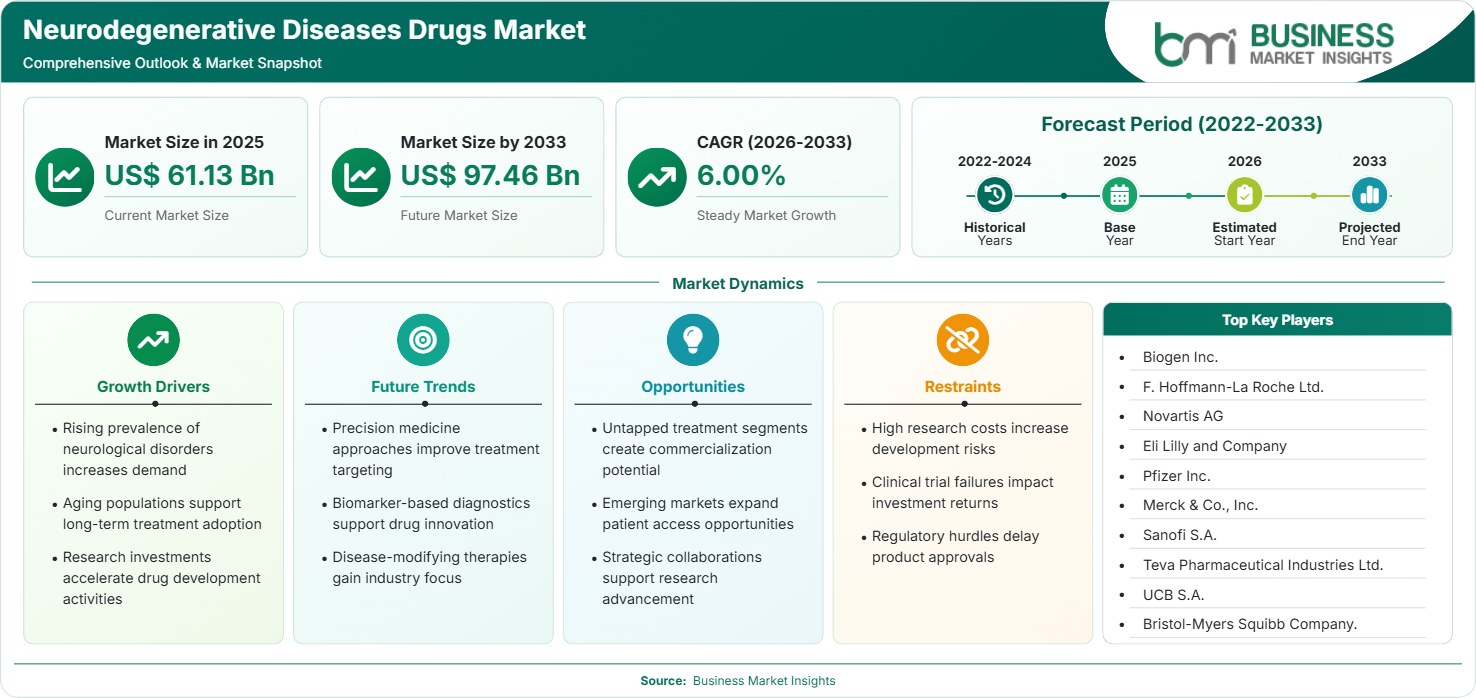
The Neurodegenerative Diseases Drugs Market size was valued at US$ 61.13 Billion in 2025 and is projected to reach US$ 97.46 Billion by 2033, growing at a CAGR of 6% during 2026–2033, supported by aging populations, expanding neurological disease prevalence, disease-modifying therapy launches, biomarker-led diagnosis, and increasing investment in precision neuroscience.

Report Coverage
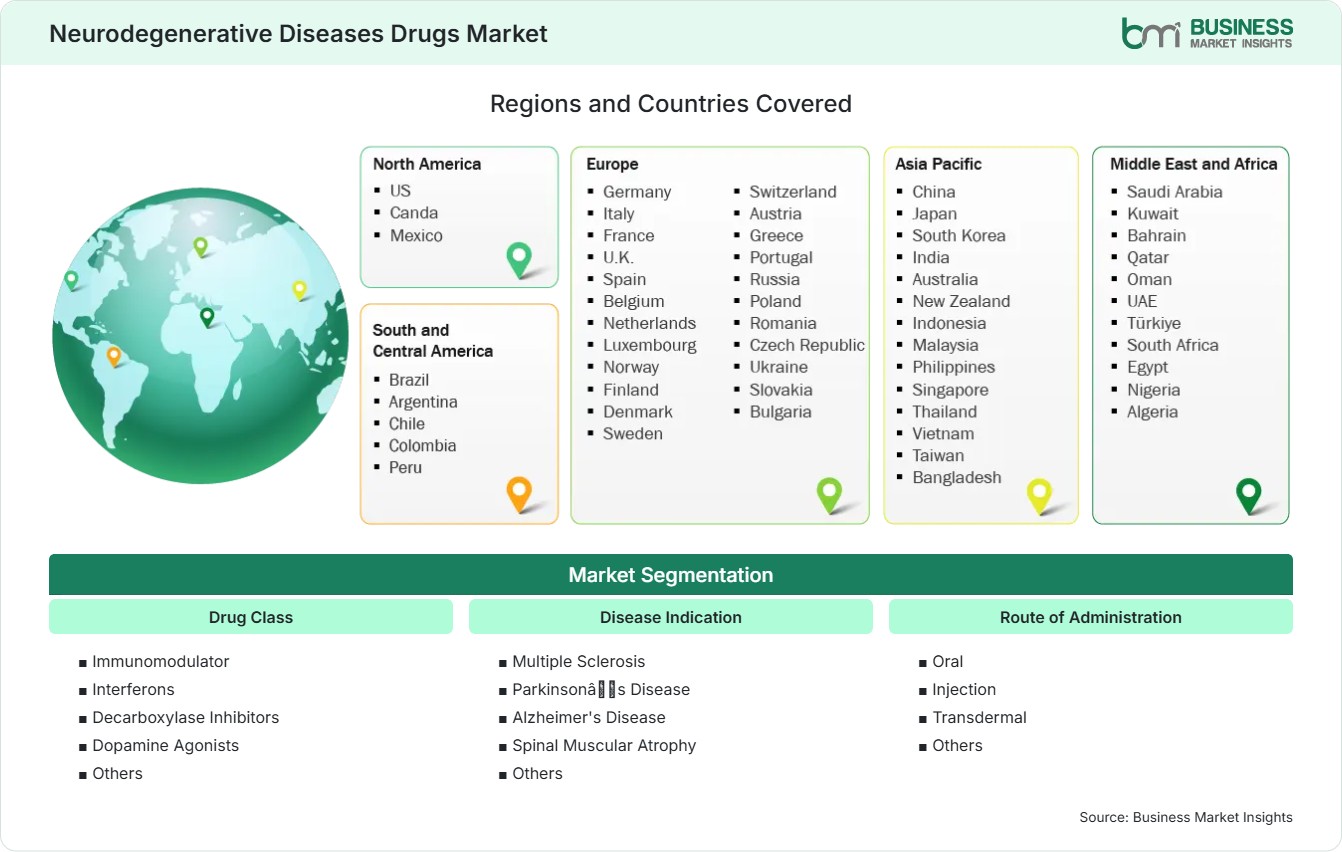
  • Drug Class: Immunomodulator, Interferons, Decarboxylase Inhibitors, Dopamine Agonists, Others
  • Disease Indication: Multiple Sclerosis, Parkinson’s Disease, Alzheimer's Disease, Spinal Muscular Atrophy , Others
  • Route of Administration: Oral, Injection, Transdermal, Others
US$ 61.13 Bn Market size in 2025
US$ 97.46 Bn Market Size by 2033
6.00% CAGR, 2026 - 2033
2026-2033 Forecast Period

AI Overview

Neurodegenerative Diseases Drugs Market Summary

  • North America Region: North America holds a market share of 42%–45% in 2025, growing at a CAGR of 5.4%–5.8% during 2026–2033. Growth is supported by advanced neurology infrastructure, favorable reimbursement, expanding biologics adoption, Alzheimer's innovation, stronger diagnostic capacity, clinical research concentration, specialist access, and increasing therapeutic awareness among aging populations.
    US market benefits from extensive biologics uptake, strong payer coverage, and a projected CAGR of 5.5%–5.9%.
  • Fastest Growing Region: Asia Pacific holds a Neurodegenerative Diseases Drugs Market share of 23%–26% in 2025 and advances at a CAGR of 7.2%–7.8% through 2026–2033. Drivers include healthcare modernization, aging demographics, growing diagnosis rates, biologics access expansion, policy support, local pharmaceutical innovation, clinical trial growth, and rising neurological care investment.
  • Leading Segment: Multiple Sclerosis accounts for 30%–34% share in 2025 and grows at 5.4%–5.9% CAGR. Established treatment pathways, high biologic utilization, long-term therapy adherence, earlier diagnosis, specialist monitoring programs, favorable coverage mechanisms, treatment switching trends, and strong clinical evidence support demand.
  • High Growth Segment: Alzheimer's Disease holds 20%–24% share in 2025 while expanding at 7.5%–8.2% CAGR. Disease-modifying therapy commercialization, biomarker adoption, earlier intervention strategies, expanding screening initiatives, healthcare investments, growing patient awareness, and pipeline innovation collectively accelerate future demand.
  • Key Market Opportunity: Expanding biomarker-based diagnosis, personalized therapies, digital monitoring platforms, and disease-modifying biologics create opportunities for premium treatments, earlier intervention pathways, improved outcomes, broader patient identification, and healthcare system efficiency.
  • Major Market Players: Biogen Inc., F. Hoffmann-La Roche Ltd., Novartis AG, Eli Lilly and Company, Pfizer Inc., Merck & Co., Inc., Sanofi S.A., Teva Pharmaceutical Industries Ltd., UCB S.A., Bristol-Myers Squibb Company.
Strategic Insights

Neurodegenerative Diseases Drugs Market: Strategic Insights

Neurodegenerative Diseases Drugs Market Strategic Framework
FREE PDF
Request your free sample
Request free sample
Stakeholder View

Key Takeaways

  • The value chain is increasingly centered on biologics manufacturing, specialized diagnostics, infusion networks, and long-term patient monitoring platforms, creating greater integration between drug developers and healthcare providers.
  • Alzheimer's disease and spinal muscular atrophy therapies represent the strongest long-term revenue expansion opportunities due to innovation intensity and premium treatment positioning.
  • R&D priorities are shifting from symptom control toward disease-modifying mechanisms targeting amyloid, tau, neuroinflammation, genetic pathways, and neuronal protection.
  • China, India, South Korea, and selected Southeast Asian markets present attractive investment environments because of diagnostic expansion and healthcare infrastructure upgrades.
  • Mergers, licensing agreements, and neuroscience-focused partnerships continue to reshape competition as companies seek advanced neurological assets and late-stage pipelines.
  • Real-world evidence generation and biomarker validation are becoming critical competitive differentiators for product adoption and reimbursement success.
Geographic Outlook

Neurodegenerative Diseases Drugs Market Regional Highlights

North America Neurodegenerative Diseases Drugs Market

North America accounts for 42%–45% of the Neurodegenerative Diseases Drugs Market share in 2025 and is expected to expand at 5.4%–5.8% CAGR through 2033. The region benefits from advanced neurology care networks, strong reimbursement systems, extensive biologics adoption, and significant neuroscience R&D spending. Growing prevalence of Alzheimer's disease, Parkinson's disease, and multiple sclerosis continues supporting demand. Regulatory support for innovative neurological treatments and broad access to specialists reinforce leadership across commercialization, clinical development, and treatment adoption.

  • High concentration of neuroscience clinical trials and academic research institutions strengthens innovation ecosystems and accelerates commercialization.
  • Disease-modifying therapies are expanding treatment paradigms, especially within Alzheimer's disease management.
  • Medicare and private payer coverage improvements support adoption of premium neurological therapeutics.
  • Strong biologics manufacturing capabilities improve supply chain resilience and product availability.

US Neurodegenerative Diseases Drugs Market

The United States represents 78%–82% of regional revenue and advances at 5.5%–5.9% CAGR. Growth is supported by strong healthcare spending, extensive neurological specialist networks, favorable reimbursement structures, and rapid uptake of innovative therapies. Advanced diagnostics, biomarker testing availability, and substantial pharmaceutical investment maintain the country's dominant position within neurological disease treatment and research activities.

  • Significant investment in Alzheimer's and Parkinson's disease clinical programs supports future innovation.
  • Broad access to specialized neurological centers improves diagnosis and treatment rates.
  • Increasing use of biomarkers is strengthening precision treatment approaches.
  • Favorable innovation ecosystem attracts global biotechnology partnerships.

Europe Neurodegenerative Diseases Drugs Market

Europe holds 27%–30% market share in 2025 and is projected to grow at 5.2%–5.7% CAGR. Demand is supported by aging demographics, universal healthcare coverage, and strong neurological disease management programs. Germany leads regional Neurodegenerative Diseases Drugs Market revenue generation, while Spain and Eastern European countries exhibit faster expansion rates due to improving diagnostics and treatment accessibility. Continued investment in neuroscience research strengthens long-term competitiveness.

  • Germany remains the largest regional market owing to advanced treatment infrastructure.
  • Spain demonstrates stronger growth momentum through healthcare modernization initiatives.
  • Regulatory harmonization supports broader therapy availability across member states.
  • Academic collaborations contribute significantly to neurological drug innovation.

Asia Pacific Neurodegenerative Diseases Drugs Market

Asia Pacific represents 23%–26% of global revenue in 2025 and records the highest CAGR of 7.2%–7.8%. Rapid population aging, healthcare investment growth, and increasing neurological disease awareness drive expansion. Japan remains the largest market, while China exhibits the strongest growth profile. Expanding specialty care infrastructure and pharmaceutical innovation activities support sustained demand momentum.

  • China benefits from increasing biologics adoption and enhanced neurological diagnostics.
  • Japan maintains leadership through high treatment penetration and aging demographics.
  • India is gaining importance as clinical research and specialty care capabilities expand.
  • Government healthcare investments improve patient access to advanced neurological therapies.

Rest of World Neurodegenerative Diseases Drugs Market

Rest of World contributes 6%–8% share and grows at 6.2%–6.8% CAGR. South and Central America benefit from improving specialty care access and pharmaceutical distribution capabilities. Middle East and Africa demand is supported by healthcare modernization initiatives and growing investment in advanced disease management. Brazil and Saudi Arabia remain key revenue contributors, while the UAE demonstrates strong growth potential.

  • Brazil leads regional demand due to large patient populations and healthcare expansion.
  • Saudi Arabia is increasing neurological care investment through healthcare transformation programs.
  • UAE continues strengthening specialty treatment infrastructure.
  • Access challenges remain but are improving through public-private partnerships.
Global Market Geography
FREE PDF
Request your free sample
Request free sample
Segment Analysis

Neurodegenerative Diseases Drugs Market Segmentation

Drug Class

Drug Class represents a critical revenue pillar, accounting for roughly 34%–38% share in 2025 and expanding at 5.8%–6.3% CAGR. The Neurodegenerative Diseases Drugs Market scope within this segment is expanding as biologics, targeted therapies, and symptomatic treatments increasingly coexist across neurological disease management frameworks.

  • Immunomodulator: Widely used in multiple sclerosis management, supported by strong clinical evidence, long-term treatment adherence, and continuing therapeutic innovation.
  • Interferons: Established therapies maintaining relevance through proven efficacy profiles, physician familiarity, and broad treatment availability.
  • Decarboxylase Inhibitors: Essential within Parkinson's disease treatment regimens, enabling improved dopamine utilization and symptom management.
  • Dopamine Agonists: Important for motor symptom control and therapy personalization across different disease stages.

Disease Indication

Disease indication remains the largest segment category, with Multiple Sclerosis holding 30%–34% share and advancing at 5.4%–5.9% CAGR. The Neurodegenerative Diseases Drugs Market trends increasingly highlight accelerated innovation in Alzheimer's disease and rare neurodegenerative conditions alongside established multiple sclerosis therapies.

  • Multiple Sclerosis: Large treated population, established biologics adoption, and robust reimbursement create sustained revenue generation.
  • Parkinson’s Disease: Expanding elderly populations and treatment optimization strategies support continued demand growth.
  • Alzheimer's Disease: Disease-modifying therapies are reshaping treatment pathways and commercial opportunities.
  • Spinal Muscular Atrophy (SMA): High-value therapies and precision treatment approaches fuel segment expansion.

Route of Administration

Route of administration dynamics are evolving, with Oral therapies holding a 46%–50% share in 2025 and growing at 5.1%–5.6% CAGR. Patient convenience remains a key adoption factor, although injectable biologics are gaining prominence across disease-modifying treatment categories.

  • Oral: Preferred for convenience, treatment adherence, and broad accessibility across chronic neurological conditions.
  • Injection: Increasingly important for biologics and advanced disease-modifying therapies requiring targeted delivery.
  • Transdermal: Supports improved compliance and stable drug administration in selected neurological disorders.
Market Forces

Neurodegenerative Diseases Drugs Market Dynamics

Key Market Drivers

Growing Burden of Aging-Related Neurological Disorders

The aging pattern throughout the globe is becoming one of the reasons why the occurrence rate of neurological disorders is increasing. As per WHO's records, there is no doubt that neurological disorders rank among the leading disabilities in the world; therefore, there is a need for solutions to handle them. The increasing number of the senior population has resulted in an increased diagnosis rate for Alzheimer’s disease, Parkinson’s disease, and many other diseases. There is a need for more emphasis on prevention strategies and chronic illness management. It can be said that such demographic trends offer a solid basis for business growth.

Acceleration of Disease-Modifying Therapy Development

The recent approval of disease-modifying drugs has changed expectations for treatment in neurodegenerative diseases. Success in the field of Alzheimer's disease has revived investors' hopes and enhanced investment activity in neuroscience. Biologicals, antibodies, and precision medicine tools are becoming important targets of development spending. Healthcare providers increasingly emphasize interventions that alter disease progression rather than solely managing symptoms, creating opportunities for premium neurological therapeutics and improved patient outcomes.

Expansion of Biomarker-Based Diagnosis

Enhanced biomarkers and imaging have the potential to aid early patient identification and treatment selection. Improvements in diagnostics will aid the implementation of precision treatment, increase recruitment into trials, and support decision-making. The increasing use of biomarkers in blood, along with advanced imaging, is helping to increase treatment uptake and broaden the pool of eligible patients. Enhanced diagnostic confidence is creating stronger commercial environments for innovative neurological therapies.

Key Market Opportunities

Commercialization of Precision Neurology Platforms

Precision neurology is an emerging field that is becoming increasingly popular due to the growing use of genetic tests, biomarkers, and digital monitoring in clinical practice. Using all these technologies, drug makers will be able to develop drugs for specific patient populations, thereby making treatment more efficient while reducing unnecessary therapies. With enhanced patient stratification, there will be better clinical outcomes, further supporting the concept of value-based medicine and creating opportunities for premium pricing. Investment prospects are growing in diagnostic, therapeutic, digital health, and holistic neurological management sectors.

Emerging Market Access Expansion

Enhancements in healthcare infrastructure across Asia-Pacific, Latin America, and certain areas of the Middle East are creating many opportunities for the growth of neurological care providers. Increased availability of specialists, enhanced reimbursement, higher healthcare spending, and greater disease awareness have contributed to market development. Organizations that build strong regional relationships, efficient distribution networks, and effective access strategies may leverage demand in previously underserved regions, unlocking significant long-term revenue potential and strengthening their global market presence

Next-Generation Alzheimer's Therapeutics

The Neurodegenerative Diseases Drugs Market Forecasts is most robust in terms of innovation for Alzheimer’s disease. Progress with therapies against amyloid, tau, and neuroinflammation, and a combination therapy approach, will likely open up many additional patients. Earlier diagnosis and expanded screening initiatives will reinforce adoption, driving future growth potential.

Market Restraints and Challenges

High Treatment Costs and Access Limitations

Neurological treatment methods are usually expensive due to complex research and development, regulatory compliance, and highly sophisticated manufacturing. High prices may lead to affordability issues for patients and medical care providers due to an underdeveloped health care system and insufficient insurance support. The medical community and insurers currently require proof of cost-effectiveness and treatment outcomes before approving coverage. Therefore, pharmaceutical companies are required to provide substantial evidence of therapy benefits and economic feasibility.

Clinical Development Complexity and Pipeline Risk

The development of drugs that affect the nervous system is fraught with considerable scientific uncertainties, lengthy clinical trial periods, and costly research processes. The high failure rate associated with the process leads to pipeline volatility and increased financing risks for the company. Other challenges include disease heterogeneity, difficulty selecting appropriate clinical endpoints, and long-term evaluation. These delays in approval and commercialization result in lower ROI across various neurological therapeutic areas.

Company Analysis

Competitive Landscape

The Neurodegenerative Diseases Drugs Market analysis indicates competition is increasingly shaped by biologics innovation, neuroscience pipeline strength, biomarker integration, and strategic partnerships.

Company Name

Overview

Products and Services relevant to this market

Biogen Inc.

Global neurology leader with strong focus on Alzheimer's disease, multiple sclerosis, and neurodegenerative research.

Leqembi collaboration, multiple sclerosis portfolio, neuroscience R&D, biologics development.

F. Hoffmann-La Roche Ltd.

Major pharmaceutical innovator active across neuroscience, diagnostics, and personalized medicine platforms.

Neurology diagnostics, neurological disorder research, precision healthcare solutions.

Novartis AG

Diversified pharmaceutical company with advanced neuroscience and rare disease capabilities.

Spinal muscular atrophy therapies, neurological disease research, specialty medicines.

Eli Lilly and Company

Expanding neuroscience presence through Alzheimer's disease innovation and biologics development.

Alzheimer's therapies, neurodegeneration pipeline, biologics research programs.

Pfizer Inc.

Global pharmaceutical company pursuing neurological disease treatments and strategic collaborations.

CNS therapeutics, neuroscience research, specialty pharmaceutical solutions.

Merck & Co., Inc.

Research-driven innovator with diversified therapeutic development activities.

Neurology-focused pipeline programs and precision treatment research.

Sanofi S.A.

Multinational healthcare company investing in specialty and neurological therapeutics.

Rare disease therapies, neuroscience partnerships, biologic development.

Teva Pharmaceutical Industries Ltd.

Major pharmaceutical company with strong neurology and generic medicine portfolio.

Multiple sclerosis treatments and specialty neurological medicines.

UCB S.A.

Biopharmaceutical specialist with expertise in neurological and immune-mediated disorders.

Neurology therapies, research platforms, specialty disease management solutions.

Bristol-Myers Squibb Company

Global biopharmaceutical organization with broad R&D capabilities.

Neuroscience research, innovative therapeutics, development partnerships.

Trust & Transparency

Research Methodology

The market analysis combines proprietary research with secondary data from government agencies, company disclosures, regulatory filings, industry databases and expert interviews. Market estimates are validated through data triangulation, cross-market benchmarking and analyst review.

View Full Research Methodology

Questions Answered

Frequently Asked Questions

What does a Neurodegenerative Diseases Drugs Market Report typically evaluate?

A Market Report generally examines disease prevalence, therapeutic innovation, regional demand patterns, competitive positioning, regulatory developments, and long-term commercial opportunities.

How are biomarkers affecting treatment adoption?

Biomarkers improve patient selection, support earlier intervention, enhance clinical confidence, and increase the effectiveness of precision treatment strategies across neurological disorders.

Why is Asia Pacific growing faster than other regions?

Rapid aging, healthcare modernization, improved diagnostics, increasing specialty care access, and government support for advanced treatments are accelerating regional demand.

What is the most important future growth catalyst?

Disease-modifying Alzheimer's therapies represent the most influential catalyst, supported by biomarker adoption, earlier diagnosis, and expanding patient identification programs.

Which disease indication currently generates the largest revenue?

Multiple sclerosis remains the largest revenue-generating indication because of established treatment pathways, extensive biologics use, strong reimbursement support, and long-term therapy adherence requirements.

Access the Full Neurodegenerative Diseases Drugs Market Report

Get segment-level forecasts, regional estimates, competitive benchmarking, company profiles and downloadable Excel datasets.

Access the full Neurodegenerative Diseases Drugs Market Report
350 pages PDF & Excel | 2026-08-28