
Nano Drone Market Outlook: Size, Share, Trends, Growth Analysis, Competitive Landscape & Forecast, 2026-2033

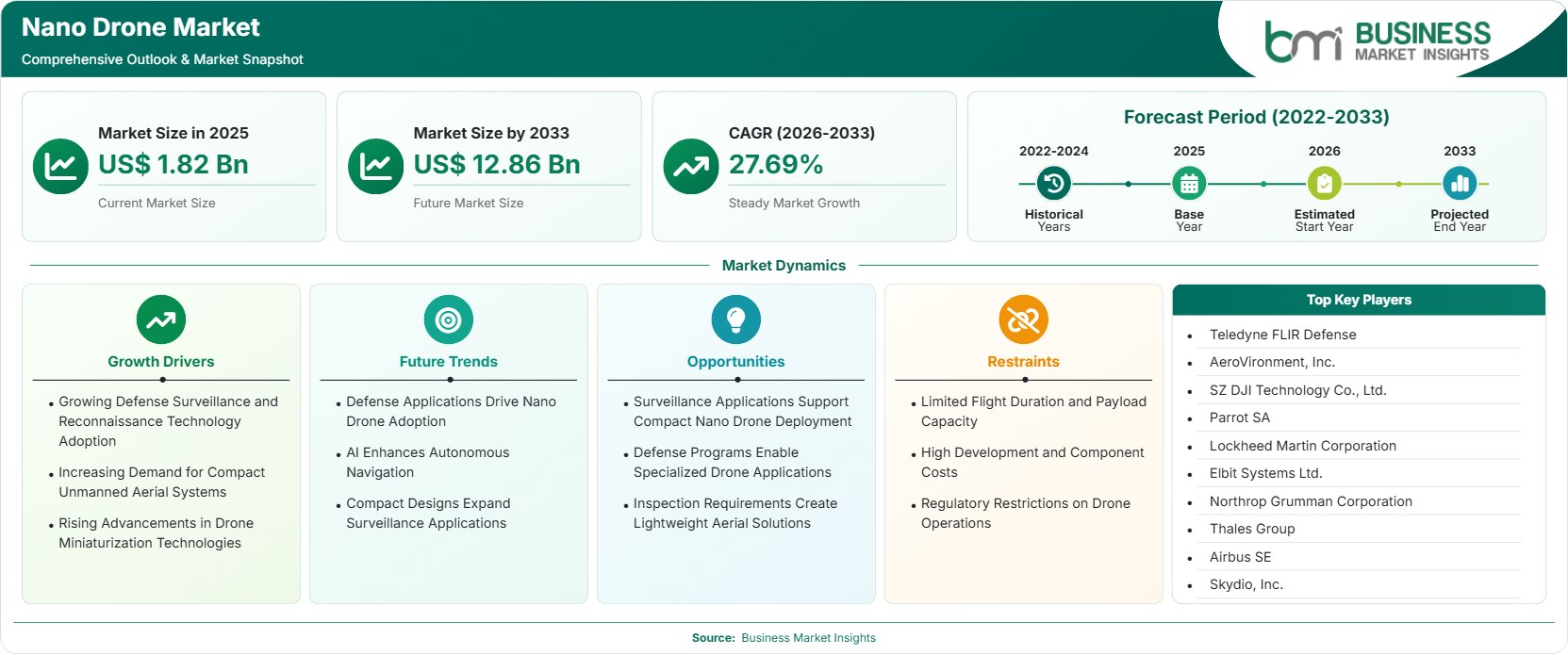
The Nano Drone Market size was valued at US$ 1.82 Billion in 2025 and is projected to reach US$ 12.86 Billion by 2033, growing at a CAGR of 27.69% during 2026–2033. Growth is supported by expanding defense reconnaissance requirements, miniaturized sensor innovation, thermal imaging adoption, public safety deployments, AI-enabled autonomy, and increasing commercial inspection opportunities across complex environments.

Report Coverage
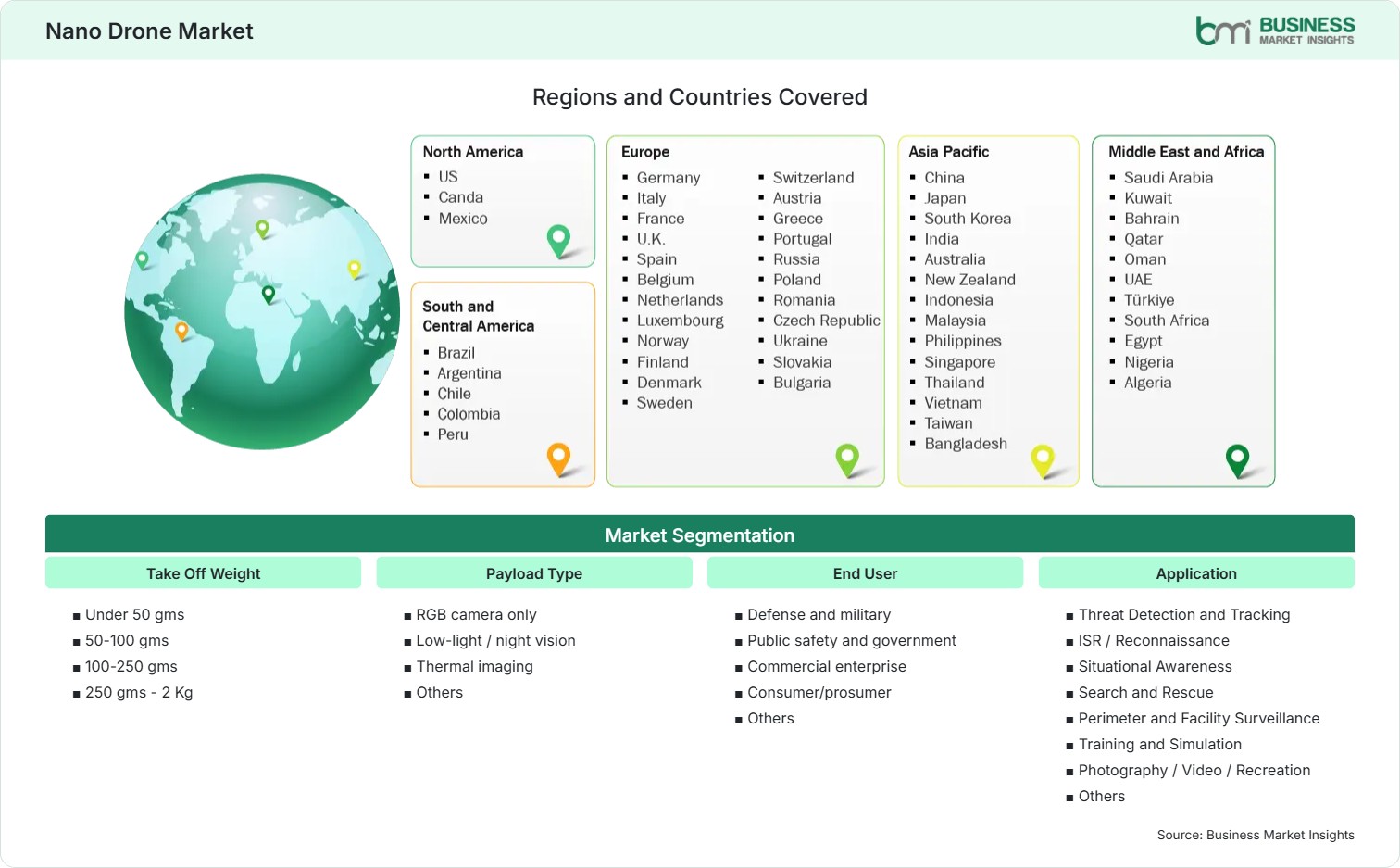
  • Take Off Weight: Under 50 gms, 50-100 gms, 100-250 gms, 250 gms - 2 Kg
  • Payload Type: RGB camera only, Low-light / night vision, Thermal imaging, Others
  • End User: Defense and military, Public safety and government, Commercial enterprise, Consumer/prosumer, Others
  • Application: Threat Detection and Tracking, ISR / Reconnaissance, Situational Awareness, Search and Rescue, Perimeter and Facility Surveillance, Training and Simulation, Photography / Video / Recreation, Others
US$ 1.82 Bn Market size in 2025
US$ 12.86 Bn Market Size by 2033
27.69% CAGR, 2026 - 2033
2026-2033 Forecast Period

AI Overview

Nano Drone Market Summary

  • North America Region: North America holds a market share of 36%–39% in 2025, growing at a CAGR of 25%–28% during 2026–2033, supported by defense modernization, border security programs, and first-responder deployments. The U.S. market benefits from military procurement and ISR investments, advancing at approximately 25%–28% CAGR.
  • Fastest Growing Region: Asia Pacific accounts for 25%–28% share in 2025 and grows at 30%–33% CAGR during 2026–2033, driven by defense digitization, smart-city surveillance, industrial inspection demand, and domestic drone manufacturing capabilities.
  • Leading Segment: Defense and military represents 38%–42% share in 2025 and advances at 28%–31% CAGR, supported by tactical reconnaissance requirements, battlefield awareness enhancement, and soldier-level intelligence collection capabilities.
  • High Growth Segment: Thermal imaging holds 18%–22% share in 2025 and expands at 31%–34% CAGR, fueled by night operations, emergency response requirements, critical infrastructure monitoring, and advanced sensing integration.
  • Key Market Opportunity: Growing integration of compact autonomous platforms with AI-enabled analytics creates opportunities across industrial inspection, emergency response, border monitoring, infrastructure assessment, and indoor navigation applications requiring low-risk aerial intelligence.
  • Major Market Players: Teledyne FLIR Defense, AeroVironment, Inc., SZ DJI Technology Co., Ltd., Parrot SA, Lockheed Martin Corporation, Elbit Systems Ltd., Northrop Grumman Corporation, Thales Group, Airbus SE, and Skydio, Inc.
Strategic Insights

Nano Drone Market: Strategic Insights

Nano Drone Market Strategic Framework
FREE PDF
Request your free sample
Request free sample
Stakeholder View

Key Takeaways

  • The value chain is increasingly integrating sensor suppliers, AI software developers, communications specialists, and drone manufacturers, creating higher demand for interoperable ecosystems rather than standalone hardware solutions.
  • Threat detection, ISR/reconnaissance, search-and-rescue, and facility surveillance applications provide the strongest expansion potential due to growing operational requirements among defense and public-sector users.
  • Innovation is shifting toward autonomous navigation, low-light imaging, thermal payloads, real-time analytics, swarming capabilities, and secure communications optimized for GPS-denied environments.
  • Asia-Pacific presents a compelling investment case as government funding, defense modernization programs, and domestic manufacturing initiatives accelerate deployment across China, India, Japan, South Korea, and Southeast Asia.
  • Strategic acquisitions increasingly target imaging specialists, AI analytics developers, and autonomous flight software providers, reflecting industry emphasis on integrated intelligence capabilities.
  • Lightweight thermal sensing and multi-payload architecture are emerging as critical purchasing criteria among military and security organizations.
Geographic Outlook

Nano Drone Market Regional Highlights

North America Nano Drone Market

North America accounts for 36%–39% Nano Drone Market share in 2025 and is projected to expand at 25%–28% CAGR through 2033. The region benefits from high budgets for defense, advanced drone systems, and procurement efforts that focus on mobile ISR capabilities. The military modernization programs, as well as the public security deployments, are some of the major contributors to the demand in the region. The technological advantages in sensors, communication, and artificial intelligence help commercialize the technology.

U.S. defense procurement continues prioritizing soldier-borne reconnaissance systems and compact surveillance platforms.

  • Homeland security and border monitoring initiatives support adoption of lightweight autonomous systems.
  • Emergency response agencies deploy compact aerial tools for hazardous environments and disaster operations.
  • Strong venture capital activity encourages innovation in autonomy, analytics, and sensor fusion.

US Nano Drone Market

The United States represents approximately 74%–78% of North American revenue and advances at 25%–28% CAGR. Demand remains concentrated in military reconnaissance, infrastructure security, and public safety operations. Programs emphasizing tactical intelligence collection support procurement of ultra-light platforms. Private-sector adoption is increasing across utilities, manufacturing facilities, and inspection-intensive sectors requiring safe access to confined spaces and difficult operating environments.

  • Soldier-level reconnaissance remains a primary procurement priority.
  • Critical infrastructure operators increasingly utilize compact inspection drones.
  • Federal research investments support autonomy and AI-enabled navigation.
  • Commercial adoption grows in industrial monitoring and security operations.

Europe Nano Drone Market

Europe maintains 26%–29% market share in 2025 and is expected to grow at 26%–29% CAGR through 2033. Defense preparedness initiatives, border security investments, and industrial inspection requirements support expansion. Germany remains the leading market, while Eastern European countries exhibit stronger Nano Drone Market growth rates due to defense modernization priorities. Regulatory harmonization across the European Union supports cross-border drone ecosystem development and advanced operational testing.

  • Germany leads regional deployment through industrial and defense applications.
  • Poland demonstrates strong growth supported by security modernization programs.
  • Public safety agencies increasingly utilize thermal-enabled compact systems.
  • Research programs focus on autonomous navigation and swarming technologies.
  • Infrastructure monitoring adoption expands across transport and energy networks.

Asia Pacific Nano Drone Market

Asia Pacific holds 25%–28% share in 2025 and records the fastest expansion at 30%–33% CAGR. Regional governments actively promote domestic drone manufacturing and defense technology development. China represents the largest market, while India registers one of the highest growth trajectories. Industrial digitalization, smart-city programs, and public-sector surveillance initiatives drive widespread deployment across commercial and governmental environments.

  • China leads manufacturing capacity and technological deployment.
  • India benefits from indigenous defense and surveillance investments.
  • Japan advances adoption for disaster management and infrastructure inspection.
  • Southeast Asia increasingly invests in border monitoring technologies.
  • Smart-city initiatives create opportunities for integrated aerial intelligence systems.

Rest of World Nano Drone Market

Rest of World accounts for 10%–13% share in 2025 and grows at 28%–31% CAGR. Middle Eastern countries emphasize security modernization and critical infrastructure protection. South and Central America increasingly explore drone-enabled monitoring for border management and emergency services. Adoption remains concentrated in government and defense applications, although energy-sector inspection activities are emerging as a significant commercialization pathway.

  • Saudi Arabia and the UAE drive regional defense-related procurement.
  • Brazil leads Latin American adoption through security and monitoring programs.
  • Energy infrastructure surveillance supports demand expansion.
  • Public safety agencies increasingly deploy thermal-imaging platforms.
  • Strategic partnerships with international manufacturers accelerate market development.
Global Market Geography
FREE PDF
Request your free sample
Request free sample
Segment Analysis

Nano Drone Market Segmentation

Take Off Weight

The segment represents a critical differentiation factor influencing endurance, payload flexibility, and operational use cases. The 100–250 g category leads with approximately 32%–36% share in 2025 and advances at 28%–31% CAGR, balancing portability and sensor capability. The Nano Drone Market scope continues expanding as lightweight designs improve mission versatility.

  • Under 50g: Favored for covert operations, indoor reconnaissance, and low-risk environments requiring highly portable platforms and discreet deployment.
  • 50-100 g: Balances maneuverability and imaging performance, supporting inspection activities and tactical surveillance needs.
  • 100-250 g: Widely adopted due to stronger endurance, payload support, and operational flexibility across end users.
  • 250 g-2 Kg: Supports advanced sensing packages and specialized missions requiring extended functionality.

Payload Type

Payload innovation increasingly determines operational value. Thermal imaging demonstrates the highest momentum, supported by public safety, security, and defense requirements. The Nano Drone Market trends indicate stronger demand for multi-sensor missions and enhanced situational awareness capabilities.

  • RGB camera only: Remains widely utilized for daytime surveillance, mapping, inspection, and recreational imaging applications.
  • Low-light/night vision: Enables improved visibility under limited illumination conditions and supports security-focused operations.
  • Thermal imaging: Expands rapidly due to rescue, defense, facility monitoring, and threat-identification applications.

End User

Defense and military remain the leading end-user category with 38%–42% share in 2025 and 28%–31% CAGR. Operational intelligence requirements, tactical reconnaissance needs, and force-protection initiatives continue supporting procurement across military organizations worldwide.

  • Defense and military: Prioritize ISR, target identification, and battlefield awareness enhancement.
  • Public safety and government: Utilize compact systems for emergency management and disaster-response missions.
  • Commercial enterprise: Increasingly adopts drones for inspection, monitoring, and operational efficiency programs.
  • Consumer/prosumer: Focuses on recreation, content creation, and technology experimentation.

Application

ISR/reconnaissance remains the dominant application segment, reflecting elevated security and intelligence requirements. Adoption has expanded beyond defense toward industrial monitoring and emergency response, strengthening long-term demand visibility.

  • Threat Detection and Tracking: Supports real-time monitoring and operational risk reduction.
  • ISR/reconnaissance: Provides actionable intelligence in dynamic operating environments.
  • Situational awareness: Enhances decision-making through immediate visual assessments.
  • Search and rescue: Improves response efficiency within hazardous locations.
  • Perimeter and facility surveillance: Protects critical infrastructure and sensitive locations.
  • Training and simulation: Supports cost-effective operational readiness programs.
  • Photography/video/recreation: Maintains relevance within consumer and prosumer communities.
Market Forces

Nano Drone Market Dynamics

Key Market Drivers

Military ISR Modernization Programs

Defense organizations increasingly require compact Intelligence, Surveillance, and Reconnaissance (ISR) systems capable of delivering real-time tactical intelligence at the squad level. The growth of the Nano Drone Market is associated with military modernization programs, which emphasize situational awareness, protection of troops, and rapid decision making. An example of such a product is Teledyne FLIR's Black Hornet, which weighs only 70 grams, illustrating the need for portable and lightweight surveillance devices. Governments around the world invest heavily in state-of-the-art surveillance technology that improves the efficiency and safety of operations.

Advances in Miniaturized Sensors and Electronics

Rapid advancements in miniaturized sensors and electronics are significantly enhancing the capabilities of modern unmanned and autonomous systems. The development in technology in relation to low-power processors, thermal imaging systems, batteries and communication systems enables an improvement in the endurance of the drones, increasing the capabilities of the drone without adding weight to them. The improved ability to image along with navigation and decision making by means of artificial intelligence makes drone operations more accurate and autonomous. This makes the use of drones more effective.

Rising Public Safety Deployment Requirements

Emergency services are increasingly adopting compact aerial systems to support disaster assessment, search-and-rescue missions, and monitoring in hazardous or inaccessible environments. As a result of their compact nature and enhanced maneuverability, they can access areas that are either dangerous or impossible to reach through human effort. This enhances situational awareness, hence faster and informed decision making. Moreover, the digitization initiatives being undertaken by the public sector have been spurring investment in sophisticated surveillance systems, thus a continued need for compact aerial technology in both urban and national government institutions.

Key Market Opportunities

AI-Powered Autonomous Operations

Autonomous operations using AI technology will be an enormous growth area because more and more businesses will start adopting systems that have the ability to carry out actions with very little human involvement. Technologies such as real-time analytics, machine vision, artificial intelligence, and obstacle avoidance are improving the performance of nano drones by enhancing accuracy and effectiveness. As a result, Nano Drone Market forecasts highlight rising demand across infrastructure inspection, emergency response, security surveillance, environmental monitoring, and industrial asset management applications worldwide.

Expansion of Critical Infrastructure Monitoring

Energy facilities, transportation networks, utilities, and industrial complexes increasingly require regular inspection of confined, hazardous, and difficult-to-access environments to maintain operational reliability. Independent systems such as robots and drones will play a critical part in lowering costs involved in inspections as well as making the entire process efficient while at the same time ensuring increased safety for workers considering the fact that there will be less need to put workers in risky situations. Digital asset management as well as analytics platforms will make this possible.

Commercialization of Indoor Navigation Solutions

Manufacturing facilities, warehouses, and logistics centers are emerging as prime markets for indoor aerial intelligence solutions. The increasing demand for real-time inventory management, asset tracking, efficiency, and safety inspections has led to widespread acceptance across various industries. The latest advancements in GPS-free navigation techniques have enabled drones and autonomous vehicles to navigate accurately, even in complex indoor environments. This has made work more efficient, decreased the amount of manual labor required, and increased situational awareness. Indoor navigation technology is likely to gain more widespread use in the future.

Market Restraints and Challenges

Regulatory Complexity and Slower Commercial Scaling

Factor: The regulatory framework varies significantly from place to place, posing regulatory compliance challenges for manufacturers and service providers. Diverse regulations on issues like airspace access, security, pilot qualification, data management, and many others will complicate the process of implementing the UAVs. Companies intending to conduct multinational activities will have to make further adjustments to their system.

Impact: The differences in regulations may prolong the time taken to commercialize the deployment of ultra-light air vehicles in multiple regions. In addition, there may be increased costs and effort involved in the process of deploying the aerial vehicle technology in multiple regions. Compliance risks may also pose difficulties in investment planning especially for small companies that may have limited regulation resources. Therefore, the fragmentation in regulations will delay the process of commercialization and limit replication of successful deployments.

Limited Endurance and Operational Constraints

Factor: The issue of battery size and the ability to store energy is an inherent technical problem facing very light air vehicles. While miniaturized technology makes such air vehicles portable and easy to deploy, such aircraft will have limited space for carrying batteries and thus the energy stored will be limited. The increasing demands for payload and sensors may limit energy usage during flights.

Impact: Shorter endurance may limit the amount of time that an aircraft can fly, its operating range, and the capability of the organization to carry out extended observation missions with a single piece of equipment. More platforms may need to be put up by the operators, as well as more frequent battery replacement/recharging and additional logistical effort to provide continuous operation. This will result in additional expense and mission complexity, especially when carrying out missions in areas where accessibility is limited or challenging.

Company Analysis

Competitive Landscape

The Nano Drone Market analysis highlights competition across defense-focused specialists, commercial drone providers, aerospace firms, and autonomy software innovators.

Company Name

Overview

Products and Services relevant to this market

Teledyne FLIR Defense

Defense technology leader with strong presence in reconnaissance and sensing solutions.

Black Hornet nano UAVs, thermal imaging payloads, ISR systems.

AeroVironment, Inc.

Manufacturer of tactical unmanned systems serving defense organizations globally.

Reconnaissance drones, autonomous systems, mission software.

SZ DJI Technology Co., Ltd.

Global drone manufacturer with broad commercial and enterprise footprint.

Compact drones, imaging systems, inspection platforms.

Parrot SA

European drone specialist focused on professional and governmental markets.

Enterprise drones, mapping, inspection, security solutions.

Lockheed Martin Corporation

Major defense contractor developing advanced autonomous technologies.

ISR systems, defense integration, tactical drone solutions.

Elbit Systems Ltd.

Defense electronics and unmanned systems provider.

Miniature UAVs, surveillance payloads, intelligence systems.

Northrop Grumman Corporation

Aerospace and defense company with autonomous systems expertise.

ISR technologies, mission systems, autonomous platforms.

Thales Group

Global technology company serving defense and security markets.

Sensor integration, surveillance systems, communications solutions.

Airbus SE

Aerospace leader investing in autonomous and surveillance technologies.

Drone platforms, imaging systems, digital mission services.

Skydio, Inc.

Autonomy-focused drone developer with advanced AI navigation expertise.

Autonomous flight software, inspection and security drones.

Trust & Transparency

Research Methodology

The market analysis combines proprietary research with secondary data from government agencies, company disclosures, regulatory filings, industry databases and expert interviews. Market estimates are validated through data triangulation, cross-market benchmarking and analyst review.

View Full Research Methodology

Questions Answered

Frequently Asked Questions

Why are thermal imaging payloads gaining traction?

Thermal imaging supports night operations, search-and-rescue missions, facility protection, and threat detection, making it valuable across defense, security, and emergency response applications.

How does a Nano Drone Market Report support strategic decisions?

It helps stakeholders evaluate growth potential, competitive positioning, investment priorities, technology adoption patterns, and regional demand shifts that influence commercial and operational planning.

What technology is most influencing product development?

Miniaturized thermal sensors, AI-based navigation, machine vision, autonomous flight control, and secure communications technologies are the primary innovation drivers reshaping product capabilities.

Which region offers the strongest long-term expansion potential?

Asia Pacific presents the strongest expansion outlook due to defense modernization programs, domestic manufacturing growth, smart-city investments, and increasing adoption across industrial sectors.

Which application generates the highest demand for compact aerial platforms?

ISR/reconnaissance activities generate the largest demand because military and security agencies require real-time intelligence collection, threat identification, and operational awareness in dynamic environments.

Access the Full Nano Drone Market Report

Get segment-level forecasts, regional estimates, competitive benchmarking, company profiles and downloadable Excel datasets.

Access the full Nano Drone Market Report
350 pages PDF & Excel | 2026-09-04