
Multichannel Analytics Market Outlook: Size, Share, Trends, Growth Analysis, Competitive Landscape & Forecast, 2026-2033

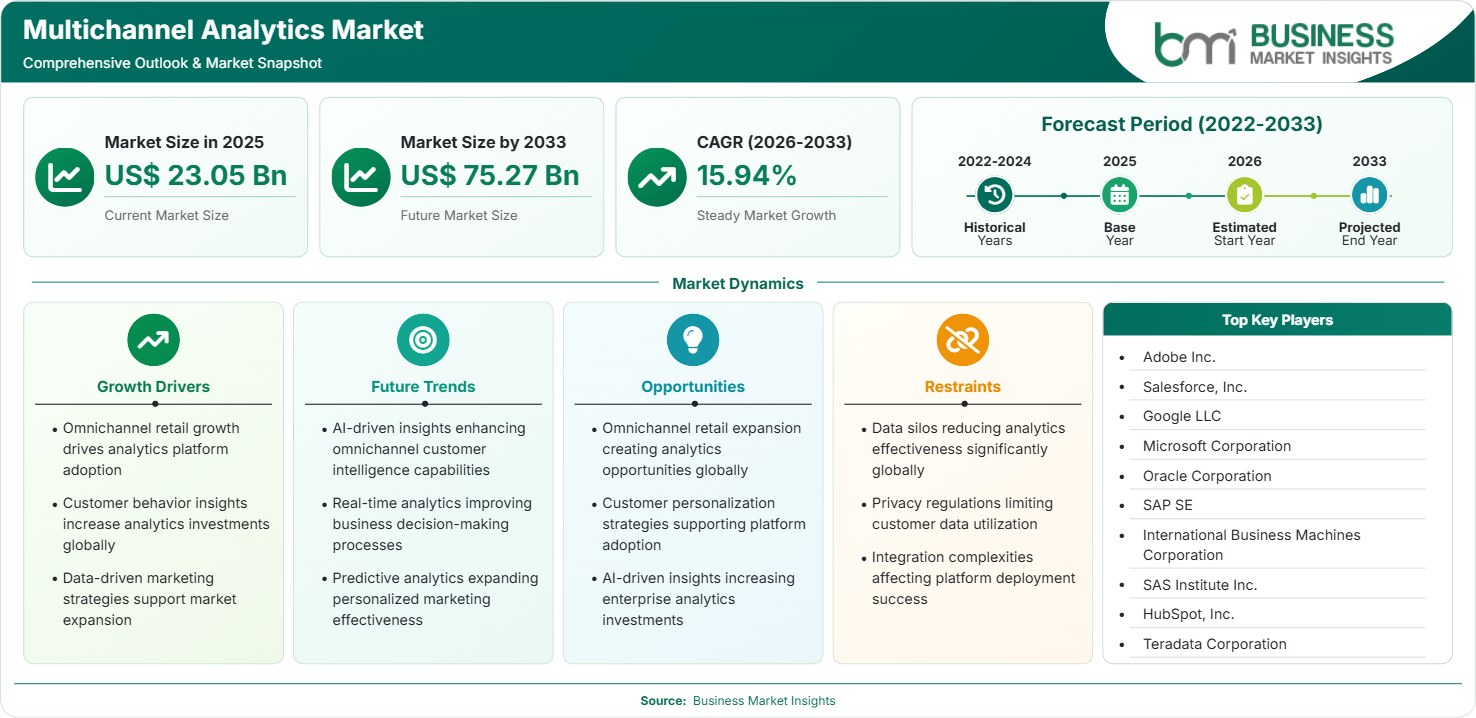
The Multichannel Analytics Market size was valued at USD 23.05 Billion in 2025 and is projected to reach USD 75.27 Billion by 2033, growing at a CAGR of 15.94% during 2026–2033, driven by real-time customer intelligence, AI-enabled personalization, integrated data platforms, and rising demand for measurable omnichannel engagement.

Report Coverage
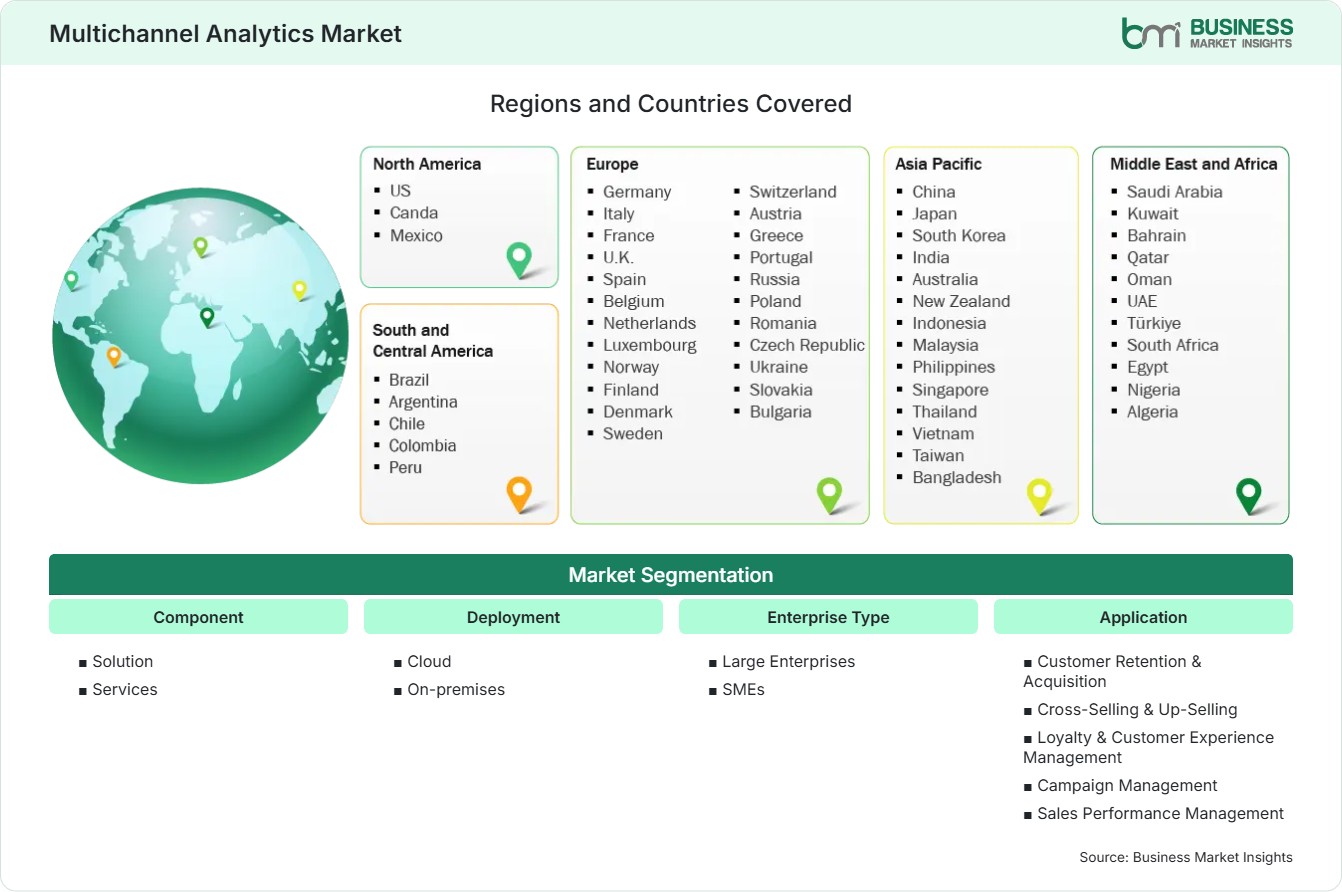
  • Component: Solution, Services
  • Deployment: Cloud, On-premises
  • Enterprise Type: Large Enterprises, SMEs
  • Application: Customer Retention & Acquisition, Cross-Selling & Up-Selling, Loyalty & Customer Experience Management, Campaign Management, Sales Performance Management
  • Industry: BFSI, IT & Telecommunication, Healthcare, Retail & E-commerce, Media & Entertainment, Travel & Hospitality, Others
US$ 23.05 Bn Market size in 2025
US$ 75.27 Bn Market Size by 2033
15.94% CAGR, 2026 - 2033
2026-2033 Forecast Period

AI Overview

Multichannel Analytics Market Summary

  • North America Region: 51%–54% share in 2025, with a 14.8%–16.1% CAGR during 2026–2033, supported by mature enterprise analytics adoption, cloud infrastructure, first-party data strategies, AI-enabled customer intelligence, and strong investment in integrated marketing and customer experience platforms.
  • Fastest Growing Region: Asia Pacific, with a 17%–20% share in 2025 and a 17.2%–19.1% CAGR during 2026–2033, driven by digital commerce expansion, mobile-first consumer engagement, cloud migration, expanding data infrastructure, and increasing enterprise adoption of AI-powered customer analytics across China, India, Japan, South Korea, and Southeast Asia.
  • Leading Segment: Solution, representing a 68%–72% share in 2025 and a 15.1%–16.0% CAGR during 2026–2033, supported by demand for integrated analytics platforms that unify customer, campaign, commerce, CRM, advertising, and behavioral data for decision-making.
  • High Growth Segment: Cloud deployment, representing a 58%–63% share in 2025 and a 16.8%–18.2% CAGR during 2026–2033, supported by scalable infrastructure, faster implementation, centralized data access, continuous platform updates, and integration with customer data and marketing technology ecosystems.
  • Key Market Opportunity: Organizations are moving from channel-specific reporting toward unified journey intelligence, creating opportunities for vendors that combine identity resolution, predictive analytics, AI-assisted recommendations, real-time measurement, privacy controls, and activation across customer touchpoints.
  • Major Market Players: Adobe Inc.; Salesforce, Inc.; Google LLC; Microsoft Corporation; Oracle Corporation; SAP SE; International Business Machines Corporation; SAS Institute Inc.; HubSpot, Inc.; Teradata Corporation.
Strategic Insights

Multichannel Analytics Market: Strategic Insights

Multichannel Analytics Market Strategic Framework
FREE PDF
Request your free sample
Request free sample
Stakeholder View

Key Takeaways

  • The value chain is now linking together data collection, identity resolution, analytics, AI models, visualization, orchestration, and activation. Companies that have integrated ecosystems are able to capture a greater share of the customer intelligence workflow than those that concentrate only on reporting.
  • Since enterprises nowadays need continuous analysis across both digital and physical contact points rather than just periodic campaign reports, cloud-based solutions and sophisticated customer applications have great potential for growth.
  • Generative AI and agentic analytics are now being incorporated into analytics workflows; Adobe has added real-time reporting and the ability to automate presentations to its Customer Journey Analytics, and Oracle has introduced an AI Assistant for its Oracle Analytics Cloud.
  • Asia Pacific presents a strong investment opportunity since mobile commerce, digital payments, cloud adoption, and customer-data infrastructure are all developing rapidly in the major economies, which in turn creates a demand for scalable analytics platforms.
  • The competition is now focusing on wider data and AI ecosystems, with platform providers extending their analytics offerings through product integration, their data-cloud capabilities, AI assistants, and features related to customer experience rather than viewing analytics as a separate reporting product.
  • Data quality, identity resolution, privacy controls, interoperability, and the time it takes to gain insights will increasingly be used to distinguish one vendor from another since enterprises need reliable customer intelligence that can be directly fed into their operational workflows.
Geographic Outlook

Multichannel Analytics Market Regional Highlights

North America Multichannel Analytics Market

North America held a 51%–54% Multichannel Analytics Market share in 2025 and is projected to record a 14.8%–16.1% CAGR through 2033. The region benefits from mature cloud infrastructure, advanced CRM adoption, high enterprise analytics penetration, and extensive digital advertising activity.

  • Enterprise modernization: Large enterprises are integrating CRM, advertising, commerce, service, and behavioral datasets to improve attribution, personalization, retention analysis, and customer lifetime value modeling.
  • AI adoption: Generative AI and natural-language analytics are reducing barriers to advanced analytics by allowing business teams to interrogate customer data without relying entirely on specialist analysts.
  • Cloud infrastructure: Hyperscale cloud platforms and mature enterprise SaaS ecosystems support scalable data ingestion, processing, modeling, and activation across multiple customer channels.
  • Privacy evolution: First-party data strategies, consent management, and privacy-resilient measurement are becoming increasingly important as organizations reduce dependence on fragmented third-party identifiers.

US Multichannel Analytics Market

The US represents approximately 72%–76% of North American Multichannel Analytics Market demand and is projected to grow at 15.0%–16.3% through 2033. Its leadership reflects widespread adoption of CRM, cloud data platforms, digital advertising, customer experience software, and AI analytics.

  • Enterprise adoption: Large US organizations increasingly connect analytics with CRM and marketing automation to convert customer insights into campaign, sales, and service actions.
  • AI-enabled analytics: Natural-language interfaces and AI assistants are expanding access to customer intelligence by allowing nontechnical users to interrogate complex datasets and generate actionable narratives.
  • Platform convergence: Leading providers increasingly combine analytics, customer data, activation, and AI capabilities, strengthening demand for unified technology stacks.

Europe Multichannel Analytics Market

Europe represented approximately 21%–24% of the global Multichannel Analytics Market in 2025 and is projected to register a 13.2%–14.7% CAGR through 2033. Adoption is supported by advanced enterprise digitization, sophisticated retail and financial services industries, and growing demand for privacy-conscious customer intelligence.

  • Germany: Industrial digitization and sophisticated B2B ecosystems support demand for unified customer and account analytics, particularly where sales, service, and marketing data must be coordinated.
  • United Kingdom: Mature digital commerce, financial services, media, and marketing technology adoption creates strong demand for real-time journey measurement and campaign optimization.
  • France: Customer experience modernization and cloud adoption are expanding analytics requirements across retail, financial services, telecommunications, and travel organizations.
  • Nordic markets: High digital maturity and strong cloud adoption provide favorable conditions for advanced analytics, automated decision-making, and privacy-conscious customer engagement.

Asia Pacific Multichannel Analytics Market

Asia Pacific accounted for approximately 17%–20% of the global Multichannel Analytics Market in 2025 and is projected to achieve a 17.2%–19.1% CAGR through 2033, making it the fastest-growing major region. Digital commerce, mobile applications, cloud infrastructure, and AI adoption are accelerating analytics demand.

  • China: Large digital ecosystems and sophisticated mobile commerce environments create substantial requirements for customer journey measurement, personalization, campaign analytics, and real-time behavioral intelligence.
  • India: Rapid digitalization across financial services, telecommunications, retail, and consumer platforms is increasing demand for scalable analytics that can process diverse customer interactions.
  • Japan: Mature enterprise technology adoption combined with demographic and productivity pressures encourages automation, predictive customer intelligence, and data-driven service optimization.
  • Southeast Asia: Expanding e-commerce, digital payments, mobile applications, and cloud adoption are creating new demand among enterprises seeking unified customer visibility.

Rest of World Multichannel Analytics Market

South and Central America and the Middle East and Africa together represented approximately 7%–10% of the global Multichannel Analytics Market in 2025, with a combined 14.0%–17.2% CAGR through 2033. Brazil and Mexico lead Latin American adoption, supported by digital commerce and financial technology development.

  • Brazil: Expanding digital commerce and financial technology ecosystems are increasing requirements for customer segmentation, campaign measurement, personalization, and retention analytics.
  • Mexico: Retail modernization, telecommunications digitization, and financial services transformation support demand for integrated customer intelligence across digital and physical channels.
  • UAE: Digital transformation programs and advanced cloud infrastructure create opportunities for sophisticated analytics, customer experience platforms, and AI-enabled decision support.
  • Saudi Arabia: Large-scale digital transformation and diversification programs are expanding technology investment across retail, financial services, travel, and government-facing services.
Global Market Geography
FREE PDF
Request your free sample
Request free sample
Segment Analysis

Multichannel Analytics Market Segmentation

Component

Solutions represented approximately 68%–72% of 2025 Multichannel Analytics Market demand and are projected to grow at 15.1%–16.0% through 2033. Integrated software platforms benefit from demand for centralized analytics, customer intelligence, visualization, predictive modeling, and AI-assisted decision-making across increasingly complex customer journeys.

  • Solution: Enterprise platforms unify customer, campaign, CRM, commerce, advertising, and behavioral data, enabling segmentation, attribution, predictive modeling, visualization, and automated recommendations.
  • Services: Consulting, implementation, integration, managed analytics, and technical support help organizations connect fragmented data sources and operationalize analytics across complex technology environments.

Deployment

Cloud deployment accounted for approximately 58%–63% of 2025 Multichannel Analytics Market demand and is projected to grow at 16.8%–18.2% through 2033. Scalability, faster implementation, centralized access, and integration with cloud data platforms support continued migration, while on-premises environments remain relevant for regulated and highly customized enterprises.

  • Cloud: Cloud platforms provide elastic processing, centralized data access, continuous upgrades, and easier integration with CRM, marketing, data warehouse, and AI services.
  • On-premises: On-premises deployments remain relevant where organizations require direct infrastructure control, specialized security policies, legacy-system integration, or strict data residency arrangements.

Enterprise Type

Large enterprises accounted for approximately 69%–73% of 2025 Multichannel Analytics Market demand and are projected to grow at 14.8%–15.8% through 2033. Their complex customer ecosystems require advanced identity resolution, high-volume processing, governance, and integration. SMEs are increasingly adopting cloud solutions because implementation barriers and infrastructure requirements are falling.

  • Large Enterprises: Complex customer journeys and large data volumes encourage adoption of advanced analytics, centralized governance, predictive models, and cross-functional decision environments.
  • Small & Medium-sized Enterprises (SMEs): Affordable cloud platforms and packaged analytics capabilities are enabling smaller organizations to access customer segmentation, campaign measurement, and performance insights.

Application

Customer Retention & Acquisition remained a major application area in 2025, supported by rising pressure to improve customer lifetime value and acquisition efficiency. Application demand is expanding as organizations connect behavioral, transactional, service, and campaign data to improve decision quality.

  • Customer Retention & Acquisition: Integrated behavioral and transactional analysis helps organizations identify churn signals, segment prospects, optimize acquisition journeys, and improve customer lifetime value.
  • Cross-Selling & Up-Selling: Predictive models identify product affinities and buying signals, enabling organizations to personalize offers and increase revenue from established customer relationships.
  • Loyalty & Customer Experience Management: Journey analytics identifies friction points and loyalty drivers across digital, physical, service, and transactional interactions.
  • Campaign Management: Cross-channel analytics improves attribution, audience selection, campaign optimization, frequency management, and budget allocation across paid and owned channels.
  • Sales Performance Management: Combining customer, opportunity, interaction, and campaign data improves pipeline visibility, account prioritization, territory management, and sales productivity.

Industry

Retail & E-commerce and BFSI represent important demand centers because both industries manage high-frequency customer interactions and generate extensive transactional and behavioral datasets. Telecommunications and healthcare also provide expanding use cases as enterprises modernize customer engagement and operational analytics.

  • BFSI: Banks and insurers use multichannel intelligence for acquisition, retention, cross-selling, fraud-aware segmentation, and personalized financial-service engagement.
  • IT and Telecommunication: Large subscriber bases and extensive digital interaction volumes support churn prediction, customer segmentation, campaign optimization, and service experience analytics.
  • Healthcare: Providers and health-related organizations increasingly connect digital engagement, appointment, service, and communication data to improve patient experience and operational decision-making.
  • Retail & E-commerce: Omnichannel shopping behavior creates strong requirements for attribution, personalization, customer lifetime value, inventory-aware engagement, and campaign optimization.
  • Media & Entertainment: Streaming, digital advertising, content interaction, and subscription data support audience segmentation, engagement analysis, personalization, and churn reduction.
  • Travel & Hospitality: Booking, loyalty, mobile, web, service, and on-property interactions provide opportunities for personalized offers, retention analytics, and customer experience optimization.
Market Forces

Multichannel Analytics Market Dynamics

Key Market Drivers

Unified Customer Data Is Becoming an Enterprise Priority

The fragmentation of customer data is another obstacle to personalization due to customer interaction taking place through different touchpoints like websites, applications, physical stores, call centers, advertising networks, social settings, and CRM solutions. As a result, companies are moving towards platforms where data is being governed, and identity is known. The resulting Multichannel Analytics Market trends increasingly emphasize unified profiles, event-level data, predictive segmentation, and activation. Vendors that connect data ingestion with analytics and operational workflows can reduce latency between insight generation and customer engagement.

AI Is Moving Analytics From Reporting Toward Decision Support

AI is helping to transform analytics from past-oriented dashboards into systems that detect anomalies, explain performance, create stories, and suggest courses of action. During 2025, Adobe added real-time reporting, automated presentations, better data stitching, and B2B journeys to Customer Journey Analytics. As organizations demand faster decisions, Multichannel Analytics Market growth will increasingly depend on AI accuracy, explainability, data quality, and the ability to connect recommendations with execution environments.

Real-Time Engagement Is Increasing Demand for Continuous Analytics

The operations for campaigns, business, services, and the digital world are now becoming more continuous, moving away from marketing cycles that happen periodically. This is where the need for real-time analytics helps organizations detect behavioral changes, conversion points, react to service triggers, and even run campaigns while the customers are actively engaged. The Customer Journey Analytics offered by Adobe now has real-time analytics features since 2025. Multichannel Analytics Market trends are consequently moving toward systems that connect measurement directly to customer engagement workflows, rather than limiting analytics to historical performance assessment.

Key Market Opportunities

Expansion of AI-Powered Journey Orchestration

The use of generative AI, predictive models, customer data platforms, and journey analytics offers the possibility of automating ever more sophisticated customer decisions. AI can detect behavioral patterns, summarise performance, recommend target audiences, generate campaign insights, and determine the next best actions. This opportunity goes beyond content generation since companies can make use of these models to link customer intent with operational decisions. Vendors who offer transparent AI controls, governed access to enterprise data, and measurable results can distinguish their platforms.

Cloud Expansion Across Emerging Enterprise Markets

Cloud infrastructure lowers the technical barriers associated with sophisticated analytics by providing scalable processing, managed storage, flexible integration, and continuously updated software capabilities. This creates substantial opportunities in Asia Pacific, Latin America, the Middle East, and other markets where enterprises are modernizing customer engagement infrastructure without maintaining extensive legacy analytics environments. Multichannel Analytics Market Forecasts are therefore increasingly linked to cloud migration, digital commerce development, and enterprise SaaS adoption.

Privacy-Resilient Measurement and First-Party Data

The changing expectations regarding privacy and how data is managed are creating opportunities for companies to deliver useful customer intelligence without relying too heavily on numerous fragmented third-party identifiers. By adopting first-party data strategies, organizations are able to build more comprehensive customer relationships at the same time as gaining better control over consent, identity, and access to data. Secure data environments, properly governed identity resolution, server-side collection, aggregated measurement, and privacy-aware collaboration can then become key factors that distinguish one product from another.

Market Restraints and Challenges

Data Fragmentation and Identity Resolution Complexity

The fact is that enterprises often have heterogeneous CRM, commerce, advertising, service, ERP, mobile, and web environments that make use of different identifiers, taxonomies, event structures, and data-quality standards. The effect of this fragmentation is to raise implementation costs, delay deployment, and lower confidence in cross-channel attribution. Even sophisticated analytics platforms are unable to generate reliable customer intelligence when the source data is incomplete, duplicated, inconsistent, or poorly governed. This situation continues to act as a limitation on both the speed of deployment and the return on investment.

Privacy, Security, and Governance Requirements

The fact is that multichannel analytics brings together sensitive information relating to users' behavior, transactions, demographics, and interactions from a number of different systems, which in turn makes it necessary to have effective privacy controls, access management, consent enforcement, retention policies, and compliance with regulations. As a result, businesses may limit the availability of data or postpone deployments if the governance frameworks in place are not able to properly manage the use of the analytics. Since requirements vary from jurisdiction to jurisdiction and from industry to industry, this adds an extra level of complexity for multinational companies.

Company Analysis

Competitive Landscape

The Multichannel Analytics Market is moderately consolidated, with competition spanning enterprise analytics, customer experience, CRM, cloud data, marketing technology, and business intelligence ecosystems.

Company Name

Overview

Products and Services relevant to this market

Adobe Inc.

Adobe provides digital experience technologies spanning analytics, customer data, content, and marketing. Its integrated experience ecosystem supports enterprise customer intelligence.

Adobe Customer Journey Analytics, Adobe Analytics, Adobe Experience Platform, Real-Time CDP, customer journey and experience analytics capabilities.

Salesforce, Inc.

Salesforce combines CRM, data, analytics, marketing, service, and AI capabilities within an enterprise cloud ecosystem.

Data 360, Tableau, Marketing Cloud, CRM analytics, customer intelligence, Agentforce, and cross-channel customer data capabilities.

Google LLC

Google provides cloud, analytics, advertising, and AI technologies that support customer data analysis and digital measurement.

Google Analytics, BigQuery, Looker, Google Cloud data and AI services, marketing measurement, and customer analytics capabilities.

Microsoft Corporation

Microsoft combines cloud infrastructure, business intelligence, data platforms, and AI to support enterprise analytical workflows.

Microsoft Fabric, Power BI, Azure data services, Dynamics 365 analytics, customer insights, and AI-enabled business intelligence.

Oracle Corporation

Oracle provides enterprise cloud applications, analytics, data management, and customer experience technologies for large organizations.

Oracle Analytics Cloud, Oracle Fusion Data Intelligence, customer experience analytics, enterprise data platforms, and AI-assisted analytics.

SAP SE

SAP integrates enterprise applications, data, analytics, planning, and customer information across business processes.

SAP Analytics Cloud, SAP Datasphere, SAP Customer Experience technologies, enterprise reporting, planning, and data analytics.

International Business Machines Corporation

IBM combines enterprise analytics, AI, hybrid cloud, data governance, and consulting capabilities for complex organizations.

IBM Cognos Analytics, watsonx, IBM Planning Analytics, data governance, AI services, and enterprise analytics consulting.

SAS Institute Inc.

SAS specializes in advanced analytics, AI, statistical modeling, customer intelligence, and decisioning for data-intensive organizations.

SAS Customer Intelligence, SAS Viya, predictive analytics, marketing analytics, AI, customer decisioning, and data management.

HubSpot, Inc.

HubSpot provides CRM, marketing, sales, service, and reporting capabilities designed to connect customer interactions across business functions.

Marketing Hub, Sales Hub, Service Hub, CRM analytics, campaign reporting, customer journey insights, and integrated reporting.

Teradata Corporation

Teradata provides enterprise data and analytics technologies designed for large-scale customer intelligence and decision support.

VantageCloud, AI and analytics, customer intelligence, data warehousing, advanced analytics, and enterprise data management.

Trust & Transparency

Research Methodology

The market analysis combines proprietary research with secondary data from government agencies, company disclosures, regulatory filings, industry databases and expert interviews. Market estimates are validated through data triangulation, cross-market benchmarking and analyst review.

View Full Research Methodology

Questions Answered

Frequently Asked Questions

How can businesses measure the return on investment from these platforms?

ROI can be evaluated through measurable changes in customer acquisition cost, retention, conversion, campaign efficiency, cross-selling, customer lifetime value, marketing attribution accuracy, service productivity, and analyst efficiency.

What should organizations evaluate before selecting a multichannel analytics platform?

Organizations should evaluate data-source connectivity, identity resolution, real-time processing, scalability, governance, privacy controls, AI capabilities, integration with CRM and marketing systems, implementation complexity, and total cost of ownership.

How does artificial intelligence affect multichannel analytics?

AI improves the ability to identify behavioral patterns, predict churn, recommend next-best actions, generate analytical narratives, detect anomalies, and interact with datasets using natural language.

What industries are likely to use multichannel analytics most extensively?

Retail and e-commerce, BFSI, telecommunications, media and entertainment, travel and hospitality, and technology businesses are particularly suited because they manage high volumes of customer interactions across multiple channels.

What is driving adoption of multichannel analytics among enterprises?

Enterprise adoption is driven by fragmented customer data, increasing digital touchpoints, demand for personalized engagement, pressure to improve marketing attribution, and the need to connect analytics with CRM and operational workflows.

Access the Full Multichannel Analytics Market Report

Get segment-level forecasts, regional estimates, competitive benchmarking, company profiles and downloadable Excel datasets.

Access the full Multichannel Analytics Market Report
350 pages PDF & Excel | 2026-10-26
Similar Research

Related Market Reports