Embedded Analytics Market Regional Highlights
North America Embedded Analytics Market
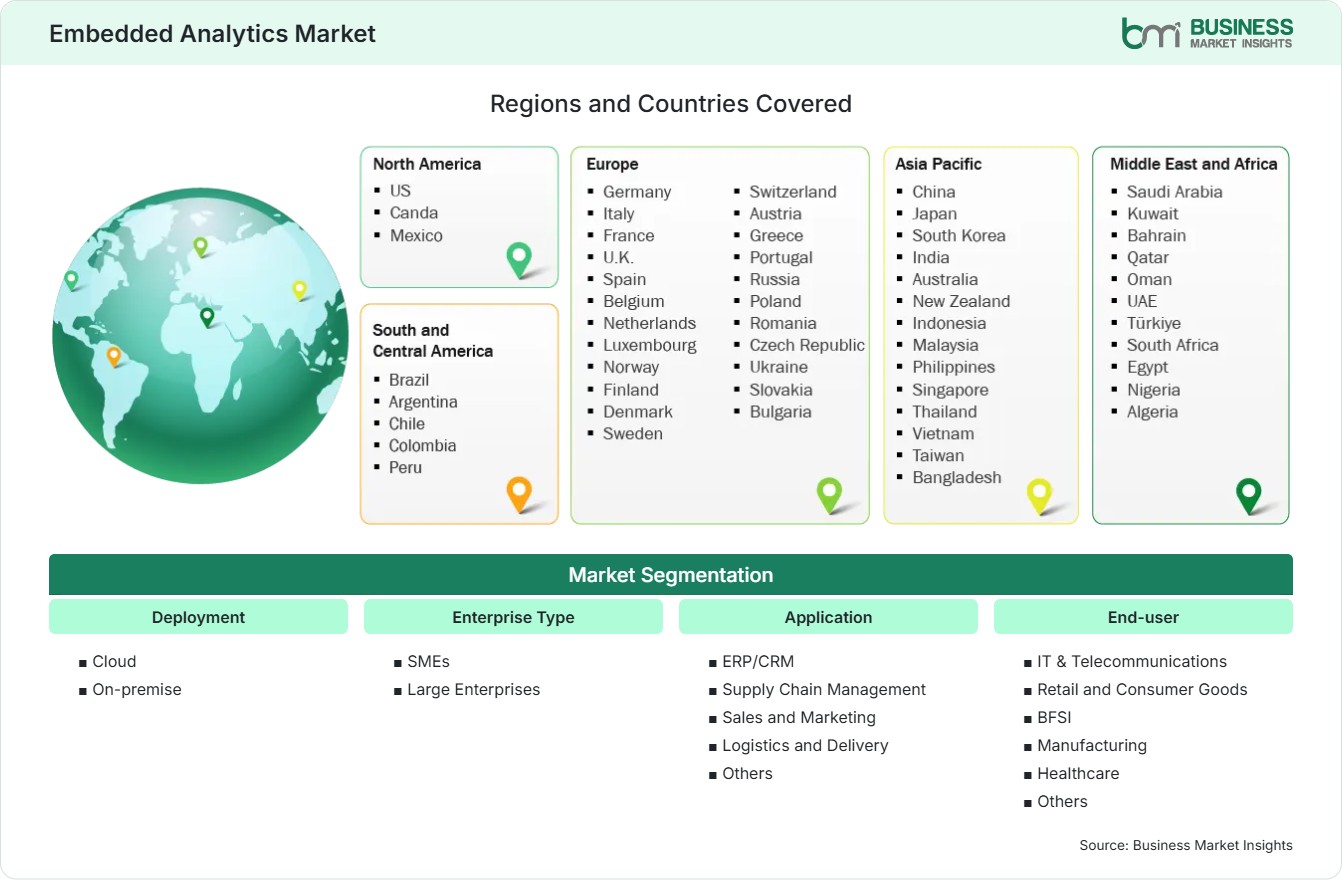
North America in the Embedded Analytics market is expected to be 35%-38% in 2025, with the region recording a CAGR of 15.20%-16.80% till 2033. Enterprise SaaS adoption, cloud transformation, and demand for consumer-facing insights drive regional adoption. Financial services, healthcare organizations, and technology companies continue to be key customers of embedded analytics solutions, while software developers seek flexible solutions that provide a competitive advantage. The US is the biggest regional contributor due to its tech ecosystem, enterprise software implementations, and AI funding.
- Cloud-native analytics adoption supports scalable SaaS integration, allowing software providers to embed reporting without maintaining separate customer infrastructure.
- Financial services applications prioritize secure reporting, risk monitoring, customer segmentation, and workflow-based intelligence within regulated operating environments.
- Healthcare technology companies require governed analytics for operational efficiency, revenue cycle management, and patient-service administration.
- Enterprise software vendors increasingly offer embedded dashboards as premium features, strengthening product differentiation and recurring revenue opportunities.
US Embedded Analytics Market
The US accounted for approximately 27%-30% of total worldwide revenues in 2025, with a CAGR of 15.50%-17.00% from 2026 to 2033. The presence of established cloud infrastructure, enterprise application deployments, and heavy investments in artificial intelligence ensures that the need will remain intact in the future. Competitiveness in development tools, semantic models, security, and conversational analytics is evident among the vendors. Applications include financial technologies, healthcare software, retail platforms, and customer relationship management applications. Many ISVs offer ample room for deployment.
- Enterprise buyers prioritize identity integration, granular permissions, and auditability when analytics becomes part of customer-facing applications and regulated workflows.
- AI-enabled querying and automated summaries support nontechnical users while increasing demand for governed semantic models and reliable data interpretation.
- Partnerships between software vendors and analytics providers shorten development cycles and enable white-label reporting across industry-specific SaaS platforms.
Europe Embedded Analytics Market
The Europe region had approximately 22%–25% Embedded Analytics Market share in 2025 and is expected to grow at a CAGR of 14.50%–16.50% up to 2033. Privacy needs, a cloud-first approach, and industry digitization influence technology choices. Germany, the UK, and France remain the key markets, while the Netherlands, Ireland, and the Nordic countries offer additional market potential in cloud-based services and software development. Germany's manufacturing sector drives demand for analytics used in production, inventory, and quality control processes. The UK benefits from the fintech sector and SaaS innovations.
- GDPR compliance encourages permission management, data minimization, and auditable access across embedded reporting and customer analytics environments.
- Germany's industrial ecosystem supports demand for analytics integrated into manufacturing execution, enterprise resource planning, and supply chain applications.
- The UK provides opportunities through financial services modernization, fintech platforms, and cloud-based operational reporting.
- France and the Nordic economies support adoption through digital public services, industrial software, and enterprise technology investment.
Asia Pacific Embedded Analytics Market
The Asia Pacific region had an estimated Embedded Analytics market share of 21% - 24% in 2025 and is projected to witness a CAGR of 19.00% - 21.50% from 2026 to 2033. Growth drivers include expansion of cloud infrastructure, digital transformation in enterprises, e-commerce transactions, and industrial automation. Leading countries in the region include China, Japan, Australia, India, and Singapore. Emerging nations such as India and Southeast Asia have considerable potential for deployment on a scalable and economical basis. Manufacturers have increasingly adopted embedded analytics solutions to measure the performance of their operations in production and logistics.
- India benefits from expanding SaaS development, digital payments, enterprise modernization, and demand for analytics integrated into business applications.
- China supports industrial analytics through manufacturing digitization, cloud infrastructure, and enterprise software deployment across complex production environments.
- Japan prioritizes operational efficiency, automation, and reliable reporting within established manufacturing and enterprise technology ecosystems.
- Singapore and Australia offer opportunities through financial services, regional cloud infrastructure, and digitally mature enterprise applications.
Rest of World Embedded Analytics Market
The South and Central American regions have accounted for 7%–9% of worldwide Embedded Analytics Market revenues in 2025, with a CAGR of 17.00%–19.00%. The key players in the region include Brazil and Mexico, driven by fintech services, retail transformation, logistics, and enterprise cloud. There is a growing demand for reporting tools embedded within business applications.
The Middle East & Africa accounted for around 8%-10% of the market in 2025 and is expected to grow at 16.50%-19.00% through 2033. The UAE, Saudi Arabia, and South Africa help boost demand through digital government, financial services, and infrastructure.
- Brazil and Mexico provide opportunities for embedded analytics in retail, financial services, logistics, and enterprise resource planning applications.
- The UAE and Saudi Arabia are investing in digital infrastructure, creating demand for integrated operational reporting and AI-supported business applications.
- South Africa supports analytics adoption across financial services, telecommunications, retail, and enterprise modernization initiatives.
- Regional vendors can differentiate through localized interfaces, implementation support, flexible licensing, and hybrid deployment capabilities.