
Supply Chain Analytics Market Outlook: Size, Share, Trends, Growth Analysis, Competitive Landscape & Forecast, 2026-2033

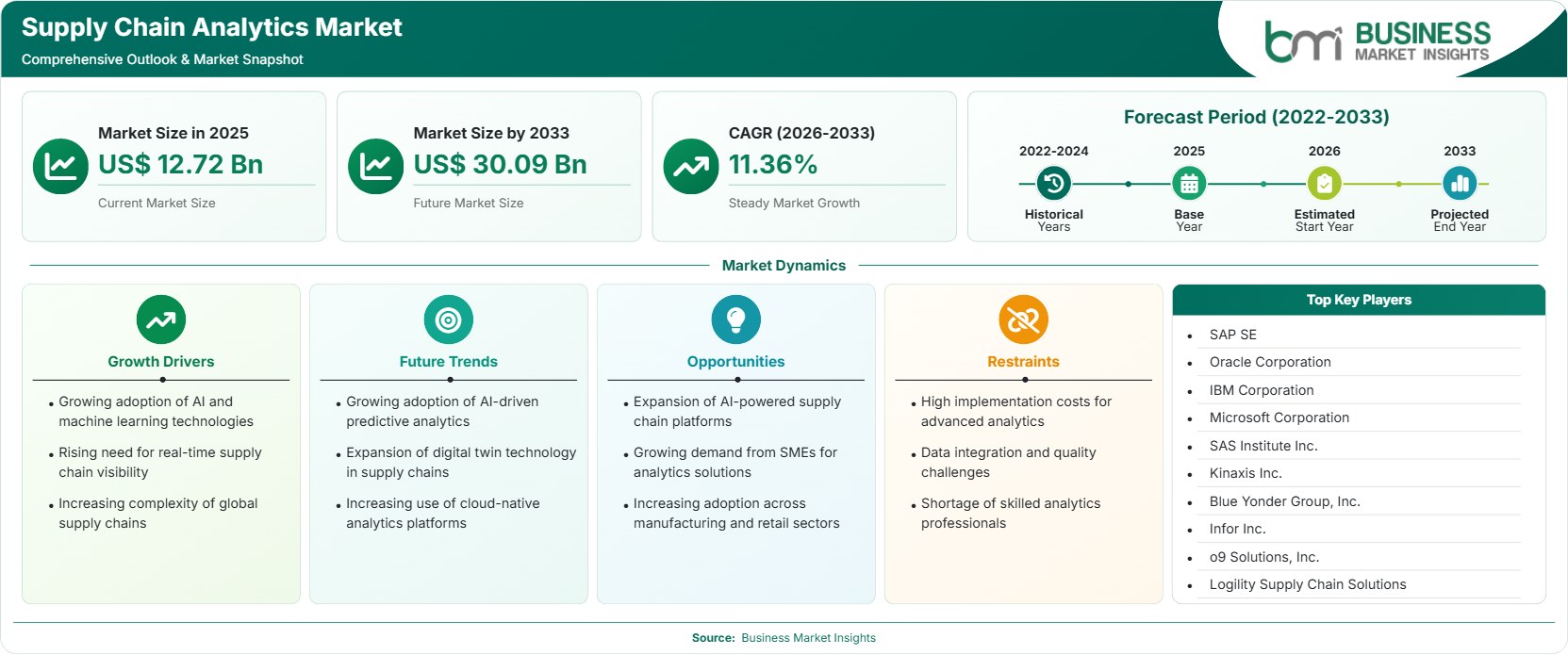
The Supply Chain Analytics Market size was valued at US$ 12.72 Billion in 2025 and is projected to reach US$ 30.09 Billion by 2033, growing at a CAGR of 11.36% during 2026–2033, driven by AI adoption, real-time visibility requirements, complex global supply networks, and increasing enterprise demand for predictive decision-making capabilities.

Report Coverage
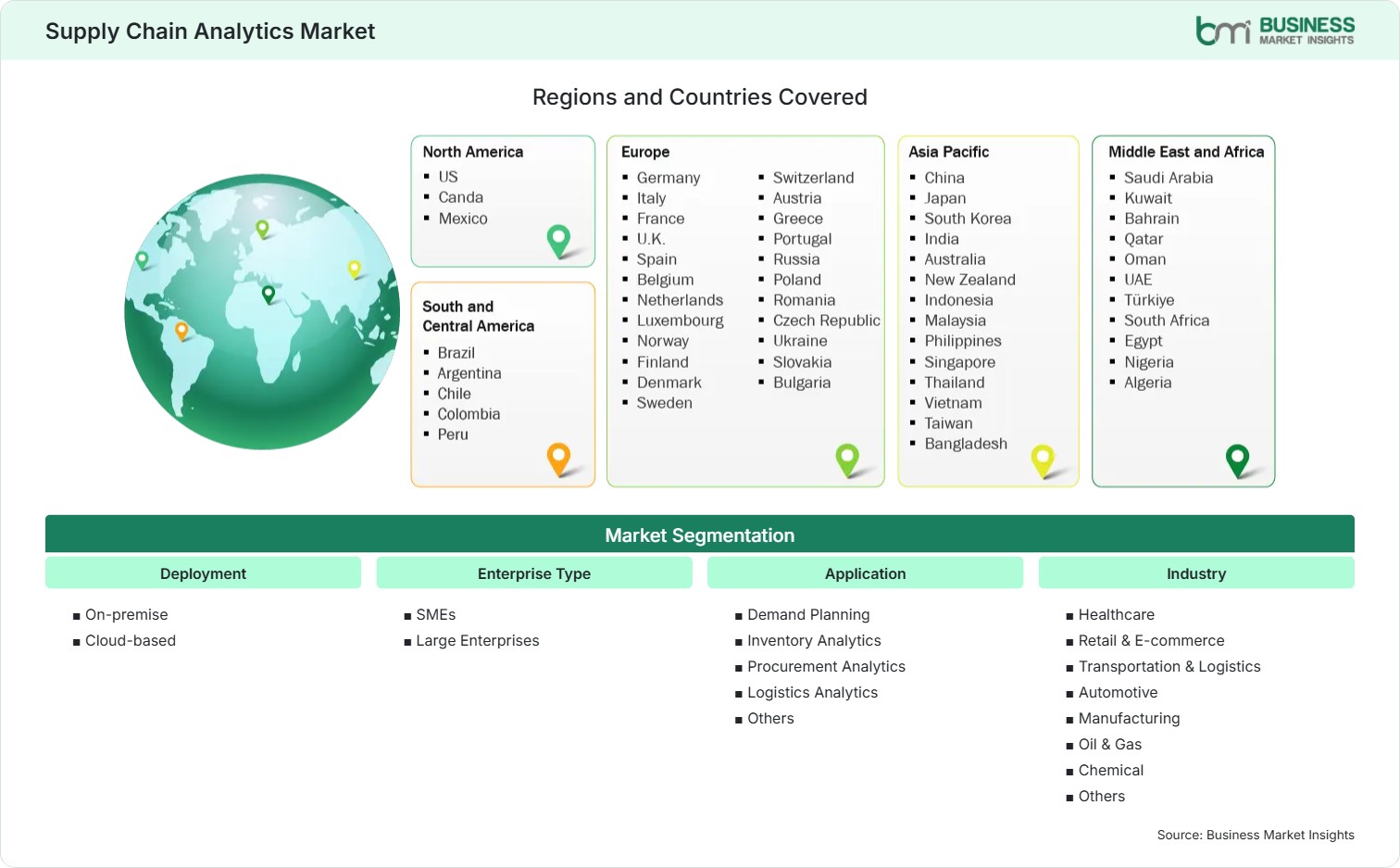
  • Deployment: On-premise, Cloud-based
  • Enterprise Type: SMEs, Large Enterprises
  • Application: Demand Planning, Inventory Analytics, Procurement Analytics, Logistics Analytics, Others
  • Industry: Healthcare, Retail & E-commerce, Transportation & Logistics, Automotive, Manufacturing, Oil & Gas, Chemical, Others
US$ 12.72 Bn Market size in 2025
US$ 30.09 Bn Market Size by 2033
11.36% CAGR, 2026 - 2033
2026-2033 Forecast Period

AI Overview

Supply Chain Analytics Market Summary

  • North America Region: North America holds 35%–40% share in 2025, growing at a CAGR of 10.8%–11.4% during 2026–2033, supported by digital transformation, cloud adoption, AI investments, and advanced enterprise analytics deployment. The US market benefits from strong software adoption, logistics modernization, and enterprise data strategies, expanding at a CAGR of 10.9%–11.5% during 2026–2033.
  • Fastest Growing Region: Asia Pacific accounts for 25%–30% share in 2025, expanding at a CAGR of 12.0%–12.6% during 2026–2033, driven by manufacturing growth, e-commerce expansion, supply chain digitization, and increasing adoption of cloud-based analytics platforms across emerging economies.
  • Leading Segment: Cloud-based deployment represents 60%–65% share in 2025, growing at a CAGR of 12.0%–12.5% during 2026–2033, supported by scalability, lower infrastructure requirements, faster implementation, and increasing preference for flexible enterprise analytics solutions.
  • High Growth Segment: SMEs segment accounts for 35%–40% share in 2025, advancing at a CAGR of 12.5%–13.0% during 2026–2033, supported by affordable cloud solutions, growing digital maturity, and increasing demand for operational efficiency improvements.
  • Key Market Opportunity: Expansion of AI-powered analytics platforms, increasing adoption among SMEs, and growing digital transformation across manufacturing, retail, and logistics sectors are creating new opportunities for solution providers.
  • Major Market Players: SAP SE, Oracle Corporation, IBM Corporation, Microsoft Corporation, SAS Institute Inc., Kinaxis Inc., Blue Yonder Group, Inc., Infor Inc., o9 Solutions, Inc., and Logility Supply Chain Solutions.
Strategic Insights

Supply Chain Analytics Market: Strategic Insights

Supply Chain Analytics Market Strategic Framework
FREE PDF
Request your free sample
Request free sample
Stakeholder View

Key Takeaways

  • Supply chain analytics ecosystems are expanding beyond traditional reporting tools toward integrated platforms combining AI, machine learning, automation, and real-time data processing capabilities.
  • Demand planning, inventory optimization, and logistics analytics represent major growth areas as enterprises seek improved efficiency and resilience across complex supply networks.
  • Innovation is focused on predictive analytics, autonomous decision-making, digital twins, and AI-based recommendations that improve supply chain responsiveness.
  • North America maintains leadership due to established technology infrastructure, while Asia Pacific provides strong growth opportunities through manufacturing expansion and digital adoption.
  • Strategic partnerships, acquisitions, and platform integrations are increasing as software providers compete to deliver comprehensive supply chain intelligence solutions.
  • Data quality, integration complexity, and implementation costs remain important considerations influencing enterprise adoption decisions.
Geographic Outlook

Supply Chain Analytics Market Regional Highlights

North America Supply Chain Analytics Market

North America represents 35%–40% share in 2025 and expands at a CAGR of 10.8%–11.4% during 2026–2033. The region leads due to advanced enterprise technology adoption, strong cloud infrastructure, and high investment in AI-enabled business solutions. The Supply Chain Analytics Market share is supported by manufacturing modernization, retail digitization, and logistics optimization initiatives. The US remains the largest contributor due to strong software adoption and enterprise analytics investments.

  • Enterprises are increasing analytics adoption to improve forecasting accuracy, inventory management, and supply chain risk monitoring capabilities.
  • Cloud platforms are gaining preference due to flexible deployment models and reduced infrastructure requirements.
  • Retail and logistics companies are investing in advanced analytics to improve customer experience and operational efficiency.
  • AI integration is becoming a key priority among organizations seeking automated supply chain decision-making.

US Supply Chain Analytics Market

The US market accounts for 30%–35% share in 2025 and grows at a CAGR of 10.9%–11.5% during 2026–2033. Growth is supported by strong enterprise software adoption, advanced logistics networks, and increasing investments in artificial intelligence technologies. Large enterprises across retail, manufacturing, healthcare, and technology sectors are driving adoption. Continuous innovation from software providers is strengthening Supply Chain Analytics market development through integrated platforms and advanced analytical capabilities.

  • Large enterprises are adopting AI-driven analytics to improve operational planning and supply chain responsiveness.
  • E-commerce growth is increasing demand for logistics analytics and inventory optimization solutions.
  • Manufacturers are using predictive tools to reduce disruptions and improve production planning.
  • Cloud-based analytics adoption is accelerating due to scalability and faster deployment advantages.

Europe Supply Chain Analytics Market

Europe holds 20%–25% share in 2025 and grows at a CAGR of 10.5%–11.2% during 2026–2033. The region is expanding through digital transformation initiatives, sustainability requirements, and increasing demand for efficient supply networks. Germany, the UK, France, and the Netherlands are key markets due to strong industrial capabilities and technology adoption. European companies are investing in analytics platforms to improve visibility, optimize resources, and support regulatory compliance. Supply chain resilience has become a strategic priority following recent disruptions affecting manufacturing and logistics operations in Supply Chain Analytics Market.

  • Manufacturing industries are increasing analytics investments to improve production efficiency and resource utilization.
  • Sustainability initiatives are encouraging companies to monitor supply chain emissions and operational performance.
  • European retailers are adopting analytics platforms to optimize inventory and customer demand forecasting.
  • Digital transformation programs are supporting adoption across small and medium-sized enterprises.
  • Industrial automation trends are strengthening demand for integrated supply chain intelligence solutions.

Asia Pacific Supply Chain Analytics Market

Asia Pacific accounts for 25%–30% share in 2025 and records the fastest growth at a CAGR of 12.0%–12.6% during 2026–2033. The region benefits from manufacturing expansion, e-commerce growth, and increasing technology adoption among enterprises. China, India, Japan, South Korea, and Southeast Asian economies are driving demand through supply chain modernization initiatives.. Growing cloud adoption and digital infrastructure development are accelerating regional Supply Chain Analytics Market share expansion.

  • Manufacturing hubs are increasing analytics adoption to improve production planning and supply chain efficiency.
  • E-commerce expansion is driving demand for logistics and inventory analytics capabilities.
  • SMEs are adopting affordable cloud platforms to improve competitiveness and operational performance.
  • Regional technology investments are supporting AI-powered supply chain transformation.
  • Automotive and electronics industries are major contributors to analytics adoption.

Rest of World Supply Chain Analytics Market

Rest of World markets represent 8%–12% share in 2025 and expand at a CAGR of 10.0%–10.8% during 2026–2033. Latin America, the Middle East, and Africa are gradually adopting analytics solutions as businesses improve digital capabilities and operational efficiency. Adoption remains dependent on technology infrastructure, investment availability, and enterprise digital maturity. Growing e-commerce activity and modernization initiatives are supporting future opportunities in Supply Chain Analytics Market forecasts.

  • Middle Eastern companies are investing in digital supply chain solutions to improve operational efficiency.
  • Latin American businesses are adopting analytics tools to strengthen logistics and inventory management.
  • African markets are developing digital infrastructure supporting future enterprise technology adoption.
  • Regional companies are exploring cloud platforms due to lower implementation complexity.
  • International technology partnerships are supporting analytics deployment across emerging economies.
Global Market Geography
FREE PDF
Request your free sample
Request free sample
Segment Analysis

Supply Chain Analytics Market Segmentation

Deployment

Deployment segmentation highlights the shift from traditional infrastructure-based analytics toward flexible digital platforms. Cloud-based deployment accounted for 60%–65% share in 2025 and is projected to grow at a CAGR of 12.0%–12.5% during 2026–2033. Growth is supported by scalability, reduced infrastructure costs, faster implementation cycles, and increasing enterprise preference for real-time analytics accessibility across global operations in Supply Chain Analytics Market.

  • On-premise: On-premise solutions remain relevant among enterprises requiring greater control over data security, compliance, and internal infrastructure management for critical supply chain operations.
  • Cloud-based: Cloud-based platforms are gaining adoption due to flexible scalability, lower maintenance requirements, rapid deployment capabilities, and integration with AI-powered supply chain analytics solutions.

Enterprise Type

Enterprise type segmentation reflects varying adoption patterns based on operational complexity, technology maturity, and investment capabilities. Large enterprises represented 60%–65% share in 2025 and are expected to grow at a CAGR of 10.8%–11.4% during 2026–2033. Adoption is driven by complex global supply networks, higher data volumes, and the need for advanced decision-making capabilities. SMEs are increasingly adopting affordable analytics solutions through cloud platforms.

  • SMEs: Small and medium enterprises are adopting analytics platforms to improve forecasting, inventory control, and operational visibility while benefiting from cost-effective cloud-based solutions.
  • Large Enterprises: Large enterprises represent strong demand due to complex supply chains, international operations, and requirements for advanced analytics across procurement, logistics, and inventory functions.

Application

Application segmentation demonstrates increasing demand for analytics capabilities across multiple supply chain functions. Demand planning accounted for 30%–35% share in 2025 and is expected to grow at a CAGR of 11.2%–11.8% during 2026–2033. Enterprises are prioritizing predictive insights to manage demand fluctuations, improve inventory efficiency, and strengthen operational planning. Expanding use cases across procurement, logistics, and inventory management are supporting broader analytics adoption.

  • Demand Planning: Demand planning analytics helps organizations forecast market requirements, optimize production schedules, and improve inventory availability through predictive data analysis.
  • Inventory Analytics: Inventory analytics enables businesses to monitor stock levels, reduce excess inventory, and improve warehouse efficiency through real-time insights.
  • Procurement Analytics: Procurement analytics supports supplier evaluation, spending optimization, and purchasing decisions by analyzing supplier performance and cost patterns.
  • Logistics Analytics: Logistics analytics improves transportation planning, delivery performance, and route optimization through data-driven operational visibility.

Industry

Industry segmentation reflects broad adoption across sectors seeking improved supply chain resilience and operational efficiency. Manufacturing accounted for 25%–30% share in 2025 and is projected to grow at a CAGR of 11.5%–12.0% during 2026–2033. Industrial companies are adopting analytics solutions to optimize production, supplier networks, inventory management, and logistics operations in Supply Chain Analytics Market. Increasing digital transformation across industries is expanding analytics implementation beyond traditional manufacturing environments.

  • Healthcare: Healthcare organizations are adopting analytics solutions to improve medical supply availability, inventory management, and procurement efficiency across complex distribution networks.
  • Retail & E-commerce: Retail and e-commerce companies use analytics to optimize demand forecasting, inventory levels, customer fulfillment, and omnichannel supply chain performance.
  • Transportation & Logistics: Transportation and logistics companies deploy analytics platforms to improve route planning, fleet utilization, shipment visibility, and delivery efficiency.
  • Automotive: Automotive manufacturers leverage analytics to manage supplier networks, production planning, inventory optimization, and just-in-time manufacturing processes.
  • Manufacturing: Manufacturing industries represent major adoption due to complex production networks, global suppliers, and increasing demand for operational efficiency improvements.
  • Oil & Gas: Oil and gas companies utilize analytics to optimize procurement, asset management, logistics operations, and supply chain risk monitoring.
  • Chemical: Chemical industries adopt analytics platforms to improve material planning, regulatory compliance, inventory control, and production efficiency.
Market Forces

Supply Chain Analytics Market Dynamics

Key Market Drivers

Growing Adoption of AI and Machine Learning Technologies

Artificial intelligence and machine learning are transforming supply chain analytics by enabling predictive forecasting, automated decision-making, and improved operational intelligence. Enterprises are increasingly integrating AI capabilities into analytics platforms to identify demand patterns, anticipate disruptions, and optimize inventory levels. Machine learning algorithms allow organizations to process large volumes of supply chain data from multiple sources, improving accuracy and responsiveness. The market growth is supported by increasing enterprise investments in intelligent automation and advanced analytics capabilities. Current Supply Chain Analytics Market trends indicate growing adoption of AI-powered platforms that combine predictive insights, real-time monitoring, and automated recommendations. Technology providers are enhancing solutions with machine learning models to support more adaptive and resilient supply chain operations.

Rising Need for Real-Time Supply Chain Visibility

Disruptions within the supply chain, evolving customer demands, and increased complexity are creating a need for real-time visibility. Companies need to monitor their inventories, transportation, suppliers, and the market conditions always to be able to address any disruptions. Analytics technologies are allowing businesses to bring together information from different sources and make decisions. Real-time visibility will help firms enhance their decision-making processes and minimize any operational delays. Many enterprises from various industries such as retail, manufacturing, healthcare, and logistics have been investing in analytics to get a greater hold on their operations.

Increasing Complexity of Global Supply Chains

Supply chains are becoming more complex due to extended supplier networks, geopolitical instability, shifts in consumer demand, and regulatory requirements. Companies are implementing analytics software in order to control interrelated operations in the supply chain and to increase its flexibility. With the help of advanced analytics, businesses can assess supplier risks, optimize inventory distribution, and plan logistics across different geographic regions. Businesses are shifting from traditional reporting mechanisms towards predictive and prescriptive analytics. The complexity of operations in the manufacturing sector, retail, and logistics is increasing demand for technologies that can analyze large volumes of data and provide insights into process optimization.

Key Market Opportunities

Expansion of AI-Powered Supply Chain Platforms

The growth of AI-based supply chain platforms is a key opportunity as businesses look for automated decision support systems and operational intelligence. Providers are designing platforms that integrate machine learning, predictive analytics, automation, and real-time monitoring capabilities. Organizations are looking for solutions that can detect risks, suggest actions, and help optimize their supply chains without much human intervention. AI-based platforms have been opening up new opportunities in areas such as demand forecasting, procurement optimization, inventory management, and logistics planning. The technology firms are also working on sophisticated algorithms and integrations for catering to various enterprise needs. The development of generative AI and intelligent automation is likely to provide new opportunities to the analytics firms in the supply chain domain.

Growing Demand From SMEs for Analytics Solutions

SMEs are emerging as an important source of growth due to affordable analytic platforms becoming more available. The use of cloud-based solutions is making analytics easier to deploy through flexible pricing schemes, rapid deployment, and reduced infrastructure needs. SMEs are now using analytics to operate efficiently, compete against larger companies, and have greater visibility on their supply chain processes. Providers are designing simple platforms that cater to smaller companies with less technical expertise. The increasing digitization of SMEs in various sectors such as manufacturing, retail, and logistics is likely to drive the adoption of analytics platforms. This presents opportunities for software vendors to capture new customers beyond the usual large companies.

Increasing Adoption Across Manufacturing and Retail Sectors

The manufacturing and retail industries are presenting considerable opportunities growing the rising need for effective inventory management, forecasting, and supply chain optimization. The manufacturing companies are employing analytics tools to enhance production planning and efficiency. On the other hand, the retailers are deploying analytics tools to cope with changing consumer preferences and inventory management. The rise in the number of e-commerce companies is presenting additional opportunities for analytics in logistics and inventory management. There is a growing trend among technology providers to develop industry-specific solutions to meet their operational needs. The continued digital transformation in the manufacturing and retail firms will present future growth opportunities for analytics providers.

Market Restraints and Challenges

High Implementation Costs for Advanced Analytics

Factor: Advanced supply chain analytics platforms require significant investment in software deployment, system integration, employee training, and infrastructure upgrades. Impact: High implementation costs can limit adoption among smaller organizations and delay analytics transformation initiatives. Organizations need to consider return on investment prudently before embarking on such projects. There are several challenges that come along with integration of analytics into existing organization systems. While the cloud computing platforms are eliminating costs, AI abilities and customized solutions will still require huge investments.

Data Integration and Quality Challenges

Factor: Supply chain analytics depends on accurate, consistent, and accessible data from multiple systems, suppliers, and operational sources. Impact: Poor data quality and integration difficulties can reduce analytical accuracy and limit the effectiveness of decision-making processes. The systems within companies are often fragmented in nature, which poses problems with regards to consolidating and standardizing data. Problems with the data could lead to complications in forecasting, optimization of inventories, and in having proper visibility into the supply chain. Companies are focusing on developing management systems and integration systems to ensure accuracy in their analysis. Solution providers are improving platforms by adding better connectivity and automation.

Company Analysis

Competitive Landscape

The Supply Chain Analytics Market analysis highlights a competitive environment driven by software innovation, AI integration, cloud-based platforms, and industry-specific analytics capabilities. Leading technology providers are focusing on predictive analytics, automation, real-time visibility, and integrated supply chain intelligence solutions to address increasing enterprise requirements across manufacturing, retail, healthcare, and logistics industries.

Company Name

Overview

Products and Services relevant to this market

SAP SE

SAP SE is a global enterprise software provider offering integrated business solutions for supply chain planning, analytics, and operational management.

Provides SAP Integrated Business Planning, supply chain analytics, demand forecasting, inventory optimization, and AI-enabled planning solutions.

Oracle Corporation

Oracle Corporation delivers enterprise cloud applications and data management solutions supporting digital supply chain transformation.

Offers Oracle Supply Chain Planning, analytics applications, procurement analytics, and cloud-based supply chain management platforms.

IBM Corporation

IBM Corporation provides technology solutions combining artificial intelligence, cloud computing, and analytics capabilities for enterprises.

Delivers AI-powered supply chain analytics, predictive insights, automation tools, and data management solutions.

Microsoft Corporation

Microsoft Corporation develops cloud and enterprise technology solutions supporting business intelligence and digital transformation initiatives.

Provides Azure analytics services, AI capabilities, Power BI solutions, and supply chain data intelligence tools.

SAS Institute Inc.

SAS Institute Inc. specializes in analytics software focused on advanced data analysis and decision intelligence.

Offers predictive analytics, demand forecasting, supply chain optimization, and risk management solutions.

Kinaxis Inc.

Kinaxis Inc. provides supply chain orchestration and planning software designed for complex global operations.

Delivers RapidResponse platform, supply chain planning analytics, scenario modeling, and real-time decision support tools.

Blue Yonder Group, Inc.

Blue Yonder Group, Inc. develops digital supply chain solutions supporting retail, manufacturing, and logistics organizations.

Provides AI-powered planning, inventory optimization, demand forecasting, and fulfillment analytics platforms.

Infor Inc.

Infor Inc. offers industry-specific enterprise software solutions with supply chain management capabilities.

Provides supply chain analytics, enterprise resource planning integration, logistics optimization, and operational intelligence solutions.

o9 Solutions, Inc.

o9 Solutions, Inc. delivers AI-powered integrated planning platforms for enterprise supply chain transformation.

Offers digital planning platforms, demand sensing, supply chain analytics, and decision intelligence solutions.

Logility Supply Chain Solutions

Logility Supply Chain Solutions provides supply chain planning and optimization software for global enterprises.

Delivers demand planning, inventory optimization, supply chain analytics, and sustainability-focused planning solutions.

Trust & Transparency

Research Methodology

The market analysis combines proprietary research with secondary data from government agencies, company disclosures, regulatory filings, industry databases and expert interviews. Market estimates are validated through data triangulation, cross-market benchmarking and analyst review.

View Full Research Methodology

Questions Answered

Frequently Asked Questions

What is the future direction of supply chain analytics technology?

Future development will focus on autonomous planning, generative AI integration, digital twins, real-time decision systems, and greater collaboration across global supply networks.

Which industries are major users of supply chain analytics market?

Manufacturing, retail, transportation, logistics, healthcare, automotive, and consumer industries are major users due to their need for improved visibility and operational optimization.

How does AI improve supply chain analytics capabilities?

AI improves analytics by enabling predictive forecasting, automated recommendations, disruption detection, demand sensing, and faster decision-making using large volumes of operational data.

Which deployment model is gaining stronger adoption?

Cloud-based deployment is gaining higher adoption because it provides scalability, lower infrastructure requirements, faster implementation, and easier integration with enterprise digital platforms.

What factors are accelerating adoption of supply chain analytics market report?

Adoption is increasing due to AI integration, demand for real-time visibility, rising supply chain complexity, and enterprise focus on improving forecasting accuracy and operational resilience.

Access the Full Supply Chain Analytics Market Report

Get segment-level forecasts, regional estimates, competitive benchmarking, company profiles and downloadable Excel datasets.

Access the full Supply Chain Analytics Market Report
350 pages PDF & Excel | 2026-08-07
Similar Research

Related Market Reports