
Multichannel Order Management Market Outlook: Size, Share, Trends, Growth Analysis, Competitive Landscape & Forecast, 2026-2033

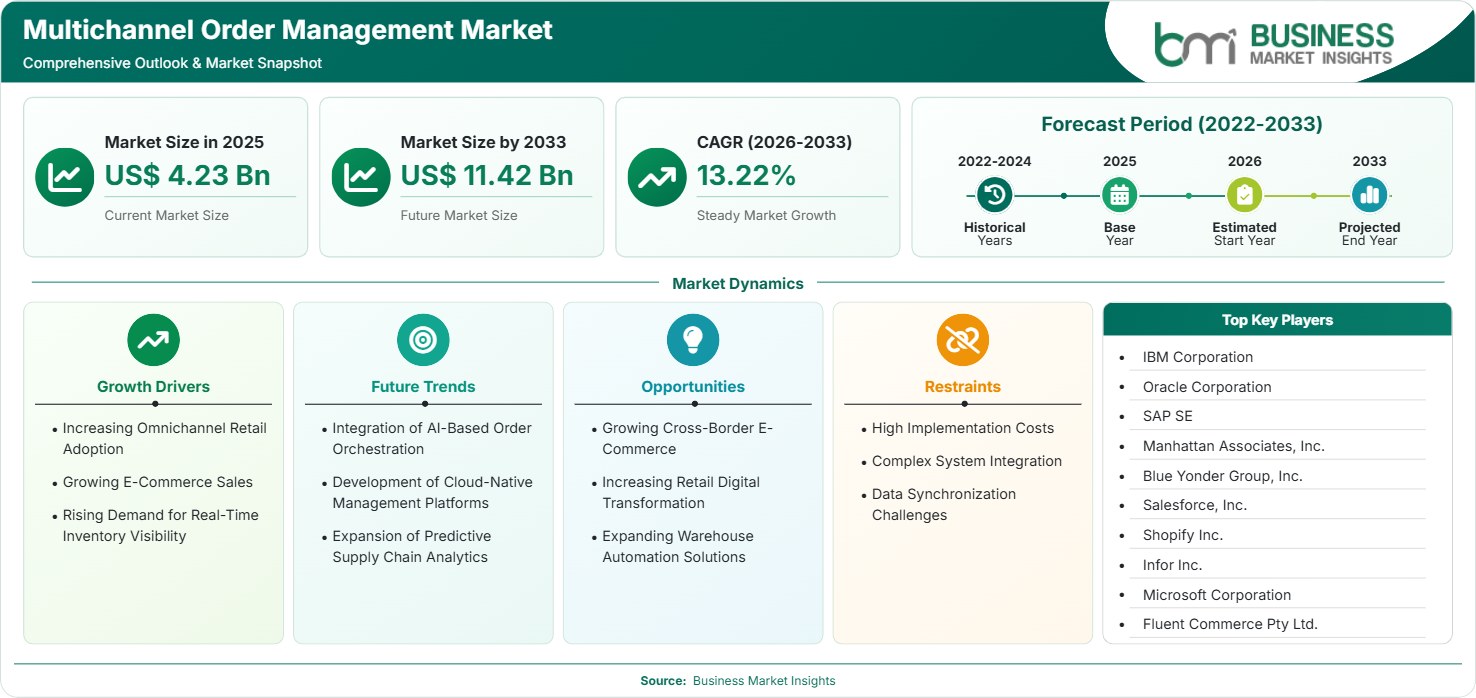
The Multichannel Order Management Market size was valued at US$ 4.23 Billion in 2025 and is projected to reach US$ 11.42 Billion by 2033, growing at a CAGR of 13.22% during 2026–2033. Rising omnichannel retail adoption, increasing e-commerce transactions, real-time inventory synchronization, cloud-based commerce platforms, AI-enabled order orchestration, and cross-border retail expansion continue creating substantial opportunities across global digital commerce ecosystems.

Report Coverage
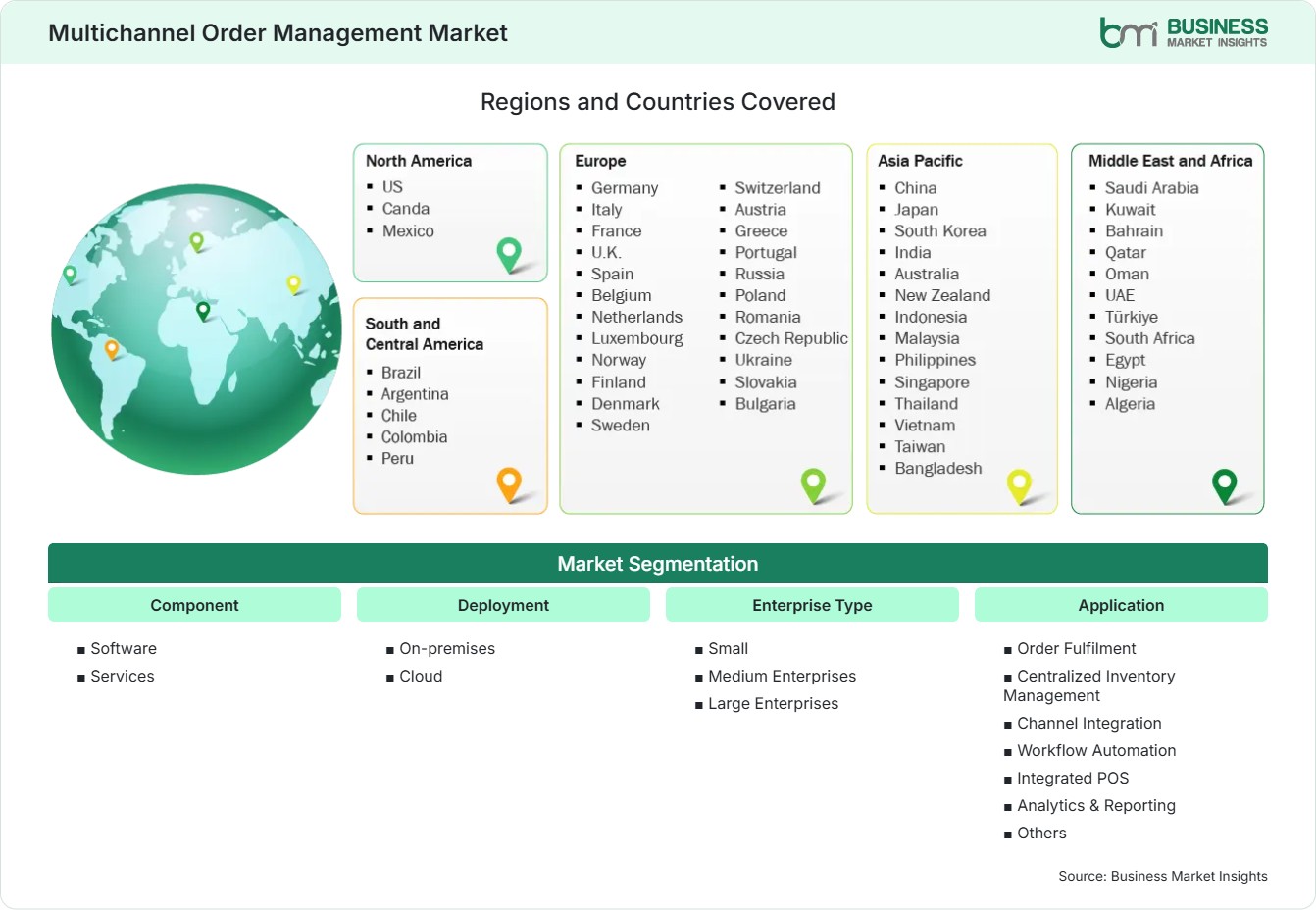
  • Component: Software, Services
  • Deployment: On-premises, Cloud
  • Enterprise Type: Small, Medium Enterprises, Large Enterprises
  • Application: Order Fulfilment, Centralized Inventory Management, Channel Integration, Workflow Automation, Integrated POS, Analytics & Reporting, Others
  • Vertical: Automotive, Manufacturing, Retail & E-commerce, Healthcare, Others
US$ 4.23 Bn Market size in 2025
US$ 11.42 Bn Market Size by 2033
13.22% CAGR, 2026 - 2033
2026-2033 Forecast Period

AI Overview

Multichannel Order Management Market Summary

  • North America Region: Holds 37%–40% market share in 2025 and is projected to expand at a CAGR of 12.5%–13.5% during 2026–2033. Growth is supported by mature omnichannel retail infrastructure, enterprise cloud adoption, AI-powered fulfilment, digital commerce investments, and warehouse automation across retail, manufacturing, and distribution sectors. The U.S. represents nearly 76%–79% of regional revenue and is expected to expand at a CAGR of 12.8%–13.8%, supported by advanced retail digitization and enterprise software modernization.
  • Fastest Growing Region: Asia Pacific accounts for 25%–28% of global revenue in 2025 and is anticipated to register a CAGR of 15.5%–16.5% through 2033. Expanding digital commerce ecosystems, increasing SME digitization, mobile commerce penetration, government digital initiatives, modern logistics infrastructure, and cloud adoption continue accelerating enterprise investments throughout regional markets.
  • Leading Segment: Software holds 64%–67% market share in 2025 and is projected to grow at a CAGR of 13.5%–14.5% through 2033. Enterprises prioritize centralized order orchestration, inventory synchronization, predictive analytics, automation capabilities, scalable cloud deployment, and seamless omnichannel customer experiences across multiple sales channels.
  • High Growth Segment: Cloud Deployment accounts for 59%–62% market share in 2025 and is forecast to expand at a CAGR of 14.8%–15.8% during 2026–2033. Businesses increasingly adopt subscription-based platforms delivering scalability, remote accessibility, rapid deployment, AI integration, lower infrastructure costs, and continuous software upgrades supporting global operations.
  • Key Market Opportunity: Growing cross-border commerce, AI-enabled fulfilment optimization, marketplace integration, warehouse automation, predictive inventory planning, and unified customer engagement platforms enable enterprises to improve operational efficiency while expanding omnichannel retail capabilities globally.
  • Major Market Players: IBM Corporation, Oracle Corporation, SAP SE, Manhattan Associates, Inc., Blue Yonder Group, Inc., Salesforce, Inc., Shopify Inc., Infor Inc., Microsoft Corporation, Fluent Commerce Pty Ltd.
Strategic Insights

Multichannel Order Management Market: Strategic Insights

Multichannel Order Management Market Strategic Framework
FREE PDF
Request your free sample
Request free sample
Stakeholder View

Key Takeaways

  • Software vendors, cloud providers, logistics partners, ERP vendors, and marketplace operators increasingly form integrated ecosystems that improve end-to-end order visibility while strengthening operational resilience.
  • Cloud-native deployment, AI-driven order routing, and centralized inventory management present the strongest long-term opportunities as retailers seek scalable platforms supporting omnichannel expansion and higher customer expectations.
  • Product innovation increasingly focuses on predictive analytics, machine learning, automation, low-code integrations, intelligent fulfilment engines, and real-time inventory synchronization across distributed warehouse environments.
  • Asia Pacific offers the strongest long-term investment potential owing to expanding digital retail ecosystems, rising cloud adoption, improving logistics infrastructure, and increasing enterprise digital transformation initiatives.
  • Strategic acquisitions increasingly target AI software developers, warehouse automation providers, fulfilment technology specialists, and cloud commerce vendors to deliver integrated enterprise commerce platforms with enhanced operational capabilities.
Geographic Outlook

Multichannel Order Management Market Regional Highlights

North America Multichannel Order Management Market

North America accounts for 37%–40% of global revenue in 2025 and is projected to expand at a CAGR of 12.5%–13.5% through 2033. The Multichannel Order Management Market share remains strongest across retail, manufacturing, and logistics industries where organizations increasingly prioritize unified commerce, real-time inventory synchronization, and automated fulfilment capabilities.

  • Large retailers continue integrating online marketplaces, physical stores, mobile commerce, and social commerce channels into unified order management environments.
  • AI-powered demand forecasting, intelligent order routing, and predictive inventory optimization increasingly enable enterprises to minimize stockouts, reduce fulfilment costs, improve warehouse productivity, and strengthen supply chain.
  • Cloud-native software deployment continues replacing legacy order management platforms because organizations require scalable architectures supporting real-time analytics, API integrations, and seamless collaboration across suppliers, warehouses, logistics providers, and customer service operations.
  • Growing investment in warehouse automation, robotics, autonomous inventory systems, and digital supply chain transformation supports enterprise modernization while accelerating adoption of centralized multichannel order orchestration platforms.

US Multichannel Order Management Market

The United States Multichannel Order Management Market contributes 76%–79% of revenue in 2025 and is forecast to register a CAGR of 12.8%–13.8% through 2033. Enterprise digital transformation, advanced retail technology adoption, marketplace expansion, and AI-driven fulfilment optimization continue strengthening software investments among retailers, manufacturers, distributors, and logistics providers.

  • Major retailers increasingly deploy unified commerce platforms integrating ERP, CRM, warehouse management, transportation management, and marketplace applications to improve fulfilment accuracy, inventory visibility, and customer engagement.
  • Cloud migration strategies continue accelerating as enterprises prioritize flexible subscription-based software supporting business continuity, scalability, cybersecurity, and continuous innovation without extensive infrastructure investments.
  • Investments in predictive analytics and AI-powered fulfilment enable organizations to optimize delivery performance, automate exception handling, and improve operational decision-making.

Europe Multichannel Order Management Market

Europe represents 28%–31% of Multichannel Order Management Market revenue in 2025 and is anticipated to expand at a CAGR of 13.0%–14.0% during 2026–2033. Germany leads regional revenue, while the United Kingdom records the fastest expansion owing to strong e-commerce investments and enterprise software modernization initiatives.

  • Germany maintains regional leadership through advanced manufacturing, organized retail infrastructure, enterprise ERP deployment, and extensive investments in digital supply chain technologies supporting integrated commerce operations.
  • The United Kingdom registers the fastest regional expansion because retailers increasingly adopt AI-enabled order orchestration, cloud commerce platforms, and automated fulfilment technologies supporting omnichannel customer experiences.
  • France strengthens adoption through digital retail transformation, expanding marketplace participation, logistics modernization, and increasing demand for centralized inventory visibility across multi-brand retail environments.
  • European enterprises increasingly prioritize compliance-ready software supporting GDPR requirements, secure customer data management, and standardized digital commerce operations.

Asia Pacific Multichannel Order Management Market

Asia Pacific Multichannel Order Management Market accounts for 25%–28% of global revenue in 2025 and is projected to record the fastest CAGR of 15.5%–16.5% through 2033. China dominates regional revenue, while India records the highest growth through accelerating retail digitalization, SME technology adoption, and government-supported digital economy initiatives.

  • China continues investing in intelligent logistics networks, cloud commerce infrastructure, AI-enabled retail platforms, and marketplace ecosystems supporting large-scale omnichannel fulfilment operations.
  • India records the strongest regional growth through expanding online retail, government digital initiatives, affordable cloud solutions, and increasing enterprise adoption of integrated commerce management platforms.
  • Japan and South Korea strengthen regional demand through advanced automation technologies, robotics-enabled warehousing, predictive analytics, and enterprise software modernization supporting highly efficient fulfilment networks.
  • Regional SMEs increasingly adopt subscription-based cloud platforms because lower implementation costs, simplified deployment, and scalable capabilities improve competitiveness within rapidly expanding digital commerce markets.

Rest of World Multichannel Order Management Market

The Rest of the World contributes 7%–9% of Multichannel Order Management Market share in 2025 and is expected to expand at a CAGR of 12.8%–13.8% through 2033. Regional enterprises increasingly modernize fulfilment operations to strengthen inventory visibility and improve customer service across multiple sales channels.

  • Brazil leads South & Central America through expanding organized retail, increasing marketplace participation, cloud software investments, and enterprise digital transformation initiatives.
  • The United Arab Emirates records the strongest Middle Eastern growth owing to smart retail investments, logistics modernization, cloud infrastructure development, and rapidly expanding cross-border digital commerce ecosystems.
  • Saudi Arabia continues strengthening enterprise software adoption through digital economy initiatives, warehouse modernization, and increasing investments supporting retail diversification.
  • Regional logistics providers increasingly integrate intelligent order management software with warehouse management systems, transportation platforms, and inventory analytics to improve fulfilment efficiency while reducing operational costs.
Global Market Geography
FREE PDF
Request your free sample
Request free sample
Segment Analysis

Multichannel Order Management Market Segmentation

Component

The Component segment is led by software, reflecting increasing enterprise demand for centralized order orchestration, inventory synchronization, and AI-driven fulfilment. This segment accounts for 64%–67% market share in 2025 and is projected to register a CAGR of 13.5%–14.5% through 2033. The Multichannel Order Management Market scope continues expanding as organizations modernize legacy commerce infrastructure and prioritize cloud-enabled operational efficiency across global supply chains.

  • Software: Supports centralized order processing, inventory synchronization, AI-powered fulfilment optimization, and seamless integration with ERP, CRM, warehouse management, and marketplace platforms.
  • Services: Includes consulting, implementation, integration, maintenance, training, and managed support services that help enterprises accelerate deployment, optimize workflows, ensure continuous platform performance, and maximize long-term return.

Deployment

Cloud deployment continues transforming enterprise commerce operations through scalability, lower infrastructure costs, and continuous software innovation. This segment captures 59%–62% market share in 2025 while expanding at a CAGR of 14.8%–15.8% during the forecast period.

  • On-premises: Preferred by organizations requiring complete infrastructure ownership, extensive customization, strict regulatory compliance, and direct control over enterprise applications supporting highly specialized business operations.
  • Cloud: Enables flexible subscription pricing, automatic software updates, simplified deployment, remote accessibility, rapid scalability, and seamless integration with digital commerce ecosystems, supporting growing omnichannel retail operations worldwide.

Enterprise Type

Large enterprises remain the primary adopters because they manage complex fulfilment operations across numerous sales channels, suppliers, warehouses, and international markets. The segment represents 66%–69% market share in 2025 and is forecast to expand at a CAGR of 13.1%–14.1% through 2033. Increasing SME cloud adoption.

  • Small and Medium Enterprises (SMEs): Rapidly adopt cloud-based order management platforms to improve operational efficiency, inventory accuracy, customer engagement, and digital competitiveness.
  • Large Enterprises: Utilize advanced automation, AI-enabled analytics, centralized inventory management, and integrated commerce platforms supporting complex multinational fulfilment operations.

Application

Order fulfilment remains the largest application because enterprises prioritize rapid delivery, inventory accuracy, and superior customer experiences across physical and digital sales channels. The segment accounts for 29%–32% market share in 2025 and is projected to grow at a CAGR of 13.8%–14.8% through 2033. Increasing automation and predictive analytics continue improving operational efficiency throughout enterprise fulfilment ecosystems.

  • Order Fulfilment: Optimizes order routing, warehouse coordination, shipment scheduling, delivery tracking, and returns processing, improving fulfilment efficiency while reducing operational delays across omnichannel commerce networks.
  • Centralized Inventory Management: Enables real-time inventory visibility across warehouses, retail stores, distribution centers, and online marketplaces, minimizing stock discrepancies while improving replenishment planning.
  • Channel Integration: Connects marketplaces, e-commerce websites, mobile applications, physical stores, and third-party sales platforms into unified commerce environments supporting seamless customer experiences.
  • Workflow Automation: Automates repetitive fulfilment activities, order validation, approvals, notifications, inventory updates, and exception handling, reducing manual intervention while improving operational productivity.
  • Integrated POS: Synchronizes in-store purchases with online inventory, customer profiles, promotions, and fulfilment operations to create consistent omnichannel shopping experiences across physical and digital retail channels.
  • Analytics & Reporting: Provides predictive demand forecasting, fulfilment performance monitoring, inventory analytics, operational dashboards, and business intelligence supporting faster enterprise decision-making and continuous operational improvement.

Vertical

Retail & E-commerce dominates industry adoption because organizations require unified inventory visibility, rapid fulfilment, and seamless customer engagement across multiple digital commerce channels. The segment holds 42%–45% market share in 2025 and is expected to register a CAGR of 14.2%–15.2% during 2026–2033. Expanding omnichannel retail ecosystems continue strengthening enterprise software investments worldwide.

  • Automotive: Improves aftermarket parts distribution, dealer inventory visibility, supplier coordination, and fulfilment efficiency across increasingly digital automotive commerce ecosystems.
  • Manufacturing: Supports production planning, inventory synchronization, distributor collaboration, and efficient order execution while improving supply chain visibility and customer service performance.
  • Retail & E-commerce: Drives the highest software adoption through marketplace integration, omnichannel fulfilment, customer experience enhancement, inventory optimization, and AI-enabled order orchestration capabilities.
  • Healthcare: Supports medical inventory management, pharmaceutical distribution, regulatory compliance, hospital procurement, and timely order fulfilment while maintaining supply chain visibility and product traceability.
Market Forces

Multichannel Order Management Market Dynamics

Key Market Drivers

Increasing Omnichannel Retail Adoption

Retailers increasingly integrate physical stores, e-commerce platforms, mobile applications, social commerce, and third-party marketplaces into unified commerce ecosystems, creating sustained demand for advanced order management platforms. The Multichannel Order Management market growth is driven by increasing customer expectations for flexibility in fulfilment, such as click-and-collect, same-day delivery, and ship from store services. As per industry retail organizations, the growth of e-commerce is continuing on a global scale with increased focus on centralized inventory management and fulfilment. Order orchestration can help reduce errors, improve inventory efficiency, increase customer satisfaction, and facilitate transaction management in growing numbers.

Growing E-Commerce Sales

Global e-commerce expansion continues generating significant transaction volumes requiring automated order processing, intelligent inventory allocation, and scalable fulfilment infrastructure. Growth in marketplaces, consumer-based business models, and subscription-based commerce drive companies to make investments in digital order management solutions. Businesses are increasingly adopting software that utilizes AI for prediction, warehousing systems, payments gateways, and transportation management. The Multichannel Order Management Market trends highlight an increasing demand for software from retailers, manufacturers, and distributors looking to decrease fulfilment time, increase inventory turns, build customer loyalty, and effectively run large-scale digital commerce operations.

Rising Demand for Real-Time Inventory Visibility

Modern enterprises require accurate, real-time inventory synchronization across warehouses, distribution centers, physical stores, and digital marketplaces to prevent overselling and stock shortages. An intelligent inventory management system speeds up fulfilment while minimizing costs of operations due to overstocking and manual adjustments. The widespread use of IoT devices, barcodes, RFID, artificial intelligence, and cloud computing allows companies to achieve uninterrupted tracking of inventories despite growing complexity of their supply chains. This helps to predict future demand and make proper procurement and enhance customer experiences through reliable product availability information.

Key Market Opportunities

Growing Cross-Border E-Commerce

International digital business is developing as firms are gaining access to the world markets through localized distribution networks, multilingual trading platforms, and payment ecosystems. The Multichannel Order Management Market forecast reveals that there is an increasing need for software that can handle multi-currency transactions, inventory management by region, customs papers, taxes, and international logistics coordination. Firms that are able to orchestrate cross-border orders can benefit from improvements in delivery services, fulfilment operations, and customers' experience in addition to increased income through international markets.

Increasing Retail Digital Transformation

Retail organizations continue modernizing legacy commerce infrastructure through cloud-native applications, AI-powered analytics, unified customer engagement platforms, and intelligent fulfilment automation. Opportunities for vendors that provide integrated order orchestration, inventory forecasting, and operational analytics capabilities are long-term through digital transformation programs. The use of headless commerce, API-first integration, and low-code development platforms creates additional implementation opportunities through the need for an enterprise to adopt a flexible digital business model that can adapt to the changing customer purchase patterns and retail environment.

Expanding Warehouse Automation Solutions

Warehouse modernization through robotics, automated storage systems, autonomous mobile robots, and AI-driven fulfilment technologies creates significant opportunities for integrated order management platforms. Firms are demanding software solutions that can help them integrate their warehouse activities with their logistics management, inventory optimization, and customer service systems. With rising investments in smart warehouses, firms can achieve order accuracy, labor efficiency, inventory visibility, and efficient fulfilment. Firms that provide intelligent orchestration solutions combined with warehouse automation solutions will be in a strong position to capitalize on these investments.

Market Restraints and Challenges

High Implementation Costs

Factor: Enterprise-wide deployment frequently requires software licensing, infrastructure upgrades, integration services, employee training, cybersecurity investments, and continuous technical support. Impact: High upfront investment can delay adoption among budget-constrained organizations, particularly small and medium enterprises evaluating digital transformation priorities. Organizations must also allocate resources for system maintenance, software updates, compliance management, and ongoing optimization, making comprehensive order management modernization financially challenging despite long-term operational benefits.

Complex System Integration

Factor: Modern order management platforms must integrate with ERP systems, CRM software, warehouse management, transportation management, e-commerce platforms, payment gateways, and legacy enterprise applications. Impact: Integration complexity increases implementation time, project costs, operational disruption, and cybersecurity risks while requiring specialized technical expertise. Organizations managing multiple legacy systems frequently encounter interoperability challenges, inconsistent data quality, and synchronization issues that reduce operational efficiency.

Company Analysis

Competitive Landscape

The Multichannel Order Management Market analysis reflects intense competition among enterprise software providers, cloud commerce vendors, and supply chain technology companies focused on AI-enabled order orchestration, inventory optimization, and omnichannel fulfilment. Leading participants continue investing in cloud-native platforms, API-first integration, machine learning, predictive analytics, and strategic partnerships to strengthen unified commerce capabilities.

Company Name

Overview

Products and Services Relevant to this Market

IBM Corporation

Provides enterprise digital transformation, AI, cloud, and supply chain solutions supporting complex commerce ecosystems across global industries.

IBM Sterling Order Management, AI-powered fulfilment, cloud integration, supply chain visibility, inventory optimization, and enterprise consulting services.

Oracle Corporation

Delivers integrated cloud applications enabling retail, manufacturing, and logistics enterprises to modernize digital commerce operations.

Oracle Fusion Cloud, Oracle Order Management Cloud, ERP integration, inventory management, fulfilment orchestration, and analytics solutions.

SAP SE

Global enterprise software provider offering intelligent commerce and supply chain platforms for multinational organizations.

SAP S/4HANA, SAP Commerce Cloud, order orchestration, warehouse integration, inventory visibility, and business analytics solutions.

Manhattan Associates, Inc.

Specializes in supply chain execution, warehouse management, transportation, and omnichannel commerce software for enterprise customers.

Manhattan Active Omni, order management, warehouse management, inventory optimization, fulfilment automation, and transportation management solutions.

Blue Yonder Group, Inc.

Develops AI-driven supply chain, retail planning, and digital fulfilment software supporting enterprise commerce transformation.

Luminate Platform, order management, demand planning, inventory optimization, warehouse solutions, and AI-enabled fulfilment technologies.

Salesforce, Inc.

Provides cloud-based CRM and digital commerce solutions connecting customer engagement with fulfilment operations.

Salesforce Commerce Cloud, Order Management, Customer 360, AI analytics, and omnichannel retail management capabilities.

Shopify Inc.

Enables merchants to manage omnichannel commerce through scalable cloud-based retail and fulfilment technologies.

Shopify Plus, Shopify Order Management, inventory synchronization, marketplace integration, payment processing, and fulfilment services.

Infor Inc.

Offers industry-specific enterprise software supporting manufacturing, distribution, and retail supply chain operations.

Infor CloudSuite, ERP integration, order management, warehouse management, inventory planning, and analytics platforms.

Microsoft Corporation

Delivers cloud infrastructure and intelligent business applications supporting enterprise digital commerce modernization.

Microsoft Dynamics 365, Azure Cloud, Power Platform, AI analytics, order management, and customer engagement solutions.

Fluent Commerce Pty Ltd.

Focuses on cloud-native distributed order management for global retailers and omnichannel commerce enterprises.

Fluent Order Management, inventory visibility, fulfilment orchestration, click-and-collect, ship-from-store, and API-based commerce integration.

Trust & Transparency

Research Methodology

The market analysis combines proprietary research with secondary data from government agencies, company disclosures, regulatory filings, industry databases and expert interviews. Market estimates are validated through data triangulation, cross-market benchmarking and analyst review.

View Full Research Methodology

Questions Answered

Frequently Asked Questions

What does the Multichannel Order Management Market Report typically include?

A comprehensive report generally covers market size, competitive landscape, segmentation, regional outlook, technology trends, growth drivers, restraints, opportunities, and future forecasts supporting strategic business decisions.

Which region offers the strongest future investment opportunities?

Asia Pacific presents the strongest long-term investment potential owing to expanding digital commerce, improving logistics infrastructure, increasing SME digitization, government digital initiatives, and growing enterprise cloud adoption.

Which industries are the major users of these platforms?

Retail & e-commerce remains the largest adopter, followed by manufacturing, automotive, and healthcare organizations seeking centralized inventory management, faster fulfilment, and improved customer experiences.

Which deployment model is expected to grow the fastest?

Cloud deployment is expected to record the highest growth because it offers scalability, lower infrastructure costs, automatic updates, remote accessibility, and simplified integration with enterprise commerce applications.

What is driving demand for Multichannel Order Management Market solutions?

Growing omnichannel retail, increasing online shopping, cloud adoption, AI-powered fulfilment, and the need for centralized inventory visibility are encouraging organizations to deploy integrated order management platforms across multiple sales channels.

Access the Full Multichannel Order Management Market Report

Get segment-level forecasts, regional estimates, competitive benchmarking, company profiles and downloadable Excel datasets.

Access the full Multichannel Order Management Market Report
350 pages PDF & Excel | 2026-08-25
Similar Research

Related Market Reports