
Military Sensors Market Outlook: Size, Share, Trends, Growth Analysis, Competitive Landscape & Forecast, 2026-2033

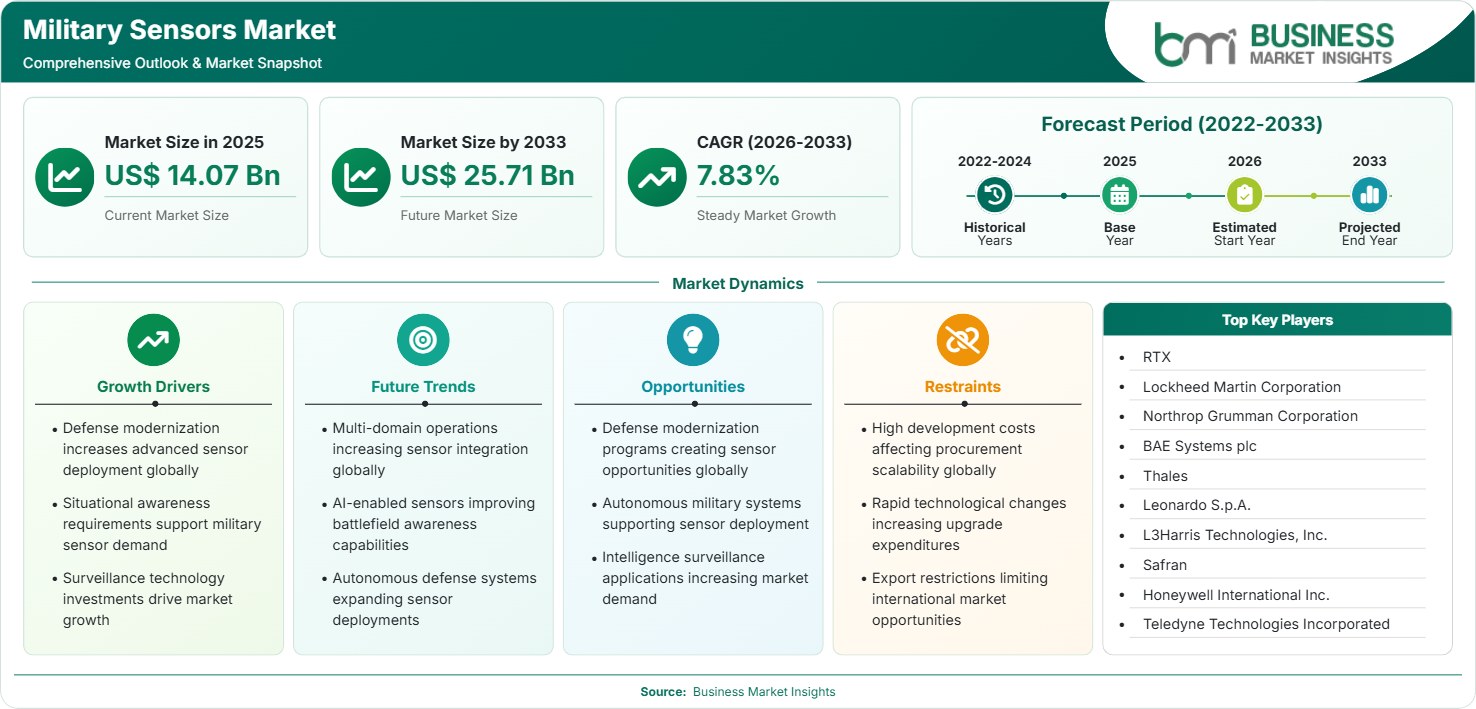
The Military Sensors Market size was valued at US$ 14.07 Billion in 2025 and is projected to reach US$ 25.71 Billion by 2033, growing at a CAGR of 7.83% during 2026–2033, driven by defense modernization, electronic warfare, autonomous systems, ISR demand, sensor fusion, and multi-domain operations.

Report Coverage
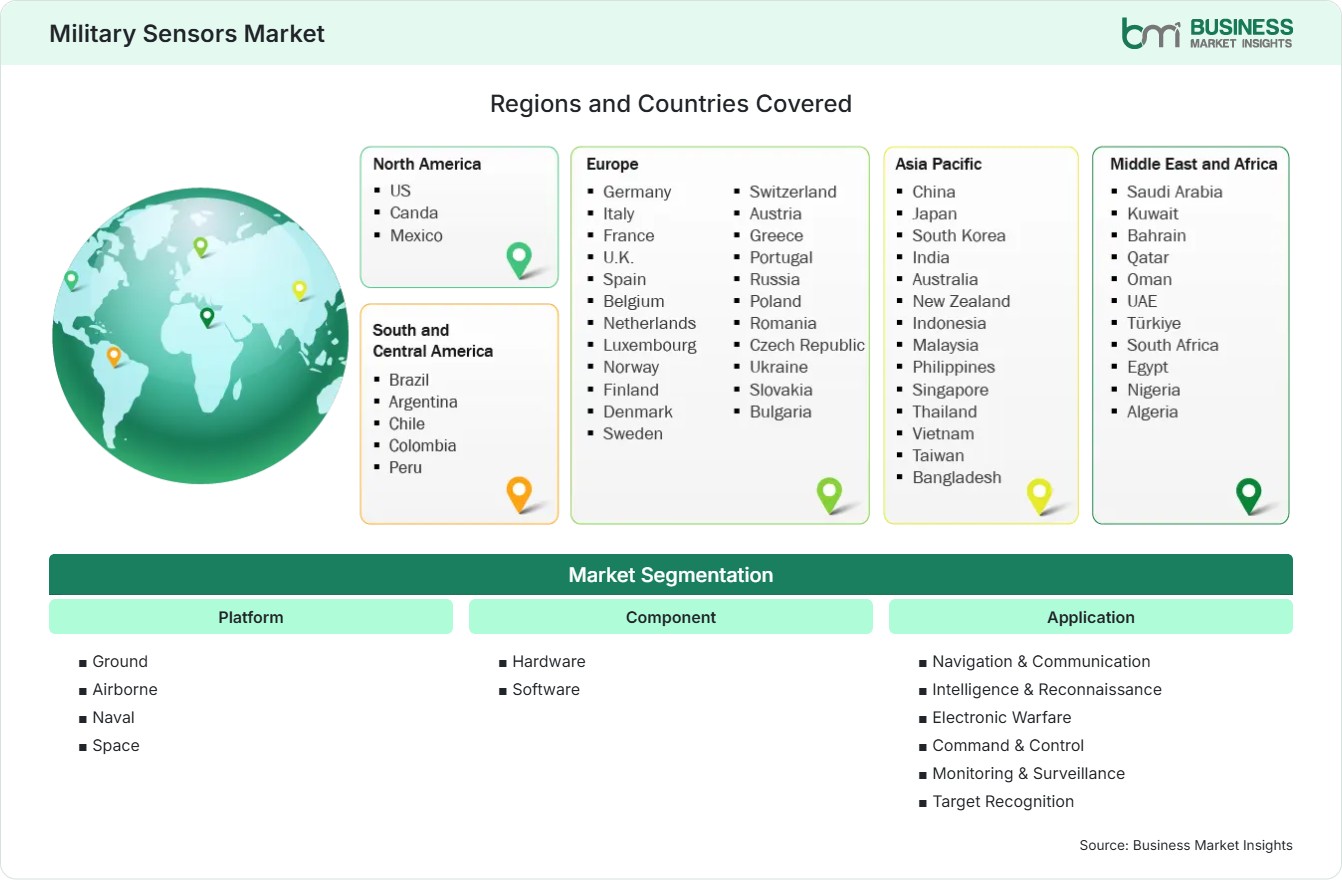
  • Platform: Ground, Airborne, Naval, Space
  • Component: Hardware, Software
  • Application: Navigation & Communication, Intelligence & Reconnaissance, Electronic Warfare, Command & Control, Monitoring & Surveillance, Target Recognition
US$ 14.07 Bn Market size in 2025
US$ 25.71 Bn Market Size by 2033
7.83% CAGR, 2026 - 2033
2026-2033 Forecast Period

AI Overview

Military Sensors Market Summary

  • North America Region: North America holds a 38%–40% share in 2025, growing at a 7.50%–8.00% CAGR during 2026–2033, influenced by defense modernization, advanced radar procurement, electronic warfare investment, autonomous platforms, missile defense programs, and sensor-fusion requirements. The US market remains central to regional demand through aircraft modernization, missile defense, C4ISR upgrades, and procurement of networked sensing architectures.
  • Fastest Growing Region: Asia Pacific holds a 22%–24% Military Sensors Market share in 2025 and is growing at an 8.70%–9.30% CAGR during 2026–2033, supported by aircraft modernization, maritime surveillance, border monitoring, unmanned systems, indigenous defense manufacturing, and expanding demand for networked battlefield sensing.
  • Leading Segment: Airborne platforms hold a 34%–37% share in 2025, advancing at an 8.00%–8.50% CAGR during 2026–2033, supported by fighter modernization, UAV deployment, infrared search, electronic intelligence, radar upgrades, and multispectral reconnaissance requirements across contested airspace.
  • High Growth Segment: Electronic Warfare applications hold a 15%–18% share in 2025, expanding at an 8.80%–9.40% CAGR during 2026–2033, driven by spectrum congestion, cognitive sensing, threat-library modernization, passive detection, signal processing, countermeasure integration, and growing requirements for resilient electromagnetic operations.
  • Key Market Opportunity: The strongest opportunity lies in software-defined sensing, AI-enabled fusion, distributed architectures, and edge processing that convert heterogeneous sensor streams into faster tactical decisions across crewed, autonomous, airborne, naval, ground, and space systems.
  • Major Market Players: RTX, Lockheed Martin Corporation, Northrop Grumman Corporation, BAE Systems plc, Thales, Leonardo S.p.A., L3Harris Technologies, Inc., Safran, Honeywell International Inc., and Teledyne Technologies Incorporated.
Strategic Insights

Military Sensors Market: Strategic Insights

Military Sensors Market Strategic Framework
FREE PDF
Request your free sample
Request free sample
Stakeholder View

Key Takeaways

  • The semiconductor and detector suppliers, the sensor manufacturers, the embedded software developers, the platform integrators, the prime contractors, and the military end users are now more linked together, and competitive differentiation is moving away from the individual sensing components towards integration, data fusion, qualification, and lifecycle support.
  • The potential for airborne and electronic warfare applications is considerable since today's aircraft and unmanned systems need to carry out sensing simultaneously in the radar, infrared, electromagnetic, navigation, and communications areas, and demand in this area is also being boosted by the retrofitting of existing fleets with modular sensor packages.
  • The design of sensors is being altered by AI-assisted classification, edge computing, multispectral imaging, MEMS miniaturization, digital signal processing, and software-defined architectures, and manufacturers are now producing more systems that integrate detection, identification, tracking, and decision support within strict limits regarding size, weight, power, and thermal output.
  • The Asia Pacific region offers a promising opportunity for expansion since the demand for advanced sensing is growing among aircraft fleets, naval forces, border surveillance networks, unmanned systems, and indigenous defense programs. Important demand centers in this regional system are India, Japan, South Korea, and Australia.
  • More of the capital is now being directed towards specialized sensing, imaging, navigation, autonomy, electronic warfare, and space technologies, and partnerships, as well as acquisitions, can speed up access to detectors, algorithms, inertial technologies, manufacturing capacity, and the existing defense qualification routes.
  • Because the cycle times for sensor technology are shorter than those for platform lifecycles, defense customers nowadays place a greater value on open architectures and the ability to upgrade. Those suppliers that can offer modular hardware, software updates, cybersecurity support, and interoperable interfaces can meet the ongoing need for modernization.
Geographic Outlook

Military Sensors Market Regional Highlights

North America Military Sensors Market

North America accounts for a 38%–40% Military Sensors Market share in 2025 and is projected to grow at a 7.50%–8.00% CAGR during 2026–2033. Military procurement increasingly prioritizes integrated sensing for missile defense, aircraft, autonomous platforms, and multidomain command networks.

  • The number of defense modernization programs is leading to greater purchases of radar, electro-optical, infrared, inertial, and electronic warfare sensors for use on aircraft, ground vehicles, missile defense systems, and autonomous platforms.
  • North American suppliers are stressing the use of modular architectures, which enable upgrades to the processors, algorithms, detectors, and communications interfaces without the need for extensive platform redesign or expensive structural alterations.
  • There is a growing need for infrared sensing, radiation-hardened electronics, onboard processing, and high-reliability payload components because of the space-based missile warning and tracking programs.
  • The demand for compact radar, RF sensing, electro-optical identification, thermal imaging, and integrated detection systems for bases and tactical formations is leading to a wider range of counter-UAS requirements.

US Military Sensors Market

The US represents the largest national Military Sensors Market demand center within North America, accounting for a 68%–72% share of regional spending in 2025 and expanding at a 7.40%–7.90% CAGR through 2033. Procurement increasingly connects sensing with command networks, missile defense, electronic warfare, autonomy, and multidomain operations.

  • The USA gains from continued spending on airborne infrared search and track, advanced radar, electronic warfare, space tracking, and integrated air-defense sensing capabilities.
  • Procurement is now giving preference to systems that combine a number of sensing methods with secure networking, thereby allowing for quicker detection, classification, targeting, and the exchange of information across operational domains.
  • The expansion of domestic manufacturing is enhancing the production capacity for proximity sensors, imaging systems, radar components, and various specialized defense electronics in response to the higher volume of procurement requirements.

Europe Military Sensors Market

Europe holds a 24%–26% Military Sensors Market share in 2025 and is projected to expand at a 7.80%–8.30% CAGR during 2026–2033. Increased defense investment is supporting demand for radar, electro-optical systems, inertial navigation, electronic warfare, and battlefield surveillance.

  • There is an increasing focus in Europe on sovereign sensing capabilities, on producing goods locally, and on ensuring resilience in the supply chains for critical radar, optronics, navigation, and electronic warfare components.
  • Germany is seeing increased demand for portable observation equipment, vehicle sensing equipment, navigation equipment, and surveillance equipment as its military modernization programs lead to greater requirements for digitally connected soldier systems.
  • France is still providing support for advanced optronics, inertial navigation, artificial intelligence, and ISR technologies via its domestic defense industrial capabilities and through its modernization programs.
  • The United Kingdom is increasing the requirements concerning multifunction radar, electronic warfare, airborne surveillance, and networked sensing with respect to future combat air and naval systems.

Asia Pacific Military Sensors Market

Asia Pacific represents a 22%–24% Military Sensors Market share in 2025 and is projected to register an 8.70%–9.30% CAGR through 2033. The rising procurement of fighter aircraft, naval platforms, unmanned systems, missile defense, and surveillance infrastructure is expanding sensor requirements.

  • China remains committed to developing advanced sensing capabilities for use in aircraft, its naval forces, missile systems, autonomous platforms, and surveillance networks, and is promoting the development of radar and electro-optical technologies made at home.
  • India is increasing its collaboration on defense manufacturing and technology, which is providing opportunities for companies that produce inertial navigation, optronics, radar, electronic warfare, and sensors for unmanned systems.
  • Japan is stressing its maritime surveillance, missile early warning capability, the modernization of its aircraft, and its integrated air-defense sensing abilities to improve its situational awareness in complicated operating environments.
  • Australia is currently increasing its demand for long-range surveillance, autonomous systems, undersea sensing, and secure communications-linked sensor architectures as part of its multidomain defense modernization.

Rest of World Military Sensors Market

The rest of the world represents an estimated 10%–12% Military Sensors Market share in 2025, with demand distributed across South and Central America, the Middle East, and Africa. South and Central American procurement is concentrated on border surveillance, maritime security, aircraft modernization, and counter-narcotics monitoring.

  • The modernization programs underway in the Middle East are leading to a greater demand for air-defense radar, thermal surveillance, electro-optical systems, the ability to detect unmanned aerial systems, and battlefield intelligence capabilities.
  • The Gulf countries are stressing the need for technology localization, for having the ability to sustain it, and for forming industrial partnerships, which in turn provide opportunities for international suppliers who are able to set up production and maintenance facilities in the region.
  • The demand from South America focuses on maritime domain awareness, border monitoring, the modernization of aircraft, and the use of affordable surveillance technologies, which have manageable lifecycle costs.
  • The defense needs of Africa are increasingly focusing on persistent surveillance, border security, unmanned systems, and the use of compact electro-optical equipment, which is suitable for operations in distributed environments.
Global Market Geography
FREE PDF
Request your free sample
Request free sample
Segment Analysis

Military Sensors Market Segmentation

Platform

The platform segment is shaped by rising requirements for distributed sensing across ground, airborne, naval, and space assets. Airborne platforms represent a 34%–37% Military Sensors Market share in 2025 and are projected to grow at an 8.00%–8.50% CAGR during 2026–2034. Platform modernization increasingly prioritizes sensor fusion, low-signature detection, autonomy, and modular integration across mission systems.

  • Ground: Ground platforms use radar, electro-optical, infrared, acoustic, navigation, and proximity sensors for surveillance, vehicle protection, targeting, and autonomous mobility. Modernization supports distributed battlefield awareness and counter-UAS operations.
  • Airborne: Airborne systems integrate radar, infrared, multispectral imaging, electronic intelligence, navigation, and targeting sensors. Fighter aircraft, helicopters, UAVs, and reconnaissance platforms drive demand for compact, high-performance sensing.
  • Naval: Naval platforms require radar, sonar, electro-optical, navigation, electronic warfare, and environmental sensors. Fleet modernization and maritime domain awareness increase demand for persistent detection across surface and subsurface environments.
  • Space: Space platforms deploy infrared, optical, radiation, navigation, and communications-linked sensing technologies. Missile warning, tracking, surveillance, and resilient space architectures are increasing the demand for qualified space-grade sensor systems.

Component

Component demand is divided between hardware and software, with software gaining importance as sensor systems become increasingly data-centric. Hardware remains the principal value contributor because radar, detectors, optics, inertial devices, and sensing modules require specialized manufacturing.

  • Hardware: Hardware includes sensing elements, processors, optics, radar components, inertial devices, detectors, and associated electronics. Reliability, miniaturization, thermal performance, and electromagnetic resilience remain central procurement requirements.
  • Software: Software enables signal processing, sensor fusion, target classification, anomaly detection, navigation support, and decision assistance. Open architectures and AI-enabled analytics increasingly support rapid upgrades across long-lived military platforms.

Application

Application demand is increasingly determined by the need to transform raw sensing into operational intelligence. Electronic warfare is projected to hold a 15%–18% share in 2025 and grow at an 8.80%–9.40% CAGR during 2026–2034. The Military Sensors Market scope is expanding as sensing becomes integral to networked warfare and autonomous operations.

  • Navigation & Communication: Navigation and communication applications rely on inertial, positioning, RF, timing, and environmental sensing. Resilient PNT requirements are increasing as militaries address jamming, spoofing, and contested electromagnetic environments.
  • Intelligence & Reconnaissance: Intelligence and reconnaissance systems combine optical, infrared, radar, RF, and multispectral inputs to generate persistent intelligence. UAVs, aircraft, satellites, and ground systems are expanding the demand for long-range sensing.
  • Electronic Warfare: Electronic warfare applications use RF sensing, signal intelligence, threat detection, direction finding, and electronic support technologies. Cognitive processing and rapid waveform recognition are increasing the demand for software-intensive sensor architectures.
  • Command & Control: Command and control applications depend on fused sensor information to support threat prioritization, mission planning, targeting, and battlefield coordination. Secure networks and low-latency processing are becoming important system requirements.
  • Monitoring & Surveillance: Monitoring and surveillance systems use radar, thermal imaging, EO/IR, acoustic sensing, and other technologies for persistent observation. Counter-UAS, border security, maritime monitoring, and infrastructure protection broaden deployment requirements.
  • Target Recognition: Target recognition systems combine imaging, radar, spectral signatures, and algorithmic classification to identify threats. AI-enabled recognition can shorten decision cycles and improve discrimination in cluttered operational environments.
Market Forces

Military Sensors Market Dynamics

Key Market Drivers

Expansion of Multi-Domain Defense Modernization

Defense modernization is increasing sensor density across aircraft, ground vehicles, ships, satellites, missiles, and unmanned platforms. The Military Sensors Market growth is supported by procurement programs that connect detection with targeting, communications, and command networks. Modern platforms require multiple sensing modalities because radar alone may not reliably identify targets in cluttered or electronically contested environments. Infrared, electro-optical, RF, acoustic, inertial, and navigation sensors, therefore, increasingly operate as complementary layers. Military procurement is also shifting toward modular architectures that allow processors, detectors, and software to be upgraded without replacing complete platforms.

Growth of Electronic Warfare and Electromagnetic Spectrum Operations

Electronic warfare is becoming a core sensing requirement because modern forces operate in increasingly contested electromagnetic environments. Radar warning receivers, passive RF sensors, electronic support systems, direction-finding equipment, and signal intelligence payloads provide early threat awareness without necessarily transmitting detectable emissions. BAE Systems describes integrated electronic warfare capabilities spanning electronic support, protection, attack, and mission support, illustrating the movement toward multifunction sensing architectures. The Military Sensors Market trends, therefore, increasingly favor systems that combine RF sensing, geolocation, signal classification, and automated threat prioritization.

Increasing Adoption of Autonomous and Unmanned Platforms

The demand for small sensors is growing due to unmanned aircraft, ground vehicles, maritime systems, and autonomous payloads, which require sensors to support navigation, obstacle detection, surveillance, target recognition, and mission autonomy. Since autonomous platforms cannot rely on remote operators to handle all perception tasks, there is an increasing need for onboard sensing and processing. As a result, MEMS-based inertial systems, compact radar, thermal imaging, EO/IR payloads, LiDAR, acoustic sensors, and multispectral cameras are becoming more important. The main focus in design is now on reducing size, weight, power, and cost while still ensuring military-grade reliability.

Key Market Opportunities

AI-Enabled Sensor Fusion at the Tactical Edge

AI-enabled sensor fusion represents an important investment opportunity because modern military platforms generate more data than individual operators can efficiently evaluate. Algorithms can correlate radar tracks, thermal imagery, RF signatures, navigation data, and visual information to improve detection and prioritization. Edge processing reduces dependence on continuous high-bandwidth connections and enables platforms to act when communication is degraded or denied. Investment opportunities extend beyond algorithms to rugged processors, accelerators, cybersecurity, model validation, and specialized software interfaces. The Military Sensors Market analysis, therefore, increasingly includes computing architecture and data-management capability alongside physical sensor performance.

Space-Based Tracking and Persistent Surveillance

Space-based sensing is now offering ever-growing possibilities in missile warning, tracking hypersonic threats, maritime surveillance, and continuous intelligence acquisition. Because satellite systems are distributed, they can achieve wider coverage and greater resilience than a small number of highly concentrated platforms. The increasing demand is creating opportunities in infrared detectors, focal-plane modules, radiation-tolerant electronics, precise timing, onboard processing, and communications interfaces. In 2026, Teledyne Technologies Incorporated began production of infrared focal-plane modules for the Space Development Agency's Tracking Layer Tranche 3 program, underscoring continued demand for specialized space-sensing components.

Localized Manufacturing and Sensor Supply-Chain Resilience

Because defense customers are placing greater importance on access to key sensing technologies, there are now opportunities for local manufacturing, regional maintenance centers, and qualified second-source suppliers. When production capacity is concentrated, radar components, infrared detectors, inertial devices, special optics, semiconductor packaging, and high-performance processors can become bottlenecks in the supply chain. As a response, manufacturers can increase the size of their regional facilities, qualify alternative materials, and design their products to use standard interfaces.

Market Restraints and Challenges

High Qualification Costs and Complex Sensor Integration

The military sensors must meet strict environmental, electromagnetic, cybersecurity, reliability, and interoperability requirements before deployment; testing includes vibration, temperature extremes, radiation exposure, electromagnetic compatibility, shock, humidity, and long-term reliability validation. As a result, such requirements lead to longer development times, higher engineering costs, and greater difficulties for smaller suppliers.

Cybersecurity, Supply Constraints, and Technology Obsolescence

The fact is that modern sensors rely on processors, software, communication interfaces, semiconductor components, optical materials, and various specialized manufacturing inputs, all of which may face supply constraints or be vulnerable to cybersecurity threats. As a result, disruptions caused by shortages, defective components, software flaws, or rapid technological change can affect deliveries and reduce system reliability. Since connected sensors expand the attack surface, data and control interfaces can be targeted by cyber attacks, spoofing, or manipulation.

Company Analysis

Competitive Landscape

The Military Sensors Market analysis indicates that competition is increasingly based on sensor breadth, platform integration, software capability, manufacturing scale, defense qualification, and access to long-term procurement programs. Major participants span radar, electro-optical, infrared, inertial, electronic warfare, navigation, imaging, and mission-system technologies.

Company Name

Overview

Products and Services relevant to this market

RTX

Global aerospace and defense technology company with extensive sensing and missile-defense capabilities across major military programs.

Air-defense radar, missile sensors, electronic warfare, navigation, detection systems, and integrated defense sensing architectures.

Lockheed Martin Corporation

Major defense prime with extensive experience integrating sensors into aircraft, missiles, naval platforms, and space systems.

Infrared search and track, radar, electro-optical systems, missile sensors, space sensing, and integrated mission systems.

Northrop Grumman Corporation

Defense technology company focused on advanced sensing, surveillance, autonomous systems, and mission electronics.

Radar, ISR sensors, electronic warfare, space sensors, airborne surveillance, and advanced signal-processing technologies.

BAE Systems plc

Defense electronics supplier with broad capabilities spanning electronic warfare, sensors, navigation, and mission systems.

EW sensors, radar warning receivers, infrared systems, signal processing, navigation, and multispectral sensing.

Thales

European technology group supplying defense electronics, radar, optronics, communications, and surveillance systems.

Ground and naval radar, optronics, electronic warfare, sonar, navigation, surveillance, and sensor-management systems.

Leonardo S.p.A.

Aerospace and defense company with substantial capabilities in radar, electro-optics, electronic warfare, and mission electronics.

AESA radar, infrared systems, electro-optical sensors, electronic warfare, naval sensors, and combat-system integration.

L3Harris Technologies, Inc.

Defense technology provider specializing in communications, space, sensors, electronic warfare, and mission systems.

EO/IR sensors, RF sensing, proximity sensors, missile warning, space infrared payloads, and sensor-enabled networks.

Safran

Aerospace, defense, and space technology group with strong positions in optronics, navigation, inertial systems, and imaging.

Thermal imaging, soldier observation, inertial navigation, EO/IR systems, PNT equipment, and AI-enabled sensing.

Honeywell International Inc.

Diversified technology company with significant aerospace sensing and navigation capabilities.

Inertial sensors, navigation systems, aerospace electronics, environmental sensing, and guidance-related technologies.

Teledyne Technologies Incorporated

Technology company specializing in imaging, sensing, aerospace electronics, defense systems, and advanced instrumentation.

Thermal imaging, infrared detectors, sensor modules, multispectral systems, unmanned sensing, and space-based infrared technologies.

Trust & Transparency

Research Methodology

The market analysis combines proprietary research with secondary data from government agencies, company disclosures, regulatory filings, industry databases and expert interviews. Market estimates are validated through data triangulation, cross-market benchmarking and analyst review.

View Full Research Methodology

Questions Answered

Frequently Asked Questions

How are defense manufacturers addressing sensor supply-chain risks?

Manufacturers are expanding regional production, qualifying alternate suppliers, increasing manufacturing capacity, using modular designs, and developing localized maintenance capabilities. These measures improve assured availability for components such as detectors, optics, inertial devices, processors, and radar electronics.

What makes space-based military sensing strategically important?

Space-based sensors provide persistent coverage for missile warning, tracking, surveillance, and early threat detection. Distributed satellite architectures can improve geographic coverage and resilience while supporting faster information delivery to terrestrial command networks.

How are unmanned platforms affecting sensor requirements?

Unmanned platforms require compact sensing packages for navigation, obstacle detection, surveillance, target recognition, and autonomous decision-making. small size, weight, power, cost, and high reliability are therefore becoming important design priorities.

Why is electronic warfare becoming an important sensor application?

The Military Sensors Market Report highlights that Electronic warfare requires rapid detection, classification, geolocation, and analysis of electromagnetic signals. Modern systems increasingly combine passive sensing, signal processing, threat libraries, and adaptive software to operate effectively against changing RF environments.

What technologies are reshaping military sensor design?

AI-assisted processing, sensor fusion, MEMS miniaturization, multispectral imaging, software-defined architectures, advanced radar, infrared detection, and edge computing are reshaping military sensing by improving detection, classification, autonomy, and response speed.

Access the Full Military Sensors Market Report

Get segment-level forecasts, regional estimates, competitive benchmarking, company profiles and downloadable Excel datasets.

Access the full Military Sensors Market Report
350 pages PDF & Excel | 2026-11-03
Similar Research

Related Market Reports