
Military Exoskeleton Market Outlook: Size, Share, Trends, Growth Analysis, Competitive Landscape & Forecast, 2026-2033

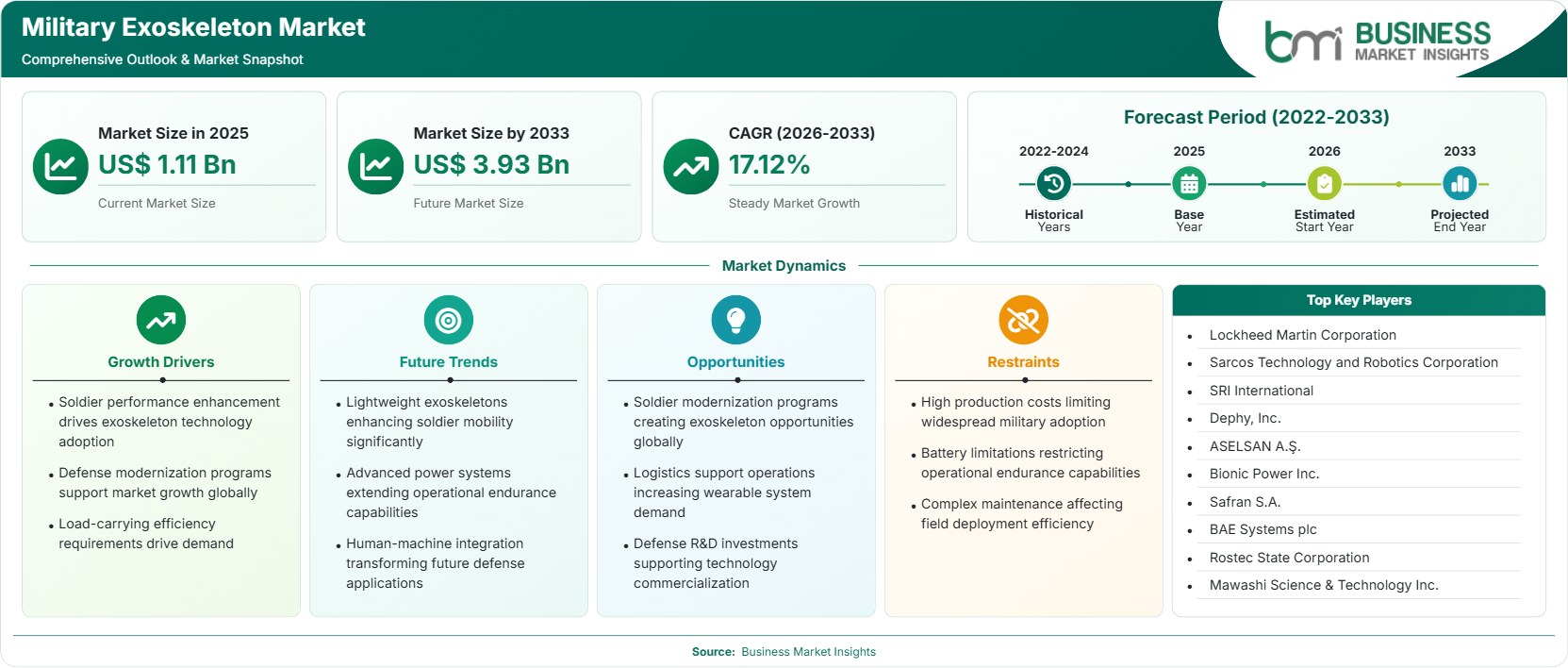
The Military Exoskeleton Market size was valued at US$ 1.11 Billion in 2025 and is projected to reach US$ 3.93 Billion by 2033, growing at a CAGR of 17.12% during 2026–2033. Rising soldier modernization programs, demand for enhanced battlefield endurance, logistics efficiency, reduced musculoskeletal injuries, and integration of AI-enabled wearable systems are creating substantial commercial and defense opportunities.

Report Coverage
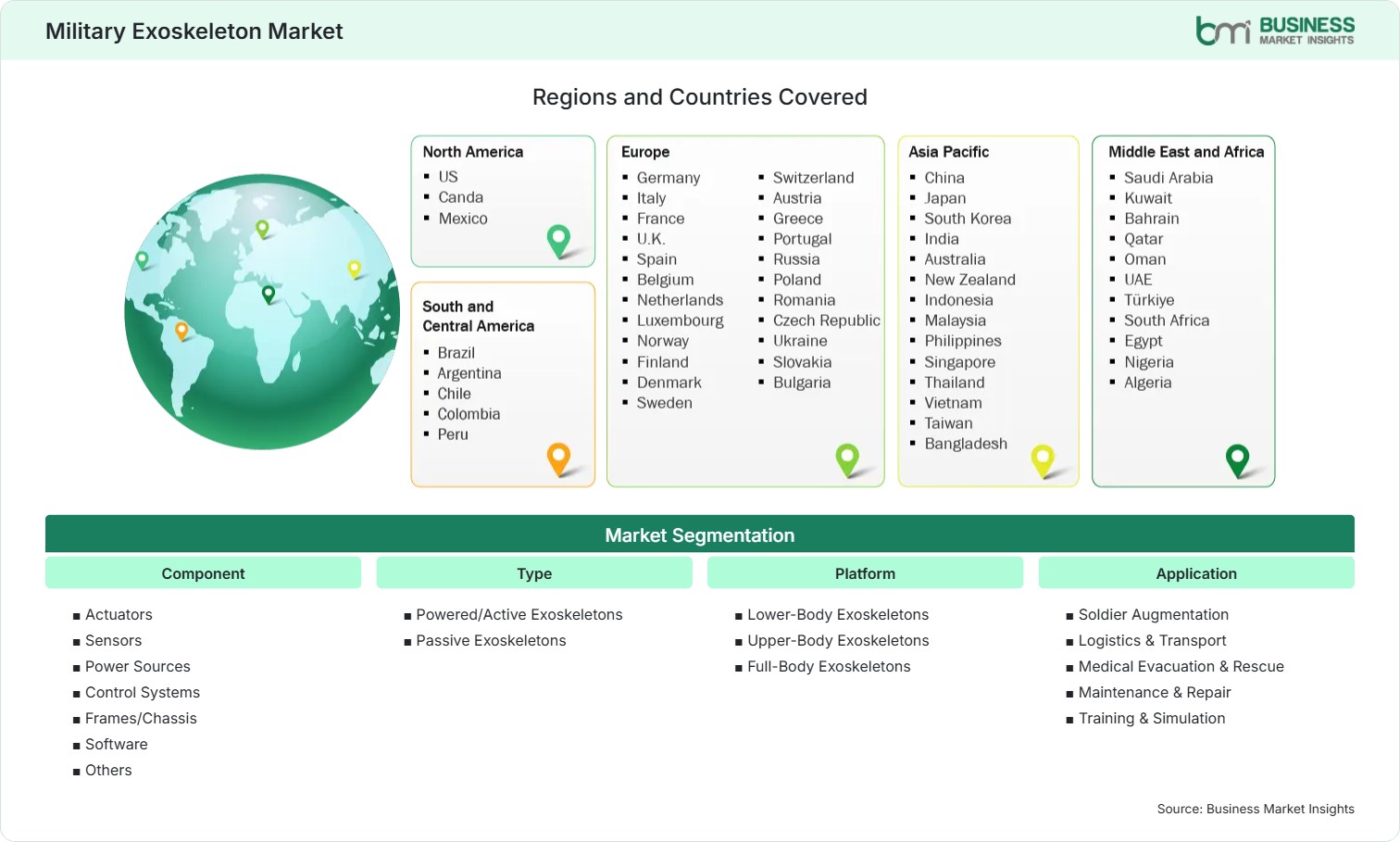
  • Component: Actuators, Sensors, Power Sources, Control Systems, Frames/Chassis, Software, Others
  • Type: Powered/Active Exoskeletons, Passive Exoskeletons
  • Platform: Lower-Body Exoskeletons, Upper-Body Exoskeletons, Full-Body Exoskeletons
  • Application: Soldier Augmentation, Logistics & Transport, Medical Evacuation & Rescue, Maintenance & Repair, Training & Simulation
  • End-User: Army, Navy, Air Force, Special Operations Forces
US$ 1.11 Bn Market size in 2025
US$ 3.93 Bn Market Size by 2033
17.12% CAGR, 2026 - 2033
2026-2033 Forecast Period

AI Overview

Military Exoskeleton Market Summary

  • North America Region: North America holds a market share of 38%–42% in 2025, growing at a CAGR of 15.5%–17.0% during 2026–2033. Growth is supported by defense modernization budgets, soldier augmentation initiatives, wearable robotics testing programs, logistics optimization efforts, injury reduction strategies, advanced sensor integration, procurement funding, and battlefield mobility enhancement priorities. The U.S. remains the dominant contributor, supported by extensive defense R&D investments and a projected CAGR of 15.8%–17.2%.
  • Fastest Growing Region: Asia Pacific accounts for a 24%–28% share in 2025 and is anticipated to expand at a CAGR of 18.5%–20.5% during 2026–2033. Expansion is driven by military modernization programs, border security investments, indigenous defense manufacturing, advanced robotics research, defense technology transfer initiatives, troop performance enhancement requirements, and increasing procurement budgets.
  • Leading Segment: Powered (Active) Exoskeletons command 58%–62% of the Military Exoskeleton Market share in 2025 and are expected to grow at a CAGR of 17.5%–19.0%. Adoption remains strong because of load-bearing enhancement, endurance improvement, integrated power systems, battlefield mobility support, advanced control algorithms, operational effectiveness, and mission performance optimization requirements.
  • High Growth Segment: Soldier Augmentation (Combat) represents a 32%–36% share in 2025 and is projected to advance at a CAGR of 18.0%–20.0%. Demand is increasing through modernization initiatives, tactical mobility improvements, fatigue reduction requirements, enhanced situational awareness capabilities, integrated wearable technologies, combat readiness enhancement, and operational effectiveness objectives.
  • Key Market Opportunity: Increasing integration of artificial intelligence, lightweight materials, predictive analytics, advanced batteries, and connected battlefield architectures enables next-generation wearable defense platforms capable of transforming mobility, survivability, endurance, and mission execution.
  • Major Market Players: Lockheed Martin Corporation, Sarcos Technology and Robotics Corporation, SRI International, Dephy, Inc., ASELSAN A.Ş., Bionic Power Inc., Safran S.A., BAE Systems plc, Rostec State Corporation, and Mawashi Science & Technology Inc.
Strategic Insights

Military Exoskeleton Market: Strategic Insights

Military Exoskeleton Market Strategic Framework
FREE PDF
Request your free sample
Request free sample
Stakeholder View

Key Takeaways

  • The value chain is evolving toward integrated ecosystems involving defense primes, robotics developers, sensor manufacturers, software providers, battery suppliers, and military research agencies, creating broad collaboration opportunities.
  • Combat augmentation and logistics support programs present the strongest near-term expansion potential as armed forces seek solutions to improve endurance, reduce injuries, and enhance operational efficiency.
  • Innovation is increasingly focused on AI-assisted motion control, lightweight composites, energy-efficient actuation systems, and predictive maintenance capabilities that improve real-world battlefield performance.
  • Asia Pacific offers one of the most attractive investment environments due to modernization spending, domestic defense manufacturing expansion, and increasing military robotics deployment initiatives.
  • Venture investments, strategic partnerships, and defense-funded pilot programs are supporting commercialization, while established defense contractors continue pursuing collaboration-led technology integration strategies.
  • Future procurement decisions are expected to prioritize interoperability with digital battlefield networks, enabling advanced wearable systems to become components of broader connected soldier architectures.
Geographic Outlook

Military Exoskeleton Market Regional Highlights

North America Military Exoskeleton Market

North America accounts for 38%–42% of global revenue in 2025 and is projected to expand at a CAGR of 15.5%–17.0% during 2026–2033. The region benefits from substantial defense modernization budgets, active soldier augmentation programs, and extensive field testing of wearable robotic systems. The Military Exoskeleton Market share remains strongest in the United States due to established defense innovation ecosystems. Procurement programs increasingly focus on reducing soldier fatigue, increasing payload capacity, enhancing mobility, and improving readiness across combat and logistics operations.

  • U.S. defense agencies continue evaluating advanced powered systems for mobility enhancement, logistics efficiency, and endurance improvement, creating strong commercialization opportunities for wearable robotics developers and defense contractors.
  • Military logistics modernization programs increasingly emphasize injury reduction and workforce sustainability, supporting broader exoskeleton deployment across transport, maintenance, and support operations.
  • AI-enabled motion control technologies are improving performance consistency, allowing military organizations to evaluate wearable systems for more demanding mission profiles and extended operational durations.
  • Partnerships among defense laboratories, robotics companies, and military branches accelerate technology maturation, reducing deployment barriers while improving operational reliability and integration capabilities.
  • Advanced battery technologies and lightweight materials development continue strengthening performance metrics, encouraging wider adoption across multiple defense use environments and mission categories.

US Military Exoskeleton Market

The United States represents approximately 72%–76% of North American revenue in 2025 and is anticipated to grow at a CAGR of 15.8%–17.2% through 2033. High levels of defense research and development funding, performance enhancement programs for soldiers, and fast-paced technology prototyping ensure leadership in national markets. It remains one of the primary centers of innovation in exoskeleton technology. The Military Exoskeleton Market growth will continue to be influenced by digitalization of the battlespace, logistics upgrades, and other factors.

  • Defense research organizations actively support actuator, sensor, and control system innovation, enabling advanced capabilities for load carriage, mobility enhancement, and mission effectiveness.
  • Integration of wearable systems with connected battlefield architectures supports data-driven operational planning and next-generation soldier modernization strategies.
  • Military logistics applications are expanding as commanders seek practical methods to improve efficiency and reduce musculoskeletal injury rates among personnel.
  • Growing collaboration between government agencies and private sector innovators accelerates transition from prototype programs to operational deployment environments.

Europe Military Exoskeleton Market

Europe has about 24%–28% market share in 2025 and is expected to see a CAGR of 16.5%–18.0% between 2026 and 2033. The demand from the region is driven by rising defense expenditure, efforts to enhance capabilities within NATO, and a growing focus on advanced soldier systems. France is the largest market, whereas Poland has emerged as one of the most rapidly developing countries, recording growth above the regional average. Government-backed research projects and domestic defense industrial capabilities continue supporting commercialization and deployment of wearable performance-enhancement technologies across operational applications.

  • France leads regional deployments through strong defense-industrial capabilities, military innovation programs, and continued evaluation of advanced powered mobility systems.
  • Poland demonstrates rapid expansion driven by modernization programs, procurement investments, and strengthening domestic defense manufacturing capacity.
  • Collaborative European research initiatives support development of lightweight materials, advanced energy systems, and enhanced ergonomic designs.
  • Military organizations increasingly prioritize logistics and maintenance applications where measurable reductions in physical workload generate immediate operational benefits.
  • Cross-border defense collaboration encourages common technology standards, improving interoperability and facilitating adoption across allied military forces.

Asia Pacific Military Exoskeleton Market

Asia Pacific accounts for 24%-28% of the world's income in 2025 and is forecast to post the highest CAGR of 18.5%-20.5% through 2033. China continues to hold the leading position in the Military Exoskeleton Market, while India is experiencing high growth in this segment. A growing defense budget, border security concerns, robotics initiatives, and support for advanced military technology drive the market forward. The regional armies are showing more interest in wearable devices that will boost their soldier's performance and endurance.

  • China maintains leadership through large-scale defense investments, domestic robotics expertise, and ongoing research into battlefield performance enhancement technologies.
  • India shows exceptional growth potential supported by modernization objectives, indigenous manufacturing initiatives, and expanding defense technology development programs.
  • Regional governments prioritize self-reliance strategies, encouraging domestic production of critical wearable technologies and supporting supply chain localization.
  • Growing focus on mountainous, border, and remote operational environments increases demand for systems capable of improving mobility and load management.
  • Defense technology partnerships support knowledge transfer, enabling accelerated development and deployment of advanced wearable military solutions.

Rest of World Military Exoskeleton Market

The Rest of World region accounts for 8%–12% of revenue in 2025 and is projected to achieve a CAGR of 16.8%–18.5% during 2026–2033. Middle Eastern defense modernization programs support growing adoption of advanced soldier technologies. Saudi Arabia leads regional spending while the United Arab Emirates demonstrates strong growth momentum.

South and Central America remain relatively young markets despite the Brazilian government’s continued efforts to modernize its military. The demand will be affected by the development of capabilities, the need for efficiency, and growing interest in wearable technologies.

  • Saudi Arabia supports adoption through military modernization strategies and investments targeting advanced battlefield technologies and force effectiveness enhancements.
  • The United Arab Emirates demonstrates rapid development through innovation-focused defense programs and growing interest in wearable robotics applications.
  • Brazil remains the leading South American adopter, supported by modernization requirements and military technology evaluation initiatives.
  • Defense diversification programs across emerging economies encourage pilot deployments and technology validation efforts.
  • Increasing awareness of injury prevention, personnel efficiency, and mission effectiveness continues to improve long-term market prospects.
Global Market Geography
FREE PDF
Request your free sample
Request free sample
Segment Analysis

Military Exoskeleton Market Segmentation

Component

Components form the technology base of wearable military devices and are projected to account for 30%–34% of market share by 2025, growing at a CAGR of 16.8%–18.2%. The continuous development of sensor, power management, software, and actuator technologies is required for effective operation. The scope of the Military Exoskeleton Market continues to widen due to developments at the component level.

  • Actuators: Enable movement assistance and load-bearing functionality, with manufacturers emphasizing lighter architectures, energy efficiency improvements, and enhanced responsiveness suitable for demanding military deployment conditions.
  • Sensors: Support motion tracking, environmental awareness, and operator monitoring, improving real-time adaptability while enhancing safety, performance optimization, and mission effectiveness across operational scenarios.
  • Power Sources: Advances in batteries and hybrid energy systems address endurance limitations, enabling longer deployment periods and supporting increasingly sophisticated wearable military platforms.
  • Control Systems: Facilitate human-machine coordination through intelligent processing capabilities, improving responsiveness, operational precision, and user comfort under dynamic mission conditions.
  • Frames/Chassis: Structural innovations focus on strength-to-weight optimization, allowing systems to withstand operational stresses without compromising mobility or user endurance.
  • Software: Expanding use of artificial intelligence and predictive analytics improves adaptive performance, diagnostics, user customization, and integration with broader military information systems.

Type

Type segmentation is led by active systems, with an overall market share of 58%-62% in 2025, and is predicted to grow at a CAGR of 17.5%-19.0%. The growth is attributed to rising needs for strength improvement, fatigue management, and mobility support. Technological advances are enabling the wider application of systems across various mission conditions and creating opportunities for future adoption.

  • Powered (Active) Exoskeletons: Deliver mechanical assistance through integrated power systems, supporting heavy-load transport, endurance enhancement, and improved operational performance during demanding military activities.
  • Passive Exoskeletons: Utilize mechanical structures without powered assistance, offering cost advantages, maintenance simplicity, and practical support for repetitive or physically demanding defense tasks.

Platform

Platform adoption depends on the operational requirements of a particular mission. This category accounts for 18%–22% of the total Military Exoskeleton Market share in 2025 and is expected to grow at a CAGR of 17.0%–18.5%. Increasingly, military units are considering configurations that provide increased mobility and stamina, reduce injuries, and enhance mission efficiency while ensuring comfort and flexibility.

  • Lower-Body Exoskeletons: Primarily support load carriage and mobility enhancement, reducing lower-limb strain while improving endurance during prolonged military operations.
  • Upper-Body Exoskeletons: Assist personnel handling equipment, tools, and repetitive lifting activities, contributing to productivity improvements and injury prevention objectives.
  • Full-Body Exoskeletons: Provide comprehensive support across multiple movement functions, enhancing overall capability for demanding operational missions and heavy-load applications.

Application

Application Demand is driven by combat augmentation applications, which account for 32% - 36% of revenue in 2025 and are projected to grow at an 18.0% - 20.0% CAGR through 2033. The Military Exoskeleton Market Trends show greater diversification not only in combat but also in logistical and rescue operations, among others, due to improved performance and safety.

  • Soldier Augmentation (Combat): Supports mobility, endurance, and load-carrying efficiency, enabling personnel to sustain performance during physically intensive battlefield missions.
  • Logistics & Transport: Improves cargo handling productivity while reducing physical strain during transportation, warehousing, and support operations.
  • Medical Evacuation & Rescue: Enhances casualty extraction capabilities by assisting personnel during physically demanding rescue and medical response situations.
  • Maintenance & Repair: Enables technicians to perform repetitive overhead or heavy-duty tasks with reduced fatigue and higher operational efficiency.
  • Training & Simulation: Supports immersive readiness programs by integrating advanced motion technologies into military training environments.

End-User

End-user demand continues to be dominated by the land-based military segment, which accounts for around 40%-44% of the market and is growing at a CAGR of 17.3%-18.8% in 2025. The adoption trends continue to be driven by mission-specific operational requirements, including endurance, protection, mobility, and logistics capabilities. Continued modernization programs support sustained procurement across military branches.

  • Army: Represents the largest adoption base due to extensive operational requirements involving mobility, endurance enhancement, and load management functions.
  • Navy: Explores applications supporting logistics operations, shipboard maintenance activities, and workforce injury reduction initiatives.
  • Air Force: Evaluates wearable technologies for aircraft maintenance, equipment handling, operational support, and personnel efficiency enhancement.
  • Special Operations Forces: Prioritize advanced systems offering mobility advantages, endurance support, and mission effectiveness improvements in high-intensity environments.
Market Forces

Military Exoskeleton Market Dynamics

Key Market Drivers

Defense Modernization Programs Accelerating Soldier Augmentation Adoption

Large armies are spending more of their defense budgets on improving their soldiers’ technology. The armed forces now require more technologies to increase their endurance and mobility and to reduce soldiers' fatigue in challenging environments. Geopolitical tensions around the world, especially in Europe, Asia, and the Middle East, have forced armies to procure advanced battlefield technologies that give them an advantage over others. The development of technologies that can help minimize musculoskeletal injuries has been another important requirement of militaries in today’s era. With the shift from experimental to operational programs, the Military Exoskeleton Market is receiving increased budget allocations and undergoing acquisition processes.

Advancements in AI, Sensors, and Power Management Systems

Rapid innovation in actuators, sensors, battery technologies, and artificial intelligence is significantly improving the operational performance of wearable military systems. Advanced control architectures enable more natural movement while increasing responsiveness under dynamic battlefield conditions. Integration of sensors enables real-time monitoring, performance prediction and optimization, and improved human-computer interaction. Higher energy density and advanced battery management extend usage time, thereby overcoming an age-old constraint that has held back powered devices. The Military Exoskeleton Market trends are increasingly driven by the convergence of robotics, artificial intelligence, and defense electronics. With technology-related hurdles falling one after another, militaries have become more confident in using wearables for logistics, maintenance, combat, and rescue operations.

Growing Emphasis on Logistics Efficiency and Injury Reduction

Logistics operations in the military involve individuals carrying heavy equipment, supplies, and ammunition under tough conditions. Wearable robot devices contribute positively by alleviating physical stress and increasing efficiency. Military establishments are becoming aware of the costs and effort involved in musculoskeletal injuries, workforce fatigue, and lack of preparedness. The introduction of exoskeletons into logistics, maintenance, and support roles brings quick advantages by improving efficiency and reducing injuries. In addition to their application in battle missions, these concrete benefits are contributing to rising requests from a number of military organizations. The diversification of use cases is not only beneficial for market resilience but also important for increasing the number of customers for wearable defense technology products.

Key Market Opportunities

AI-Enabled Connected Soldier Ecosystems

The architecture of future battlefields would integrate networks connecting soldiers, vehicles, sensors, and control systems. Exoskeletons that soldiers can wear and that are equipped with artificial intelligence may become important components of such an integrated network system. Real-time data analysis, movement assistance, health monitoring, and customizable configuration features will increase the utility of such devices. The defense departments are interested in developing technologies that increase situational awareness without compromising mobility and endurance. With increasing digitization in warfare, exoskeleton manufacturers with software-intelligence integration capabilities will have an edge over competitors.

Expansion into Emerging Defense Economies

A number of new military powers are increasing their military budgets and pursuing self-reliance through indigenously developed technology and manufacturing. Nations in the Asia-Pacific region, the Middle East, and parts of Latin America are implementing programs to upgrade their soldiers, which can help make them more effective in combat. The programs present potential for licensing, technology transfer, local manufacturing, and research collaboration. Military Exoskeleton Market Forecasts show that non-traditional markets will account for an ever-greater portion of future revenues. Vendors offering scalable solutions and localization strategies can capitalize on the resulting demand.

Advanced Lightweight Materials and Energy Innovations

Advancements in materials technology offer great potential to enhance the system's usability, reliability, and effectiveness. Modern lightweight composites, polymers, and advanced structural materials will make the system lighter without loss of durability. On the other hand, emerging innovations in battery technologies, hybrid energy solutions, and energy harvesting techniques will enable the system to address endurance challenges and expand its operating range. The user’s comfort and mobility, along with high-performance capabilities during extended mission execution, are critical factors for end users. Business ventures that implement these innovations in military applications can expect to make good use of the opportunities at hand.

Market Restraints and Challenges

High Development and Procurement Costs

Factor: The development of military exoskeleton suits requires complex components, including actuators, batteries, sensors, software, and robust structural materials. Impact: High development and procurement costs can hinder implementation, especially for budget-strapped defense departments. The testing and certification process adds to the cost of ownership. Most armies continue to weigh the return on investment before embarking on wide deployment. The supplier also has to make huge investments in research and development to comply with the military standards. Financial factors could hinder market penetration rates, especially in regions where procurement priorities favor traditional defense capabilities over emerging wearable technologies.

Operational Reliability and Power Limitations

Factor: Exoskeleton technology is expected to function reliably in difficult environmental conditions, such as extreme weather, rugged landscapes, dust conditions, and continuous operation. Impact: Reliability and power issues can reduce confidence in deploying the product and extend the procurement decision-making timeline. Battery performance plays a key role in the active exoskeleton's effectiveness under real-time conditions. Malfunctions while on duty may pose a danger to the device's user and limit consumer acceptance. The companies have to strike an effective balance among functionality, weight, durability, and power consumption without compromising performance.

Company Analysis

Competitive Landscape

The Military Exoskeleton Market analysis reflects a competitive landscape characterized by defense contractors, wearable robotics specialists, and advanced technology developers focused on soldier performance enhancement, logistics efficiency, and next-generation mobility solutions.

Company Name

Overview

Products and Services relevant to this market

Lockheed Martin Corporation

Global defense contractor engaged in aerospace, battlefield technologies, and advanced soldier modernization platforms.

ONYX lower-body exoskeleton systems, mobility enhancement technologies, defense integration solutions, and soldier performance programs.

Sarcos Technology and Robotics Corporation

Robotics specialist developing highly advanced wearable systems and industrial robotic solutions.

Powered exoskeleton systems, human augmentation technologies, robotic mobility platforms, and operational support solutions.

SRI International

Research organization with significant expertise in wearable robotics and defense-focused innovations.

Human performance technologies, advanced exoskeleton research, sensing systems, and military mobility platforms.

Dephy, Inc.

Wearable robotics company focused on lightweight, intelligent assistive systems.

Powered mobility devices, adaptive control software, actuator technologies, and defense-oriented wearable solutions.

ASELSAN A.Ş.

Leading Turkish defense technology provider supporting military modernization programs.

Soldier systems, integrated electronics, wearable defense technologies, and battlefield support platforms.

Bionic Power Inc.

Developer of energy-assisted wearable technology solutions for demanding operational environments.

Load assistance systems, power-generation wearables, mobility support technologies, and endurance enhancement solutions.

Safran S.A.

International aerospace and defense company with advanced human-system integration capabilities.

Soldier modernization technologies, sensors, navigation systems, and wearable support solutions.

BAE Systems plc

Major defense contractor serving global military customers across multiple domains.

Human augmentation technologies, integrated defense systems, soldier capability enhancement solutions, and battlefield electronics.

Rostec State Corporation

Russian state-owned technology organization supporting advanced defense programs.

Military robotics technologies, wearable systems development, mobility enhancement programs, and integrated defense platforms.

Mawashi Science & Technology Inc.

Specialized developer focused on advanced exoskeleton technologies and human augmentation systems.

Tactical exoskeleton platforms, defense mobility solutions, load-bearing systems, and wearable performance technologies.

Trust & Transparency

Research Methodology

The market analysis combines proprietary research with secondary data from government agencies, company disclosures, regulatory filings, industry databases and expert interviews. Market estimates are validated through data triangulation, cross-market benchmarking and analyst review.

View Full Research Methodology

Questions Answered

Frequently Asked Questions

What insights are included in a Military Exoskeleton Market Report?

A comprehensive report typically covers market sizing, competitive benchmarking, regional opportunities, technology trends, segmentation analysis, procurement developments, and forecast assessments supporting business and investment decisions.

What factors are creating long-term growth opportunities?

Artificial intelligence integration, advanced batteries, connected soldier architectures, lightweight materials, and expanding defense modernization programs are generating strong long-term opportunities.

How do powered exoskeletons differ from passive exoskeletons?

Powered systems utilize actuators and energy sources to provide active movement assistance, while passive systems rely on mechanical structures that redistribute loads without electrical power.

Which region currently leads global revenue generation?

North America remains the leading regional market due to significant defense modernization spending, strong research capabilities, and extensive deployment trials conducted by military organizations.

What are the primary applications of military exoskeleton systems?

Military exoskeleton systems are primarily used for combat augmentation, logistics support, maintenance operations, casualty evacuation, and military training activities. These applications improve endurance, reduce fatigue, and support operational efficiency.

Access the Full Military Exoskeleton Market Report

Get segment-level forecasts, regional estimates, competitive benchmarking, company profiles and downloadable Excel datasets.

Access the full Military Exoskeleton Market Report
350 pages PDF & Excel | 2026-11-10
Similar Research

Related Market Reports