Wearable Robotic Exoskeleton Market Regional Highlights
North America Wearable Robotic Exoskeleton Market
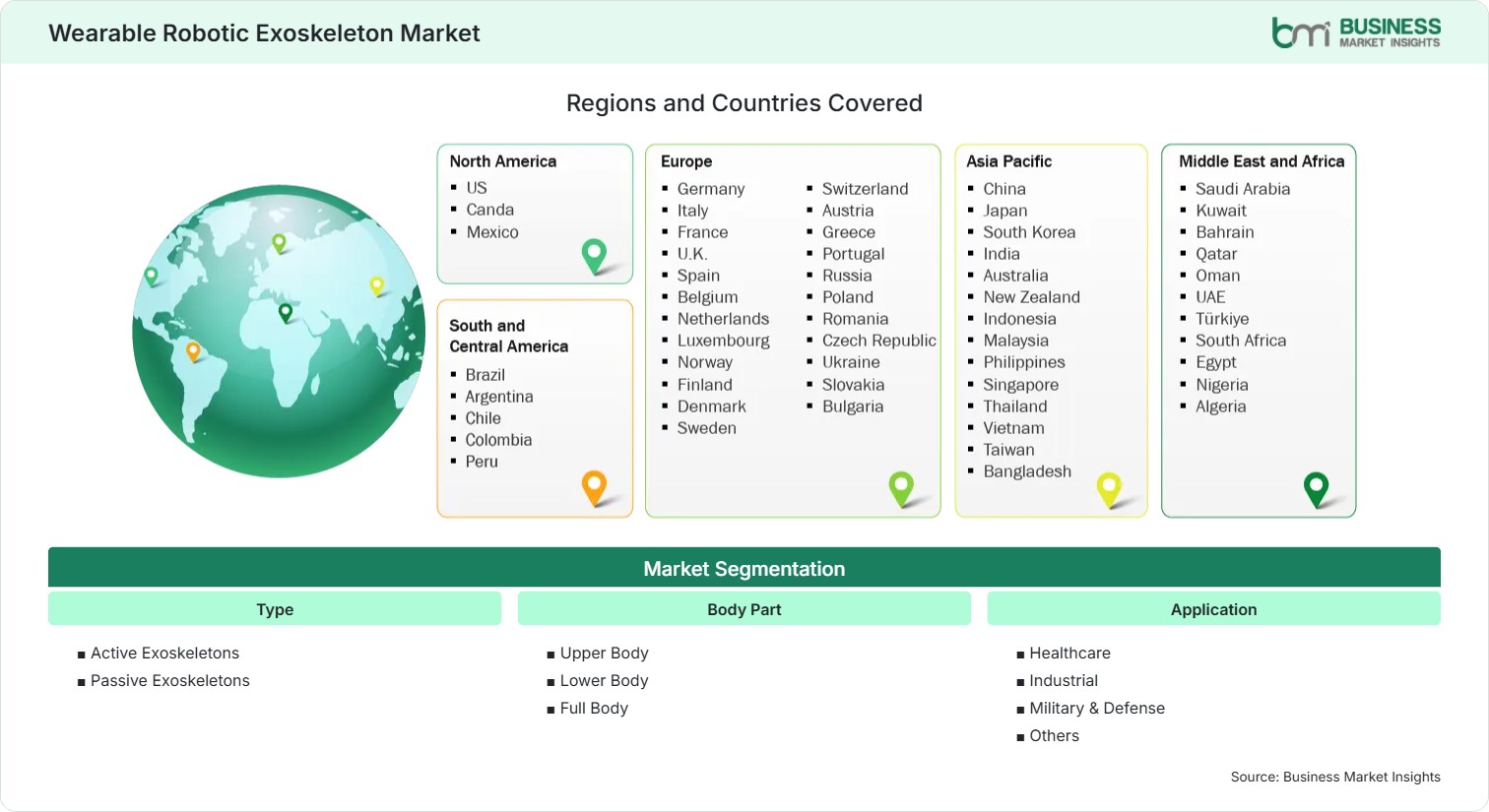
North America held an estimated 34%–38% share in 2025 and is projected to expand at a 40%–44% CAGR through 2033. The regional Wearable Robotic Exoskeleton Market share is supported by healthcare robotics, industrial safety programs, defense research, and technology investment. The U.S. remains dominant, while Canada offers opportunities through rehabilitation technologies, workplace assistance, and advanced robotics research.
- Rehabilitation centers are evaluating robotic mobility systems for patients requiring gait training and functional assistance following neurological or physical impairments.
- Industrial employers are exploring wearable assistance to reduce physical strain during repetitive lifting, overhead work, and material handling tasks.
- Defense organizations are researching wearable robotics for load carriage and soldier assistance, creating opportunities for systems capable of improving endurance without restricting mobility.
- Venture investment and strategic partnerships are connecting robotics developers with healthcare institutions, industrial users, and technology infrastructure providers.
US Wearable Robotic Exoskeleton Market
The U.S. represented an estimated 29%–33% share in 2025 and is projected to grow at a 41%–45% CAGR through 2033. Advanced healthcare infrastructure, industrial capabilities, defense research, and technology development create favorable conditions. The Wearable Robotic Exoskeleton Market also benefits from established robotics companies and growing interest in workplace ergonomics, rehabilitation, mobility assistance, and human performance augmentation.
- Healthcare providers are expanding interest in robotic rehabilitation for structured gait training and mobility recovery.
- Manufacturing and logistics companies are testing wearable assistance to address ergonomic risks associated with repetitive lifting and physically demanding tasks.
- Federal research and defense programs support innovation in wearable robotics, creating opportunities for advanced load assistance and mobility systems.
- Commercialization increasingly depends on demonstrating measurable outcomes, including improved rehabilitation performance, reduced worker fatigue, and productivity benefits.
Europe Wearable Robotic Exoskeleton Market
Europe held an estimated 27%–31% share in 2025 and is projected to grow at a 39%–43% CAGR through 2033. Germany remains a leading Wearable Robotic Exoskeleton Market, while France, the UK, Italy, and Switzerland provide additional opportunities. Engineering capabilities, healthcare innovation, workplace safety priorities, and industrial automation support adoption, although reimbursement complexity and regulatory requirements can affect commercialization.
- Germany benefits from established robotics engineering and industrial manufacturing capabilities, supporting healthcare and workplace applications.
- France is developing opportunities in rehabilitation and industrial assistance as healthcare institutions and manufacturers explore human-machine collaboration.
- The UK offers potential through healthcare research, rehabilitation technologies, and industrial applications focused on workplace ergonomics.
- Switzerland's precision engineering ecosystem supports specialized robotics development where compact design and control accuracy are important.
Asia Pacific Wearable Robotic Exoskeleton Market
Asia Pacific represented an estimated 24%–28% share in 2025 and is projected to grow at a 47%–51% CAGR through 2033. China and Japan lead the regional Wearable Robotic Exoskeleton Market, while South Korea and Singapore provide high-growth opportunities. Industrial automation, manufacturing investment, aging-related healthcare requirements, and government-backed robotics programs are strengthening regional demand.
- Japan benefits from strong robotics expertise and rising demand for mobility and aging-care solutions across healthcare and assisted living.
- China offers substantial potential because of large-scale manufacturing, industrial automation, and growing investment in domestic robotics technologies.
- South Korea's electronics and manufacturing ecosystem creates opportunities for sensor integration, intelligent controls, and industrial wearable robotics.
- Singapore provides a technology-focused environment for robotics research and industrial automation, supporting pilot deployments and specialized commercial applications.
Rest of World Wearable Robotic Exoskeleton Market
South and Central America accounted for an estimated 5%–7% share in 2025 and are projected to grow at a 38%–42% CAGR through 2033. Brazil and Mexico offer leading opportunities through healthcare and manufacturing. The Middle East and Africa represented an estimated 4%–6% share and are projected to grow at a 35%–40% CAGR, supported by healthcare modernization and industrial development.
- Brazil offers opportunities in rehabilitation and industrial applications as healthcare providers and manufacturers gradually adopt advanced robotics and assistive technologies.
- Mexico's manufacturing ecosystem creates potential for workplace assistance systems designed to support repetitive tasks and improve ergonomic conditions.
- Saudi Arabia's healthcare modernization and infrastructure projects provide opportunities for rehabilitation robotics and construction-focused wearable assistance technologies.
- The UAE is investing in advanced healthcare and technology infrastructure, creating opportunities for specialized robotics and mobility assistance applications.