
Military Cloud Computing Market Outlook: Size, Share, Trends, Growth Analysis, Competitive Landscape & Forecast, 2026-2033

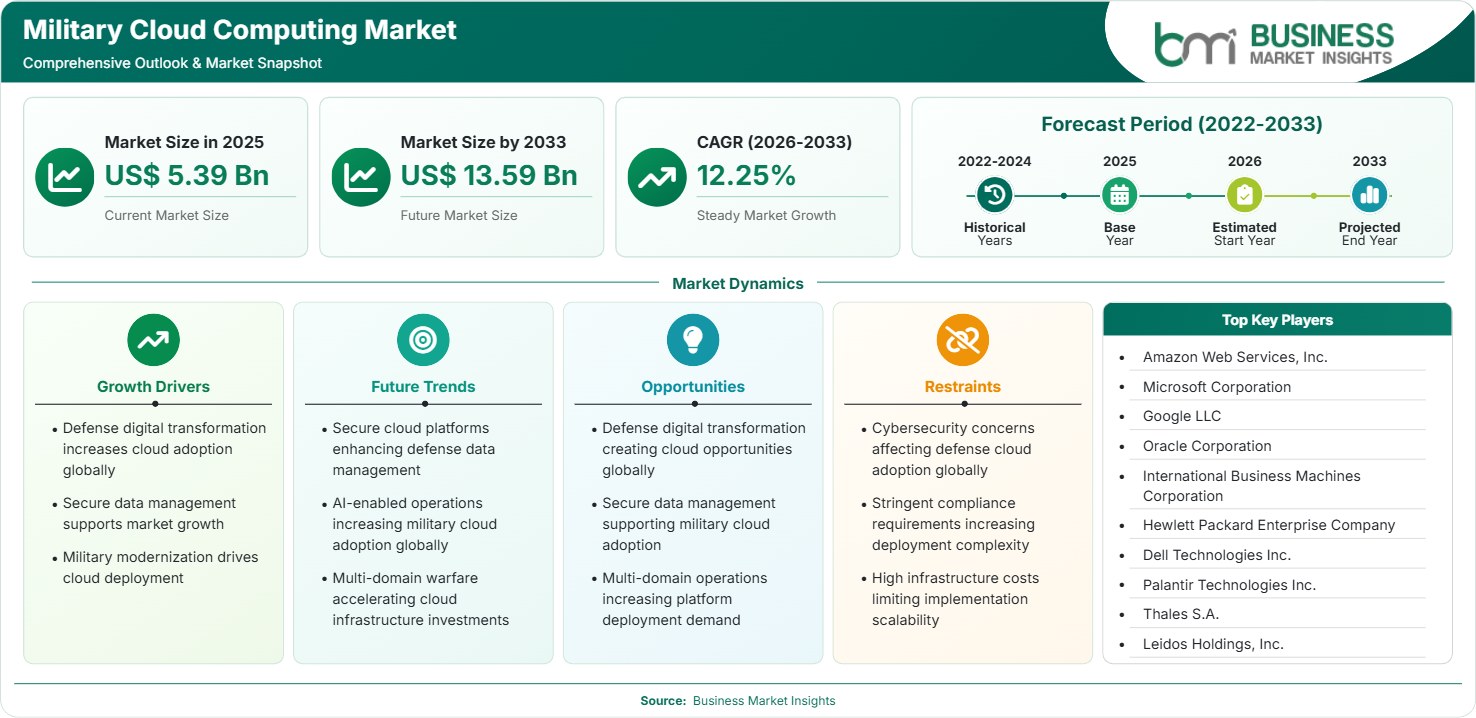
The Military Cloud Computing Market size was valued at US$ 5.39 Billion in 2025 and is projected to reach US$ 13.59 Billion by 2033, growing at a CAGR of 12.25% during 2026–2033, driven by secure data exchange, artificial intelligence, battlefield connectivity, cyber defense, and modernization of defense infrastructure.

Report Coverage
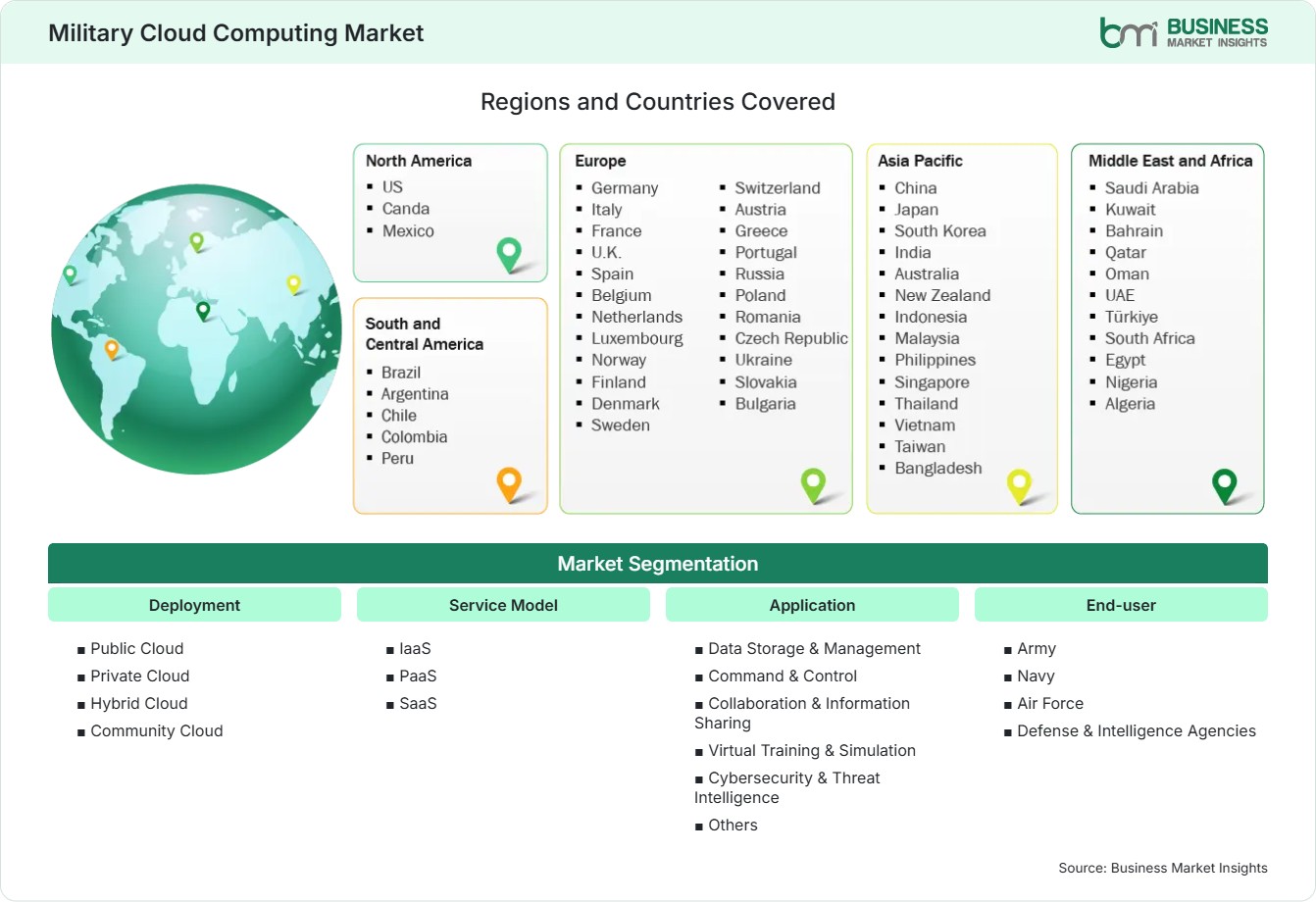
  • Deployment: Public Cloud, Private Cloud, Hybrid Cloud, Community Cloud
  • Service Model: IaaS, PaaS, SaaS
  • Application: Data Storage & Management, Command & Control, Collaboration & Information Sharing, Virtual Training & Simulation, Cybersecurity & Threat Intelligence, Others
  • End-user: Army, Navy, Air Force, Defense & Intelligence Agencies
US$ 5.39 Bn Market size in 2025
US$ 13.59 Bn Market Size by 2033
12.25% CAGR, 2026 - 2033
2026-2033 Forecast Period

AI Overview

Military Cloud Computing Market Summary

  • North America Region: North America holds an estimated 38%–42% Military Cloud Computing Market share in 2025, advancing at a 11%–13% CAGR during 2026–2033. Secure cloud modernization, defense data integration, classified computing, and AI-enabled command systems support procurement. The United States leads through established defense cloud programs, extensive military networks, and strong technology partnerships.
  • Fastest Growing Region: Asia Pacific accounts for an estimated 22%–26% share in 2025, with a 14%–16% CAGR during 2026–2033. Military digitization, regional security priorities, sovereign infrastructure, and investment in integrated command systems are accelerating adoption across major defense economies.
  • Leading Segment: Private Cloud holds an estimated 35%–39% share in 2025, with an 11%–13% CAGR during 2026–2033. Dedicated infrastructure, access controls, data sovereignty, and classified workload isolation sustain demand among defense organizations.
  • High Growth Segment: Hybrid Cloud represents an estimated 25%–29% share in 2025, expanding at a 14%–16% CAGR during 2026–2033. Distributed operations, tactical edge computing, scalable analytics, and controlled integration between classified and unclassified environments support adoption.
  • Key Market Opportunity: Defense agencies can modernize legacy systems through secure hybrid architectures, tactical edge deployments, interoperable data platforms, and AI-ready infrastructure, creating opportunities for specialized integrators and cloud providers.
  • Major Market Players: Amazon Web Services, Inc.; Microsoft Corporation; Google LLC; Oracle Corporation; International Business Machines Corporation; Hewlett Packard Enterprise Company; Dell Technologies Inc.; Palantir Technologies Inc.; Thales S.A.; and Leidos Holdings, Inc.
Strategic Insights

Military Cloud Computing Market: Strategic Insights

Military Cloud Computing Market Strategic Framework
FREE PDF
Request your free sample
Request free sample
Stakeholder View

Key Takeaways

  • Competitive advantage depends on combining accredited infrastructure, secure networking, identity management, encryption, application modernization, and mission-specific integration. Defense customers increasingly evaluate complete delivery ecosystems rather than cloud capacity alone.
  • Command and control, intelligence sharing, and cybersecurity workloads offer attractive opportunities because they depend on integrating information from multiple operational systems. Providers should prioritize reliable data access and interoperability across classified environments.
  • Hybrid architectures and tactical edge computing are becoming central to defense modernization. Investment in offline functionality, synchronization, distributed processing, and AI-ready infrastructure can address operational requirements that conventional centralized cloud deployments cannot meet independently.
  • Asia Pacific offers opportunities for suppliers supporting sovereign cloud infrastructure, military data modernization, and secure communications. Local partnerships and compliance with national security requirements will influence procurement outcomes across individual countries.
  • Strategic alliances between cloud hyperscalers, defense technology companies, and systems integrators can accelerate entry into regulated programs. Acquisitions and partnerships involving cybersecurity, data integration, and edge computing capabilities can strengthen competitive positioning.
  • Long contract periods and mission-critical workloads reward providers that demonstrate service continuity, transparent consumption costs, and credible exit strategies. Buyers increasingly need architectures that permit workload portability without compromising security accreditation.
Geographic Outlook

Military Cloud Computing Market Regional Highlights

North America Military Cloud Computing Market

North America is estimated to account for 38%-42% of the Military Cloud Computing Market in 2025, driven by proven military technology systems and investment in secure digital infrastructure. Growth for the region is forecast at an 11%-13% CAGR between 2026 - 2033. The US is the largest contributor in North America, with Canada another source of demand driven by intelligence, secure communication, and defense information management.

  • Defense cloud programs are expanding access to commercial infrastructure across classification levels. The Department of the Navy's December 2025 task orders for Google and Oracle demonstrate continued movement toward multi-provider procurement.
  • Providers with accredited environments can support intelligence processing, secure software development, mission planning, and sensitive data storage. Their competitiveness depends on compliance, resilient infrastructure, cleared personnel, and integration with existing defense networks.
  • Demand for computing at forward operating locations encourages suppliers to combine centralized cloud services with edge devices. Low-bandwidth operation, local processing, and secure synchronization remain important differentiators.
  • Defense digitization and secure information-sharing initiatives create demand for sovereign data controls, cybersecurity, and interoperable platforms. Procurement success depends on local compliance and the ability to support allied operations.

US Military Cloud Computing Market

The US stands as the largest domestic market, with projected share ranging from 32% - 36% of world revenues in 2025 and a CAGR of 11% - 13% for the period 2026 - 2033. The factors aiding adoption include the federal procurement process, established cloud players, and large-scale classified computing needs. The Military Cloud Computing Market is affected by enterprise licensing, security analytics, and connectivity. Customers are considering the efficiency of centralized procurement alongside the requirements for independent service providers, resilient systems, and control mechanisms.

  • Consolidated procurement can reduce fragmented licensing and improve access to standardized cloud capabilities. The May 2026 Microsoft enterprise agreement illustrates the scale of centralized digital infrastructure purchasing.
  • Military organizations are exploring secure AI applications for intelligence analysis, logistics, and mission support. Adoption requires governance, controlled data access, model evaluation, and human oversight for consequential operational decisions.
  • Access to several accredited providers helps agencies match workloads to security, performance, and availability requirements. Portability and common identity controls can reduce operational disruption during migration or provider changes.

Europe Military Cloud Computing Market

Europe Military Cloud Computing Market is expected to account for 18%-22% share in 2025, and have a modelled CAGR of 10%-12% in 2026-2033. Investments in the military cloud computing market in Europe are influenced by factors such as defense modernization, cybersecurity needs, interoperability, and data sovereignty. Countries like the United Kingdom, France, and Germany are significant centers of demand in the market due to their well-developed defense sectors and modernization initiatives. Poland and the Nordic countries also provide prospects for military cloud computing investments.

  • United Kingdom secure data environments and intelligence integration create demand for cloud platforms that support classified workloads. Providers need strong security accreditation, local delivery capabilities, and compatibility with allied information-sharing systems.
  • France and Germany national sovereignty priorities encourage secure hosting, controlled access, and partnerships with domestic defense technology companies. Systems integrators can benefit from projects that connect legacy command platforms with modern analytics.
  • Nordic countries' distributed operating environments and harsh climatic conditions increase the importance of resilient connectivity and reliable edge computing. Cloud deployments must support operations where networks can be disrupted or geographically constrained.
  • Central and Eastern Europe military modernization creates demand for interoperable command systems, cybersecurity services, and secure information exchange. Poland's investment priorities provide opportunities for suppliers that can align technical capabilities with national procurement requirements.

Asia Pacific Military Cloud Computing Market

Asia Pacific Military Cloud Computing Market is projected to hold a 22%-26% share in 2025, with an estimated CAGR of 14%-16% between 2026-2033, making it the fastest-growing region. The modernization of military capabilities, digital sovereignty considerations, and intelligence coordination requirements are the drivers behind market development. China, India, Japan, South Korea, and Australia are important centers of demand, although foreign companies' access to these markets varies widely. Singapore shows the need for isolated cloud solutions and AI for military purposes.

  • India's modernization of military communications, intelligence management, and defense infrastructure creates opportunities for secure cloud platforms. Procurement must address data sovereignty, cybersecurity requirements, and integration with domestic defense systems.
  • Japan and South Korea, with advanced technology ecosystems and sophisticated defense requirements, support demand for resilient data platforms, secure analytics, and operational interoperability. Suppliers must accommodate stringent national security and procurement conditions.
  • Australia allied interoperability and geographically dispersed operations increase demand for secure information-sharing platforms. Cloud services that connect headquarters with deployed forces can support mission planning and logistics.
  • Southeast Asia sovereign cloud deployments, cybersecurity modernization, and digital defense initiatives offer selective opportunities. Singapore's isolated cloud approach demonstrates the relevance of air-gapped computing for sensitive military applications.

Rest of World Military Cloud Computing Market

South and Central America will account for an estimated 4%-7% share of the Military Cloud Computing Market by 2025. The expected growth CAGR 2026-2033 is 9% - 12%. Countries like Brazil and Chile offer opportunities to secure command infrastructure, logistics, and cybersecurity services. The decision to adopt cloud computing will be determined by the financial state, purchasing cycle, and availability of competent integration partners. It could be possible that defense organizations opt for an incremental deployment strategy that ensures enhanced data access without replacing current infrastructure. Providers from this region could facilitate migration, compliance, and lifecycle management.

The Middle East & Africa are forecast to hold a share of 7% - 11% in 2025, with a modelled CAGR of 12% - 15% from 2026 to 2033. Countries like Saudi Arabia, the UAE, and Israel provide demand opportunities driven by defense technology and digital security. South Africa offers opportunities in defense information management and cybersecurity.

  • Brazil's defense ecosystem provides opportunities for secure data management and communications integration. Vendors should emphasize scalable implementation, training, and lifecycle support where budgets constrain rapid enterprise-wide migration.
  • Middle Eastern investment in digitization programs can support procurement of sovereign cloud infrastructure, advanced analytics, and cybersecurity. Local partnerships and compliance with national data requirements can influence supplier selection.
  • African selective deployments may prioritize logistics, secure collaboration, and intelligence coordination. Modular cloud services can help organizations modernize specific workloads before committing to larger infrastructure transformations.
  • Regional integration, multinational exercises, and cross-border security cooperation create demand for controlled information exchange. Successful solutions must accommodate varying security policies, network maturity, and data access permissions.
Global Market Geography
FREE PDF
Request your free sample
Request free sample
Segment Analysis

Military Cloud Computing Market Segmentation

Deployment

Private Clouds dominate the deployment strategy, with an expected share of 35% - 39% of the Military Cloud Computing Market by 2025, while Hybrid Cloud deployments are projected to grow at a 14% - 16% CAGR from 2026 - 2033. The choice of deployment strategies depends on the requirements for classification, sovereignty, connectivity, and resilience. The private cloud strategy is better suited for strict workload control, while hybrid clouds link enterprise assets with distributed computing.

  • Public Cloud: Public cloud provides scalable computing, development environments, and approved collaboration tools. Defense organizations can use authorized services for suitable unclassified workloads, training applications, and administrative systems while retaining controls over data classification and access.
  • Private Cloud: Dedicated infrastructure supports sensitive applications requiring greater administrative control, customized security policies, and predictable performance. Military organizations use private environments for mission systems, controlled data repositories, and workloads with stringent sovereignty requirements.
  • Hybrid Cloud: Hybrid deployment combines private infrastructure, authorized public services, and edge resources. It enables agencies to place workloads according to sensitivity, latency, and availability requirements while facilitating controlled data movement between operational environments.
  • Community Cloud: Community cloud supports organizations sharing security, compliance, or mission requirements. Participating defense agencies can collaborate within governed environments, provided access permissions, ownership responsibilities, and information-sharing rules are explicitly defined.

Service Model

The Infrastructure as a Service model is projected to account for 40%-44% of the Military Cloud Computing Market in 2025, driven by the increasing need for configurable computing, storage, and network capabilities. The Platform as a Service model is a highly promising growth market, owing to the modernization and development of applications with analytics capabilities within defense organizations. Software as a Service helps with collaboration and administrative processes where authorized.

  • Infrastructure-as-a-Service (IaaS): IaaS supplies virtual machines, storage, networking, and configurable infrastructure for defense applications. It supports migration from legacy data centers and gives agencies greater flexibility over operating systems, security configuration, and workload placement.
  • Platform-as-a-Service (PaaS): PaaS provides managed development, integration, database, and analytics capabilities. Defense technology teams can build mission applications faster while applying standardized security controls, automated deployment practices, and approved data-processing workflows.
  • Software-as-a-Service (SaaS): SaaS delivers hosted applications for collaboration, document management, planning, and selected operational functions. Adoption depends on security accreditation, access controls, data residency, and suitability for the relevant classification environment.

Application

The Data Storage and Management vertical is projected to account for around 24% - 28% of market share in 2025 due to the need for reliable storage facilities and limited access to operational information. The Cybersecurity and Threat Intelligence solution is forecast to grow at a 14%- 16% CAGR from 2026-2033. The Military Cloud Computing Market covers enterprise data services, mission coordination, collaboration, simulation, and analysis.

  • Data Storage and Management: Secure repositories consolidate authorized information from logistics, personnel, intelligence, and mission systems. Encryption, retention controls, backup, and metadata management help agencies maintain data availability while meeting governance requirements.
  • Command and Control: Cloud-enabled command systems integrate operational information, planning tools, and selected sensor feeds. Their value depends on low-latency access, reliable communications, interoperable applications, and continuity when centralized networks become unavailable.
  • Collaboration and Information Sharing: Secure collaboration environments allow authorized personnel to exchange documents, coordinate tasks, and distribute operational updates. Cross-domain controls and identity management are essential when participants operate under different permissions or security classifications.
  • Virtual Training and Simulation: Cloud infrastructure supports distributed exercises, synthetic environments, and scalable simulation workloads. Centralized scenario management can improve training consistency, while edge processing helps maintain performance when participants have limited connectivity.
  • Cybersecurity and Threat Intelligence: Cloud-based security tools aggregate logs, detect anomalies, and support intelligence analysis. Integration with approved monitoring systems can improve threat visibility, accelerate incident investigation, and strengthen defensive coordination across networks.

End-user

Army’s share in the Military Cloud Computing Market in 2025 is expected to be 32%–36%, considering the large number of logistics, command, intelligence, and communications requirements. Defense & Intelligence Agencies present lucrative avenues for growth due to secure analytics and fusion of multi-source intelligence. Service penetration will depend on service doctrines, purchasing processes, and classification policies. Specialized solutions will be needed by naval and air services.

  • Army: Army deployments support mission planning, logistics, intelligence coordination, personnel management, and mobile command. Solutions must work across fixed installations and deployed units, including environments with intermittent connectivity and limited bandwidth.
  • Navy: Naval forces use cloud capabilities for fleet logistics, maintenance records, intelligence coordination, and mission support. Shipboard constraints and disrupted connectivity increase the importance of secure synchronization, local processing, and resilient communications.
  • Airforce: Air forces apply cloud computing to mission planning, maintenance analytics, simulation, and operational data integration. Systems must support rapid information access while respecting aircraft-network separation, mission assurance, and stringent security requirements.
  • Defense and Intelligence Agencies: These organizations require controlled repositories, multi-source analytics, secure collaboration, and intelligence-processing environments. Strong identity controls, auditability, data lineage, and compartmentalized access are essential for sensitive information.
Market Forces

Military Cloud Computing Market Dynamics

Key Market Drivers

Modernization of Defense Information Infrastructure

Legacy defense systems generally have distinct databases, user interfaces, and hardware dependencies, which can lead to wasted resources. Migration to the new infrastructure will result in improved resource utilization and more effective management of logistics and other operational functions. The Military Cloud Computing Market growth comes from agencies that can integrate fragmented workloads without affecting mission-critical operations. Cloud computing will also help to update the software quickly and perform better analysis. But modernization requires evaluation of applications, categorization of information, and a structured transition. It has become common practice for defense customers to assess the vendor's capacity for continuity of operations during the integration of old and new systems. Value is determined by the infrastructure’s ability to interoperate, support, and be flexible.

Expansion of Data-Driven and AI-Assisted Operations

Defense agencies are managing increasing amounts of data coming from sensors, intelligence systems, logistics systems, and training systems. Cloud platforms enable scalable access to storage and computing for authorized analytical workloads. Applications can leverage machine learning to detect anomalies, perform predictive maintenance, analyze images, and support decision-making, though they will need to undergo thorough validation. Military Cloud Computing Market trends point to a preference for cloud computing solutions in which data is securely managed and access to AI capabilities is controlled. Location of processing becomes a factor – applications that are sensitive to latency might be best suited to edge computing, whereas large-scale analytics can be performed on centralized platforms.

Demand for Interoperability and Distributed Operations

Information exchange is becoming vital in military operations between different services, headquarters, intelligence units, and forces on the ground. Cloud platforms enable common data services, application programming interfaces, and collaboration within and beyond organizational structures. However, interoperability should not be expected from infrastructure alone; data formats, access, procedures, and security policies must also align. Forces distributed across different areas will still need their computing resources to continue functioning when the network becomes congested or cut off altogether. In such instances, design models that incorporate centralization and localized processing with synchronization are preferred. The procurement process will assess resilience, recoverability, and integration with the existing tactical communication.

Key Market Opportunities

Secure Hybrid and Tactical Edge Deployments

Hybrid clouds enable tying workload deployment to operational sensitivities, connectivity, and performance. Sensitive information can be stored in a protected environment, but authorized applications can rely on scalable services, and deployed units can handle immediate information processing locally. This will reduce dependence on being connected to the core infrastructure at all times. Investments that can be made here include ruggedized edge computing servers, disconnected-mode operation apps, secure sync, and policy enforcement. Military Cloud Computing Market Forecasts are especially useful for vendors that develop integrated architectures, as opposed to those that provide stand-alone hosting services. This needs to be manageable, recoverable, and compatible with existing communications. Defense system integrators can help in this regard by collaborating with the vendors.

AI-Ready Infrastructure and Intelligence Integration

Defense organizations need an infrastructure capable of supporting high-performance computing, data pipelines, and governed AI applications. Providers can distinguish themselves by offering safe model deployment, data cataloging, access management, and monitoring tailored for sensitive workloads. The applications include predictive maintenance, simulation, intelligence triage, and logistics planning. However, commercial AI offerings cannot just be plugged into any military setup; there need to be validation and classification guidelines, among other things. Providers who facilitate controlled experiments and deployments can help organizations move from proof-of-concept projects to sustainable initiatives.

Sovereign Cloud Partnerships and Lifecycle Services

Countries seeking greater control over defense information can create demand for locally operated infrastructure, national security accreditation, and specialist integration. Providers can work with domestic telecommunications operators, defense contractors, and government technology organizations to meet localization requirements. Business opportunities arise not only from basic cloud hosting but also from areas such as migration, security monitoring, application transformation, education, and maintenance. For smaller military departments, it may be more appealing to go for managed services to alleviate the load of maintaining unique infrastructure. Nevertheless, cooperation in the Military Cloud Computing Market should include well-defined security incident handling, data access, subcontractor relationships, and service continuity. The suppliers capable of combining expertise and localization will be able to secure their foothold in sovereign defense initiatives.

Market Restraints and Challenges

Cybersecurity Exposure and Classification Constraints

Factor: Military-related workloads may involve operational, personnel, intelligence, and logistics data that could become targets for espionage and advanced cyber operations performed on behalf of governments. Potential risks if the applications were moved to shared or interconnected systems include configuration errors, credential theft, vulnerabilities, and unauthorized access. Impact: The agencies can wait until the providers offer appropriate levels of certification, encryption, authorization, audit capability, and incident response. Information exchange across different classification domains needs special attention, as authorization at one classification level does not automatically mean authorization at the other. Additional security requirements lead to higher implementation and maintenance costs. The providers need to define data ownership, vulnerability management, and recovery policies.

Legacy Integration, Connectivity, and Vendor Dependence

Factor: Military organizations need robust infrastructure with tailored user interfaces and formats. There may be issues with low bandwidth, connectivity, or latency. Impact: Migration will include aspects such as integration, parallel processing, staff training, and testing, which may be very costly before it is operational. Private cloud computing may prove challenging in the future, as fragmented purchasing can lead to different technical standards. Interface documentation, data transfer, a tested recovery process, and an exit strategy will become important for defense customers. Service providers who fail to understand integration challenges will incur higher life cycle costs and lose the trust of program managers.

Company Analysis

Competitive Landscape

Military Cloud Computing Market analysis is shaped by competition among hyperscale cloud providers, enterprise technology vendors, cybersecurity specialists, and defense systems integrators. The following companies operate in relevant cloud infrastructure, secure data management, enterprise software, or defense integration markets. Their capabilities differ by classification authorization, geographic coverage, integration expertise, and ability to support mission-critical deployments.

Company Name

Overview

Products and Services relevant to this market

Amazon Web Services, Inc.

Provides cloud infrastructure, analytics, storage, and computing services, including specialized environments for government and classified workloads.

AWS GovCloud, classified cloud environments, secure storage, compute, analytics, machine learning, and edge computing capabilities.

Microsoft Corporation

Supplies enterprise cloud services, collaboration software, identity management, and security capabilities for government and defense customers.

Microsoft Azure, Azure Government, Microsoft 365, cloud infrastructure, data analytics, identity services, and secure collaboration.

Google LLC

Offers cloud infrastructure, data analytics, AI services, and managed computing for public-sector and regulated workloads.

Google Cloud, government cloud services, data analytics, AI infrastructure, security tools, and application modernization capabilities.

Oracle Corporation

Provides enterprise databases, cloud infrastructure, and isolated deployment options suited to sensitive government and defense workloads.

Oracle Cloud Infrastructure, Oracle Cloud Isolated Region, database services, secure computing, and enterprise data management.

International Business Machines Corporation

Supplies hybrid cloud technology, enterprise integration, automation, and consulting services for complex regulated environments.

IBM Cloud, Red Hat OpenShift, hybrid cloud management, automation, cybersecurity consulting, and application modernization.

Hewlett Packard Enterprise Company

Develops enterprise servers, networking, private cloud infrastructure, and edge computing products for distributed operations.

HPE GreenLake, private cloud infrastructure, secure servers, networking, and edge computing solutions.

Dell Technologies Inc.

Provides enterprise computing, storage, data protection, and infrastructure solutions for on-premises and hybrid environments.

Dell PowerEdge servers, storage systems, data protection, infrastructure management, and hybrid cloud integration.

Palantir Technologies Inc.

Specializes in data integration, operational analytics, and software platforms used by government and defense organizations.

Palantir Gotham, Foundry, data integration, operational decision support, and AI-enabled analytical applications.

Thales S.A.

Develops defense electronics, cybersecurity, secure communications, and digital identity technologies for government customers.

Secure information systems, cybersecurity solutions, defense communications, identity management, and digital infrastructure integration.

Leidos Holdings, Inc.

Provides defense technology, systems integration, mission engineering, and digital modernization services to government agencies.

Secure IT modernization, cloud migration, cybersecurity, intelligence systems integration, and mission-support services.

Trust & Transparency

Research Methodology

The market analysis combines proprietary research with secondary data from government agencies, company disclosures, regulatory filings, industry databases and expert interviews. Market estimates are validated through data triangulation, cross-market benchmarking and analyst review.

View Full Research Methodology

Questions Answered

Frequently Asked Questions

What should buyers examine when evaluating a Military Cloud Computing Market Report?

Buyers should examine the report's deployment definitions, service-model coverage, end-user segmentation, regional assumptions, and treatment of classified workloads. They should also distinguish verified contract announcements from modelled market estimates and assess whether the analysis reflects sovereign cloud requirements and tactical connectivity constraints.

How can smaller defense organizations adopt cloud capabilities without replacing all legacy systems?

A phased migration can begin with approved administrative workloads, data backup, and selected collaboration applications. Agencies can then modernize interfaces and introduce analytics incrementally. Pilot programs, integration testing, workforce training, and clear security boundaries help manage implementation risk.

What procurement criteria should defense agencies evaluate beyond infrastructure cost?

Agencies should assess accreditation, service availability, interoperability, incident response, data portability, lifecycle support, and recovery performance. They should also examine subcontractor dependencies, personnel clearance requirements, and the ability to maintain mission continuity during provider transitions.

How does tactical edge computing complement centralized military cloud infrastructure?

Tactical edge computing processes time-sensitive information near deployed personnel, sensors, and equipment. It reduces dependence on distant data centers and supports local operations during connectivity disruptions. Centralized cloud infrastructure remains useful for large-scale analytics, long-term storage, and coordinated planning.

What factors determine whether a military workload belongs in a private, public, or hybrid cloud?

Classification requirements, data sovereignty, latency, connectivity, and operational criticality determine deployment. Sensitive applications may require dedicated or isolated environments, while approved administrative workloads can use authorized public cloud services. Hybrid architectures combine these approaches under consistent security policies.

Access the Full Military Cloud Computing Market Report

Get segment-level forecasts, regional estimates, competitive benchmarking, company profiles and downloadable Excel datasets.

Access the full Military Cloud Computing Market Report
350 pages PDF & Excel | 2026-10-22
Similar Research

Related Market Reports