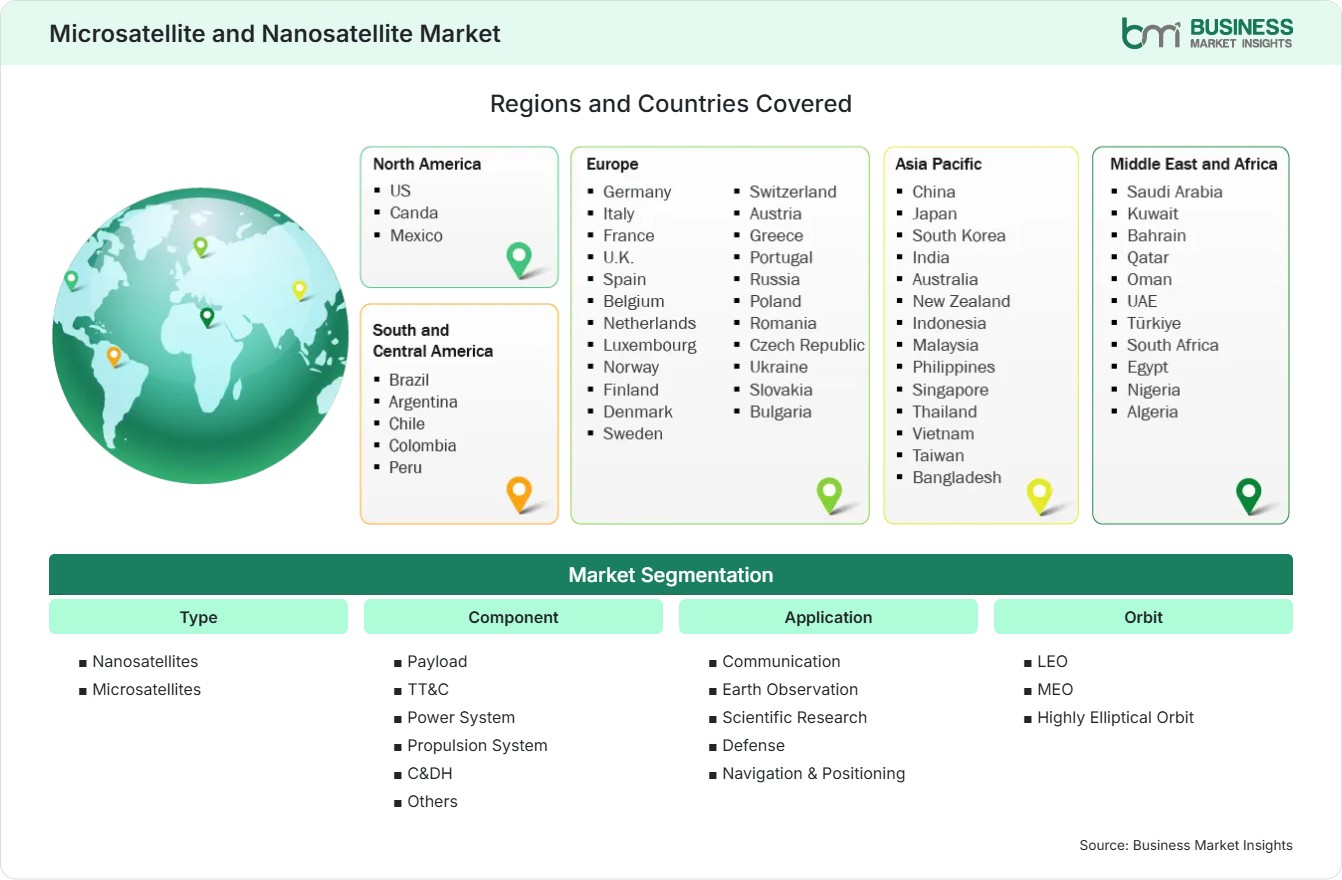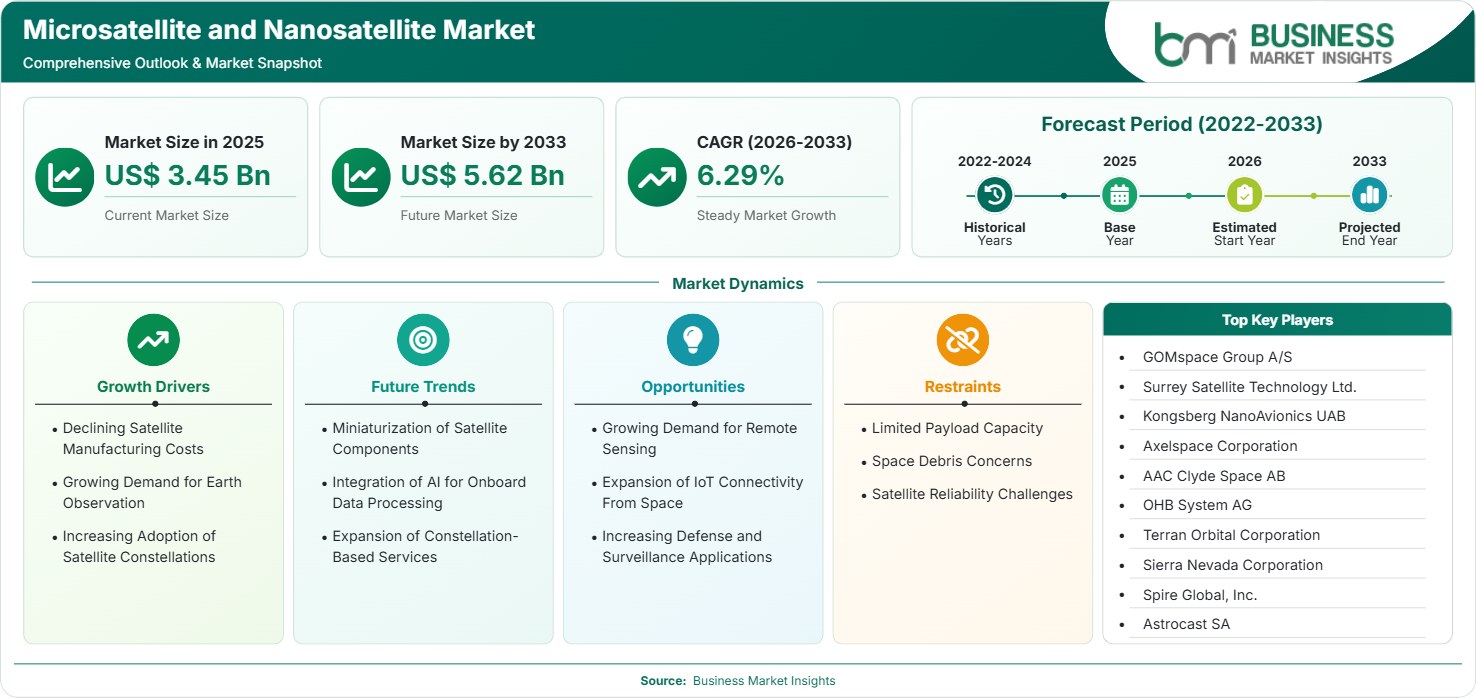
Microsatellite and Nanosatellite Market Regional Highlights
North America Microsatellite and Nanosatellite Market
North America accounted for approximately 37%–40% of global revenue in 2025 and is projected to expand at a 5.8%–6.4% CAGR through 2033. Strong participation from commercial satellite operators, defense agencies, and private investors sustains regional leadership. The region benefits from advanced launch infrastructure, mature satellite manufacturing capabilities, and growing demand for geospatial intelligence. The Microsatellite and Nanosatellite Market share remains concentrated in the United States, while Canada strengthens its position through Earth observation programs, research initiatives, and emerging space technology ventures.
- There is ongoing defense modernization effort that has led to the procurement of small satellite constellations for applications such as secure communication, intelligence collection, early missile detection and awareness within space.
- The funding for private capital has remained strong, thus supporting various startups in satellite constellations and analytics as well as the commercialization of satellite data services.
- Earth observation applications are expanding across agriculture, energy infrastructure monitoring, insurance assessment, and environmental surveillance, strengthening demand for advanced imaging capabilities.
- Growth in software-defined satellites and onboard processing technologies enables faster data delivery and mission flexibility, improving operator economics and service adoption.
- The government’s initiative towards launching commercial services makes access to space easier and helps increase participation in the entire regional space system.
US Microsatellite and Nanosatellite Market
The United States represented approximately 78%–82% of North American revenue in 2025 and is anticipated to grow at a 5.9%–6.5% CAGR through 2033. Extensive federal spending, commercial constellation deployment, and strong venture-capital activity continue reinforcing market leadership. Major aerospace contractors, technology firms, and space startups contribute to continuous innovation in payload development, satellite manufacturing, and mission operations.
- The commercial sector continues to launch numerous satellites for better revisit rates, improved connectivity, and increased reliability for both communications and Earth observation.
- Government departments are increasingly leveraging small satellite designs to support conventional space technologies and increase mission redundancy.
- Academic institutions and research centers make active use of nanosatellite systems in conducting experiments, technology demonstrations, and human resource development programs.
- Expanding demand for geospatial intelligence and climate-monitoring services creates additional opportunities for satellite data providers and analytics companies.
Europe Microsatellite and Nanosatellite Market
Europe held an estimated 25%–28% market share in 2025 and is forecast to register a 5.9%–6.6% CAGR through 2033. Strong institutional support from European space programs, increasing public-private partnerships, and sustainability-focused Earth observation initiatives support regional expansion. Germany remains the leading market, while the United Kingdom demonstrates strong innovation in small satellite manufacturing and mission services.
- Germany is driving regional demand by virtue of its industrial prowess, government investment in space programs, and commercial deployment of satellites.
- United Kingdom continues to be one of the fastest innovating regions due to satellite manufacturing hubs and funding for constellations.
- The need for environmental monitoring is still fueling the purchase of observation satellites that help monitor climate change and perform compliance functions.
- Expanded collaboration between research institutes and commercial organizations accelerates development of next-generation payload technologies and mission architectures.
- Regional sustainability objectives strengthen adoption of efficient satellite platforms, propulsion solutions, and responsible space operations practices.
Asia Pacific Microsatellite and Nanosatellite Market
Asia Pacific accounted for 24%–27% of global revenue in 2025 and is expected to achieve the fastest expansion at 7.2%–7.8% CAGR during the forecast period. Rapid development of indigenous launch capabilities, government-backed space initiatives, and increasing private-sector participation support regional momentum. China and Japan remain leading contributors, while India demonstrates particularly strong investment potential. Strong demand for connectivity, disaster management, agricultural monitoring, and resource management continues supporting Microsatellite and Nanosatellite Market growth across diverse end-use industries.
- China is constantly increasing its number of commercial and governmental satellites in addition to improving its manufacturing capabilities and launching capabilities.
- India represents a high-growth market driven by increased private participation, satellite startups, and supportive policy reforms.
- Japan maintains a strong presence through technological innovation, advanced payload development, and scientific research missions.
- The regional governments are using satellites more often in case of natural disasters, maritime surveillance, and infrastructure development.
- Expanding digital economies create opportunities for communication satellites supporting IoT services and remote connectivity requirements.
Rest of World Microsatellite and Nanosatellite Market
The Rest of World region represented approximately 9%–11% of global revenue in 2025 and is expected to expand at a 6.5%–7.1% CAGR through 2033. South and Central America are increasing investments in environmental monitoring and telecommunications infrastructure. Meanwhile, Middle East and African nations continue developing sovereign space capabilities through national satellite programs and international partnerships.
- Brazil is continually developing earth observation technologies that help in agriculture production, forest management, and environment monitoring initiatives.
- UAE continues its regional dominance by developing strategic space programs that are technology-based and are focused on innovation.
- Telecommunication infrastructure gaps across remote locations support rising demand for cost-effective satellite connectivity solutions.
- Growing government interest in national security and border surveillance encourages deployment of compact satellite systems.
- International collaborations help developing space economies access expertise, launch services, and satellite technology capabilities efficiently.