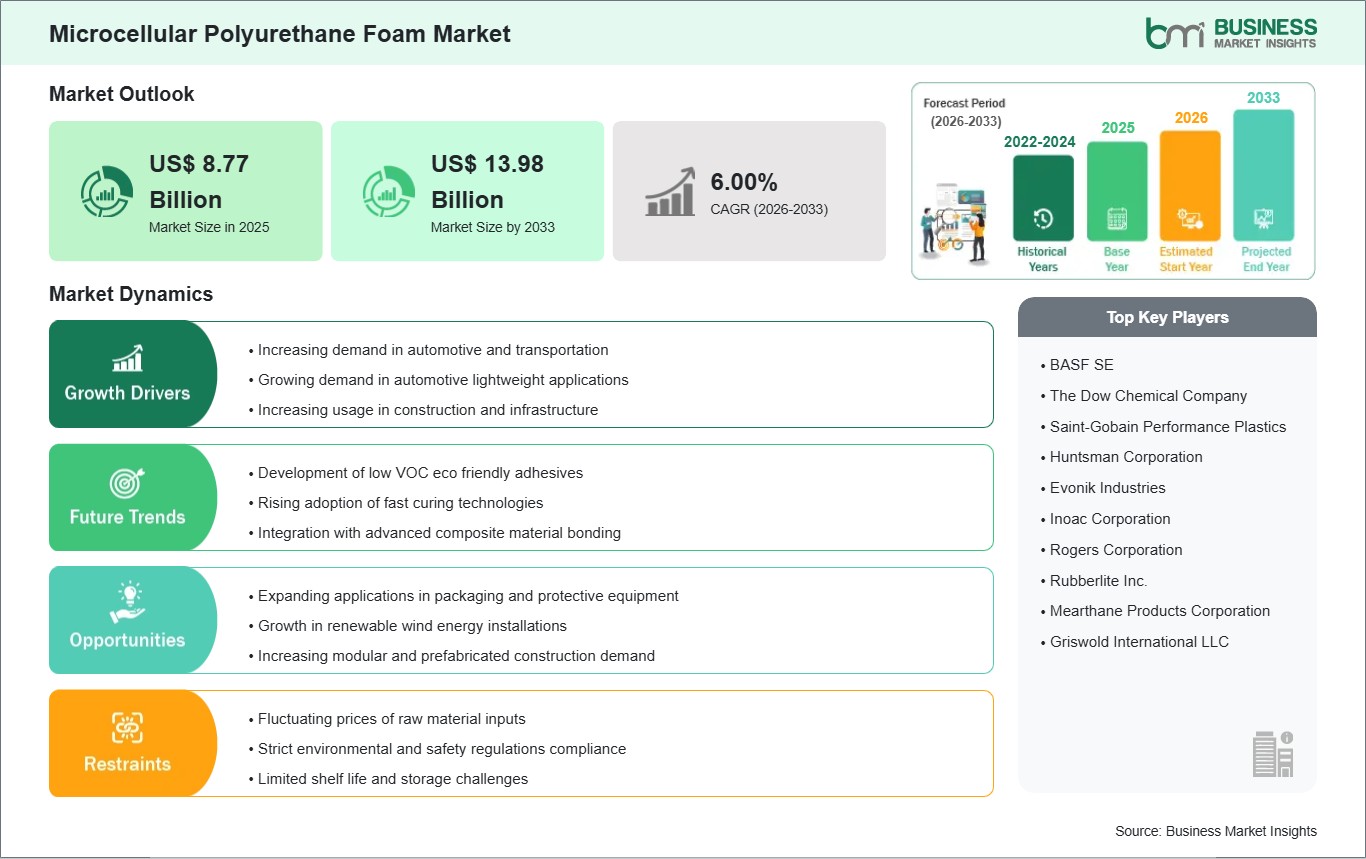
The Microcellular Polyurethane Foam Market size is expected to reach US$ 13.98 Billion by 2033 from US$ 8.77 Billion in 2025. The market is estimated to record a CAGR of 6.00% from 2026 to 2033.
The microcellular polyurethane foam market is experiencing steady growth, driven by increasing demand for lightweight, high-performance materials across automotive, furniture, packaging, and electronics industries. Microcellular PU foams offer superior mechanical strength, excellent cushioning properties, and thermal insulation while reducing material usage and overall weight, making them particularly attractive for applications targeting energy efficiency and cost optimization. Technological advancements in foam formulation and processing, including precision-controlled foaming and environmentally friendly blowing agents, are enhancing product performance and expanding the range of end-use applications. In the automotive sector, manufacturers are adopting microcellular PU foams to reduce vehicle weight, improve fuel efficiency, and meet stricter emission regulations.
The furniture and bedding industry leverages these foams for superior comfort, durability, and ergonomic support. Increasing emphasis on sustainable production processes, such as the use of bio-based polyols and low-VOC formulations, is driving innovation while aligning with global environmental regulations. However, challenges such as volatile raw material costs, high energy requirements for processing, and competition from alternative foaming materials remain constraints. Key market participants are focusing on R&D, strategic collaborations, and capacity expansions to gain a competitive edge, emphasizing performance differentiation, sustainability, and technical support services. Overall, the microcellular PU foam market outlook is positive, underpinned by industrial modernization, lightweight material adoption, and rising consumer preference for high-performance and eco-friendly products.

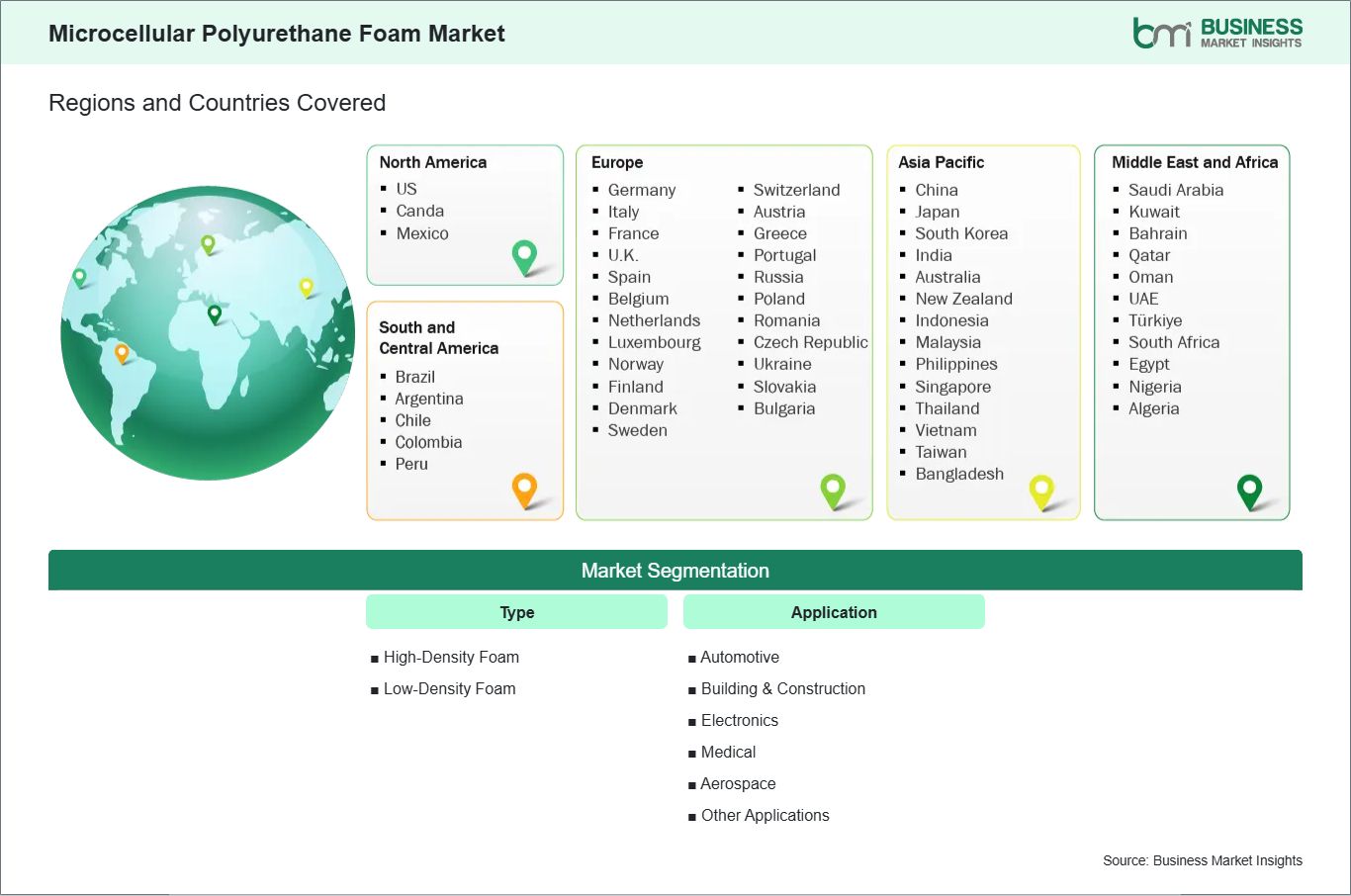
Key segments that contributed to the derivation of the microcellular polyurethane foam market analysis are type, application.
The automotive and transportation sectors are increasingly embracing microcellular polyurethane (PU) foams due to their combination of lightweight structure, durability, and performance versatility. These foams are widely used in seating, dashboards, headliners, door panels, and other interior components, where they provide excellent energy absorption, vibration damping, and thermal insulation. By reducing the weight of vehicle components without compromising strength or safety, microcellular PU foams contribute to fuel efficiency improvements and emission reduction initiatives, which are major priorities in modern automotive design.
These foams not only reduce the weight of components, but they also give manufacturers the ability to create complex, intricate shapes that will allow for the easy integration of multiple materials while maintaining a strong structural support in all forms. Their performance is not affected by mechanical force, vibration, or temperature changes, which makes them very reliable and durable in the applications used within the automotive industry. The demand for these foams has surged due to the growing trend toward electric and hybrid vehicles, as lightweight, high-performance materials are critical to improving battery performance, which directly translates into overall vehicle performance.
In addition, microcellular polyurethane foams contribute to reduced complexity during manufacturing and utilize less material when providing more cost-effective and sustainable solutions for manufacturers. To continue improving foam properties (increasing fire resistance, improving chemical resistance, etc.) to meet evolving safety standards, many manufacturers are investing heavily in R&D efforts for foam formulation improvement. The versatility of these foams and their strength in supporting new innovative designs make them an increasingly important part of the automotive and transportation industries, further establishing their place in the future of mobility solutions.
Microcellular polyurethane foams are gaining traction across packaging, protective gear, and industrial applications due to their unique combination of cushioning, energy absorption, and lightweight properties. In packaging, these foams provide superior protection for sensitive electronics, machinery, and consumer goods during transit, reducing the risk of damage while minimizing overall material usage. Their ability to conform to varying shapes ensures secure placement of products, improving stability and reducing waste.
Microcellular PU foams by far are another area of substantial growth. These foams are used in many applications, particularly sports equipment and helmets but also industrial pads and personal protective gear. They provide shock absorbency and resiliency for repeated impact. As a result, they provide excellent performance under repetitive loads and maintain their properties for a very long time. Furthermore, microcellular foams are extremely valuable to provide thermal and acoustic insulation to make the environment comfortable, maintain temperature, and minimize noise.
The growing emphasis on sustainability and resource efficiency supports the growth of the microcellular PU foam market. Their light weight characteristics reduce energy consumption during transportation and manufacturing, while their durable nature helps to extend product life cycles. As a result, microcellular PU foams are increasingly being used in the consumer and industrial markets as they continue to grow in popularity. As industries continue to emphasize safety, efficiency, and innovation, microcellular PU foams are gaining popularity as a versatile material that offers performance, protection and sustainability, thereby allowing companies to meet ever-changing consumer and manufacturer demands while improving product quality and operational efficiency.

The microcellular polyurethane foam market demonstrates steady growth, with size and share analysis highlighting evolving trends and competitive dynamics among key players. The report examines subsegments categorized within type, application, offering insights into their contribution to overall market performance.
By Type, the high-density foam subsegment dominated the market in 2025, driven by its superior mechanical strength, durability, and wide industrial applications.
Based on Application, the automotive subsegment dominated the market in 2025, supported by increasing demand for lightweight, durable, and high-performance foam solutions in vehicle interiors and components.
| Report Attribute | Details |
|---|---|
| Market size in 2025 | US$ 8.77 Billion |
| Market Size by 2033 | US$ 13.98 Billion |
| Global CAGR (2026 - 2033) | 6.00% |
| Historical Data | 2022-2024 |
| Forecast period | 2026-2033 |
| Segments Covered | By Type
|
|
Regions and Countries Covered
| |
| North America | US, Canada, Mexico |
| Europe | Belgium, Austria, Finland, Denmark, Greece, Poland, Romania, Russia, Ukraine, Czech Republic, Slovakia, Bulgaria, Italy, Luxembourg, Germany, Switzerland, France, Netherlands, Norway, Portugal, Spain, Sweden, United Kingdom |
| Asia-Pacific | Australia, China, India, Japan, South Korea, Indonesia, Malaysia, Philippines, Singapore, Thailand, Vietnam, Bangladesh, New Zealand, Taiwan |
| South and Central America | Brazil, Argentina, Peru, Chile, Colombia |
| Middle East and Africa | Bahrain, Kuwait, Oman, Qatar, Saudi Arabia, United Arab Emirates, Turkiye, South Africa, Egypt, Algeria, Nigeria |
| Market leaders and key company profiles |
|
The "Microcellular Polyurethane Foam Market Size and Forecast (2022 - 2033)" report provides a detailed analysis of the market covering below areas:
The geographical scope of the Microcellular Polyurethane Foam Market report is divided into North America, Asia Pacific, Europe, Middle East & Africa, and South & Central America. North America held the largest share in 2025.
Regional-level dynamics in the microcellular polyurethane foam market reveal varied growth patterns influenced by industrial maturity, regulatory frameworks, and sector-specific demand. North America is the dominant region, driven by advanced automotive manufacturing, aerospace innovation, and strict regulatory standards promoting lightweight and high-performance materials. The U.S. leads the adoption of microcellular PU foams in automotive interiors and insulation applications.
Europe shows steady growth, fueled by sustainability mandates, energy efficiency initiatives, and the adoption of bio-based foams in construction, automotive, and furniture sectors, with Germany, France, and Italy leading the market.
Asia Pacific is emerging as the fastest-growing region, led by China, Japan, and South Korea, supported by rapid industrialization, infrastructure development, and the expansion of automotive and electronics manufacturing hubs.
Middle East & Africa demonstrates moderate growth, driven by construction and furniture sectors, with increasing demand for lightweight and thermally insulating materials suitable for extreme climatic conditions.
South & Central America is a developing market, where growing automotive production, furniture manufacturing, and industrial modernization are gradually enhancing microcellular PU foam adoption, though price sensitivity and supply chain constraints limit rapid expansion.
Across all regions, growth is shaped by regulatory compliance, industrial application diversification, and the push for innovative, sustainable, and high-performance foam solutions.

The Microcellular Polyurethane Foam Market is evaluated by gathering qualitative and quantitative data post primary and secondary research, which includes important corporate publications, association data, and databases. A few of the key developments in the microcellular polyurethane foam market are:
The Microcellular Polyurethane Foam Market is valued at US$ 8.77 Billion in 2025, it is projected to reach US$ 13.98 Billion by 2033.
As per our report Microcellular Polyurethane Foam Market, the market size is valued at US$ 8.77 Billion in 2025, projecting it to reach US$ 13.98 Billion by 2033. This translates to a CAGR of approximately 6.00% during the forecast period.
The Microcellular Polyurethane Foam Market report typically cover these key segments-
The historic period, base year, and forecast period can vary slightly depending on the specific market research report. However, for the Microcellular Polyurethane Foam Market report:
The Microcellular Polyurethane Foam Market is populated by several key players, each contributing to its growth and innovation. Some of the major players include:
The Microcellular Polyurethane Foam Market report is valuable for diverse stakeholders, including:
Essentially, anyone involved in or considering involvement in the Microcellular Polyurethane Foam Market value chain can benefit from the information contained in a comprehensive market report.
Please tell us your area of interest
(Market Segments/ Regions and Countries/ Companies)