Market Summary
Executive Summary and Global Market Analysis
Micro injection molding machines are precision manufacturing systems engineered to produce extremely small plastic components with tight dimensional control. They are designed for low shot volumes, stable repeatability, and controlled material flow, making them suitable for miniature parts used in medical devices, electronics assemblies, optical modules, and compact automotive systems. Their relevance rises where part geometry, surface consistency, and production accuracy must align within narrow process windows.
Market momentum is shaped by the broader shift toward miniaturized components across performance-critical industries. Manufacturers are aligning equipment investments with the need for higher precision, shorter cycle control, and dependable output in complex production environments. Medical product design, compact electronic architecture, and lightweight automotive assemblies continue to encourage equipment upgrades, especially where conventional molding platforms cannot deliver consistent micro-scale performance.
Segmentation patterns indicate broad demand across clamping force classes and end-use applications. Machines in the 10-30 tons category are widely positioned for balanced throughput and precision, while compact systems in the 0-10 tons range address delicate, ultra-small part requirements. On the application side, medical manufacturing holds strong relevance because it requires repeatable production of miniature components, while electronics and fiber optics reinforce demand for exact molding tolerances.
Technology development within this market is centered on process stability, automation integration, and finer control over material behavior during injection. Electric drive systems, compact automation cells, and advanced monitoring functions are refining how manufacturers manage micro-part consistency. These developments are helping producers reduce variation, support clean production settings, and handle complex part geometries with better operational discipline across small-batch and scaled manufacturing lines.
Competitive conditions remain shaped by product differentiation, application specialization, and machine configurability rather than volume-led positioning alone. Suppliers are focusing on precision capability, usability, and alignment with regulated or technically demanding industries. The market therefore reflects a mix of established equipment expertise and targeted innovation, with competition increasingly influenced by how effectively vendors address micro-scale production challenges in specialized manufacturing environments.
Segment Analysis
Micro Injection Molding Machine Market Segmentation
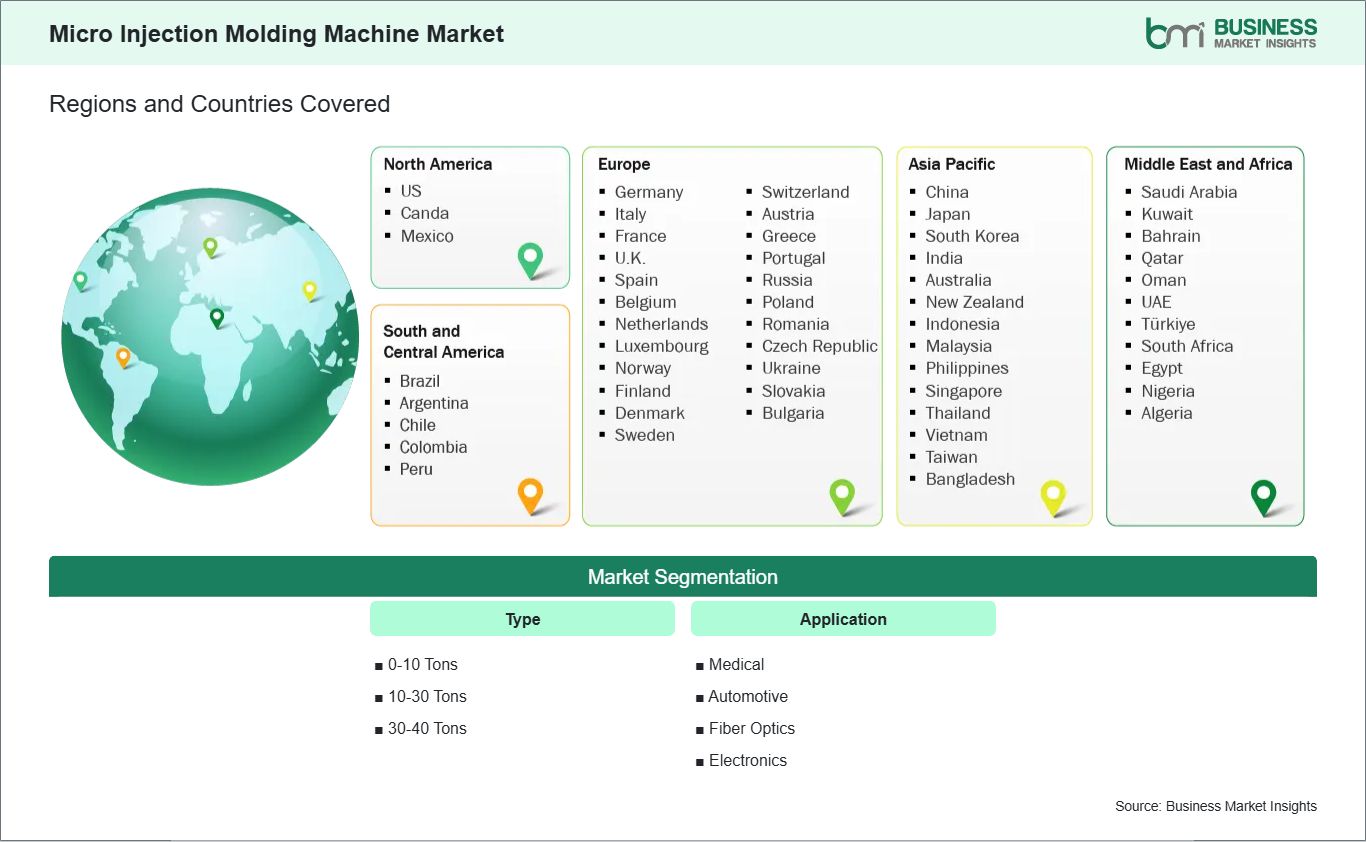
The Micro Injection Molding Machine market is segmented by type and application, reflecting different precision requirements and end-use production priorities.
By Type
- 0-10 Tons : Supports ultra-small parts requiring fine shot control.
- 10-30 Tons : Balances precision, flexibility, and stable production throughput.
- 30-40 Tons : Handles larger micro components and higher mold complexity.
By Application
- Medical : Commands strong attention due to strict tolerance and component reliability requirements.
- Automotive : Supports miniature functional parts used in sensing and connection systems.
- Fiber Optics : Prioritizes exact geometry for delicate transmission-related component assemblies.
- Electronics : Benefits from compact part production for dense and precise device layouts.
Market Forces
Micro Injection Molding Machine Market Drivers and Opportunities
Rising Utilization of Miniaturized Medical Components
Healthcare manufacturing increasingly depends on compact components that require exact molding performance and repeatable production behavior. As device architectures become smaller, manufacturers need equipment capable of processing low shot volumes without compromising dimensional stability. This requirement is encouraging the use of micro injection molding machines in medical production settings where precision, material control, and clean manufacturing conditions directly influence component acceptance and process efficiency.
Its market effect extends beyond equipment replacement and into how manufacturers structure advanced production lines for small-format devices. The need for validated output, stable cycle execution, and reduced process deviation increases the relevance of specialized molding platforms. As medical programs emphasize consistency and part integrity, this driver remains closely linked to procurement decisions, capacity planning, and long-term equipment positioning across precision-focused manufacturing environments.
Automation-Led Precision Manufacturing Expansion
Production strategies across electronics, automotive, and optical manufacturing are moving toward automated micro-scale processing with tighter control over consistency. This trend is accelerating innovation in machine design, including integrated monitoring, compact robotics, and improved parameter management. These developments create practical use cases where micro injection molding machines support high-accuracy part production, lower manual intervention, and more predictable output in technically demanding assembly chains.
Future scope emerges from broader deployment in facilities that require scalable precision without sacrificing process discipline. As automated manufacturing cells become more compact and adaptable, the market gains room for expansion across specialized product categories and regional production hubs. This opportunity carries strategic impact because it supports quality-focused growth, enables broader application coverage, and strengthens the role of micro molding equipment within advanced manufacturing investment plans.
Size and Share Analysis
Micro Injection Molding Machine Market Size and Share Analysis
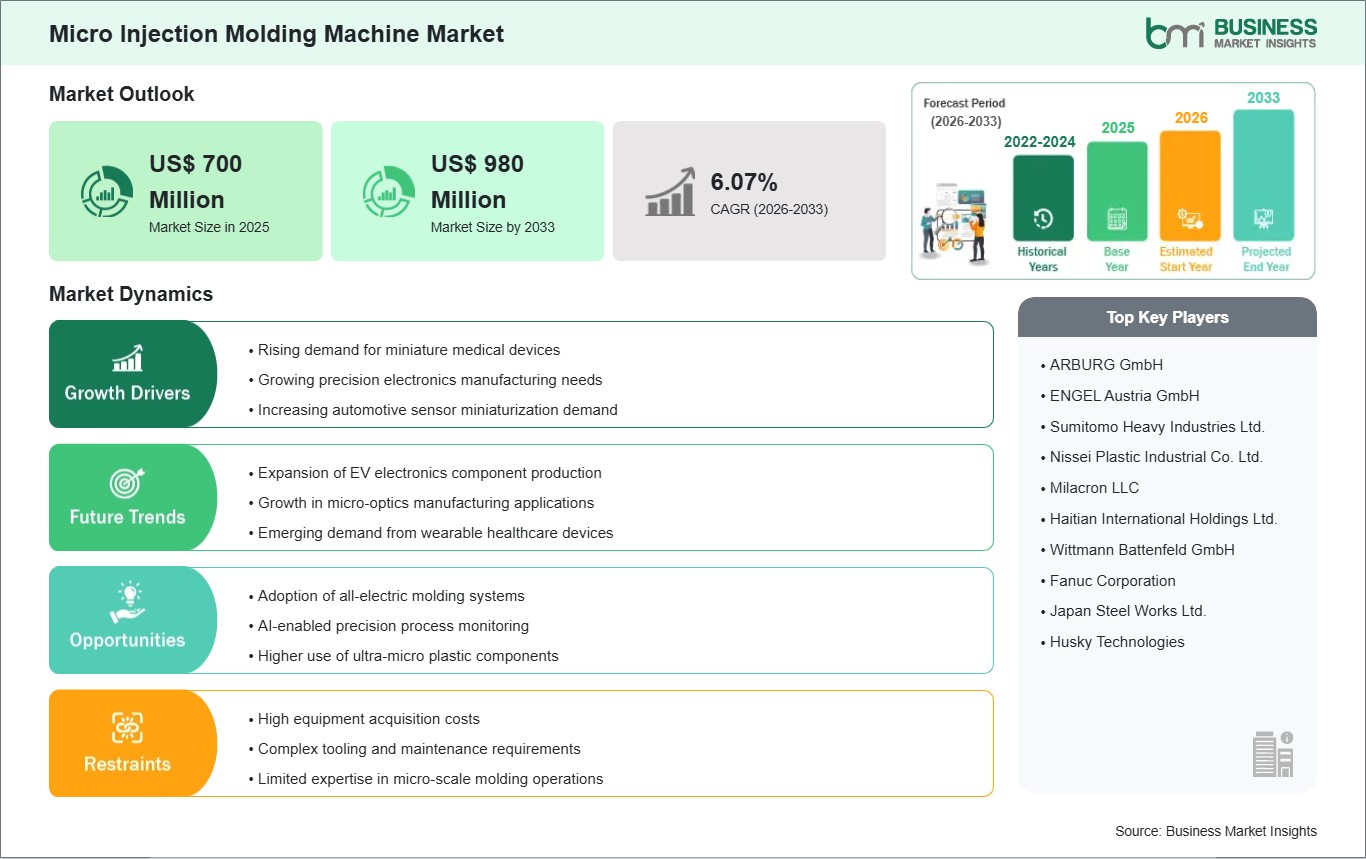
The Micro Injection Molding Machine market size is expected to reach US$ 980 Million by 2033 from US$ 700 Million in 2025. The market is estimated to record a CAGR of 6.07% from 2026 to 2033.
This trajectory points to measured expansion supported by precision manufacturing requirements, steady equipment replacement, and broader industrial emphasis on micro-scale component production.
By type, the 10-30 tons segment maintains a leading position because it aligns well with manufacturers seeking control, flexibility, and workable production range. The 0-10 tons segment remains relevant where extremely small parts and delicate tooling demand more compact machine behavior. The 30-40 tons category serves applications requiring added mold capability and broader processing scope within the micro manufacturing environment.
By application, medical stands out as the dominant area because manufacturers prioritize consistent accuracy for miniature parts used in sensitive device assemblies. Electronics also commands meaningful share through dense component design and compact product formats, while automotive contributes through sensor and connector integration. Fiber optics remains an important specialized application where dimensional precision and process repeatability are essential for product performance.
Report Coverage
Micro Injection Molding Machine Market Report Coverage and Deliverables
The " Micro Injection Molding Machine Market Size and Forecast (2022-2033)" report provides a detailed analysis of the market covering below areas:
- Market size and forecast at global, regional, and country levels for all the key market segments covered under the scope
- Market trends, as well as market dynamics such as drivers, restraints, and key opportunities
- Market analysis covering key market trends, global and regional framework, major players, regulations, and recent market developments
- Industry landscape and competition analysis covering market concentration, heat map analysis, prominent players, and recent developments for the market
- Detailed company profiles, including SWOT analysis
Geographic Insights
Micro Injection Molding Machine Market Geographic Insights
The Micro Injection Molding Machine market shows diverse regional adoption patterns influenced by manufacturing maturity, component complexity, and sector-specific demand for precision equipment. Across the global landscape, purchasing behavior reflects how strongly local industries rely on miniaturized parts, regulated production environments, and advanced tooling capabilities. Markets with established medical and electronics ecosystems typically move faster toward specialized machine platforms, while developing industrial bases adopt them through selective, application-led expansion.
North America benefits from strong technical manufacturing capabilities and sustained interest in precision-led production systems. Demand is supported by medical device development, high-specification electronics work, and a broader preference for automated processing environments. Buyers in the region often emphasize machine consistency, validation support, and operational control, which elevates the appeal of advanced micro molding equipment for specialized programs that require dependable output over repeated production cycles.
Asia Pacific continues to stand out through its broad manufacturing base and its role in supplying compact components to downstream industries. The region benefits from electronics production depth, expanding automotive component activity, and rising interest in high-precision medical manufacturing. Equipment demand is further shaped by practical needs for scale, efficiency, and tighter process control, making micro injection molding machines increasingly relevant within production strategies aimed at complex miniature parts.
Europe maintains steady relevance through engineering-intensive industries that value process stability and exact part formation, particularly in medical, electronics, and technical polymer applications. Emerging markets across the Middle East, Africa, and South and Central America show more selective uptake, often tied to industrial upgrading and niche production requirements. Together, these regions broaden the market's geographic profile by adding incremental demand where specialized manufacturing capabilities are becoming strategically important.
Industry Activity
Recent Developments
Recent developments reflect continued focus on precision, automation, and application-specific machine design. The updates below highlight notable activity relevant to this market.
- In May 2025, Wirthwein Medical has expanded its manufacturing capabilities by introducing a specially developed, fully electric 2K injection molding machine. The new system is designed for the production of highly precise and extremely small multi-component parts, including container closure systems and components used in pharmaceutical primary packaging. Tailored to the company's specific requirements, the machine combines precision, automation, and innovative technology.
- In July 2025, MHS has introduced the latest generation of its M3 micro injection molding machine, a fully automated manufacturing cell developed for high-volume production of direct-gated precision micro parts. The system operates without material waste and is designed to deliver consistent production results. The M3-D08 will be demonstrated at K 2025 in Düsseldorf, Germany, from October 8-15 in Hall 1, Booth C40. The M3 is intended for the large-scale production of complex micro-molded components weighing less than 200 milligrams, including parts as small as 10 milligrams or below.
Trust & Transparency
Research Methodology
The market analysis combines proprietary research with secondary data from government agencies, company disclosures, regulatory filings, industry databases and expert interviews. Market estimates are validated through data triangulation, cross-market benchmarking and analyst
review.
View Full Research Methodology
Key Sources Referred:
World Bank -Global Trade Indicators World Trade Organization (WTO) International Monetary Fund (IMF) International Trade Administration (ITA) Company Websites Company Annual Reports Company Investor Presentations