
Membrane Electrode Assemblies (MEA) Market Outlook: Size, Share, Trends, Growth Analysis, Competitive Landscape & Forecast, 2026-2033

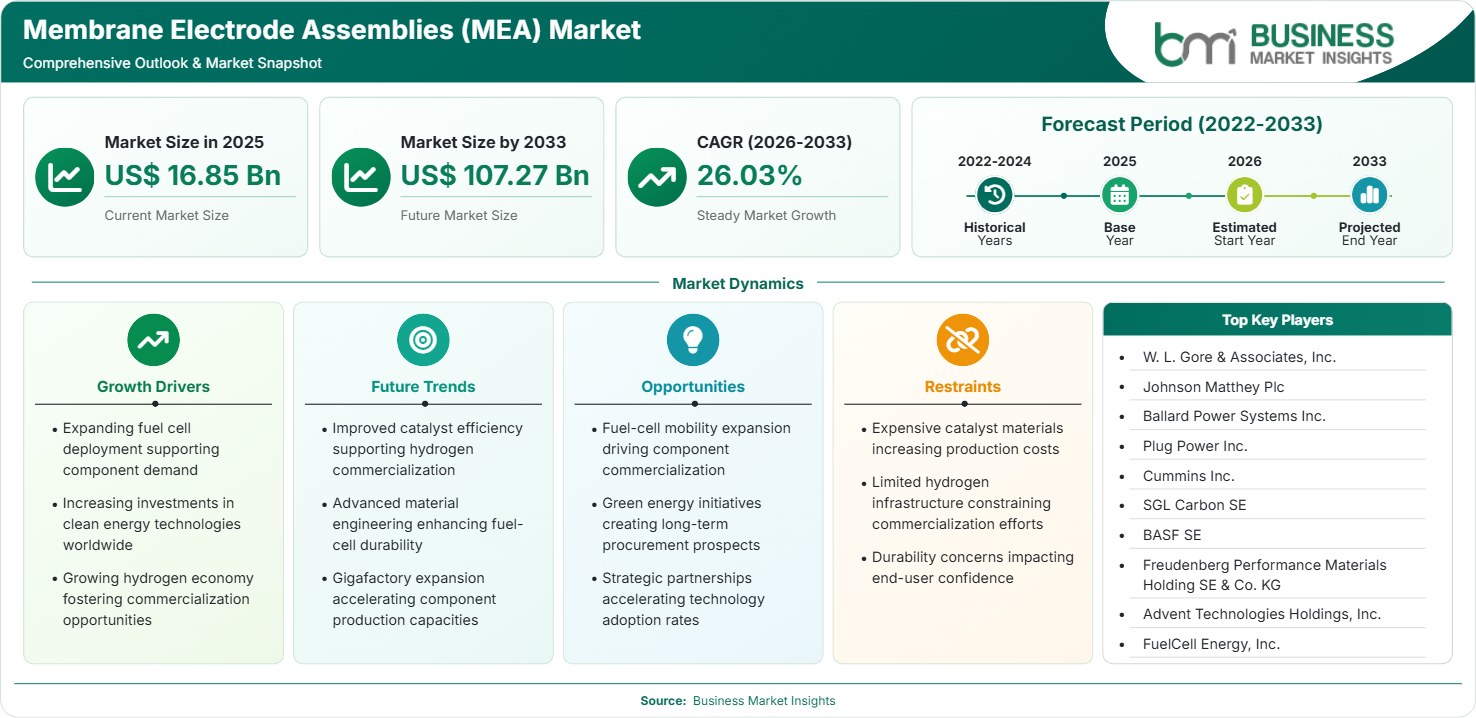
The Membrane Electrode Assemblies (MEA) Market size was valued at US$ 16.85 Billion in 2025 and is projected to reach US$ 107.27 Billion by 2033, growing at a CAGR of 26.03% during 2026–2033, driven by accelerating hydrogen economy investments, fuel cell transportation deployment, electrolyzer expansion, decarbonization mandates, and increasing adoption across mobility, industrial, and renewable energy integration applications.

Report Coverage
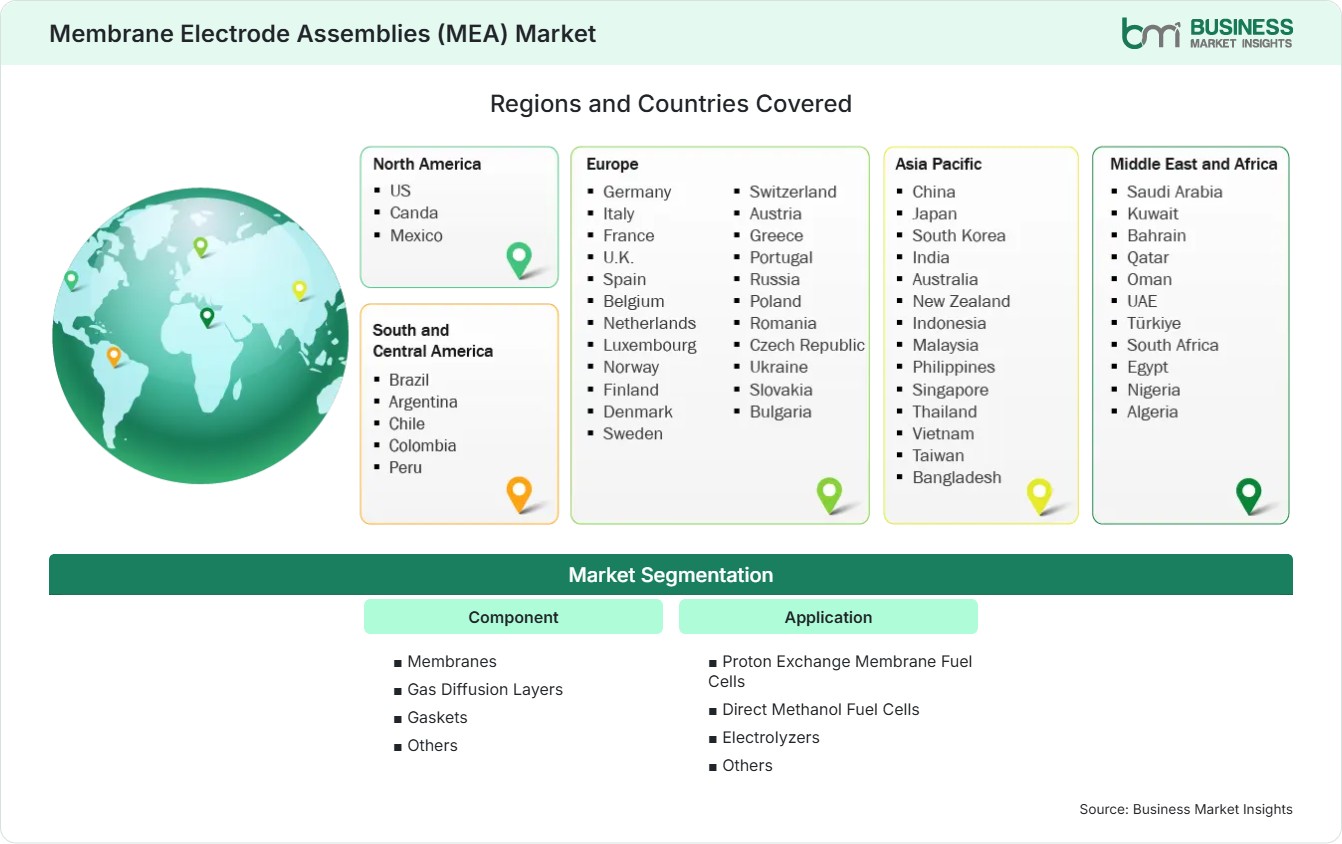
  • Component: Membranes, Gas Diffusion Layers, Gaskets, Others
  • Application: Proton Exchange Membrane Fuel Cells , Direct Methanol Fuel Cells , Electrolyzers, Others
US$ 16.85 Bn Market size in 2025
US$ 107.27 Bn Market Size by 2033
26.03% CAGR, 2026 - 2033
2026-2033 Forecast Period

AI Overview

Membrane Electrode Assemblies (MEA) Market Summary

  • North America Region: North America holds a market share of 34%–37% in 2025, growing at a CAGR of 24%–27% during 2026–2033. Demand is supported by hydrogen hub funding, fuel cell vehicle commercialization, electrolyzer manufacturing scale-up, clean-energy incentives, industrial decarbonization investments, supply-chain localization, catalyst innovation, infrastructure deployment, public-private partnerships, sustainable transportation adoption. Brief US market analysis: The US leads regional demand through hydrogen infrastructure expansion and DOE-backed projects, advancing at a CAGR of 24%–26%.
  • Fastest Growing Region: Asia Pacific holds a market share of 29%–32% in 2025, growing at a CAGR of 28%–31% during 2026–2033. Strong manufacturing ecosystems, hydrogen mobility targets, electrolyzer investments, fuel-cell buses, industrial decarbonization agendas, export competitiveness, government subsidies, renewable integration, localized production, and technology partnerships accelerate adoption.
  • Leading Segment: Proton Exchange Membrane Fuel Cells (PEMFC) holds a market share of 46%–49% in 2025, growing at a CAGR of 25%–28% during 2026–2033. Commercial vehicles, backup power systems, distributed generation, hydrogen refueling infrastructure, efficiency improvements, catalyst advances, durability gains, policy incentives, fleet electrification, and emissions reduction initiatives support expansion.
  • High Growth Segment: Electrolyzers hold a market share of 23%–26% in 2025, growing at a CAGR of 30%–33% during 2026–2033. Green hydrogen projects, renewable power integration, industrial applications, hydrogen exports, gigawatt-scale investments, energy security priorities, supportive funding mechanisms, technological optimization, and manufacturing scale drive growth.
  • Key Market Opportunity: Expansion of green hydrogen production facilities creates substantial opportunities for advanced catalyst-coated membranes, high-durability gas diffusion layers, localized manufacturing capacity, and next-generation materials supporting lower lifecycle costs.
  • Major Market Players: W. L. Gore & Associates, Inc.; Johnson Matthey Plc; Ballard Power Systems Inc.; Plug Power Inc.; Cummins Inc.; SGL Carbon SE; BASF SE; Freudenberg Performance Materials Holding SE & Co. KG; Advent Technologies Holdings, Inc.; FuelCell Energy, Inc.
Strategic Insights

Membrane Electrode Assemblies (MEA) Market: Strategic Insights

Membrane Electrode Assemblies (MEA) Market Strategic Framework
FREE PDF
Request your free sample
Request free sample
Stakeholder View

Key Takeaways

  • The value chain is becoming more integrated as membrane suppliers, catalyst manufacturers, producers of gas diffusion layers, and developers of fuel-cell stacks enter into strategic partnerships to ensure a steady supply and improve production economics.
  • The greatest potential for growth lies in the use of electrolyzers as green hydrogen projects progress from pilot installations to full-scale commercial operations in various energy-intensive industries.
  • Industry innovation is centered on reducing platinum-group-metal content, improving membrane durability, enhancing conductivity, and increasing stack efficiency under demanding operating conditions.
  • The Asia Pacific region has the strongest case for investment because of the considerable government support it receives, its manufacturing capabilities, and the rapid growth in hydrogen transport and industrial use.
  • As companies look to gain access to technology, expand their production scale, and strengthen their access to technology in the growing hydrogen economy, the number of partnerships and joint development agreements is rising.
  • Suppliers are expected to gain a competitive advantage through localized manufacturing schemes, provided that they are able to meet regional content requirements and achieve their supply-chain resilience objectives.
Geographic Outlook

Membrane Electrode Assemblies (MEA) Market Regional Highlights

North America Membrane Electrode Assemblies Market

North America accounts for 34%–37% of global demand in 2025 and is projected to expand at a CAGR of 24%–27% through 2033. The region benefits from hydrogen hub investments, industrial decarbonization policies, and commercial vehicle fuel-cell deployment. The Membrane Electrode Assemblies Market share remains concentrated in the United States and Canada, supported by strong research ecosystems, manufacturing expansion, and public funding for clean hydrogen infrastructure development across transportation and energy applications.

  • The funding from the DOE for the hydrogen hub promotes large-scale commercialization projects and encourages a range of manufacturing investments in the areas of membranes, catalysts, and stack components.
  • Increasingly, heavy-duty transportation fleets are evaluating fuel-cell technologies for long-range operations, as rapid refueling and operational flexibility remain essential.
  • Industrial users are seeking hydrogen-based methods for achieving decarbonization in the areas of refining, chemicals, and energy-intensive manufacturing.
  • Investment from private capital is still going into electrolyzer and hydrogen infrastructure projects, which is enhancing the long-term outlook for demand.
  • The formation of strategic partnerships between technology developers and industrial companies speeds up the process of commercialization and deployment.

US Membrane Electrode Assemblies Market

The United States represents 78%–82% of North American Membrane Electrode Assemblies Market demand and advances at a CAGR of 24%–26% during the forecast period. Incentives provided by the federal government, hydrogen production credits, and investments made in infrastructure that produces low-carbon energy are driving market growth. Manufacturing activities within the country are promoting localizing the supply chain and increasing production of key components for fuel cells and electrolyzers.

  • The mechanisms for federal support are still helping to improve the economics of projects involving hydrogen-based technologies and the manufacturing of components.
  • More operators of commercial vehicles are looking into fuel-cell systems for use in freight and logistics applications.
  • Investments in advanced manufacturing increase the extent of domestic production of membranes and related materials.
  • The objectives set for the deployment of clean energy lead to extra demand in various industrial sectors.

Europe Membrane Electrode Assemblies Market

Europe holds 27%–30% Membrane Electrode Assemblies Market share in 2025 and is anticipated to record a CAGR of 25%–28% through 2033. Regional deployment is dominated by Germany, whereas Spain and the Netherlands are becoming high-growth regions for hydrogen investments. Decarbonization commitment, hydrogen strategy and industry transformation encourage adoption. Regional manufacturing and research collaboration increases competitiveness in fuel cells and electrolyzers supply chain.

  • Germany is still the biggest regional market for MEA, thanks to automotive and industrial hydrogen projects.
  • Spain shows great potential for growth as a result of its initiatives to develop hydrogen using renewable energy.
  • EU funding programs boost manufacturing capacity and help bring new technology to market.
  • The use of electrolysis in industrial applications is still speeding up in a number of member states.
  • Projects for cross-border hydrogen infrastructure have a positive effect on the long-term demand fundamentals.

Asia Pacific Membrane Electrode Assemblies Market

Asia Pacific captures 29%–32% of global demand and records the fastest CAGR of 28%–31% during 2026–2033. China leads deployment volumes while India emerges as a high-growth market supported by hydrogen mission initiatives. Strong manufacturing ecosystems, fuel-cell transportation programs, and electrolyzer investments support the region. Significant Membrane Electrode Assemblies Market growth opportunities are linked to localization strategies and expanding renewable-energy integration efforts.

  • China leads regional production and use in both fuel-cell and electrolyzer applications.
  • Japan keeps supporting hydrogen mobility and building fuel-cell infrastructure.
  • India is benefiting from its growing investment in hydrogen and its domestic manufacturing programs.
  • Regional supply chains offer competitive cost structures and manufacturing scale advantages.
  • The government's incentives cause the commercial adoption to take place in a number of industries.

Rest of World Membrane Electrode Assemblies Market

The Rest of World region accounts for 8%–11% of Membrane Electrode Assemblies Market demand and advances at a CAGR of 26%–29% through 2033. In South & Central America, Brazil dominates the landscape through clean energy and decarbonization of the industries. In the Middle East & Africa, Saudi Arabia and UAE invest in huge green hydrogen projects. Abundance of renewable energy sources and hydrogen exports favor a positive outlook in the long term.

  • Saudi Arabia is becoming a major center for hydrogen production, thanks to large-scale investments.
  • The UAE's projects are likely to increase regional demand for technologies and components associated with electrolysis.
  • Brazil is promoting diversification of its clean energy sources through various initiatives related to hydrogen.
  • Strategies for exporting hydrogen place a demand on advanced electrolyser technologies.
  • International partnerships help to promote the transfer of technology and investment activity.
Global Market Geography
FREE PDF
Request your free sample
Request free sample
Segment Analysis

Membrane Electrode Assemblies (MEA) Market Segmentation

Component

This segment accounts for 51%–54% market share in 2025 and grows at a CAGR of 25%–28%. Increasing focus on efficiency, durability, and cost optimization supports demand across core materials. The Membrane Electrode Assemblies Market scope continues expanding as manufacturers enhance catalyst utilization and develop next-generation membrane architectures for advanced fuel-cell and electrolyzer systems.

  • Membranes: Critical for proton conductivity and system efficiency, supported by innovations improving durability, chemical stability, and high-performance operation across transportation and industrial applications.
  • Gas Diffusion Layers: Enable efficient gas transport and water management, supporting higher power density and operational reliability in fuel-cell and electrolyzer systems.
  • Gaskets: Essential for sealing performance, durability, and system integrity, particularly in demanding operating environments requiring long service lives.

Application

Applications represent the primary demand driver, with adoption supported by hydrogen mobility, energy storage, and green hydrogen investments. This segment holds 46%–49% share in leading categories and includes the most rapidly expanding use cases. The Membrane Electrode Assemblies Market trends increasingly reflect growth in electrolyzer deployments and industrial hydrogen applications.

  • Proton Exchange Membrane Fuel Cells (PEMFC): Widely adopted across transportation and stationary power applications due to fast response rates, compact design, and favorable operational efficiency.
  • Direct Methanol Fuel Cells (DMFC): Finding niche opportunities in portable power and specialized applications requiring energy density, operational flexibility, and simplified fuel logistics.
  • Electrolyzers: Benefiting from accelerating green hydrogen investments, renewable integration projects, and industrial decarbonization initiatives supporting long-term deployment growth.
Market Forces

Membrane Electrode Assemblies (MEA) Market Dynamics

Key Market Drivers

Acceleration of Global Hydrogen Economy Programs

Hydrogen strategies supported by the government in North America, Europe, and Asia are generating long-term demand for fuel-cell and electrolyzer technologies. The national hydrogen roadmaps now place greater emphasis on providing manufacturing incentives, funding infrastructure, and offering assistance with commercialization. The International Energy Agency remains confident about the strong momentum of the projects that have been announced in the area of hydrogen investment. These policies promote the use of advanced materials and help to develop the supply chain. Increasing industrial interest in low-carbon fuels is leading to higher demand for equipment and more component purchases.

Expansion of Fuel Cell Transportation Applications

Interest in the use of fuel cells is increasing in buses, trucks, logistics fleets, rail transport, and in some marine applications. People prefer the advantages of quick refueling, a long driving range, and operational flexibility when compared to certain battery-only solutions. The need to decarbonize fleets and more stringent emission regulations are promoting the introduction of this technology. As the various vehicle programs move towards commercial scale, demand for durable, high-performance assemblies rises. Greater catalyst efficiency and better manufacturing processes also improve competitiveness.

Growth of Electrolyzer Deployment for Green Hydrogen Production

The quick growth of green hydrogen projects is acting as a major driver of industrial progress. To boost efficiency and reliability, electrolyzers require high-performance membrane and catalyst systems. Commercial deployment is being pushed forward by large-scale initiatives in Europe, the Middle East, Asia, and North America. The increasing availability of renewable electricity not only improves the economics of these projects but also helps to promote wider hydrogen adoption. Greater investment pledges from utilities, industrial companies, and energy developers are increasing the level of procurement. The long-term decarbonization goals for the steel, chemicals, refining, and energy storage sectors also contribute to the demand for advanced assembly technologies and the related manufacturing capacity.

Key Market Opportunities

Localized Manufacturing Capacity Development

Resilience issues within the supply chain are leading to regional manufacturing investments in large markets. If companies can establish regional manufacturing capabilities, they may take advantage of government incentives, procurement preferences, and lower logistics risks. Increasing demands for domestic content in important energy technologies create opportunities in manufacturing membranes, catalysts, and gas diffusion layers. Manufacturing on a regional level could improve response capabilities and customer relations. Future Membrane Electrode Assemblies Market Forecasts are increasingly influenced by localization strategies and government-supported industrial development initiatives designed to strengthen technological competitiveness and secure supply availability.

Advanced Low-Platinum Catalyst Technologies

The continued reduction in reliance on platinum-group metals remains a major area of opportunity. Advances in research are allowing for more efficient use of catalysts while at the same time keeping up with the required levels of performance and durability. Since the amount of precious metal used is reduced, this can greatly enhance commercial competitiveness and open up a wider range of applications. Firms that succeed in bringing next-generation catalyst technologies to market could obtain higher margins and see wider acceptance. Industrial customers are now demanding solutions that offer cost advantages without having to sacrifice performance. Further innovation in materials science is expected to create differentiation opportunities in both the fuel-cell and electrolyzer markets, especially as volumes put into use grow and global commercialization proceeds.

Industrial Decarbonization and Power Integration

The use of hydrogen in industries provides a great number of opportunities for growth, apart from the transportation sector. The production of steel, chemical products, refining, and energy storage is now considering the potential of hydrogen use. The use of modern devices is of great importance for electrochemical reactions. The current Membrane Electrode Assemblies Market Report indicates that Renewable-powered hydrogen facilities also support long-duration storage and grid balancing applications. Commercialization across industrial sectors offers opportunities for long-term contracts, large-scale production deployments, and technology partnerships supporting sustained MEA market expansion.

Market Restraints and Challenges

High Material Costs and Manufacturing Complexity

Factor: Dependence on platinum-group metals, specialized membranes, and precision manufacturing processes increases production costs.

Impact: Higher system costs may retard the adoption of price-sensitive customers, leading to delays in the commercialization process. Even as continued innovations lead to increased efficiency in materials usage, there are still difficulties with cost-effectiveness, particularly when compared with traditional technologies in certain fields. Producers have to strike a balance between increased performance and cost-effectiveness. Volatility in supply chains may also affect procurement economics. Major capital investments in production plants present entry barriers to the industry.

Infrastructure and Supply Chain Development Gaps

Factor: Hydrogen production, storage, transportation, and refueling networks remain unevenly developed across regions.

Impact: Limited infrastructure can constrain technology deployment and reduce confidence among end users evaluating investments. Project developers may face delays related to permitting, construction, and supply coordination. Regional disparities in hydrogen availability create adoption challenges despite strong policy support. Companies must often invest across multiple parts of the value chain to support commercialization. Addressing infrastructure bottlenecks will remain important for accelerating deployment and achieving broader MEA Market penetration across transportation and industrial applications.

Company Analysis

Competitive Landscape

The competitive environment reflects ongoing innovation, strategic partnerships, and manufacturing expansion. The Membrane Electrode Assemblies Market analysis highlights increasing focus on electrolyzer components, catalyst-coated membranes, and fuel-cell durability improvements.

Company Name

Overview

Products and Services relevant to this market

W. L. Gore & Associates, Inc.

Advanced materials company with strong expertise in fuel-cell membrane technologies and hydrogen applications.

Proton exchange membranes, catalyst-coated membranes, fuel-cell materials, hydrogen technology solutions.

Johnson Matthey Plc

Global sustainable technologies company focused on catalysts and hydrogen solutions.

Catalyst coated membranes, electrolyzer components, fuel-cell catalysts, hydrogen materials.

Ballard Power Systems Inc.

Leading fuel-cell technology developer serving mobility and stationary markets.

Fuel-cell stacks, MEA technologies, hydrogen power systems, engineering services.

Plug Power Inc.

Hydrogen ecosystem participant with integrated fuel-cell and electrolyzer capabilities.

Fuel cells, electrolyzers, hydrogen infrastructure, related components.

Cummins Inc.

Power technologies company active in hydrogen and electrolyzer solutions.

PEM electrolyzers, fuel-cell systems, hydrogen production technologies.

SGL Carbon SE

Specialty materials manufacturer serving fuel-cell and energy applications.

Gas diffusion layers, carbon materials, fuel-cell components.

BASF SE

Chemicals leader engaged in catalyst and advanced materials development.

Catalyst technologies, fuel-cell materials, hydrogen solutions.

Freudenberg Performance Materials Holding SE & Co. KG

Industrial materials specialist supporting fuel-cell manufacturing requirements.

Gas diffusion media, seals, technical materials, fuel-cell products.

Advent Technologies Holdings, Inc.

Fuel-cell materials and electrochemical technology developer.

MEAs, membranes, fuel-cell components, engineering solutions.

FuelCell Energy, Inc.

Clean-energy technology company serving distributed power markets.

Fuel-cell technologies, hydrogen-related solutions, energy systems.

Trust & Transparency

Research Methodology

The market analysis combines proprietary research with secondary data from government agencies, company disclosures, regulatory filings, industry databases and expert interviews. Market estimates are validated through data triangulation, cross-market benchmarking and analyst review.

View Full Research Methodology

Questions Answered

Frequently Asked Questions

What does a Membrane Electrode Assemblies Market Report typically evaluate?

A comprehensive report assesses market size, competitive positioning, technology developments, regional demand patterns, application trends, investment activity, and future growth opportunities.

How important is innovation in catalyst technology?

Catalyst innovation is critical because it reduces material costs, improves efficiency, extends operating life, and enhances commercial viability across fuel-cell and electrolyzer applications.

Which region is expected to grow fastest during the forecast period?

Asia Pacific is projected to register the highest growth rate because of strong manufacturing ecosystems, supportive government policies, and expanding hydrogen mobility initiatives.

Which application area offers the strongest future potential?

Electrolyzers present the highest growth potential due to increasing investments in green hydrogen production and industrial decarbonization programs worldwide.

What is driving long-term demand for membrane electrode assemblies?

Hydrogen adoption across transportation, industrial decarbonization, renewable energy storage, and green hydrogen production is creating sustained demand for advanced electrochemical components and associated manufacturing capacity.

Access the Full Membrane Electrode Assemblies (MEA) Market Report

Get segment-level forecasts, regional estimates, competitive benchmarking, company profiles and downloadable Excel datasets.

Access the full Membrane Electrode Assemblies (MEA) Market Report
350 pages PDF & Excel | 2026-09-20
Similar Research

Related Market Reports