
Medical Gas Analyzers Market Outlook: Size, Share, Trends, Growth Analysis, Competitive Landscape & Forecast, 2026-2033

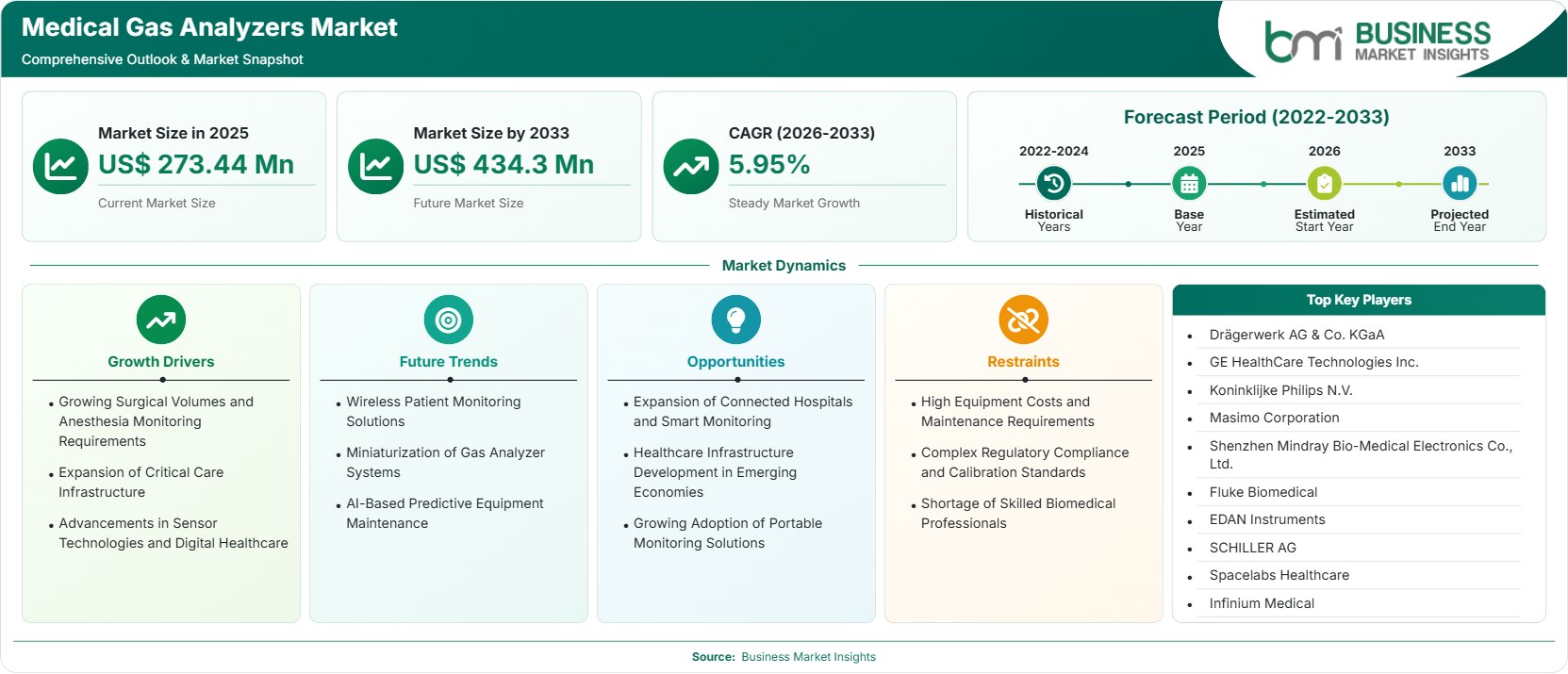
The Medical Gas Analyzers Market size was valued at US$ 273.44 Million in 2025 and is projected to reach US$ 434.3 Million by 2033, growing at a CAGR of 5.95% during 2026–2033. Rising surgical procedures, stricter patient safety standards, expanding critical care infrastructure, and advances in anesthesia monitoring create strong opportunities for market expansion.

Report Coverage
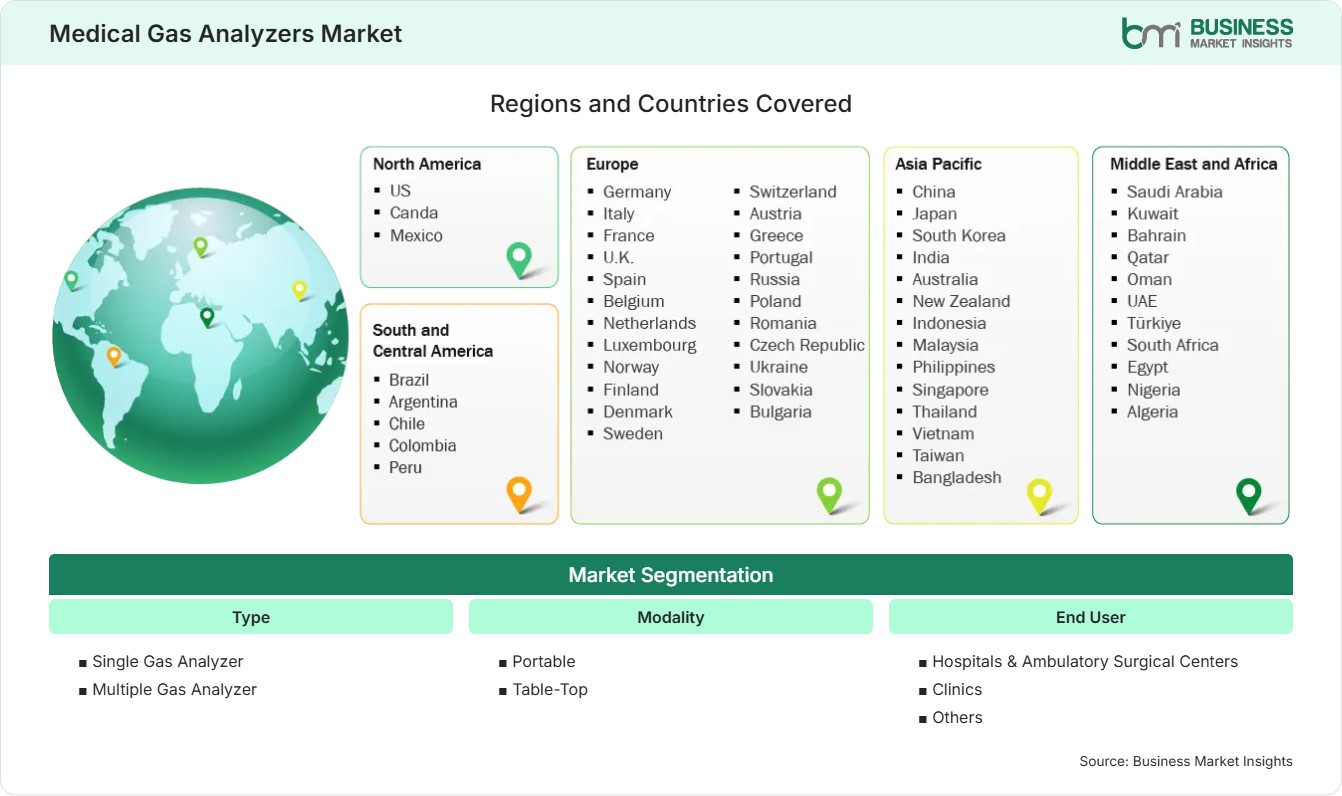
  • Type: Single Gas Analyzer, Multiple Gas Analyzer
  • Modality: Portable, Table-Top
  • End User: Hospitals & Ambulatory Surgical Centers, Clinics, Others
US$ 273.44 Mn Market size in 2025
US$ 434.3 Mn Market Size by 2033
5.95% CAGR, 2026 - 2033
2026-2033 Forecast Period

AI Overview

Medical Gas Analyzers Market Summary

  • North America Region: North America holds 36%–39% medical gas analyzers market share in 2025, growing at a CAGR of 5.2%–5.6% during 2026–2033. Growth is driven by advanced hospital infrastructure, strict patient safety regulations, increasing anesthesia monitoring adoption, operating room modernization, and digital healthcare integration. The U.S. market benefits from continuous hospital investments, high surgical volumes, and advanced respiratory monitoring adoption, supporting a 5.3%–5.7% CAGR through 2033.
  • Fastest Growing Region: Asia Pacific accounts for 25%–28% market share in 2025 and is projected to grow at a CAGR of 7.1%–7.6%. Expansion is supported by healthcare infrastructure investments, rising surgical procedures, medical tourism, increasing ICU capacity, domestic manufacturing, and government healthcare modernization programs.
  • Leading Segment: Multiple Gas Analyzer represents 58%–62% market share in 2025 while expanding at a CAGR of 6.2%–6.6%. Simultaneous monitoring, improved clinical accuracy, digital integration, enhanced patient safety, and increasing adoption within anesthesia workstations continue supporting demand.
  • High Growth Segment: Portable modality holds 41%–45% market share in 2025 and records a CAGR of 6.8%–7.3%. Rising emergency care, ambulatory surgeries, transport monitoring, compact sensor innovations, and wireless connectivity continue strengthening adoption across healthcare environments.
  • Key Market Opportunity: Expanding smart hospitals create demand for cloud-connected gas analyzers integrating predictive maintenance, artificial intelligence, remote diagnostics, workflow optimization, and centralized asset management to improve operational efficiency and patient safety.
  • Major Market Players: Drägerwerk AG & Co. KGaA, GE HealthCare Technologies Inc., Koninklijke Philips N.V., Masimo Corporation, Shenzhen Mindray Bio-Medical Electronics Co., Ltd., Fluke Biomedical, EDAN Instruments, SCHILLER AG, Spacelabs Healthcare, Infinium Medical.
Strategic Insights

Medical Gas Analyzers Market: Strategic Insights

Medical Gas Analyzers Market Strategic Framework
FREE PDF
Request your free sample
Request free sample
Stakeholder View

Key Takeaways

  • The medical gas analyzers market continues to grow with the cooperation of medical equipment manufacturers, software firms, hospitals, and biomedical service providers.
  • Many gas analyzers and portable analyzers have the highest business potential due to the growing demand in hospitals for increased operating room capacity, emergency care services, and intensive care capabilities.
  • Innovation in the industry includes wireless technology, artificial intelligence, predictive maintenance, analytics in the cloud, miniaturized sensors, and compatibility with hospital information systems.
  • The greatest opportunities for investments in the coming years are in Asia Pacific due to the growth of health facilities, growing number of surgeries, government initiatives, and domestic production of medical devices.
  • Strategic partnerships, expansion into regional markets, and after-sales services are key factors of competition among manufacturers in establishing good relations with their customers.
  • Sustainability programs that encourage modular design, reduced gas calibration usage, and energy efficient monitoring systems are gaining importance in purchasing decisions.
Geographic Outlook

Medical Gas Analyzers Market Regional Highlights

North America Medical Gas Analyzers Market

North America accounts for 36%–39% of the Medical Gas Analyzers Market share in 2025 and is expected to grow at a CAGR of 5.2%–5.6% through 2033. Strong healthcare infrastructure, high surgical volumes, advanced anesthesia systems, and strict patient safety regulations continue supporting regional leadership. Hospitals are steadily replacing legacy monitoring systems with connected analyzers that improve measurement accuracy, workflow efficiency, and regulatory compliance.

  • The hospitals are consistently upgrading the anesthesia workstations with multi-gas analyzers which enhance the performance of monitors, documentation, cyber security, and operational efficiency.
  • The growth in ambulatory surgical centers and minimally invasive surgery has increased the requirement for portable analyzers for perioperative and emergency respiratory monitoring.
  • The predictive maintenance software and remote diagnostics help the healthcare organization to minimize the equipment downtime and optimize the performance of analyzers.
  • The manufacturers develop a relationship with the customers by providing calibration, software updates, training, and maintenance of equipment.

US Medical Gas Analyzers Market

The United States contributes 78%–82% of the North American market and is projected to expand at a CAGR of 5.3%–5.7% during the forecast period. Continued investments in hospital modernization, digital healthcare, and advanced operating room technologies sustain demand. High adoption of connected anesthesia monitoring systems and strong replacement cycles further reinforce long-term market expansion.

  • The introduction of more gas analyzers to large health care organizations' hospital information systems is on the rise.
  • Modernization of intensive care departments leads to the purchase of high-tech respiratory monitoring equipment with better precision of analysis.
  • AI maintenance and digital asset management increase efficiency and decrease maintenance expenses.
  • Accreditation and regulatory compliance motivate regular calibration and replacement of old equipment.

Europe Medical Gas Analyzers Market

Europe holds 27%–30% market share in 2025 and is forecast to register a CAGR of 5.5%–5.9% through 2033. Mature healthcare systems, strict medical device regulations, and continuous investments in hospital modernization support market growth. Germany remains the largest regional market, while Poland and other Eastern European countries record comparatively faster expansion.

  • Germany has led regional demand due to its sophisticated hospitals and high uptake of anesthesia monitoring technology.
  • The United Kingdom has continued spending on operating theater upgrades and digital monitoring of patients in public hospitals.
  • Faster growth is seen in Poland due to increased investments in surgery by hospitals.
  • Sustainability policies in Europe have promoted uptake of energy-efficient and modular monitoring technology.
  • Increasing regulations in medical devices have pushed for the replacement of old monitoring systems with new ones.

Asia Pacific Medical Gas Analyzers Market

Asia Pacific represents 25%–28% market share in 2025 and is anticipated to grow at a CAGR of 7.1%–7.6%, making it the fastest-growing regional market. Expanding healthcare infrastructure, rising surgical procedures, growing medical tourism, and government investments in hospital modernization continue driving equipment demand. China leads the region, while India records the fastest growth.

  • China benefits from large-scale hospital expansion, domestic manufacturing, and increasing demand for advanced respiratory monitoring technologies.
  • India experiences strong growth through expanding tertiary hospitals, specialty clinics, and ambulatory surgical centers.
  • Japan continues replacing conventional monitoring equipment with advanced digital anesthesia monitoring solutions.
  • Southeast Asian countries invest in healthcare modernization, increasing adoption of advanced gas analyzers across public and private hospitals.
  • Local manufacturing and distribution partnerships improve equipment availability and after-sales service across the region.

Rest of World Medical Gas Analyzers Market

The Rest of World region accounts for 8%–10% market share in 2025 and is expected to expand at a CAGR of 6.0%–6.4% through 2033. South & Central America benefit from improving hospital investments, while the Middle East & Africa experience increasing healthcare modernization supported by government funding and private healthcare expansion.

  • Brazil leads South & Central America through growing investments in hospital modernization and surgical care infrastructure.
  • Saudi Arabia records the strongest Middle Eastern growth through national healthcare transformation and hospital expansion projects.
  • South Africa continues strengthening tertiary healthcare facilities with advanced respiratory monitoring technologies.
  • International manufacturers expand regional partnerships to improve technical support, product availability, and maintenance services.
  • Rising private healthcare investment and medical tourism continue supporting procurement of advanced monitoring equipment.
Global Market Geography
FREE PDF
Request your free sample
Request free sample
Segment Analysis

Medical Gas Analyzers Market Segmentation

Type

The Type segment accounted for 58%–62% market share in 2025 and is projected to grow at a CAGR of 6.2%–6.6% through 2033. The Medical Gas Analyzers Market scope continues expanding as hospitals prioritize accurate respiratory monitoring, digital connectivity, and patient safety while increasing investments in advanced anesthesia technologies.

  • Single Gas Analyzer: Widely used for targeted oxygen or carbon dioxide monitoring in smaller hospitals, clinics, and routine respiratory applications where cost efficiency and operational simplicity remain important.
  • Multiple Gas Analyzer: Enables simultaneous monitoring of multiple anesthetic gases, improving clinical accuracy, workflow efficiency, patient safety, and compatibility with advanced anesthesia workstations.

Modality

The Modality segment represented 41%–45% market share in 2025 and is expected to expand at a CAGR of 6.8%–7.3% during the forecast period. Increasing emergency care requirements, outpatient procedures, and advances in compact sensing technologies continue supporting broader adoption across healthcare environments.

  • Portable: Supports emergency transport, ambulatory care, biomedical servicing, and point-of-care monitoring through lightweight design, rapid measurements, and flexible deployment.
  • Table-Top: Preferred in operating rooms and intensive care units where continuous monitoring, analytical precision, and seamless integration with hospital equipment are essential.

End User

The End User segment held 64%–68% market share in 2025 and is projected to grow at a CAGR of 6.1%–6.5% through 2033. Rising surgical procedures, expanding critical care capacity, and healthcare modernization continue driving analyzer procurement across medical facilities.

  • Hospitals & Ambulatory Surgical Centers: Account for the largest demand owing to high procedural volumes, advanced anesthesia monitoring requirements, and continuous investment in patient safety technologies.
  • Clinics: Increasingly adopt compact analyzers for respiratory diagnostics, outpatient procedures, and routine monitoring while maintaining reliable clinical performance.
Market Forces

Medical Gas Analyzers Market Dynamics

Key Market Drivers

Growing Surgical Volumes and Anesthesia Monitoring Requirements

Global growth in the numbers of surgeries is further fueling the demand for innovative respiratory monitoring systems. The WHO stresses that continuous anesthesia monitoring is essential to ensure safety of patients and prevent complications during surgery. More orthopedic, cardio, neurosurgery, and minimally invasive procedures call for effective monitoring of oxygen, carbon dioxide, and anesthetic gases. Medical Gas Analyzers Market growth will be further fueled by the increased number of ambulatory surgical centers, operating room upgrades, and increasing use of anesthesia workstations. The demand for analyzers with better accuracy, automation of calibration, digital interface, and better respiratory monitoring is growing among hospitals.

Expansion of Critical Care Infrastructure

The governments and healthcare organizations are still continuing their investments in ICU, ER, and tertiary care hospitals in order to improve healthcare capabilities. Such investments will lead to higher requirement of advanced medical gas analyzers that can facilitate ventilators, anesthesia systems, and respiratory monitors. The factors like replacement of old devices with newer devices having more accuracy in measurements have been included in the Medical Gas Analyzers Market trends. The expansion of healthcare infrastructure in APAC, MEA, and Latin American regions along with modernization efforts in developed nations will help in maintaining procurement opportunities.

Advancements in Sensor Technologies and Digital Healthcare

Technological advancements have brought about improvements in the performance of analyzers through infrared spectroscopy, paramagnetic oxygen sensors, miniature electronic components, and wireless communication. The current generation of analyzers is increasingly embracing connectivity to the cloud, predictive maintenance, artificial intelligence, and integration with hospital information systems. All these features facilitate easy management of the devices and increase their accuracy and decrease their maintenance needs. Additionally, healthcare facilities get to enjoy the benefits of automated calibration, live reporting, and monitoring by different clinical departments. With healthcare facilities embracing digital transformation projects, vendors that develop software-driven analyzers are gaining an edge over others.

Key Market Opportunities

Expansion of Connected Hospitals and Smart Monitoring

The global transition toward digitally connected hospitals creates attractive opportunities for manufacturers of advanced medical gas analyzers. Healthcare providers increasingly seek equipment capable of integrating with anesthesia workstations, electronic medical records, and centralized monitoring platforms. Medical Gas Analyzers Market Forecasts indicate that investments in cloud connectivity, predictive maintenance, cybersecurity, and remote diagnostics will continue expanding across both developed and emerging healthcare markets. Manufacturers offering software-enabled lifecycle services, interoperability, and automated reporting solutions are expected to strengthen customer retention while generating recurring service revenue through long-term maintenance contracts.

Healthcare Infrastructure Development in Emerging Economies

The rapid development of the healthcare sector in the Asia Pacific region, Latin America, the Middle East, and Africa offers great growth prospects. The authorities are making efforts towards the development of tertiary care hospitals, ICUs, and surgical facilities along with supporting the use of new medical technologies. Increasing spending on healthcare, medical tourism, and the local manufacturing of equipment is also increasing the demand for respiratory monitors. The manufacturers who set up production centers and distribution centers will be able to have an advantage in these emerging markets.

Growing Adoption of Portable Monitoring Solutions

Increasing preference for portable healthcare equipment creates new commercial opportunities across emergency care, ambulatory surgery, transport medicine, and outpatient healthcare services. Compact analyzers equipped with wireless communication, longer battery life, and high analytical accuracy support flexible deployment across diverse clinical environments. Healthcare providers value portable systems that deliver reliable respiratory monitoring without compromising performance. Continued advancements in miniaturized sensor technologies and digital connectivity are expected to expand product applications while improving operational efficiency and supporting decentralized healthcare delivery.

Market Restraints and Challenges

High Equipment Costs and Maintenance Requirements

Factor: Advanced gas analyzers require sophisticated sensing technologies, precision calibration systems, software updates, and regular servicing, resulting in higher acquisition and operational costs. Impact: Budget constraints often delay equipment replacement, particularly in smaller hospitals and healthcare facilities within developing regions. High ownership costs also encourage procurement of lower-priced alternatives with fewer advanced features, limiting adoption of premium multi-gas monitoring platforms. Manufacturers must balance innovation with affordability by expanding financing options, service agreements, and localized technical support to improve accessibility.

Complex Regulatory Compliance and Calibration Standards

Factor: Medical gas analyzers must comply with rigorous international quality, safety, and performance regulations while meeting periodic calibration and documentation requirements. Impact: Compliance increases development costs, extends product approval timelines, and adds operational complexity for manufacturers and healthcare providers. Hospitals must maintain regular calibration schedules and preventive maintenance programs to ensure measurement accuracy and regulatory compliance. These requirements can slow procurement decisions, particularly among smaller healthcare organizations with limited technical resources, while increasing overall lifecycle management costs.

Company Analysis

Competitive Landscape

The market remains moderately consolidated, with leading manufacturers focusing on product innovation, digital integration, precision sensing technologies, and global service expansion. Medical Gas Analyzers Market analysis indicates that companies are strengthening their competitive positions through hospital partnerships, software-enabled monitoring platforms, aftermarket services, and regulatory compliance while expanding portable and multi-gas analyzer portfolios.

Company Name

Overview (20–30 words)

Products and Services Relevant to this Market (20–30 words)

Drägerwerk AG & Co. KGaA

Global medical technology company specializing in anesthesia, intensive care, respiratory monitoring, and hospital equipment with a strong international service network.

Multi-gas analyzers, anesthesia monitoring systems, gas detection technologies, calibration services, respiratory monitoring solutions, and technical support.

GE HealthCare Technologies Inc.

Leading healthcare technology provider delivering imaging, anesthesia, patient monitoring, and digital healthcare solutions for hospitals worldwide.

Gas analysis modules, anesthesia monitoring systems, patient monitoring platforms, equipment lifecycle services, and digital healthcare integration.

Koninklijke Philips N.V.

International healthcare technology company focused on connected care, patient monitoring, and hospital workflow optimization solutions.

Patient monitoring systems, respiratory monitoring technologies, clinical software, equipment integration, and healthcare support services.

Masimo Corporation

Medical technology company recognized for advanced patient monitoring, signal processing innovation, and noninvasive monitoring technologies.

Respiratory monitoring solutions, patient monitoring systems, sensor technologies, connectivity software, and clinical monitoring accessories.

Shenzhen Mindray Bio-Medical Electronics Co., Ltd.

Global manufacturer offering anesthesia, monitoring, imaging, and diagnostic equipment with expanding international operations.

Anesthesia systems, gas monitoring modules, patient monitors, biomedical equipment, and healthcare technology solutions.

Fluke Biomedical

Specialized biomedical equipment manufacturer providing testing, calibration, and compliance solutions for healthcare facilities.

Medical gas flow analyzers, calibration devices, biomedical testing equipment, preventive maintenance tools, and inspection solutions.

EDAN Instruments, Inc.

Medical device company supplying diagnostic, patient monitoring, and imaging technologies for hospitals and clinics globally.

Patient monitoring equipment, portable monitoring devices, diagnostic systems, biomedical accessories, and healthcare monitoring solutions.

SCHILLER AG

Swiss medical technology manufacturer specializing in cardiopulmonary diagnostics, emergency care, and patient monitoring systems.

Respiratory monitoring equipment, emergency monitoring systems, diagnostic devices, healthcare software, and biomedical support services.

Trust & Transparency

Research Methodology

The market analysis combines proprietary research with secondary data from government agencies, company disclosures, regulatory filings, industry databases and expert interviews. Market estimates are validated through data triangulation, cross-market benchmarking and analyst review.

View Full Research Methodology

Questions Answered

Frequently Asked Questions

How does this Medical Gas Analyzers Market Report support business decisions?

The report provides strategic insights into regional opportunities, competitive positioning, technology trends, market segmentation, investment priorities, and growth prospects, enabling informed planning for manufacturers, investors, distributors, and healthcare providers.

What technologies are shaping future market development?

Artificial intelligence, cloud connectivity, predictive maintenance, wireless communication, miniaturized sensors, and interoperability with hospital information systems are transforming analyzer performance and operational efficiency.

Which region is expected to grow the fastest?

Asia Pacific is projected to register the highest growth owing to expanding healthcare infrastructure, rising medical tourism, increasing healthcare expenditure, and continuous investments in hospital modernization.

Which end-user segment dominates the market?

Hospitals and ambulatory surgical centers account for the largest share due to high surgical volumes, continuous respiratory monitoring requirements, and regular investments in modern anesthesia equipment.

What factors are driving demand for medical gas analyzers?

Growing surgical procedures, stricter patient safety regulations, expanding intensive care infrastructure, and increasing adoption of advanced anesthesia monitoring technologies are the primary drivers supporting long-term market demand.

Access the Full Medical Gas Analyzers Market Report

Get segment-level forecasts, regional estimates, competitive benchmarking, company profiles and downloadable Excel datasets.

Access the full Medical Gas Analyzers Market Report
350 pages PDF & Excel | 2026-08-18
Similar Research

Related Market Reports