
Medical Billing Outsourcing Market Outlook: Size, Share, Trends, Growth Analysis, Competitive Landscape & Forecast, 2026–2033

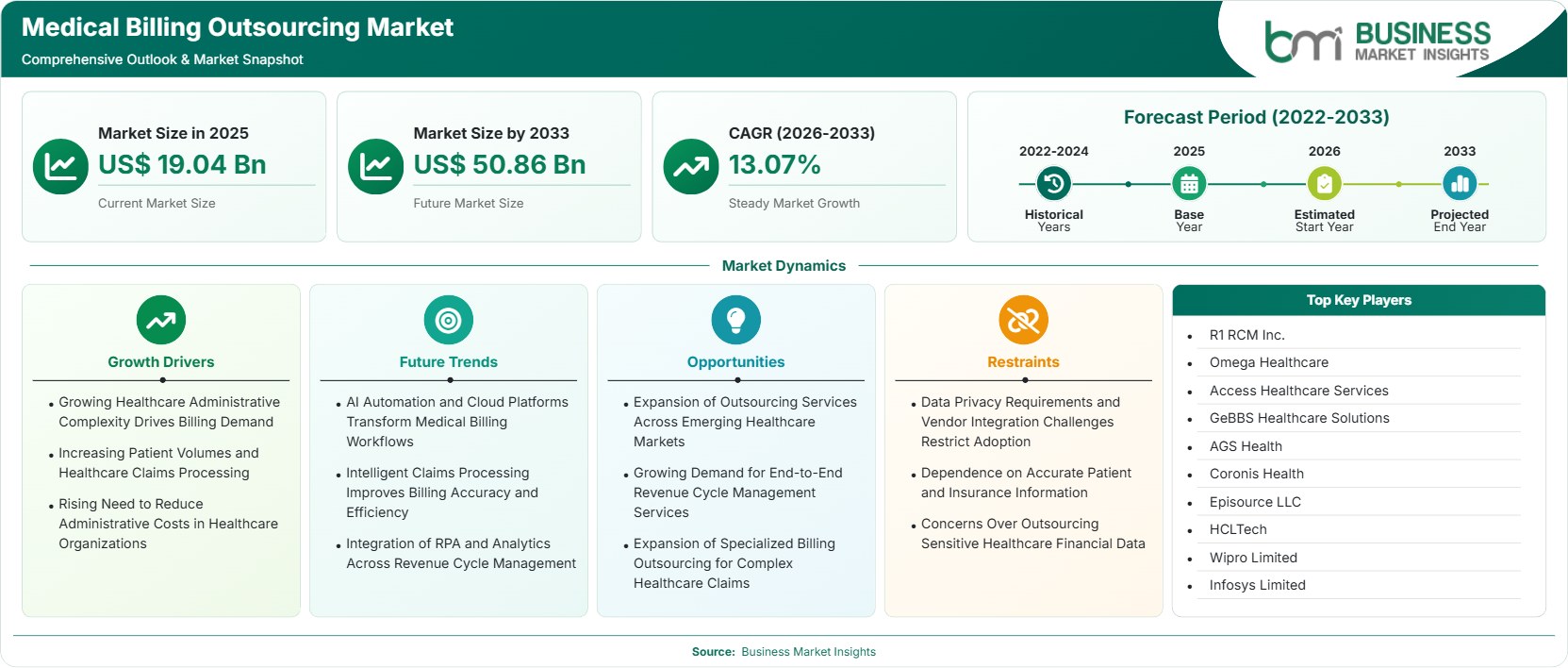
The Medical Billing Outsourcing Market size was valued at US$ 19.04 Billion in 2025 and is projected to reach US$ 50.86 Billion by 2033, growing at a CAGR of 13.07% during 2026–2033, driven by administrative complexity, digital workflows, specialized billing expertise, and demand for efficient revenue-cycle management.

Report Coverage
  • Service: Front-End, Middle-End, Back-End
  • End-user: Hospitals, Physician's Office, Others
US$ 19.04 Bn Market size in 2025
US$ 50.86 Bn Market Size by 2033
13.07% CAGR, 2026 - 2033
2026-2033 Forecast Period

01 AI Overview

Medical Billing Outsourcing Market Summary

  • North America Region: North America holds a 49%–52% share in 2025 and records a 12.4%–13.3% CAGR during 2026–2033, supported by high healthcare expenditure, complex reimbursement systems, and strong demand for specialized revenue-cycle services. The US represents 88%–92% of North American demand and expands at a 12.7%–13.6% CAGR, supported by reimbursement complexity, provider cost pressures, claims volumes, workforce constraints, and revenue-cycle modernization.
  • Fastest Growing Region: Asia Pacific holds a 17%–20% share in 2025 and expands at a 14.2%–15.2% CAGR during 2026–2033, driven by healthcare digitalization, expanding provider networks, cost-efficient delivery capabilities, healthcare information technology adoption, increasing outsourcing maturity, and growing demand for specialized coding and billing services.
  • Leading Segment: Back-End services account for a 43%–47% share in 2025 and expand at a 13.4%–14.3% CAGR during 2026–2033, supported by claims submission, payment posting, denial management, accounts receivable follow-up, collections, reimbursement optimization, and increasingly automated revenue-cycle workflows.
  • High Growth Segment: Physicians’ Office end users hold a 24%–28% share in 2025 and expand at a 14.0%–15.0% CAGR during 2026–2033, supported by limited internal billing resources, growing documentation requirements, payer complexity, claim denial pressures, specialty billing needs, and increasing preference for external revenue-cycle expertise.
  • Key Market Opportunity: Expansion of end-to-end revenue-cycle management, AI-enabled billing workflows, specialized claims processing, emerging healthcare outsourcing hubs, and technology-supported services creates opportunities to improve reimbursement accuracy, reduce administrative workloads, and strengthen provider financial performance.
  • Major Market Players: R1 RCM Inc., Omega Healthcare Management Services, Inc., Access Healthcare Services, Inc., GeBBS Healthcare Solutions, Inc., AGS Health, Coronis Health, Episource LLC, HCL Technologies Limited, Wipro Limited, Infosys Limited.
02 Strategic Insights

Medical Billing Outsourcing Market: Strategic Insights

Medical Billing Outsourcing Market Strategic Framework
FREE PDF
Request your free sample
Request free sample
03 Stakeholder View

Key Takeaways

  • Outsourcing is increasingly becoming an operating-model decision rather than a narrow cost-reduction measure, with providers evaluating vendors across reimbursement performance, workflow integration, compliance, scalability, and data governance.
  • Back-End services provide the strongest commercial opportunity because denials, accounts receivable, collections, payment posting, and reimbursement accuracy have direct relationships with provider cash flow.
  • Automation is shifting outsourced billing from labor-intensive transaction processing toward exception management, analytics, automated validation, intelligent work allocation, and human oversight of complex cases.
  • Asia Pacific offers a compelling delivery and demand opportunity because healthcare digitalization is expanding while providers and healthcare enterprises continue seeking cost-efficient specialized administrative capabilities.
  • Consolidation is increasing the strategic value of technology-enabled platforms that combine billing expertise, automation, analytics, coding, claims management, and end-to-end revenue-cycle capabilities.
  • Back-End services remain structurally important because reimbursement realization depends on accurate claims, timely follow-up, denial resolution, and effective collections.
04 Geographic Outlook

Medical Billing Outsourcing Market Regional Highlights

North America Medical Billing Outsourcing Market

North America accounts for a 49%–52% share in 2025 and expands at a 12.4%–13.3% CAGR through 2033. The region maintains the largest Medical Billing Outsourcing Market share because complex reimbursement structures, high healthcare spending, extensive provider networks, and administrative cost pressures encourage external billing support. The United States represents 88%–92% of regional demand and grows at a 12.7%–13.6% CAGR. Canada contributes through hospital modernization, digital health adoption, and increasing administrative specialization.

  • High healthcare expenditure creates extensive billing workloads across hospitals and physician organizations, strengthening demand for specialized claims processing, coding, denial management, payment posting, and accounts receivable services.
  • Provider workforce constraints are increasing reliance on external billing teams capable of maintaining consistent administrative throughput without expanding internal revenue-cycle staffing requirements.
  • Electronic health record adoption is improving information availability while increasing data volumes, requiring specialized workflows that connect clinical documentation with accurate billing and reimbursement processes.

US Medical Billing Outsourcing Market

The United States represents 88%–92% of North American demand in 2025 and U.S. Medical Billing Outsourcing Market forecast to grow at 12.7%–13.6% CAGR through 2033. The country's reimbursement environment creates substantial administrative complexity across hospitals, physician groups, specialty practices, and outpatient organizations. Providers face pressure from claim denials, staffing shortages, payer requirements, documentation standards, and rising operating expenses.

  • Rising administrative workloads are encouraging healthcare providers to evaluate external billing models that can improve processing capacity while limiting expansion of internal administrative teams.
  • Payer complexity increases demand for specialized expertise in eligibility, coding, documentation, claims submission, denial prevention, appeals, payment reconciliation, and accounts receivable management.
  • Automation is becoming increasingly important as providers seek to reduce repetitive billing activities, improve data validation, accelerate workflows, and identify revenue leakage.

Europe Medical Billing Outsourcing Market

Europe medical billing outsourcing market represents a 19%–22% share in 2025 and expands at a 11.8%–12.8% CAGR through 2033. The region benefits from healthcare digitalization, growing administrative specialization, increasing use of electronic health information, and demand for efficient reimbursement processes. Germany and the United Kingdom remain leading markets because of established healthcare infrastructure and significant administrative activity.

  • Germany supports outsourcing demand through hospital modernization, healthcare information technology adoption, administrative specialization, and increasing requirements for efficient financial workflows.
  • The United Kingdom provides opportunities through healthcare digitization, operational efficiency programs, workforce pressures, and continued development of technology-enabled administrative processes.
  • Poland benefits from a growing healthcare business-services ecosystem, skilled professionals, multilingual capabilities, and proximity to major European healthcare markets.
  • Data protection requirements encourage vendors to strengthen governance, secure information handling, access controls, process documentation, and compliance-oriented delivery models.

Asia Pacific Medical Billing Outsourcing Market

Asia Pacific medical billing outsourcing market holds a 17%–20% share in 2025 and records the fastest regional growth at a 14.2%–15.2% CAGR through 2033. India, China, Australia, Japan, and the Philippines contribute substantially to demand and delivery capabilities. India records a 15.0%–16.0% CAGR as healthcare information technology adoption, specialized workforce availability, and outsourcing maturity increase. The region's expanding healthcare infrastructure, digitalization, and cost optimization priorities are supporting demand for coding, billing, claims, analytics, and revenue-cycle services.

  • India provides strong delivery potential through trained healthcare professionals, established outsourcing infrastructure, English-language capabilities, and increasing specialization in revenue-cycle management.
  • The Philippines supports healthcare business-process outsourcing through a large service workforce, established international delivery capabilities, and familiarity with healthcare administrative workflows.
  • Australia and Japan provide demand opportunities as healthcare organizations modernize administrative processes and pursue greater efficiency across increasingly digital healthcare environments.
  • China is expanding healthcare digitalization and administrative technology adoption, creating longer-term opportunities for specialized billing, claims processing, analytics, and workflow services.

Rest of World Medical Billing Outsourcing Market

Rest of World represents an 8%–12% share in 2025 and expands at an 11.0%–12.0% CAGR through 2033. Latin American healthcare systems are increasing digital adoption and administrative modernization, while Middle Eastern healthcare investment is creating new demand for specialized financial and operational capabilities. Brazil and Mexico are leading Latin American markets, with Brazil growing at a 12.5%–13.5% CAGR. Saudi Arabia and the United Arab Emirates lead Middle Eastern demand, supported by healthcare infrastructure investment and digital transformation. Latin American providers are increasingly evaluating outsourcing to manage administrative workloads, improve claims processing, and access specialized billing expertise. Middle Eastern healthcare organizations are investing in technology-enabled operations as new facilities, insurance systems, digital platforms, and private healthcare networks expand.

  • Brazil provides the strongest regional opportunity through healthcare digitization, private provider expansion, administrative modernization, and growing demand for specialized revenue-cycle capabilities.
  • Mexico benefits from expanding private healthcare activity, healthcare information technology adoption, and increasing requirements for efficient claims and reimbursement administration.
  • Saudi Arabia is strengthening healthcare infrastructure and digital health capabilities, supporting opportunities for technology-enabled billing, coding, claims, and financial administration.
  • The United Arab Emirates provides demand through expanding private healthcare networks, insurance administration, digital health infrastructure, and increasing operational specialization.
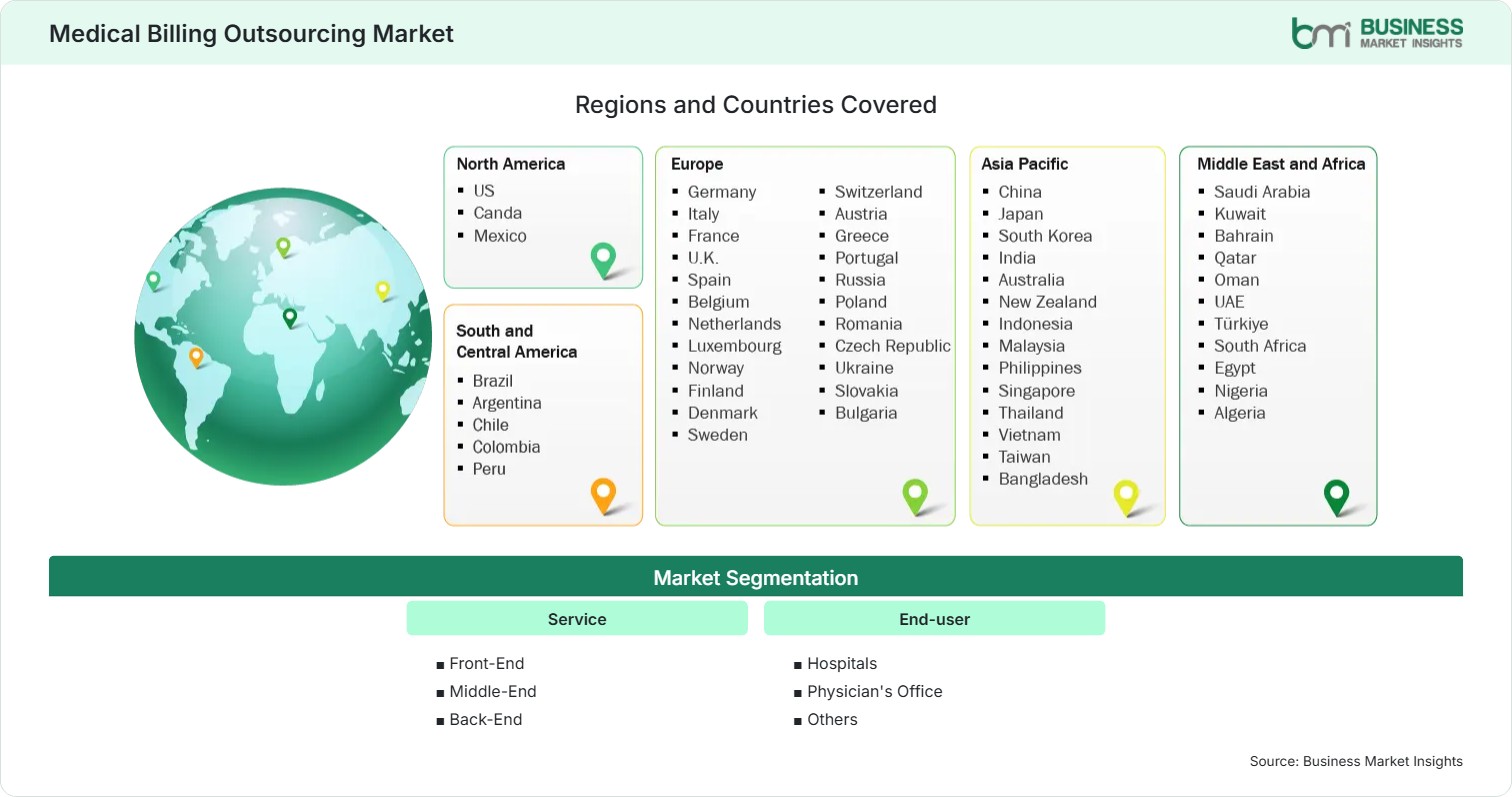
Global Market Geography
FREE PDF
Request your free sample
Request free sample
05 Segment Analysis

Medical Billing Outsourcing Market Segmentation

Service

Back-End services account for a 43%–47% share in 2025 and expand at a 13.4%–14.3% CAGR through 2033. The segment benefits from increasing denial complexity, claims volumes, reimbursement pressure, and provider demand for specialized financial workflows. The Medical Billing Outsourcing Market scope increasingly encompasses integrated processes connecting claims submission, accounts receivable, collections, and reimbursement optimization.

  • Front-End: Supports registration, eligibility verification, insurance validation, patient information management, and authorization workflows, improving claim readiness and reducing preventable administrative errors.
  • Middle-End: Covers coding, clinical documentation support, charge capture, compliance checks, and claim-quality processes that strengthen reimbursement accuracy before claims reach payers.
  • Back-End: Handles claims submission, payment posting, denial management, accounts receivable, collections, and reimbursement follow-up, making it central to revenue realization and cash-flow management.

End-user

Physicians’ Office end users hold a 24%–28% share in 2025 and expand at a 14.0%–15.0% CAGR through 2033. Smaller provider organizations frequently face limited administrative staffing and increasingly complex payer requirements, encouraging external support. Hospitals remain major demand centers because of high claims volumes and complex reimbursement workflows.

  • Hospitals: Generate extensive billing workloads because of high patient volumes, multiple specialties, complex coding requirements, large payer mixes, and substantial accounts receivable operations.
  • Physicians’ Office: Increasingly outsource billing to access specialized coding, claims, denial management, payment posting, and reimbursement expertise without maintaining large internal administrative teams.
06 Market Forces

Medical Billing Outsourcing Market Dynamics

Key Market Drivers

Growing Healthcare Administrative Complexity Drives Billing Demand

Healthcare billing has become more complicated for providers, who must address many aspects, including payer policies, documentation, coding, eligibility, and the billing processes. With outsourcing providers, specialized functions will be centralized across all processes, such as front-end, middle-end, and back-end, thus healthcare institutions do not need to continually expand their own administrative functions to cope with complexity. This development is driving demand for providers that can balance operations and technology.

Increasing Patient Volumes and Healthcare Claims Processing

Growing healthcare utilization increases the volume of patient registrations, eligibility checks, coding activities, claims submissions, payment transactions, denials, and accounts receivable workloads. Higher transaction volumes place pressure on provider organizations to maintain administrative speed without compromising accuracy. Outsourcing allows billing workloads to be distributed across specialized teams and technology-supported workflows, improving scalability during periods of increasing demand. The expansion of outpatient services and physician-based care also creates additional administrative requirements that can be difficult for smaller organizations to manage internally.

Rising Need to Reduce Administrative Costs in Healthcare Organizations

Healthcare institutions face continued pressure to manage their administrative costs while ensuring the quality of their reimbursements and services. Billing activities involve skilled personnel, specific know-how, IT systems, compliance measures, and process management. Outsourcing would allow the transformation of part of the above-mentioned fixed costs into flexible services along with gaining specific know-how. The above factors are considered to be Medical Billing Outsourcing Market trend towards outcome-based contracts, technology-driven delivery, automation, analytics, and revenue cycle management.

Key Market Opportunities

Expansion of Outsourcing Services Across Emerging Healthcare Markets

Emerging healthcare markets provide substantial opportunities as hospitals, physician networks, private healthcare providers, and healthcare technology ecosystems become more digitally connected. Administrative processes are expanding alongside healthcare access, insurance coverage, outpatient services, and electronic information systems. Delivery companies can also establish regional capabilities around coding, claims processing, eligibility, payment posting, analytics, and denial management. The opportunity is strongest where healthcare organizations face simultaneous growth in administrative workloads and limited availability of specialized revenue-cycle professionals.

Growing Demand for End-to-End Revenue Cycle Management Services

Healthcare providers increasingly prefer coordinated revenue-cycle services because fragmented administrative processes can create information gaps between patient access, coding, claims, payments, denials, and accounts receivable. End-to-end outsourcing can connect these workflows and create greater visibility across the financial lifecycle. This model allows vendors to apply shared data, standardized processes, analytics, automation, and performance management across multiple revenue-cycle stages. It also creates opportunities to identify revenue leakage earlier and improve coordination between administrative functions. Providers can select integrated services based on operational maturity, internal staffing, and technology requirements.

Expansion of Specialized Billing Outsourcing for Complex Healthcare Claims

Complex health insurance claims present an opportunity for outsourcing due to the requirement of extensive knowledge about coding, documentation, payers’ policies, specialty specific workflows, and reimbursement procedures for successful claim processing. There is a growing need for support in handling complex administrative tasks where any mistakes could cause denials, late reimbursement, or other types of reworks. The outsourcing of such tasks would be a combination of professional knowledge and analysis, automated workflows, validations, and quality controls.

Market Restraints and Challenges

Data Privacy Requirements and Vendor Integration Challenges Restrict Adoption

Factor: Healthcare billing outsourcing requires continuous exchange of sensitive patient, provider, insurance, and financial information across multiple systems and organizations. Impact: Strict privacy, security, and interoperability requirements can increase integration complexity, implementation time, vendor-management requirements, and compliance costs. Providers must ensure secure data transfer, controlled access, appropriate governance, auditability, and reliable connectivity with electronic health records and billing platforms.

Dependence on Accurate Patient and Insurance Information

Factor: Performance in billing requires precise patient demographics, insurance eligibility, authorization, documentation, codes, and payer-specific information. Impact: Lack or imprecision of this information may lead to rejection and denial of claims, late payments, extra effort, and loss of revenue. The outsourcing firm needs to develop a control mechanism that identifies these deficiencies before the claims get processed.

07 Company Analysis

Competitive Landscape

The Medical Billing Outsourcing Market analysis indicates that competition is increasingly based on revenue-cycle breadth, technology integration, coding expertise, denial management, data security, automation, analytical capabilities, delivery scale, and the ability to manage increasingly complex reimbursement workflows.

Company Name

Overview

Products and Services relevant to this market

R1 RCM Inc.

Healthcare revenue-cycle management company providing technology-enabled financial and administrative services to healthcare providers.

Patient access, coding, clinical documentation, claims, denial management, accounts receivable, payment processes, analytics, and revenue-cycle management.

Omega Healthcare Management Services, Inc.

Healthcare services provider focused on technology-enabled administrative, clinical, and revenue-cycle capabilities.

Medical coding, billing, claims processing, accounts receivable, denial management, analytics, automation, and revenue-cycle services.

Access Healthcare Services, Inc.

Healthcare business-process and revenue-cycle services provider supporting healthcare organizations through technology-enabled delivery.

Revenue-cycle management, medical billing, coding, claims management, denial resolution, analytics, automation, and patient financial services.

GeBBS Healthcare Solutions, Inc.

Healthcare technology and services provider specializing in revenue-cycle management and healthcare information management.

Medical billing, coding, claims processing, denial management, accounts receivable, automation, analytics, and specialized RCM services.

AGS Health

Technology-enabled healthcare revenue-cycle provider serving healthcare organizations across financial and administrative workflows.

Coding, billing, denial management, accounts receivable, automation, analytics, clinical documentation, and revenue-cycle management services.

Coronis Health

Healthcare revenue-cycle organization providing specialized financial and administrative services across provider organizations.

Medical billing, coding, accounts receivable, denial management, credentialing, analytics, and revenue-cycle optimization services.

Episource LLC

Healthcare technology and services company supporting clinical documentation, coding, risk adjustment, and healthcare administrative processes.

Medical coding, clinical documentation, risk adjustment, analytics, data services, and healthcare administrative support.

HCL Technologies Limited

Global technology and services company providing digital transformation and healthcare technology capabilities.

Healthcare IT services, data management, automation, analytics, application services, digital operations, and healthcare process support.

Wipro Limited

Global technology services company combining healthcare domain expertise with automation, analytics, cloud, and AI capabilities.

Healthcare operations, claims processing, automation, analytics, payer services, digital transformation, and AI-enabled healthcare workflows.

Infosys Limited

Global consulting and technology services provider supporting healthcare organizations through digital transformation and AI-enabled operations.

Healthcare technology, process transformation, analytics, automation, AI services, data management, and operational modernization.

10 Trust & Transparency

Research Methodology

The market analysis combines proprietary research with secondary data from government agencies, company disclosures, regulatory filings, industry databases and expert interviews. Market estimates are validated through data triangulation, cross-market benchmarking and analyst review.

View Full Research Methodology

11 Questions Answered

Frequently Asked Questions

What does Medical Billing Outsourcing Market Report coverage typically evaluate?

Coverage evaluates service categories, end-user demand, regional dynamics, competitive positioning, outsourcing models, and strategic developments affecting healthcare billing providers.

What technologies are changing outsourced billing operations?

Artificial intelligence, robotic process automation, analytics, workflow orchestration, optical character recognition, automated validation, and predictive tools are increasingly supporting repetitive processing, and revenue-cycle monitoring.

Why are specialized billing services gaining importance?

Specialized billing requires detailed knowledge of documentation, coding, payer policies, authorization requirements, and reimbursement rules.

How can outsourcing affect healthcare revenue visibility?

Integrated outsourcing can improve visibility by connecting claims, payments, denials, accounts receivable, and collection workflows.

What factors are most important when selecting a billing outsourcing provider?

A provider's evaluation should consider billing accuracy, denial performance, compliance controls, reporting transparency, turnaround times, and the vendor's ability to support changing payer requirements.

Access the Full Medical Billing Outsourcing Market Report

Get segment-level forecasts, regional estimates, competitive benchmarking, company profiles and downloadable Excel datasets.

Access the full Medical Billing Outsourcing Market Report
350 pages PDF & Excel | 2026-08-20