
Maritime Cybersecurity Market Outlook: Size, Share, Trends, Growth Analysis, Competitive Landscape & Forecast, 2026-2033

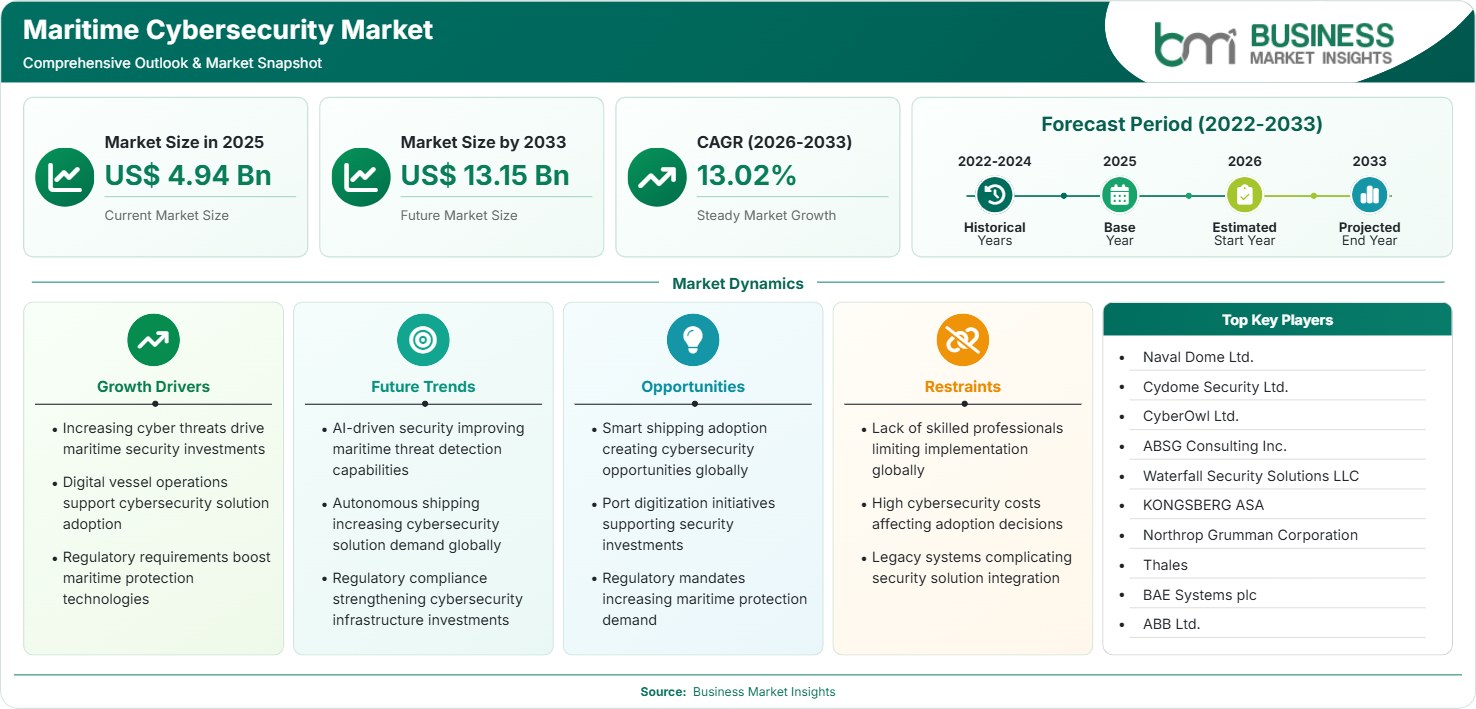
The Maritime Cybersecurity Market size was valued at US$ 4.94 Billion in 2025 and is projected to reach US$ 13.15 Billion by 2033, growing at a CAGR of 13.02% during 2026–2033, driven by vessel digitalization, regulatory mandates, connected fleets, OT exposure, and expanding port infrastructure.

Report Coverage
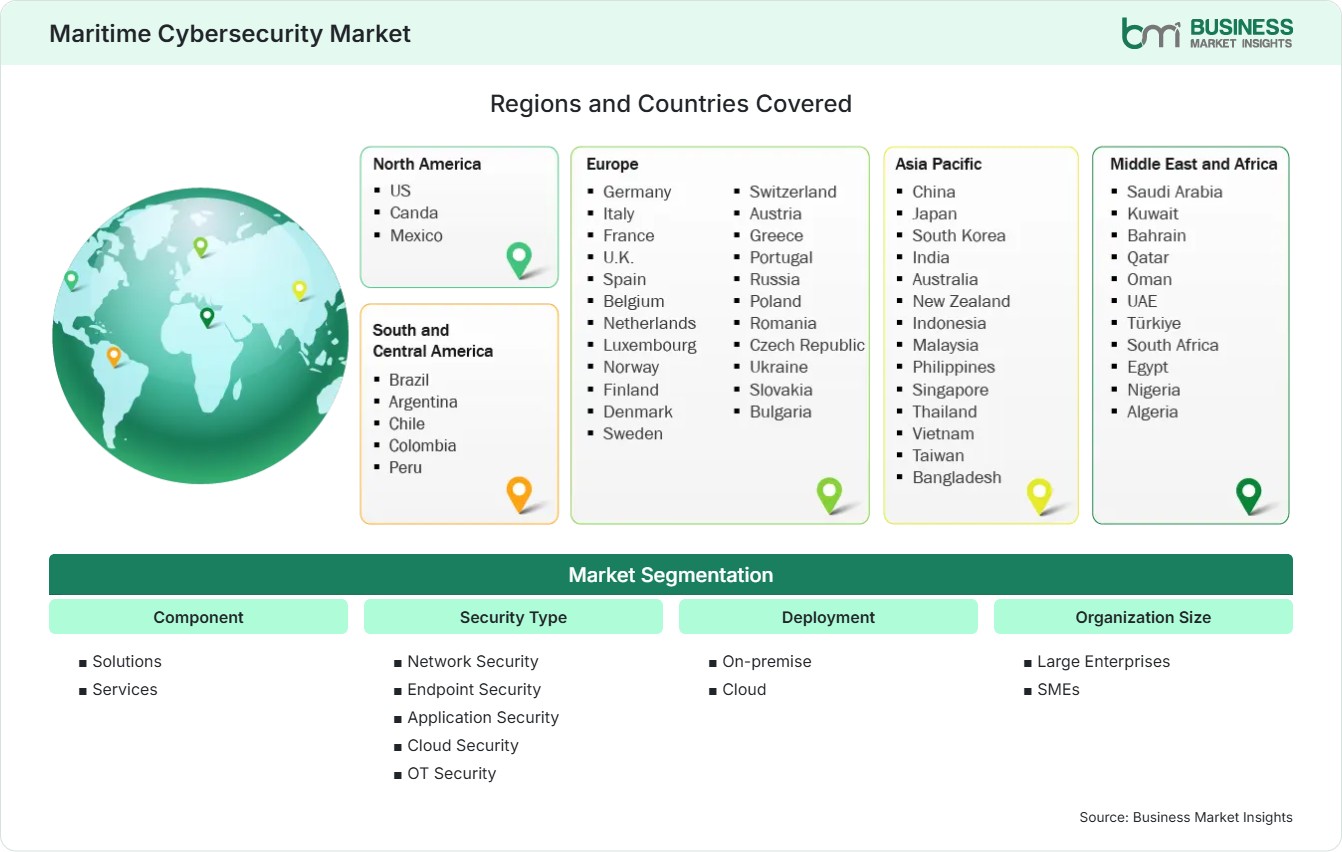
  • Component: Solutions, Services
  • Security Type: Network Security, Endpoint Security, Application Security, Cloud Security, OT Security
  • Deployment: On-premise, Cloud
  • Organization Size: Large Enterprises, SMEs
  • End User: Commercial Shipping, Naval & Defense, Port Operators, Offshore Operations, Others
US$ 4.94 Bn Market size in 2025
US$ 13.15 Bn Market Size by 2033
13.02% CAGR, 2026 - 2033
2026-2033 Forecast Period

AI Overview

Maritime Cybersecurity Market Summary

  • North America Region: holds a 31%–34% share in 2025, growing with a CAGR of 11.5%–12.5%, influenced by US Coast Guard requirements, connected fleets, port modernization, OT protection, and rising investment in resilient maritime infrastructure across operators.
  • Fastest Growing Region: Asia Pacific holds a 24%–27% share in 2025, growing with a CAGR of 14.0%–15.0%, supported by expanding fleets, smart ports, shipbuilding, digital logistics, offshore assets, national cyber programs, and modernization across China, India, Japan, Singapore, and South Korea.
  • Leading Segment: Solutions hold a 61%–64% share in 2025, growing with a CAGR of 12.4%–13.4%, driven by integrated network visibility, endpoint protection, OT monitoring, vulnerability management, compliance requirements, and centralized fleet cybersecurity platforms for maritime operators.
  • High Growth Segment: Operational Technology (OT) Security records a 19%–22% share in 2025, growing with a CAGR of 15.0%–16.0%, driven by connected propulsion, navigation, automation, remote access, vessel integration, and increasing protection requirements for critical onboard systems.
  • Key Market Opportunity: Fleet-wide cybersecurity platforms combining asset discovery, OT monitoring, threat intelligence, vulnerability management, compliance reporting, and managed response can convert fragmented protection budgets into recurring service revenues.
  • Major Market Players: Naval Dome Ltd.; Cydome Security Ltd.; CyberOwl Ltd.; ABSG Consulting Inc.; Waterfall Security Solutions LLC; KONGSBERG ASA; Northrop Grumman Corporation; Thales; BAE Systems plc; ABB Ltd.
Strategic Insights

Maritime Cybersecurity Market: Strategic Insights

Maritime Cybersecurity Market Strategic Framework
FREE PDF
Request your free sample
Request free sample
Stakeholder View

Key Takeaways

  • Value is moving in a direction that involves integrated ecosystems which connect shipboard systems, shore networks, satellite communications, port platforms, classification requirements, cybersecurity specialists, and managed-service providers.
  • The potential benefits of OT security, endpoint protection, managed detection, and vulnerability monitoring are strong since the integration of propulsion, navigation, automation, and remote-access technologies increases the attack surface.
  • The security architecture is now shifting from periodic compliance checks to include continuous asset discovery, the use of behavioral analytics, detection assisted by AI, zero-trust access, encrypted communications, and centralized monitoring at the fleet level.
  • The Asia Pacific region offers multiple opportunities for suppliers of maritime cyber technology because of its shipbuilding capabilities, the expansion of its commercial fleets, the growing smart-port infrastructure, offshore development activities, and its national digitalization programs.
  • It is increasingly important to have partnerships involving maritime specialists, providers of industrial cybersecurity, classification organizations, and technology companies, since operators need specialized protection in their domain rather than just generic enterprise cybersecurity.
  • The tendency towards regulatory convergence is raising the commercial value of compliance automation, the collection of evidence, cyber-risk assessment, the reporting of incidents, and the integration of security measures throughout the entire lifecycle, directly into shipbuilding procurement and projects aimed at modernizing ports.
Geographic Outlook

Maritime Cybersecurity Market Regional Highlights

North America Maritime Cybersecurity Market

North America held a 31%–34% Maritime Cybersecurity Market share in 2025 and is projected to expand at an 11.5%–12.5% CAGR through 2033. The region benefits from stringent maritime security expectations, sophisticated port infrastructure, connected commercial fleets, naval modernization, and increasing OT protection requirements.

  • The requirements of the US Coast Guard are causing formal investments to be made more quickly in the areas of cybersecurity governance, training, reporting, and risk management for the maritime assets that are covered.
  • The modernization of the port is leading to a greater reliance on connected cranes, terminal operating systems, access controls, logistics platforms, and industrial networks, all of which require layered protection.
  • The need for reliable communications, secure navigation, protected mission systems, and cyber monitoring among widely dispersed maritime assets has led to demand in the fields of naval and defense.
  • Managed cybersecurity services are becoming more relevant since operators need continuous monitoring without having to maintain large teams of specialists within the company.

US Maritime Cybersecurity Market

The US represented a substantial portion of the North American Maritime Cybersecurity Market demand in 2025, with an estimated 20%–23% share of global spending and an 11.8%–12.8% CAGR through 2033. Demand is shaped by maritime transportation security requirements, naval modernization, large commercial ports, offshore infrastructure, and extensive dependence on digital vessel systems.

  • The demand for cybersecurity plans, training, assessments, incident procedures, and documented controls is growing among regulated operators as a result of compliance programs.
  • As ports move towards greater use of terminal automation and digital cargo-management systems, their cybersecurity requirements are also being expanded.
  • The naval and defense organizations are still stressing the importance of secure communications, mission resilience, cyber situational awareness, and the protection of connected platforms.
  • Security companies that have capabilities specifically related to maritime operational technology are able to meet requirements that conventional enterprise security tools may not cover entirely.

Europe Maritime Cybersecurity Market

Europe accounted for a 26%–29% Maritime Cybersecurity Market share in 2025 and is projected to grow at a 12.0%–13.0% CAGR through 2033. The region combines major shipping nations, technologically advanced shipyards, dense port networks, offshore energy assets, and strong cybersecurity governance.

  • Norway has access to advanced maritime technology, offshore infrastructure, autonomous systems, and integrated maritime surveillance capabilities.
  • The United Kingdom possesses a large port infrastructure together with commercial shipping, naval operations, and expertise in cybersecurity, which meets the demand for specialized maritime protection.
  • Germany, France, and the Netherlands gain the advantages of shipbuilding, logistics, ports, offshore operations, and industrial cybersecurity capabilities.
  • Regulatory alignment causes shipowners and port operators to incorporate cyber controls into their procurement, risk assessment, governance, and plans for operational continuity.

Asia Pacific Maritime Cybersecurity Market

Asia Pacific held a 24%–27% Maritime Cybersecurity Market share in 2025 and is projected to register a 14.0%–15.0% CAGR through 2033, making it the fastest-growing regional market. China, Japan, South Korea, Singapore, India, and Australia provide diverse demand across commercial fleets, shipbuilding, ports, offshore energy, naval systems, and logistics.

  • China has extensive ecosystems in the fields of shipbuilding, shipping, port automation, and industrial technology, and this enables a wide demand for integrated maritime cybersecurity.
  • The fact is that Singapore gains its status as a global maritime hub and benefits from its advanced digital port infrastructure, which demands a continuous level of cyber resilience.
  • India has strong potential for growth due to its efforts to modernize its ports, its development of digital logistics, its shipbuilding aspirations, its offshore activities, and the growing awareness of cybersecurity.
  • Japan and South Korea meet the demand by making use of their advanced shipbuilding capabilities, automation, navigation technologies, commercial fleets, and technology-intensive marine operations.
  • Australia provides its contribution through its defense forces, its offshore operations, its ports, its critical infrastructure, and through its maritime assets, which are widely spread across the globe and which therefore require resilient communications and monitoring.

Rest of World Maritime Cybersecurity Market

South and Central America represented approximately a 6%–8% Maritime Cybersecurity Market share in 2025, with regional growth estimated at 12.5%–13.5% through 2033. Brazil remains the largest opportunity because of commercial ports, offshore energy, maritime logistics, and extensive industrial infrastructure.

  • Brazil and Mexico provide opportunities in the areas of ports, offshore assets, commercial fleets, and industrial maritime infrastructure.
  • Panama obtains advantages from strategic shipping operations and has high-value maritime infrastructure that needs reliable digital protection.
  • The United Arab Emirates and Saudi Arabia are creating port and logistics systems that are intensive in terms of technology, incorporating cybersecurity into their modernization programs.
  • There is demand in South Africa for ports, shipping, offshore operations, and critical infrastructure.
  • Regional suppliers are now collaborating with global cybersecurity experts to combine their local operational knowledge with advanced security technologies.
Global Market Geography
FREE PDF
Request your free sample
Request free sample
Segment Analysis

Maritime Cybersecurity Market Segmentation

Component

Solutions accounted for a 61%–64% Maritime Cybersecurity Market share in 2025, while services represented the remaining demand. Solutions benefit from recurring requirements for network, endpoint, application, cloud, and OT protection. Services gain traction as operators outsource assessment, monitoring, compliance, incident response, and managed security functions.

  • Solutions: Integrated platforms combine monitoring, detection, vulnerability management, endpoint protection, network controls, and OT visibility, supporting fleet-wide cybersecurity governance and faster incident response.
  • Services: Consulting, assessment, managed monitoring, training, incident response, and compliance services help operators address specialist shortages while maintaining continuous cybersecurity coverage across distributed maritime environments.

Security Type

Operational Technology Security represented a 19%–22% Maritime Cybersecurity Market share in 2025 and is projected to grow at a 15.0%–16.0% CAGR through 2034. Increasing automation, remote maintenance, connected controls, and integrated navigation systems are strengthening OT protection requirements across vessels and maritime facilities.

  • Network Security: Segmentation, intrusion detection, secure remote access, firewalls, and traffic monitoring protect shipboard and shore networks from unauthorized communication and lateral movement.
  • Endpoint Security: Endpoint detection, malware prevention, patching, and device monitoring protect workstations, servers, engineering systems, and connected maritime equipment from evolving threats.
  • Application Security: Secure development, vulnerability testing, identity controls, and application monitoring protect vessel-management, logistics, cargo, and port software from exploitation and unauthorized access.
  • Cloud Security: Identity management, encryption, workload monitoring, configuration controls, and data protection address expanding use of cloud platforms for fleet and port operations.
  • Operational Technology (OT) Security: Specialized monitoring protects propulsion, steering, automation, navigation, industrial controls, and safety systems while minimizing disruption to operational processes.

Deployment

Cloud deployment is gaining momentum as distributed fleets require centralized visibility, scalable analytics, and remote security operations. On-premise infrastructure remains important for sensitive environments where latency, availability, sovereignty, or operational isolation limit cloud adoption.

  • On-premise: Local infrastructure supports sensitive vessel, naval, port, and industrial environments requiring direct control, predictable availability, network isolation, and restricted external connectivity.
  • Cloud: Cloud platforms enable centralized fleet monitoring, scalable threat analytics, remote administration, consolidated reporting, and rapid deployment across geographically distributed maritime operations.

Organization Size

Large enterprises represented a 68%–72% share in 2025, supported by extensive fleets, larger cybersecurity budgets, regulatory exposure, and complex IT and OT environments. SMEs are increasingly adopting managed solutions to overcome specialist staffing constraints and affordability barriers.

  • Large Enterprises: Fleet scale, complex infrastructure, compliance obligations, and high operational downtime costs encourage integrated cybersecurity platforms, dedicated security teams, and continuous monitoring.
  • Small and Medium-sized Enterprises (SMEs): Managed security, subscription platforms, automated monitoring, and outsourced compliance support allow smaller operators to improve protection without building extensive internal cybersecurity capabilities.

End User

Commercial Shipping represented a 35%–39% share in 2025, reflecting the extensive deployment of connected navigation, communications, cargo, and fleet-management technologies. Naval and defense, ports, and offshore operations provide additional high-value applications.

  • Commercial Shipping: Connected vessels, remote maintenance, electronic documentation, fleet platforms, and satellite communications create cybersecurity requirements spanning navigation, communications, cargo, and operational systems.
  • Naval and Defense: Mission-critical platforms require secure communications, resilient navigation, protected command systems, cyber situational awareness, and specialized controls for contested operating environments.
  • Port Operators: Automated terminals, maritime single windows, access systems, cargo platforms, and industrial networks require coordinated cybersecurity across IT, OT, and external stakeholders.
  • Offshore Operations: Offshore energy facilities depend on connected industrial controls, remote operations, communications, and safety systems, increasing requirements for continuous monitoring and resilient access management.
Market Forces

Maritime Cybersecurity Market Dynamics

Key Market Drivers

Connected Vessel and Port Digitalization

Digital transformation is increasing the number of connected assets requiring protection across ships, ports, logistics platforms, communications networks, and industrial controls. Navigation, propulsion, cargo management, remote diagnostics, electronic documentation, and shore-based fleet platforms increasingly exchange operational data. This interconnected architecture creates efficiency gains while expanding potential attack paths. DNV’s Maritime Cyber Priority research surveyed almost 500 maritime professionals and identified increasing awareness, investment, and maturity around cyber risk management. The Maritime Cybersecurity Market growth, therefore, increasingly reflects operational digitalization rather than standalone IT security spending.

Regulatory Cybersecurity Requirements

Maritime regulations and the rules set by classification societies are now requiring owners, operators, shipyards, and suppliers to take cyber risk into account when preparing safety plans and designing vessels. According to IMO Resolution MSC.428(98), it is expected that cyber risk management should be included in safety management systems, and the IACS UR E26 and E27 have introduced cyber-resilience requirements for appropriate newbuilds from July 2024. As a result, compliance has turned cybersecurity from an optional technological project into a necessity in the areas of procurement, engineering, governance, and the entire lifecycle of the vessel. This, in turn, generates demand for assessment tools, documentation, secure system architecture, monitoring, training, incident response, and evidence management. The ongoing regulatory developments also prompt shipyards and equipment suppliers to meet cyber requirements at an earlier stage in the vessel development process, thus increasing the market opportunity for embedded security technologies and specialized services.

Increasing OT Exposure Across Maritime Assets

Vessel automation, remote diagnostics, integrated propulsion systems, navigation systems, industrial controls, and connected port equipment are becoming increasingly connected to digital networks. The effects of a breach can go well beyond data loss to include operational disruption, equipment failure, safety incidents, and extended periods of downtime. Because of this, maritime operators need security measures that can understand industrial protocols and operational constraints, rather than relying merely on traditional enterprise security defenses. OT monitoring, network segmentation, application allowlisting, secure remote access, and vulnerability management are now key elements of vessel resilience programs.

Key Market Opportunities

Fleet-wide Managed Cybersecurity Platforms

Fleet operators increasingly manage geographically dispersed vessels with limited onboard cybersecurity resources. A centralized managed platform can combine asset discovery, network monitoring, endpoint protection, vulnerability management, threat intelligence, compliance reporting, and incident escalation across ships and shore facilities. This model creates recurring revenue opportunities while reducing the operational burden on vessel crews and corporate IT teams. Maritime Cybersecurity Market Forecasts increasingly favor architectures capable of connecting heterogeneous fleets rather than requiring identical technology stacks.

Cybersecurity by Design for Newbuild Vessels

Newbuild programs provide an opportunity to integrate cybersecurity before systems become operationally entrenched. Shipyards, equipment suppliers, classification organizations, and owners can incorporate network zoning, identity management, secure remote access, vulnerability controls, logging, monitoring, and incident-response architecture during design and commissioning. This approach reduces retrofit complexity and improves consistency across vessel fleets. IACS cyber requirements have strengthened the commercial rationale for embedding cybersecurity into system integration and essential onboard systems. Maritime Cybersecurity Market Trends indicate that Vendors that offer design assessment, secure architecture validation, testing, documentation, and lifecycle monitoring can participate earlier in procurement cycles.

Port and Maritime Single Window Security

The process of digitizing ports is opening up new possibilities in cybersecurity for maritime single windows, electronic certificates, the exchange of ship-port data and cargo information, and automated arrival procedures. Draft measures approved by the IMO in 2026 would mandate Contracting Governments to introduce cybersecurity measures for maritime single windows through their national laws, with proposed implementation in 2027 and an expected date of coming into force in 2029. This regulatory route can lead to increased investment in identity controls, encryption, application security, monitoring, incident response, and resilience testing. Moreover, ports offer attractive settings involving multiple stakeholders since operators, shipping companies, government agencies, terminal providers, logistics companies, and technology suppliers all interact via a common digital infrastructure.

Market Restraints and Challenges

Legacy Systems and Long Asset Lifecycles

Factor: Maritime vessels and industrial facilities frequently operate equipment with long service lives, proprietary protocols, limited patching capabilities, and constrained processing resources. Impact: Retrofitting modern cybersecurity controls can require extensive engineering, testing, downtime, and coordination with equipment manufacturers. Security teams must balance vulnerability remediation with operational continuity because aggressive patching can interfere with certified or safety-critical systems.

Cybersecurity Skills Shortages and Fragmented Ownership

Factor: Maritime cybersecurity responsibilities are distributed among shipowners, managers, crews, shipyards, equipment suppliers, ports, classification bodies, regulators, and external technology providers. Impact: Fragmented accountability can produce inconsistent asset inventories, unclear incident escalation, uneven security standards, and gaps between IT and OT teams. DNV’s maritime research indicates growing awareness and investment, but organizational maturity varies across the sector.

Company Analysis

Competitive Landscape

The Maritime Cybersecurity Market analysis indicates a fragmented competitive structure combining maritime specialists, industrial technology providers, defense contractors, cybersecurity companies, classification-linked service providers, and infrastructure security vendors. Competitive differentiation increasingly depends on OT expertise, regulatory alignment, fleet-scale monitoring, integration capabilities, and the ability to support both shipboard and shore-based environments.

Company Name

Overview

Products and Services relevant to this market

Naval Dome Ltd.

Maritime cybersecurity specialist focused on protecting shipboard operational technology and connected marine assets against cyber threats.

OT protection, vessel cybersecurity, threat detection, network monitoring, vulnerability management, and maritime cyber-resilience services.

Cydome Security Ltd.

Maritime-focused cybersecurity company providing centralized protection across vessel IT, OT, communications, and connected maritime assets.

EDR, NDR, SIEM, vulnerability scanning, asset visibility, risk management, managed cybersecurity, and maritime threat intelligence.

CyberOwl Ltd.

Cybersecurity specialist focused on maritime and industrial environments, emphasizing continuous monitoring and operational cyber-risk visibility.

Fleet monitoring, cyber-risk analytics, threat detection, vulnerability intelligence, and maritime cybersecurity advisory services.

ABSG Consulting Inc.

Risk-management and technical advisory provider supporting maritime organizations with cybersecurity compliance and operational resilience.

Maritime cyber assessments, MTSA support, cybersecurity training, compliance advisory, OT risk management, and resilience consulting.

Waterfall Security Solutions LLC

Industrial cybersecurity provider specializing in the protection of critical infrastructure and operational technology environments.

Unidirectional security gateways, OT monitoring architectures, industrial network protection, and secure data transfer technologies.

KONGSBERG ASA

Maritime technology and defense group with extensive vessel, navigation, automation, surveillance, and critical infrastructure capabilities.

Maritime systems, navigation, vessel automation, surveillance, cyber-resilient infrastructure, and integrated maritime security technologies.

Northrop Grumman Corporation

Defense technology company serving complex naval and mission-critical environments requiring advanced cyber and systems capabilities.

Mission systems, cybersecurity, secure communications, defense electronics, cyber resilience, and naval technology solutions.

Thales

Technology and defense group providing cybersecurity, digital identity, communications, and mission systems across maritime environments.

Cybersecurity platforms, secure communications, digital identity, naval systems, critical infrastructure protection, and cyber services.

BAE Systems plc

Defense and technology company with extensive naval systems and cyber capabilities serving government and maritime customers.

Naval systems, cyber defense, secure communications, electronic systems, intelligence, and mission cybersecurity services.

ABB Ltd.

Industrial technology provider integrating marine automation, electrical systems, digital platforms, and specialized cybersecurity capabilities.

Marine cyber security, OT protection, asset monitoring, risk assessment, secure connectivity, automation security, and managed services.

Trust & Transparency

Research Methodology

The market analysis combines proprietary research with secondary data from government agencies, company disclosures, regulatory filings, industry databases and expert interviews. Market estimates are validated through data triangulation, cross-market benchmarking and analyst review.

View Full Research Methodology

Questions Answered

Frequently Asked Questions

What technologies will influence maritime cybersecurity procurement through 2033?

The Maritime Cybersecurity Market Report highlights that Procurement is likely to increasingly emphasize OT monitoring, AI-assisted threat detection, secure remote access, zero-trust architectures, asset discovery, behavioral analytics, cloud security, automated compliance reporting, and integrated fleet platforms capable of correlating cyber events across vessels and shore facilities.

How can smaller shipping companies improve cyber resilience without large security teams?

Smaller operators can use managed security services, cloud-based monitoring, standardized assessments, automated vulnerability management, centralized reporting, and outsourced incident response. These approaches reduce the need to maintain specialized cybersecurity teams while providing continuous protection across distributed assets.

What role do classification requirements play in maritime cybersecurity adoption?

Classification requirements increasingly influence vessel design, system integration, procurement, testing, documentation, and lifecycle management. Their effect extends cybersecurity responsibilities beyond shipowners to shipyards, equipment suppliers, system integrators, and technology manufacturers.

Why is OT security becoming more important for maritime operators?

Connected propulsion, navigation, automation, remote maintenance, and industrial controls increase the potential consequences of unauthorized access. OT security provides visibility and protection for systems where cyber disruption can affect physical operations, vessel safety, equipment availability, and cargo movement.

How does cybersecurity differ between ships and conventional enterprise networks?

Shipboard environments combine IT with safety-critical OT, navigation, propulsion, automation, communications, and equipment with long operating lifecycles. Security controls, therefore, must account for availability, certification, operational continuity, limited bandwidth, and industrial protocols rather than relying exclusively on conventional enterprise security practices.

Access the Full Maritime Cybersecurity Market Report

Get segment-level forecasts, regional estimates, competitive benchmarking, company profiles and downloadable Excel datasets.

Access the full Maritime Cybersecurity Market Report
350 pages PDF & Excel | 2026-11-03
Similar Research

Related Market Reports