
Healthcare Cybersecurity Market Outlook: Size, Share, Trends, Growth Analysis, Competitive Landscape & Forecast, 2026-2033

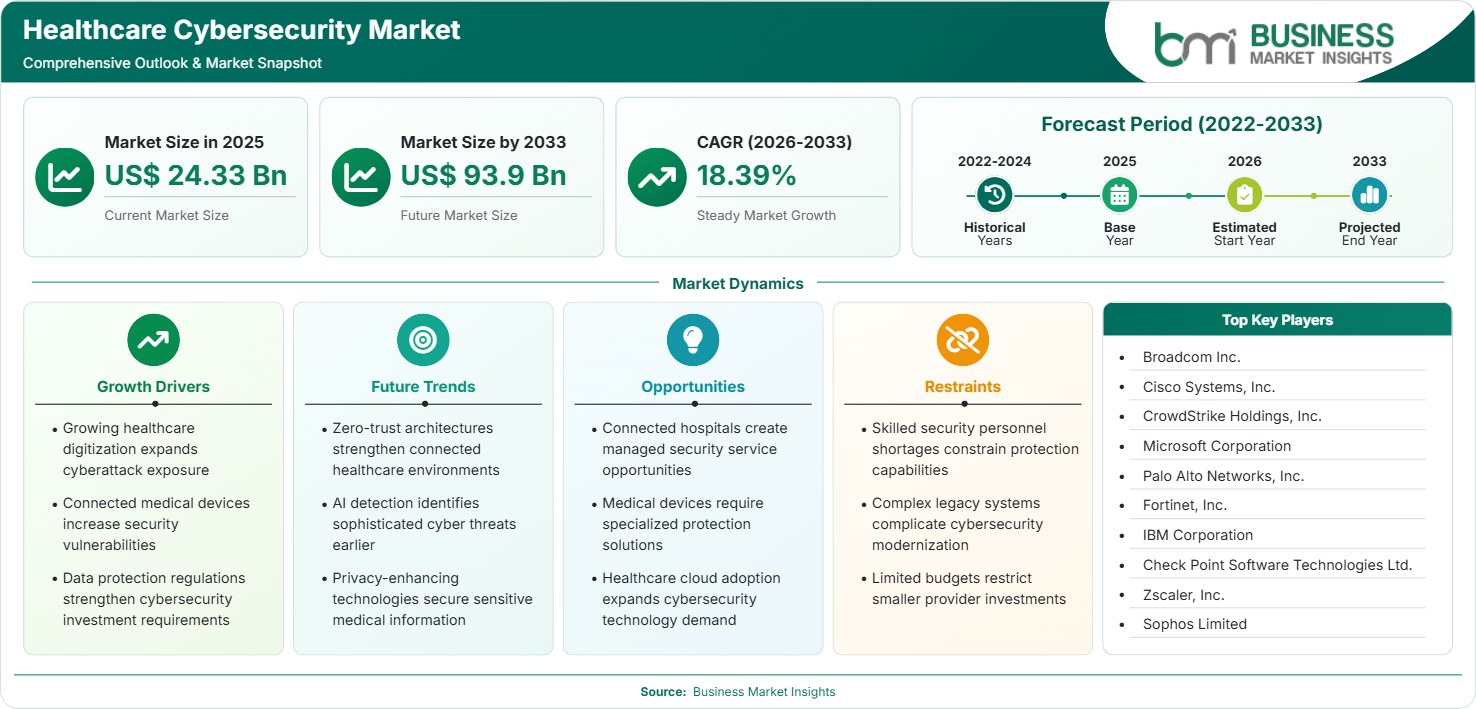
The Healthcare Cybersecurity Market size was valued at US$ 24.33 Billion in 2025 and is projected to reach US$ 93.9 Billion by 2033, growing at a CAGR of 18.39% during 2026–2033, driven by ransomware exposure, connected healthcare infrastructure, cloud adoption, regulatory compliance, and demand for resilient patient data protection.

Report Coverage
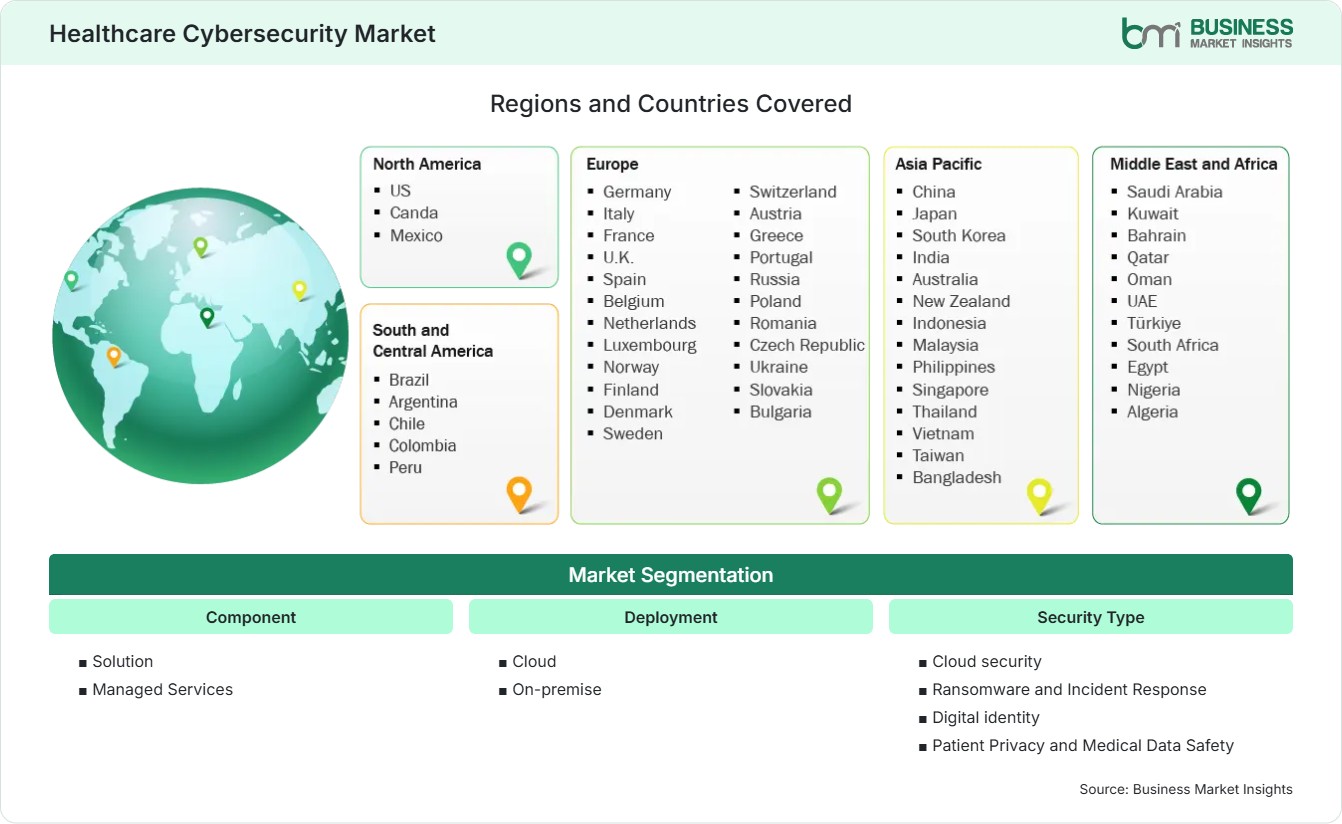
  • Component: Solution, Managed Services
  • Deployment: Cloud, On-premise
  • Security Type: Cloud security, Ransomware and Incident Response, Digital identity, Patient Privacy and Medical Data Safety
US$ 24.33 Bn Market size in 2025
US$ 93.9 Bn Market Size by 2033
18.39% CAGR, 2026 - 2033
2026-2033 Forecast Period

AI Overview

Healthcare Cybersecurity Market Summary

  • North America Region: North America holds an estimated 38%–42% Healthcare Cybersecurity Market share in 2025, growing at a CAGR of 17.2%–18.6% during 2026–2033, supported by healthcare digitization, ransomware exposure, compliance requirements, and managed security adoption. The US market is projected to expand at a modeled CAGR of 17.5%–18.8%, driven by hospital cybersecurity investment, insurance requirements, and cloud protection.
  • Fastest Growing Region: Asia Pacific accounts for an estimated 18%–22% share in 2025, with a CAGR of 20.1%–22.5% during 2026–2033. Expanding digital health platforms, cloud infrastructure, medical device connectivity, and regulatory modernization create opportunities for local and international security providers.
  • Leading Segment: Solutions represent an estimated 61%–65% share in 2025, growing at a CAGR of 17.3%–18.7% during 2026–2033. Integrated threat detection, identity protection, ransomware prevention, and data security support healthcare organizations with complex digital infrastructure.
  • High Growth Segment: Cloud deployment represents an estimated 43%–47% share in 2025, expanding at a CAGR of 20.2%–22.6% during 2026–2033. Cloud migration, telemedicine, interoperability, and scalable security monitoring support adoption across healthcare providers and technology platforms.
  • Key Market Opportunity: Growing healthcare digitization creates demand for unified identity, cloud security, ransomware response, and managed protection services, particularly among mid-sized hospitals, diagnostic networks, and emerging digital health providers.
  • Major Market Players: Broadcom Inc., Cisco Systems, Inc., CrowdStrike Holdings, Inc., Microsoft Corporation, Palo Alto Networks, Inc., Fortinet, Inc., IBM Corporation, Check Point Software Technologies Ltd., Zscaler, Inc., and Sophos Limited.
Strategic Insights

Healthcare Cybersecurity Market: Strategic Insights

Healthcare Cybersecurity Market Strategic Framework
FREE PDF
Request your free sample
Request free sample
Stakeholder View

Key Takeaways

  • The value chain includes cybersecurity software developers, cloud infrastructure providers, managed security operations centers, healthcare IT integrators, compliance consultants, and incident response specialists. Buyers increasingly evaluate interoperability and response capability rather than standalone product features.
  • Managed services and cloud security offer expansion opportunities where healthcare providers lack internal security teams. Smaller hospitals and diagnostic networks can adopt outsourced monitoring, identity governance, and incident response without building complete in-house operations.
  • Security vendors are developing more integrated approaches that combine behavioral detection, automated investigation, identity analytics, and workload protection. AI-supported monitoring can reduce analyst workload, although organizations must validate alerts and preserve appropriate clinical safeguards.
  • Asia Pacific offers opportunities associated with digital health infrastructure, healthcare platform expansion, and regulatory modernization. Vendors with local delivery teams and expertise in healthcare workflows can address implementation and compliance requirements.
  • The competitive environment supports partnerships between cloud providers, cybersecurity specialists, healthcare IT firms, and managed service companies. Strategic investments are focused on expanding security coverage, customer reach, and specialized response capabilities.
  • Healthcare buyers increasingly assess recovery time, backup integrity, third-party exposure, and incident response readiness alongside prevention capabilities. Security spending therefore extends beyond technology acquisition to testing, governance, training, and operational resilience.
Geographic Outlook

Healthcare Cybersecurity Market Regional Highlights

North America Healthcare Cybersecurity Market

North America represented an estimated 38%–42% Healthcare Cybersecurity Market share in 2025 and is projected to grow at a CAGR of 17.2%–18.6% during 2026–2033. Healthcare cybersecurity spending is supported by extensive electronic health record adoption, interconnected provider networks, insurance requirements, and persistent ransomware exposure. The region maintains a mature ecosystem of security vendors, managed service providers, and healthcare technology integrators. Demand is shifting toward identity-centric protection, cloud workload monitoring, and incident response. Large hospital systems continue investing in integrated platforms, while smaller providers increasingly consider outsourced security operations to manage resource limitations and compliance obligations.

  • Ransomware exposure across hospitals and healthcare businesses sustains demand for prevention, monitoring, immutable backups, and recovery planning.
  • Cloud adoption supports spending on workload protection, identity governance, API security, and continuous configuration monitoring.
  • Large healthcare systems seek integrated platforms that connect endpoint, network, data, and incident response functions.
  • Managed security providers address staffing shortages through continuous monitoring and specialized healthcare security expertise.

US Healthcare Cybersecurity Market

The US accounted for an estimated 31%–35% of global spending in 2025, with a modeled CAGR of 17.5%–18.8% during 2026–2033. Its demand base includes hospital networks, insurers, pharmaceutical companies, diagnostic providers, and digital health platforms. Regulatory obligations and financial consequences of disruptions encourage investment in security controls. Comparitech recorded 225 healthcare ransomware attacks in the US during the first half of 2026, the highest national total in its dataset. The market includes established technology vendors and specialized providers serving organizations with different budgets and operational requirements.

  • Healthcare providers prioritize protection of electronic health records, clinical systems, patient identities, and connected devices.
  • Insurers and healthcare technology suppliers strengthen third-party risk assessments, access controls, and monitoring requirements.
  • Security budgets increasingly incorporate recovery testing, vulnerability remediation, and managed detection services.

Europe Healthcare Cybersecurity Market

Europe held an estimated 22%–26% Healthcare Cybersecurity Market share in 2025 and is projected to expand at a CAGR of 16.4%–18.1% during 2026–2033. Germany, the United Kingdom, and France represent major demand centers, while Spain, Italy, and selected Nordic markets offer further opportunities. European healthcare organizations are addressing ransomware, legacy systems, data governance, and cross-border information exchange. Germany is modeled at a CAGR of 17.0%–18.8%, while the United Kingdom is estimated at 16.8%–18.4%. Procurement decisions emphasize compliance, resilience, interoperability, and continuity of essential clinical services.

  • National healthcare digitization programs support spending on secure interoperability and identity management.
  • Hospitals seek protection for legacy infrastructure that cannot always be replaced rapidly or economically.
  • European data governance requirements encourage access controls, audit trails, and privacy-oriented security architecture.
  • Managed services support smaller providers facing shortages of specialized cybersecurity personnel.

Asia Pacific Healthcare Cybersecurity Market

Asia Pacific represented an estimated 18%–22% share in 2025 and is projected to grow at a CAGR of 20.1%–22.5% during 2026–2033. China, Japan, Australia, South Korea, and India form important demand centers, while Southeast Asian markets present additional opportunities. India is modeled at a CAGR of 21.0%–23.5%, supported by expanding digital health platforms and healthcare IT adoption. Australia is estimated at 18.5%–20.5%. Market development varies by healthcare funding, regulatory maturity, provider size, and local technology infrastructure. Vendors require adaptable solutions that address fragmented environments and diverse procurement practices.

  • Digital health initiatives increase the number of identities, connected applications, and clinical data exchanges requiring protection.
  • Hospitals and pharmaceutical companies are expanding vulnerability management and security monitoring capabilities.
  • Local service providers can support implementation, compliance interpretation, and incident response in fragmented markets.
  • Cloud-based security services offer scalable deployment models for organizations with limited internal cybersecurity teams.

Rest of World Healthcare Cybersecurity Market

South and Central America accounted for an estimated 5%–7% of global spending in 2025, with a modeled CAGR of 18.2%–20.6% during 2026–2033 for the Healthcare Cybersecurity Market. Brazil and Mexico provide important demand centers, while Chile and Colombia offer additional opportunities as healthcare digitization advances. Security priorities include patient data protection, cloud security, ransomware prevention, and third-party access controls. Adoption varies according to healthcare investment, institutional capacity, and regulatory enforcement. Vendors offering flexible deployment and managed monitoring can address organizations with constrained technology budgets.

The Middle East and Africa accounted for an estimated market share of 7%–9% and are expected to grow at a CAGR of 19.0%–21.4%. Countries such as the United Arab Emirates, Saudi Arabia, and South Africa offer lucrative prospects through the modernization of healthcare systems and the development of digital infrastructure. The demand for cloud security, healthcare data security, identity management, and incident response exists in the region. Foreign suppliers partner with regional companies to address implementation challenges, language barriers, regulatory requirements, and support needs.

  • Healthcare modernization programs create demand for secure platforms, endpoint controls, and continuous monitoring.
  • Brazil and Mexico offer opportunities in hospital networks, private healthcare, and health technology ecosystems.
  • Gulf countries are investing in digital infrastructure that requires identity, cloud, and data security capabilities.
  • Local partnerships help vendors address regulatory interpretation, implementation support, and regional service expectations.
Global Market Geography
FREE PDF
Request your free sample
Request free sample
Segment Analysis

Healthcare Cybersecurity Market Segmentation

Component

The Solutions sub-segment held an estimated market share of 61%-65%, whereas the Managed Services sub-segment accounted for 35%-39% of the Healthcare Cybersecurity Market size in 2025. Both sub-segments are estimated to grow at a CAGR of 17.4%- 19.2% from 2026 to 2033. There is a growing trend among organizations to integrate technology into continuous monitoring and incident response.

  • Solution: Security solutions address endpoint protection, network security, identity governance, cloud workloads, and patient data. Integrated platforms support coordinated threat detection, vulnerability management, and policy enforcement across complex healthcare environments.
  • Managed Services: Managed services provide monitoring, detection, response, and security operations expertise. Healthcare organizations use these services to address staffing constraints, maintain continuous oversight, and strengthen incident response readiness.

Deployment

Cloud deployment mode had around 43%-47% market share in the Healthcare Cybersecurity Market during 2025, while the on-premises deployment mode accounted for 53%-57%. The segment's growth rate is forecast at 18.8%-21.8%. Healthcare facilities are trying to strike a balance between cloud scalability and governance, legacy systems, integrations, and clinical continuity.

  • Cloud: Cloud deployment supports scalable security monitoring, centralized policy management, and protection of distributed applications. Demand is linked to telemedicine, healthcare software, cloud migration, and interoperable digital health platforms.
  • On-premise: On-premise deployment remains relevant for hospitals with legacy systems, specialized clinical applications, and internal infrastructure requirements. Organizations prioritize access controls, network segmentation, vulnerability management, and secure integration with modern platforms.

Security Type

Types of security segmentations are cloud security, ransomware, incident response, digital identity, patient privacy, and medical data security. Ransomware and incident response segments are the fastest-growing security segments, with a CAGR of 20.0%-22.5%, driven by operational disruptions and growing demand for recovery. Overall demand for security types still correlates with the complexity of clinical and patient information systems.

  • Cloud Security: Cloud security protects workloads, configurations, identities, and data across distributed healthcare environments. Adoption is supported by migration to cloud applications, telehealth services, and interoperable infrastructure.
  • Ransomware and Incident Response: This category combines detection, containment, investigation, recovery, and preparedness services. Healthcare providers prioritize rapid response because disruption to clinical and administrative systems can affect patient services.
  • Digital Identity: Digital identity solutions manage authentication, authorization, privileged access, and user lifecycle controls. Healthcare organizations use them to protect staff accounts, vendor access, patient portals, and connected applications.
  • Patient Privacy and Medical Data Safety: Data safety solutions address encryption, access monitoring, privacy controls, and governance. Demand grows as organizations exchange sensitive records across providers, insurers, laboratories, and technology platforms.
Market Forces

Healthcare Cybersecurity Market Dynamics

Key Market Drivers

Ransomware and Clinical Service Disruption Risks

Ransomware remains a core driver of Healthcare Cybersecurity Market growth because healthcare systems depend on continuous access to patient records, scheduling, imaging, laboratory, and billing applications. During the first half of 2026, Comparitech identified 410 ransomware cases targeting the healthcare industry worldwide, including 247 targeting hospitals, clinics, and other medical providers. This shows the necessity for organizations to ensure that they have endpoint monitoring, network segmentation, immutable backup, and incident response systems in place. While ensuring that data breaches do not occur is crucial, hospitals also need to safeguard their operations. That is why security expenditure is shifting from prevention to recovery, forensics, and crisis management.

Expansion of Connected Healthcare Infrastructure

Connected medical devices, electronic health records, telemedicine systems, and interoperable applications increase the number of assets requiring continuous security oversight. Most healthcare organizations operate in a hybrid environment, with legacy hardware, cloud services, clinical applications, and third-party interfaces. This is what gives rise to the need for discovery, vulnerability prioritization, identity governance, and network segmentation, hence the Healthcare Cybersecurity Market trends. Security measures should account for device availability and workflow, as excessive intervention can disrupt critical services. Vendors are developing solutions that detect anomalies without adding excessive workload. The needs arise not only for hospital IT but also for medical devices and laboratory service vendors.

Regulatory Compliance and Patient Data Protection

Regulations concerning privacy, cybersecurity mandates, and contracts drive healthcare security procurement. The organization needs to demonstrate that patients' private information is used properly and protected, monitored, and managed throughout its lifecycle. This requirement drives the need for audit trails, encryption, identity management, data loss protection, and policies reporting. Third-party risk management is also important because some third-party organizations have access to patient information and may be able to connect to organizational systems. Tools that facilitate evidence gathering and identify gaps in policy implementation can assist the compliance team. But compliance certification does not equal resilience.

Key Market Opportunities

Managed Detection and Response for Mid-Sized Providers

Mid-sized hospitals, diagnostic clinics, outpatient centers, and specialty providers sometimes encounter problems when hiring security analysts and running continuous monitoring groups. Managed detection and response services offer an opportunity to resolve such issues through external threat monitoring, analysis, escalation, and incident response assistance. The providers will have the choice among different packages based on the complexity of the infrastructure, regulations, and internal competencies. Managed security vendors with specific playbooks for healthcare could compete by integrating with clinical processes, medical devices, and hospital IT systems. There is also demand for out-of-hours monitoring and a proper response process. Cooperation between managed security services and healthcare IT companies could expand the market.

Cloud-Native Protection and Identity-Centric Security

The migration of healthcare applications to the cloud creates opportunities for security platforms that combine workload monitoring, identity governance, configuration management, and data protection. The cloud environment allows scalability, but the wrong permission setup, exposed interfaces, and credential breaches increase risk factors that require constant monitoring. Healthcare cybersecurity market forecasts indicate opportunities for healthcare providers who integrate cloud security with access to their clinical applications and third-party identity management. Products that facilitate policy-based enforcement, access control in line with the least privilege principle, and visibility will be useful for managing distributed environments. Vendors of such solutions will be helpful to hospitals with a hybrid infrastructure.

Medical Device Security and Specialized Incident Response

Connectivity of medical devices enables asset visibility, vulnerability assessments, network monitoring, and response coordination services. There is a need for security controls for hospitals that consider factors such as device availability, manufacturers, and clinical safety. Not all devices can be patched or changed as in traditional enterprise IT, which makes it very important to have compensating controls and segmentation. There is the possibility of working with specialized services that would help hospitals map device dependencies and exposed communication paths, and coordinate a response. There is also an opportunity for medical device manufacturers. Partnerships between device companies, hospital operators, and cybersecurity vendors can improve visibility across equipment lifecycles and support more consistent risk management.

Market Restraints and Challenges

Legacy Infrastructure and Healthcare Integration Complexity

Factor: Medical institutions may have old software and hardware, specialized medical equipment, and infrastructure that needs substantial testing before any security updates can be deployed. Such infrastructure might not even have modern security APIs and proper asset visibility, making the process more difficult. Impact: The deployment might take longer and be accompanied by disruptions to clinical workflows, impeding the adoption of new solutions. Providers need to coordinate among their cybersecurity, clinical engineering, and IT departments, as well as medical equipment vendors, to avoid service interruptions. Vendors have to support heterogeneous infrastructure without resorting solely to replacement approaches.

Budget Constraints and Cybersecurity Skills Shortages

Factor: Small healthcare organizations may face budget constraints for security, limited security-related skills, and competition for funds for clinical technology. The security-related services entail recurring costs for monitoring, maintenance, licensing, and incident preparation. Impact: There may be delays in the deployment process, fragmented control, or an inability to consistently provide evidence of security performance. Some of the staffing problems can be solved through services provided by the managed security provider; nevertheless, governance will be required by the buyers. The vendors will have to prove their value proposition through measurable coverage, response, and efficient deployment. Flexible pricing and healthcare-specific implementation are possible solutions to widening access.

Company Analysis

Competitive Landscape

The Healthcare Cybersecurity Market analysis indicates competition among diversified technology companies, specialist cybersecurity vendors, cloud providers, and managed security firms. Providers differentiate through platform integration, threat intelligence, identity protection, cloud security, healthcare expertise, and response capabilities. The following companies represent relevant active participants in the competitive ecosystem.

Company Name

Overview

Products and Services relevant to this market

Broadcom Inc.

Diversified technology company with enterprise security capabilities and a substantial software portfolio.

Endpoint protection, enterprise security software, identity and access-related capabilities, and threat protection solutions.

Cisco Systems, Inc.

Networking and security provider serving enterprise and healthcare infrastructure environments.

Network security, secure access, segmentation, threat detection, and security monitoring capabilities.

CrowdStrike Holdings, Inc.

Cybersecurity specialist focused on cloud-delivered endpoint and threat protection technologies.

Endpoint detection and response, managed detection, threat intelligence, identity protection, and incident response.

Microsoft Corporation

Technology company offering cloud infrastructure, enterprise applications, and integrated cybersecurity products.

Cloud security, identity management, endpoint protection, security analytics, and incident response capabilities.

Palo Alto Networks, Inc.

Cybersecurity company serving organizations with network, cloud, and security operations requirements.

Network security, cloud protection, security operations, threat prevention, and incident response solutions.

Fortinet, Inc.

Security technology provider with network protection and enterprise security capabilities.

Network security, secure access, endpoint-related protection, security operations, and threat intelligence.

IBM Corporation

Enterprise technology and services provider with cybersecurity consulting and security operations capabilities.

Security analytics, managed security, identity governance, incident response, and cybersecurity consulting.

Check Point Software Technologies Ltd.

Cybersecurity company focused on enterprise network, cloud, and endpoint protection.

Cloud security, network security, threat prevention, security management, and data protection.

Zscaler, Inc.

Cloud security company focused on secure access and distributed enterprise environments.

Zero trust access, cloud security, secure web access, data protection, and identity-centric controls.

Sophos Limited

Cybersecurity provider serving businesses through endpoint protection and managed security services.

Endpoint security, managed detection and response, ransomware protection, and security operations support.

Trust & Transparency

Research Methodology

The market analysis combines proprietary research with secondary data from government agencies, company disclosures, regulatory filings, industry databases and expert interviews. Market estimates are validated through data triangulation, cross-market benchmarking and analyst review.

View Full Research Methodology

Questions Answered

Frequently Asked Questions

What information is covered in a Healthcare Cybersecurity Market Report?

A Market Report typically examines market size, growth projections, competitive participants, deployment models, security categories, regional dynamics, market drivers, opportunities, and restraints. Research scope varies according to the publisher's methodology and coverage.

What should healthcare organizations assess before deploying medical device security solutions?

Organizations should assess device inventories, manufacturer support, clinical dependencies, network exposure, patching constraints, and response procedures. Security controls should improve visibility and protection without creating unacceptable disruption to patient care.

Which organizations can benefit from managed cybersecurity services?

Hospitals, diagnostic networks, outpatient providers, pharmaceutical companies, and digital health platforms can use managed services when internal security staffing or monitoring coverage is limited. Service requirements depend on infrastructure complexity and organizational risk priorities.

How does cloud adoption affect healthcare security requirements?

Cloud adoption increases the need for identity governance, configuration monitoring, workload protection, and secure application interfaces. Healthcare organizations must align cloud security controls with privacy requirements and clinical workflows.

What factors influence healthcare cybersecurity procurement decisions?

Healthcare providers evaluate patient data protection, clinical continuity, regulatory requirements, infrastructure compatibility, incident response capabilities, and total operating costs. Procurement decisions increasingly include security monitoring, backup validation, third-party risk management, and recovery testing.

Access the Full Healthcare Cybersecurity Market Report

Get segment-level forecasts, regional estimates, competitive benchmarking, company profiles and downloadable Excel datasets.

Access the full Healthcare Cybersecurity Market Report
350 pages PDF & Excel | 2026-09-28
Similar Research

Related Market Reports