
Marine Propulsion Market Outlook: Size, Share, Trends, Growth Analysis, Competitive Landscape & Forecast, 2026-2033

Marine Propulsion Market Size, Share, Trends & Forecast Report, 2026–2033

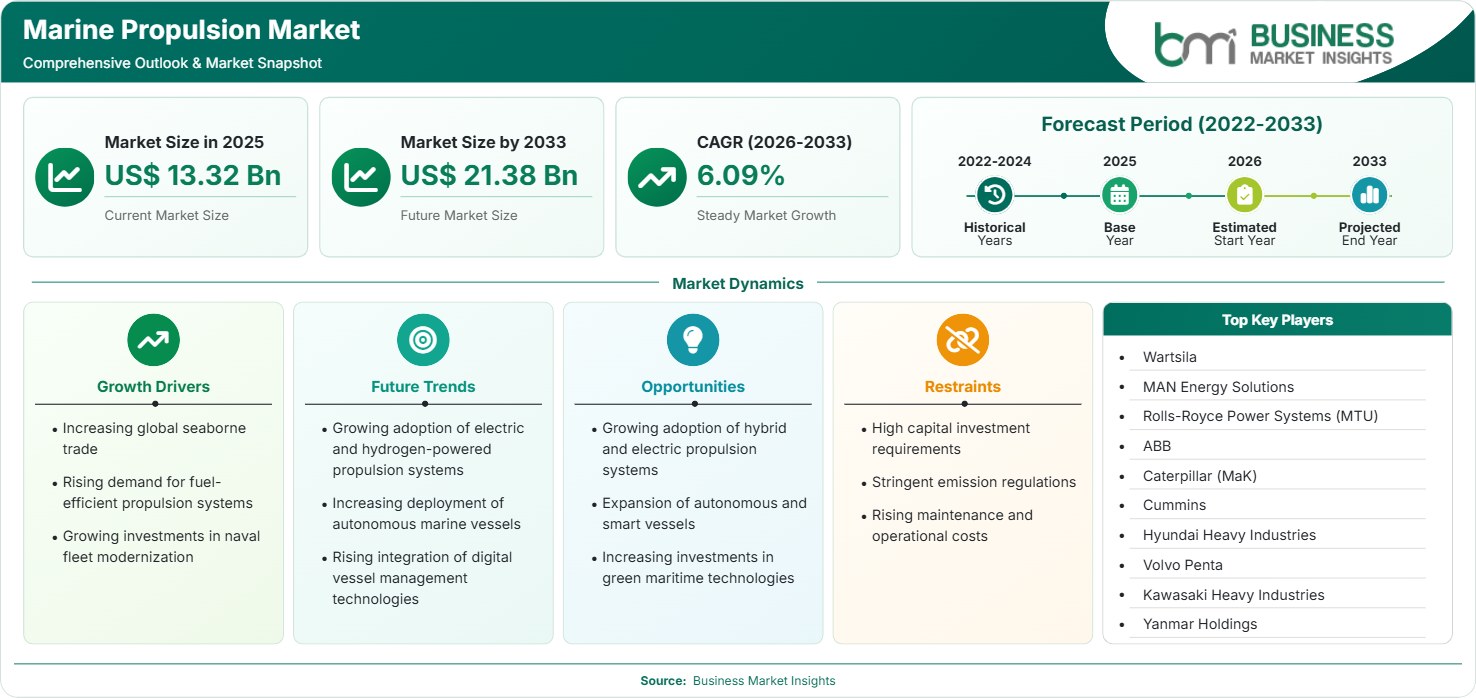
The Marine Propulsion Market was valued at US$ 13.32 Billion in 2025 and is projected to reach US$ 21.38 Billion by 2033, expanding at a CAGR of 6.09% during 2026–2033. Market growth is supported by increasing global seaborne trade, rising demand for fuel-efficient propulsion systems, and continuous investments in naval fleet modernization. The transition toward low-emission propulsion technologies and digitally connected vessels is further strengthening long-term industry development.

Report Coverage
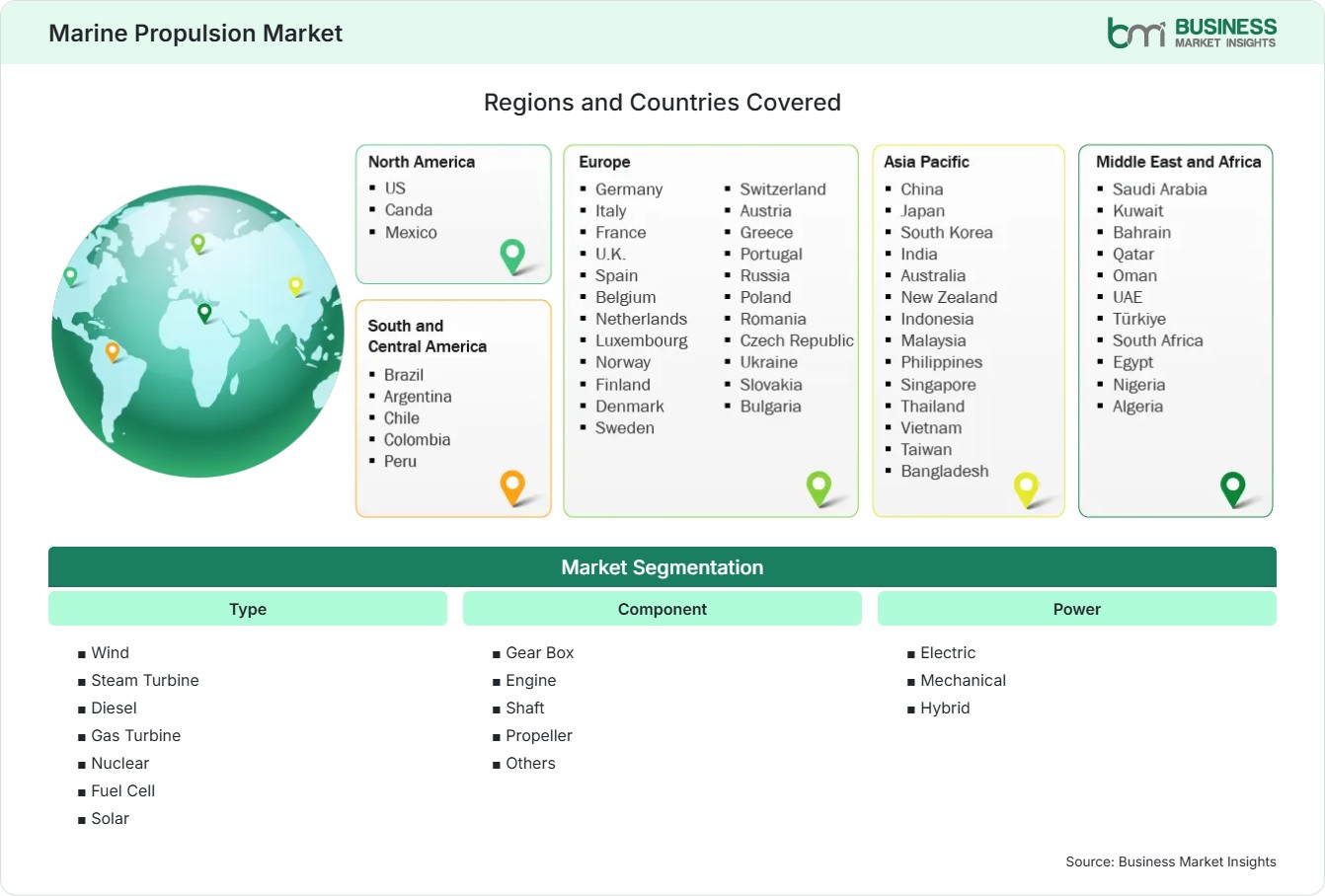
  • Type: Wind, Steam Turbine, Diesel, Gas Turbine, Nuclear, Fuel Cell, Solar
  • Component: Gear Box, Engine, Shaft, Propeller, Others
  • Power: Electric, Mechanical, Hybrid
US$ 13.32 Bn Market size in 2025
US$ 21.38 Bn Market Size by 2033
6.09% CAGR, 2026 - 2033
2026-2033 Forecast Period

01 AI Overview

Marine Propulsion Market Summary

  • North America Region: North America accounted for 24%–27% share in 2025 and is expected to grow at a 5.7%–6.3% CAGR through 2033. Growth is supported by commercial fleet upgrades, naval modernization programs, and investments in advanced marine technologies. The US market is projected to expand at a 5.9%–6.5% CAGR during the forecast period.
  • Fastest Growing Region: Asia Pacific represented 42%–45% share in 2025 and is anticipated to register the highest 6.6%–7.2% CAGR, driven by expanding shipbuilding activities, increasing international trade, and rising investments in commercial and defense fleets.
  • Leading Segment: Diesel propulsion held 44%–47% share in 2025 and is projected to grow at a 5.8%–6.4% CAGR, supported by its widespread use across cargo ships, tankers, offshore vessels, and fishing fleets.
  • High Growth Segment: Hybrid propulsion accounted for 18%–21% share in 2025 and is forecast to record a 7.4%–8.0% CAGR, owing to increasing demand for fuel efficiency, lower emissions, and compliance with international environmental regulations.
  • Key Market Opportunity: Growing investments in hybrid-electric propulsion technologies, autonomous vessels, and green shipping initiatives are creating attractive opportunities for equipment manufacturers and system integrators.
  • Major Market Players: Wartsila, MAN Energy Solutions, Rolls-Royce Power Systems (MTU), ABB, Caterpillar (MaK), Cummins, Hyundai Heavy Industries, Volvo Penta, Kawasaki Heavy Industries, and Yanmar Holdings.
02 Strategic Insights

Marine Propulsion Market: Strategic Insights

marine-propulsion-market-market-strategic-framework
FREE PDF
Request your free sample
Request free sample
03 Stakeholder View

Key Takeaways

  • Demand for advanced propulsion systems continues increasing as shipping companies focus on reducing fuel costs, improving operational efficiency, and meeting stricter environmental standards.
  • Diesel propulsion remains the dominant technology, while hybrid propulsion is emerging as the fastest-growing segment due to sustainability initiatives.
  • Investments in digital vessel management, intelligent propulsion controls, and predictive maintenance are improving fleet reliability and operational performance.
  • Asia Pacific continues to lead market expansion through large-scale shipbuilding activities, growing export trade, and increasing naval procurement.
  • Strategic collaborations among engine manufacturers, shipbuilders, and technology providers are accelerating innovation in low-emission propulsion systems.
04 Geographic Outlook

Marine Propulsion Market Regional Highlights

North America Marine Propulsion Market

North America represents 24%–27% Marine Propulsion Market share in 2025 and is projected to expand at a 5.7%–6.3% CAGR during 2026–2033. Growth is driven by commercial fleet modernization, offshore energy activities, and continuous investments in naval defense programs. The region is also witnessing greater adoption of hybrid propulsion technologies and digital vessel management systems to improve operational efficiency and environmental compliance.

  • Commercial shipping companies are investing in fuel-efficient propulsion systems to reduce operating expenses and improve fleet productivity.
  • Naval modernization programs continue supporting procurement of advanced propulsion technologies for defense vessels.
  • Offshore energy projects are increasing demand for reliable propulsion systems capable of operating under challenging marine conditions.
  • Investments in smart vessel technologies are strengthening integration of propulsion systems with digital monitoring platforms.
  • Environmental regulations continue encouraging adoption of cleaner propulsion technologies across commercial fleets.

US Marine Propulsion Market

The United States accounted for 19%–21% regional share in 2025 and is expected to register a 5.9%–6.5% CAGR through 2033. Demand is supported by strong naval shipbuilding programs, modernization of commercial fleets, and increasing investments in offshore support vessels. Manufacturers continue developing advanced propulsion technologies that improve fuel economy, operational flexibility, and compliance with evolving maritime emission standards.

  • Ship operators are upgrading propulsion equipment to improve fuel efficiency and reduce maintenance costs.
  • Defense investments continue supporting development of advanced propulsion technologies for naval applications.
  • Offshore service vessel demand is strengthening adoption of durable and efficient propulsion systems.
  • Increasing digitalization of maritime operations is improving propulsion monitoring and predictive maintenance capabilities.

Europe Marine Propulsion Market

Europe accounted for 22%–25% share in 2025 and is projected to expand at a 5.9%–6.5% CAGR during 2026–2033. The region benefits from advanced shipbuilding capabilities, stringent environmental regulations, and early adoption of low-emission propulsion technologies. Norway leads innovation in sustainable marine propulsion, while Germany remains a major manufacturing hub. Poland is projected to be the fastest-growing market with a 6.4%–7.0% CAGR, supported by expanding shipbuilding and port infrastructure investments.

  • European shipowners continue investing in hybrid and alternative-fuel propulsion systems to meet IMO emission standards.
  • Germany maintains leadership in marine engineering through continuous innovation in high-efficiency propulsion equipment.
  • Norway remains a pioneer in electric and hybrid vessel deployment across commercial and passenger fleets.
  • Poland is expanding shipbuilding capacity to support growing regional and export demand.
  • Digital vessel management platforms are improving propulsion efficiency, maintenance planning, and operational reliability.

Asia Pacific Marine Propulsion Market

Asia Pacific represented 42%–45% share in 2025 and is forecast to register the highest 6.6%–7.2% CAGR through 2033. Rapid expansion of commercial shipbuilding, increasing international seaborne trade, and growing naval procurement programs continue driving regional demand. China remains the largest market, while India is projected to record the fastest growth at 7.0%–7.6% CAGR owing to expanding shipbuilding infrastructure, port modernization, and defense investments.

  • China continues dominating global commercial shipbuilding and propulsion equipment manufacturing.
  • India is strengthening domestic shipbuilding through government-supported maritime development initiatives.
  • Expansion of international shipping routes continues increasing demand for efficient propulsion technologies.
  • Naval modernization programs across Asia are accelerating procurement of advanced propulsion systems.
  • Investments in green shipping and alternative marine fuels continue supporting technology adoption.

Rest of World Marine Propulsion Market

Rest of World accounted for 9%–11% share in 2025 and is expected to expand at a 6.0%–6.6% CAGR during the forecast period. Demand is supported by offshore energy developments, commercial fleet expansion, and modernization of naval vessels across Latin America and the Middle East. Saudi Arabia is projected to register a 6.5%–7.1% CAGR, driven by maritime infrastructure development and investments in domestic shipbuilding capabilities.

  • Offshore oil and gas activities continue supporting demand for reliable propulsion systems.
  • Port expansion projects are encouraging fleet modernization across regional shipping operators.
  • Governments are increasing investments in naval modernization to strengthen maritime security.
  • Growing adoption of fuel-efficient propulsion technologies supports compliance with global environmental standards.
  • Regional shipbuilding initiatives continue creating opportunities for propulsion equipment suppliers.
global-market-geography
FREE PDF
Request your free sample
Request free sample
05 Segment Analysis

Marine Propulsion Market Segmentation

Type

The type segment remains dominated by diesel propulsion because of its high reliability, fuel efficiency, and suitability for a wide range of commercial and naval vessels. Meanwhile, alternative propulsion technologies are gaining momentum as shipping companies pursue lower emissions and improved operational efficiency. The segment accounted for 44%–47% share in 2025 and is projected to expand at a 5.8%–6.4% CAGR through 2033. The Marine Propulsion Market scope continues broadening as hybrid, fuel cell, and renewable-powered systems gain commercial acceptance.

  • Wind: Wind-assisted propulsion improves fuel efficiency by utilizing rotor sails, rigid sails, and other technologies that reduce engine fuel consumption on long-distance voyages.
  • Steam Turbine: Steam turbine systems remain relevant for selected naval and specialized marine applications requiring dependable high-power output.
  • Diesel: Diesel propulsion dominates commercial shipping because of proven durability, operational efficiency, global service availability, and compatibility with diverse vessel categories.
  • Gas Turbine: Gas turbines provide high power density and rapid acceleration for naval vessels and specialized high-speed marine applications.
  • Nuclear: Nuclear propulsion supports long-endurance naval vessels by delivering continuous power with minimal refueling requirements.
  • Fuel Cell: Fuel cell technologies offer low-emission propulsion while supporting sustainable maritime transportation and future zero-carbon shipping objectives.
  • Solar: Solar-assisted propulsion complements onboard power systems by reducing auxiliary energy consumption and improving overall vessel efficiency.

Component

Component demand is driven by ongoing replacement, maintenance, and modernization of marine propulsion systems. Engines remain the largest revenue contributor because they determine propulsion efficiency, reliability, and operational performance across virtually every vessel category. The segment represented 36%–39% share in 2025 and is projected to grow at a 6.0%–6.6% CAGR during the forecast period.

  • Gear Box: Marine gearboxes optimize torque transmission, improve propulsion efficiency, and support smooth engine performance across different operating conditions.
  • Engine: Marine engines deliver primary propulsion power while improving fuel economy, operational reliability, and vessel productivity.
  • Shaft: Propulsion shafts efficiently transfer engine power to propellers while ensuring dependable long-term mechanical performance.
  • Propeller: Advanced propeller designs improve thrust generation, maneuverability, fuel efficiency, and overall vessel operating performance.

Power

Power systems are evolving rapidly as shipowners increasingly prioritize sustainability and operational flexibility. Mechanical propulsion remains dominant, while hybrid propulsion is expanding at the fastest pace because of stricter emission standards and fuel efficiency requirements. The segment accounted for 52%–55% share in 2025 and is anticipated to register a 6.2%–6.8% CAGR during 2026–2033.

  • Electric: Electric propulsion supports quieter vessel operation, lower emissions, and improved energy efficiency across ferries, offshore vessels, and specialized ships.
  • Mechanical: Mechanical propulsion remains widely deployed owing to proven reliability, lower operational complexity, and extensive commercial adoption.
  • Hybrid: Hybrid propulsion combines conventional engines with electric power systems to improve fuel economy, operational flexibility, and environmental performance.
06 Market Forces

Marine Propulsion Market Dynamics

Key Market Drivers

Increasing global seaborne trade

International seaborne trade continues to expand as global commerce, containerized cargo movement, and energy transportation increase across major shipping routes. Growing demand for bulk carriers, container ships, tankers, and specialized commercial vessels is driving investments in advanced propulsion technologies that improve operational efficiency and vessel reliability. According to UNCTAD, maritime transport remains the backbone of global merchandise trade, supporting long-term fleet expansion worldwide. Marine propulsion market growth is strengthened by increasing vessel construction, fleet modernization, and rising demand for propulsion systems capable of supporting efficient long-distance operations.

Rising demand for fuel-efficient propulsion systems

The shipping industry is focusing on the development of new forms of propulsion that consume less fuel, provide better performance, and minimize the overall life-cycle costs of operation. High efficiency diesel engines, propellers, power management systems, and hybrid propulsion all help increase efficiency while ensuring reliable performance of the vessels. The constantly rising cost of fuel as well as increased demands for higher profitability continue to encourage investments in advanced propulsion equipment.

Growing investments in naval fleet modernization

Governments are expanding defense budgets to modernize naval fleets with technologically advanced propulsion systems capable of improving endurance, maneuverability, mission readiness, and operational efficiency. Modern naval ships have begun to feature digital propulsion control systems, hybrid power configurations, sophisticated monitoring tools, and efficient propulsion technology that helps in improving reliability and reducing costs of ownership during their operation life cycle. Marine Propulsion Market Trends show that steady procurement activities by the navy along with higher investments on advanced defense ships and intelligent propulsion systems will continue to play an important role in future market growth.

Marine Propulsion Market: Key Opportunities

Growing adoption of hybrid and electric propulsion systems

Maritime shipping has seen an increase in the uptake of hybrid and electric propulsion in order to cut down on emissions, lower fuel consumption, and adhere to international environmental guidelines. The shipowners have been developing propulsion systems that use batteries along with other low-emission vessels. These developments are expanding opportunities for propulsion manufacturers delivering innovative power solutions for commercial and passenger vessels. Marine propulsion market forecasts indicate that hybrid propulsion adoption will accelerate as decarbonization strategies become central to global maritime operations.

Expansion of autonomous and smart vessels

Advancements in autonomous navigation, artificial intelligence, and digital management of vessels are fueling the need for smart propulsion that can facilitate automation. Smart propulsion enables real-time performance tracking, predictive maintenance, optimal energy usage, and greater reliability. The use of IoT sensors and other monitoring tools is helping ship operators improve fleet efficiency, minimize maintenance expenditures, and decrease downtime. With autonomous shipping becoming commercially viable after successful pilot projects, propulsion makers can expect increased demand for digitally-enabled marine equipment, which will contribute to the positive market outlook.

Increasing investments in green maritime technologies

Governments, shipbuilders, and shipping companies continue investing in environmentally sustainable technologies to reduce greenhouse gas emissions and improve energy efficiency. Alternative fuels, fuel cells, renewable-assisted propulsion, and advanced energy storage systems are creating new commercial opportunities across the marine propulsion value chain. Continuous research into low-carbon shipping solutions, increasing investments in green vessel technologies, and stricter international environmental regulations are expected to strengthen long-term demand for next-generation propulsion technologies, supporting the market forecast.

Market Restraints and Challenges

High capital investment requirements

Factor: Marine propulsion systems require substantial investment in advanced engines, power management equipment, installation, vessel integration, and long-term maintenance. Impact: The cost of the initial installation may hinder fleet renewal, especially for small and medium-sized shipping firms due to their poor financial capacity. This challenge is being tackled through better fuel efficiency of engines, increased equipment life span, and modular designs, which lower the total cost of owning the system.

Stringent emission regulations

Factor: International maritime organizations continue introducing stricter emission standards covering sulfur oxides, nitrogen oxides, carbon emissions, and vessel energy efficiency. Impact: Compliance demands changes in the technology used for propulsion, use of cleaner fuels, and implementation of more effective exhaust gas reduction technologies, all of which add to the cost of operations. The equipment suppliers are making efforts in the form of developing more efficient engines, hybrid propulsion, and alternate fuels.

07 Company Analysis

Competitive Landscape

The competitive environment is characterized by continuous investment in fuel-efficient engines, hybrid propulsion technologies, digital vessel management platforms, and alternative marine power solutions. Marine Propulsion Market analysis indicates that leading manufacturers are strengthening their market position through product innovation, strategic partnerships, capacity expansion, and investments in sustainable propulsion technologies.

Company Name

Overview

Products and Services Relevant to this Market

Wartsila

Global marine technology company specializing in sustainable propulsion solutions.

Marine engines, hybrid propulsion systems, power management solutions, digital vessel technologies.

MAN Energy Solutions

Leading supplier of large marine propulsion technologies.

Marine diesel engines, dual-fuel engines, propulsion systems, energy solutions.

Rolls-Royce Power Systems (MTU)

Manufacturer of advanced propulsion and power generation equipment.

Marine engines, propulsion systems, hybrid power solutions, vessel automation.

ABB

Global technology company providing integrated marine electrification solutions.

Electric propulsion systems, marine drives, energy management platforms, automation technologies.

Caterpillar (MaK)

Supplier of propulsion systems for commercial and offshore vessels.

Marine diesel engines, propulsion equipment, power systems, service solutions.

Cummins

Global engine manufacturer serving commercial marine applications.

Marine engines, propulsion technologies, power generation equipment, digital monitoring solutions.

Hyundai Heavy Industries

Major shipbuilder and marine equipment manufacturer.

Marine propulsion systems, ship engines, integrated vessel technologies.

Volvo Penta

Provider of marine propulsion solutions for commercial and leisure vessels.

Marine engines, IPS propulsion systems, hybrid propulsion technologies.

Kawasaki Heavy Industries

Industrial manufacturer serving marine and defense industries.

Marine propulsion equipment, gas turbines, integrated power systems.

Yanmar Holdings

Manufacturer of compact and medium-sized marine propulsion systems.

Marine diesel engines, propulsion equipment, power solutions, vessel support systems.


10 Trust & Transparency

Research Methodology

The market analysis combines proprietary research with secondary data from government agencies, company disclosures, regulatory filings, industry databases and expert interviews. Market estimates are validated through data triangulation, cross-market benchmarking and analyst review.

View Full Research Methodology

11 Questions Answered

Frequently Asked Questions

What does the Marine Propulsion Market Report include?

The report provides detailed insights into market size, regional analysis, segment performance, competitive landscape, technological developments, market drivers, opportunities, restraints, recent industry developments, and forecasts through 2033.

Which region is expected to witness the fastest market growth?

Asia Pacific is projected to record the highest growth during the forecast period due to expanding shipbuilding activities, increasing international trade, rising naval procurement, modernization of port infrastructure, and continuous investments in commercial and defense maritime industries.

Why is hybrid propulsion experiencing rapid growth?

Hybrid propulsion combines conventional engines with electric power systems to improve fuel economy, reduce emissions, lower operating costs, and help vessel operators comply with increasingly stringent international maritime environmental regulations.

Which propulsion type dominates the Marine Propulsion Market?

Diesel propulsion holds the largest market share because of its high reliability, fuel efficiency, extensive service network, and broad adoption across cargo vessels, tankers, fishing fleets, offshore support vessels, and naval ships.

What are the primary factors driving the Market?

The market is driven by increasing global seaborne trade, rising demand for fuel-efficient propulsion systems, growing investments in naval fleet modernization, expansion of commercial shipping activities, and the adoption of environmentally sustainable marine technologies.

Access the Full Marine Propulsion Market Report

Get segment-level forecasts, regional estimates, competitive benchmarking, company profiles and downloadable Excel datasets.

Access the full Marine Propulsion Market Report
350 pages PDF & Excel | 2026-08-04