Market Summary
Executive Summary and Global Market Analysis
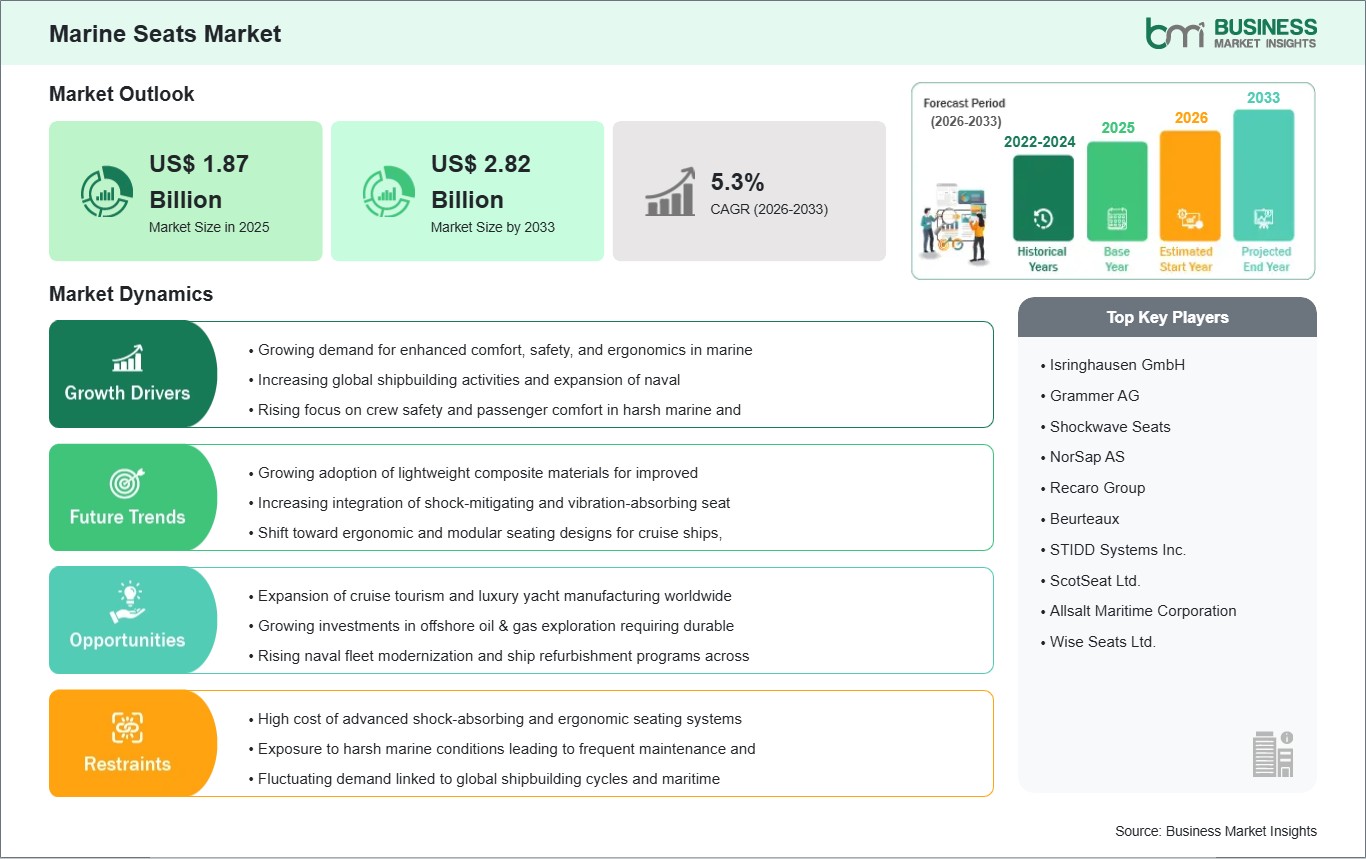
The Marine Seats Market refers to the industry involved in the design, manufacturing, and supply of specialized seating solutions used in marine vessels such as commercial ships, naval vessels, offshore platforms, yachts, and recreational boats. These seats are engineered to provide durability, comfort, shock absorption, and safety in harsh marine environments, often incorporating features such as vibration damping, ergonomic design, corrosion resistance, and adjustable configurations. Marine seats are widely used in navigation bridges, crew areas, passenger vessels, and high-performance military and offshore vessels.
The market is witnessing steady growth driven by rising global maritime trade, expansion of naval defense fleets, and increasing demand for luxury and recreational boating activities. Growth in commercial shipping, offshore oil and gas exploration, and naval modernization programs is significantly contributing to the demand for advanced marine seating solutions. Additionally, increasing focus on crew safety, operational comfort, and ergonomic workplace standards in marine environments is further supporting market expansion.
However, the market faces challenges such as high manufacturing costs associated with specialized materials, strict regulatory standards for marine safety, and fluctuations in shipbuilding demand. Harsh environmental conditions such as saltwater exposure, humidity, and continuous vibration also require advanced engineering and maintenance, increasing overall product costs and complexity.
Despite these challenges, the marine seats market holds strong growth potential due to rising investments in shipbuilding, naval modernization programs, and increasing demand for high-performance and luxury marine vessels. Technological advancements in shock-mitigating seat systems, lightweight composite materials, and smart adjustable seating solutions are expected to further enhance product performance. Collectively, these factors position marine seats as a critical component of modern marine vessel design and operational efficiency worldwide.
Segment Analysis
Marine Seats Market Segmentation
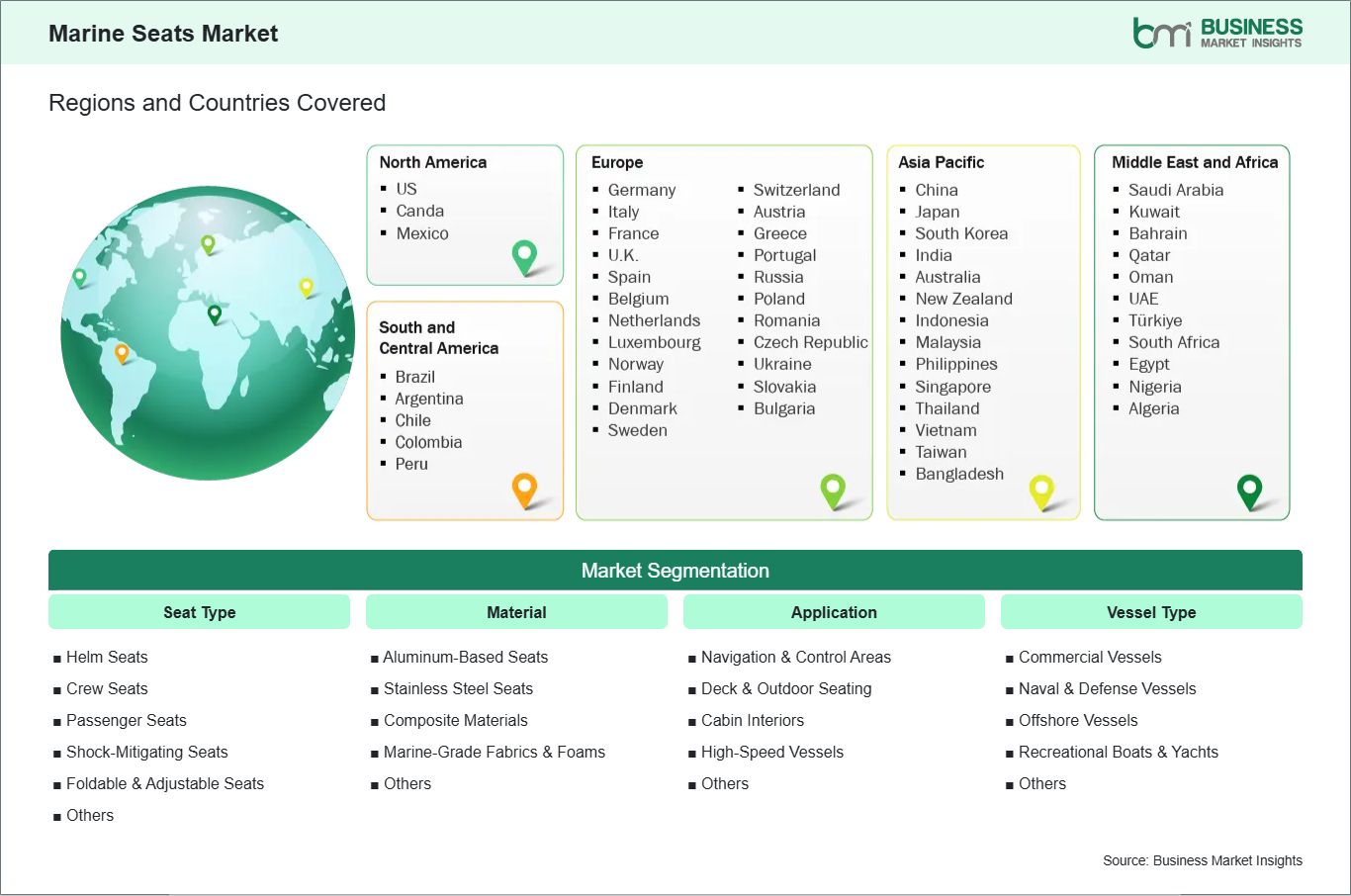
The Marine Seats Market is segmented based on seat type, material, application, end use, and vessel type, reflecting the demand for durable, ergonomic, and vibration-resistant seating solutions across commercial, defense, and recreational marine vessels.
By Seat Type
- Helm Seats: Used in navigation bridges of ships and boats for steering and control operations
- Crew Seats: Designed for operational crew members requiring durability and ergonomic support
- Passenger Seats: Used in ferries, cruise ships, and commercial passenger vessels for comfort and safety
- Shock-Mitigating Seats: Designed to reduce impact and vibration in high-speed and offshore vessels
- Foldable & Adjustable Seats: Space-saving seating solutions for flexible marine interiors
- Others: Includes customized and application-specific marine seating systems.
By Material
- Aluminum-Based Seats: Lightweight and corrosion-resistant structures
- Stainless Steel Seats: High durability and resistance to marine corrosion
- Composite Materials: Lightweight and high-strength seating solutions
- Marine-Grade Fabrics & Foams: Used for cushioning, comfort, and environmental resistance
- Others: Includes hybrid material structures for specialized applications.
By Application
- Navigation & Control Areas: Helm and bridge seating for operational control
- Deck & Outdoor Seating: Used in open marine environments exposed to harsh conditions
- Cabin Interiors: Passenger and crew accommodation seating
- High-Speed Vessels: Specialized shock-absorbing seating for performance boats
- Others: Includes luxury yachts and custom marine interiors.
By Vessel Type
- Commercial Vessels: Cargo ships, ferries, and transport ships
- Naval & Defense Vessels: Military ships requiring rugged and shock-resistant seating
- Offshore Vessels: Oil rigs, supply vessels, and support ships
- Recreational Boats & Yachts: Luxury and leisure marine applications
- Others: Includes research vessels and specialty marine craft.
By End User
- Shipbuilding Industry: Largest segment due to continuous demand for new vessels
- Naval Defense Sector: Requires high-durability and shock-resistant seating systems
- Offshore Oil & Gas Industry: Uses rugged seating for harsh marine environments
- Marine Tourism & Leisure Industry: Demand driven by cruise ships and luxury yachts
- Others: Includes repair, retrofitting, and marine equipment suppliers.
Market Forces
Marine Seats Market Drivers and Opportunities
Growing Demand for Comfort, Safety, and Ergonomics in Marine Operations Driving Market Growth
The Marine Seats Market is primarily driven by increasing demand for enhanced comfort, safety, and ergonomic seating solutions across commercial, defense, and recreational marine vessels. Growing global maritime trade, expansion of shipbuilding activities, and rising passenger traffic in ferries and cruise ships are significantly boosting demand for advanced marine seating systems. Ship operators are increasingly focusing on improving crew productivity and passenger experience through ergonomically designed and shock-absorbing seating solutions.
The rising focus on crew safety and operational efficiency in harsh marine environments is further accelerating market growth. Marine seats designed with vibration damping, corrosion resistance, and impact absorption capabilities are becoming essential for vessels operating in rough sea conditions, offshore platforms, and high-speed boats.
Technological Advancements in Marine Seating and Expanding Shipbuilding Activities Creating Strong Growth Opportunities
Opportunities in the Marine Seats Market are expanding significantly due to continuous innovation in lightweight composite materials, shock-mitigating seat systems, and modular seating designs. These advancements are improving durability, comfort, and performance while reducing maintenance requirements in marine environments.
The increasing investments in naval modernization programs, offshore oil and gas exploration, and luxury yacht manufacturing are creating strong demand for high-performance marine seating solutions. Additionally, the growth of smart seating technologies with integrated sensors for posture monitoring and vibration control is further enhancing market potential.
Rising shipbuilding activities in Asia Pacific, coupled with refurbishment and retrofitting of existing fleets in Europe and North America, are also contributing to market expansion. The adoption of advanced manufacturing techniques such as corrosion-resistant coatings, 3D-designed ergonomic structures, and high-strength lightweight materials is further supporting long-term growth.
Size and Share Analysis
Marine Seats Market Size and Share Analysis
The marine seats marketis projected to grow from US$ 2.82 billion by 2033 from US$ 1.87 billion in 2025. The market is estimated to record a CAGR of 5.3% from 2026 to 2033.
By seat type, helm seats hold the largest market share due to their widespread use in navigation bridges of commercial, defense, and recreational vessels where operator comfort and control are critical. Crew seats also account for a significant share, driven by their extensive use in operational and working areas of ships requiring durability and ergonomic support. Shock-mitigating seats are witnessing strong growth due to increasing demand in high-speed vessels and offshore operations where vibration and impact reduction are essential. Passenger seats are also expanding steadily, supported by rising cruise tourism and ferry transportation demand.
By material, composite materials dominate the market share, supported by their lightweight properties, high strength, and resistance to corrosion in harsh marine environments. Aluminum-based seats also account for a strong share due to their durability and reduced weight advantages. Stainless steel seating systems remain widely used in heavy-duty and naval applications due to their high corrosion resistance. Marine-grade fabrics and foams are witnessing increasing demand due to their enhanced comfort, waterproof properties, and long service life in marine conditions.
Report Coverage
Marine Seats Market Report Coverage and Deliverables
The "Marine Seats Market Size and Forecast (2022–2033)" report provides a detailed analysis of the market covering below areas:
- Market size and forecast at global, regional, and country levels for all market segments covered under the scope
- Market trends, as well as drivers, restraints, and opportunities
- Market analysis covering key trends, global and regional framework, major players, regulations, and recent developments
- Industry landscape and competition analysis covering market concentration, heat map analysis, prominent players, and recent developments for the market
- Detailed company profiles, including SWOT analysis
Geographic Insights
Marine Seats Market Geographic Insights
The Marine Seats Market demonstrates significant regional variation, influenced by differences in shipbuilding activity, naval modernization programs, offshore oil & gas exploration, maritime trade volume, and demand for luxury and recreational vessels across major global economies. Growth patterns are closely linked to increasing demand for ergonomic, shock-resistant, and corrosion-resistant seating solutions in commercial, defense, and recreational marine applications.
North America holds a significant share of the marine seats market due to strong naval defense expenditure, advanced shipbuilding capabilities, and a well-established commercial maritime industry. The United States dominates the regional market, supported by continuous naval modernization programs, high demand for offshore vessels, and growing cruise ship operations. Canada also contributes steadily through shipbuilding activities and marine transportation infrastructure development..
Asia Pacific is the fastest-growing regional market, driven by large-scale shipbuilding activities, expanding maritime trade, and rising naval modernization programs. China, South Korea, and Japan are global leaders in ship production, significantly contributing to marine seat demand. India is also emerging as a growing market due to expanding coastal infrastructure, defense investments, and increasing commercial vessel construction.
Overall, the Marine Seats Market is driven by global shipbuilding expansion, rising naval modernization programs, and increasing demand for durable, ergonomic, and high-performance seating solutions across commercial, defense, and recreational marine vessels.
Industry Activity
Recent Developments
The marine seats market is evaluated by gathering qualitative and quantitative data post primary and secondary research, which includes important corporate publications, association data, and databases. Recent developments and news in the market include:
- In June 2026, Anemoi Marine Technologies and its partners have completed a joint development project aimed at simplifying the integration of Rotor Sail wind propulsion systems on medium-range (MR) tankers, with classification society DNV granting Approval in Principle (AiP) for the design. The project was developed in collaboration with Guangzhou Shipyard International (GSI) and tanker operator Hafnia and focused on integrating two folding, explosion-rated Rotor Sails into an MR tanker design.
- In September 2024, Shockwave Seats, a Canadian-based marine suspension company revolutionizing marine shock mitigation around the globe, announces the expansion of the Shockwave S5 recreational product line. The expansion includes the introduction of the stainless steel Shockwave S5-SS, a premium product, as well as the Shockwave S5-LW for the fresh water market and lighter duty applications.
Trust & Transparency
Research Methodology
The market analysis combines proprietary research with secondary data from government agencies, company disclosures, regulatory filings, industry databases and expert interviews. Market estimates are validated through data triangulation, cross-market benchmarking and analyst
review.
View Full Research Methodology
Key Sources Referred:
World Bank - Global Trade IndicatorsWorld Trade Organization (WTO)(International Monetary Fund )IMFInternational Trade Administration (ITA)Company websiteCompany annual reportsCompany investor presentations