
Marine Vessel Market Outlook: Size, Share, Trends, Growth Analysis, Competitive Landscape & Forecast, 2026-2033

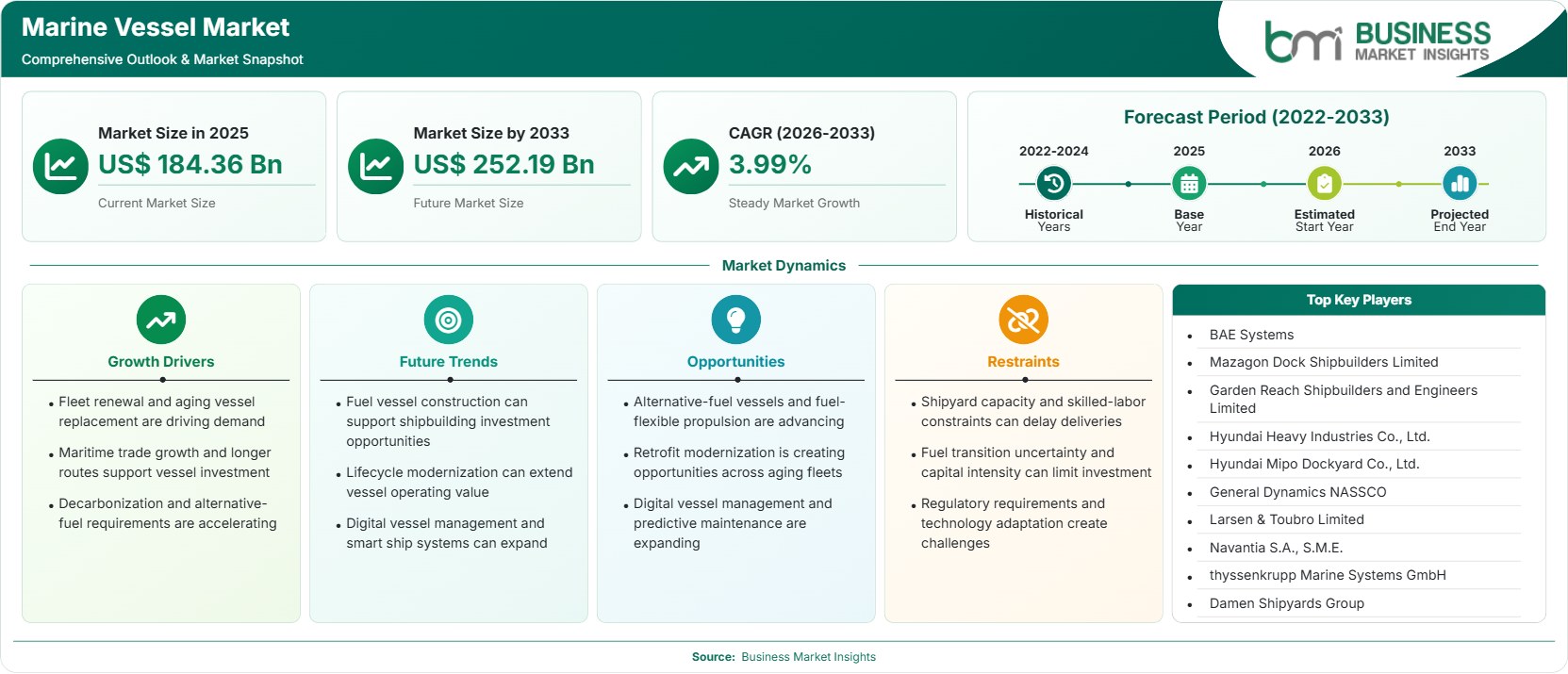
The Marine Vessel Market size was valued at US$ 184.36 Billion in 2025 and is projected to reach US$ 252.19 Billion by 2033, growing at a CAGR of 3.99% during 2026–2033, supported by fleet renewal, maritime trade, naval modernization, decarbonization, offshore activity, and shipyard capacity expansion.

Report Coverage
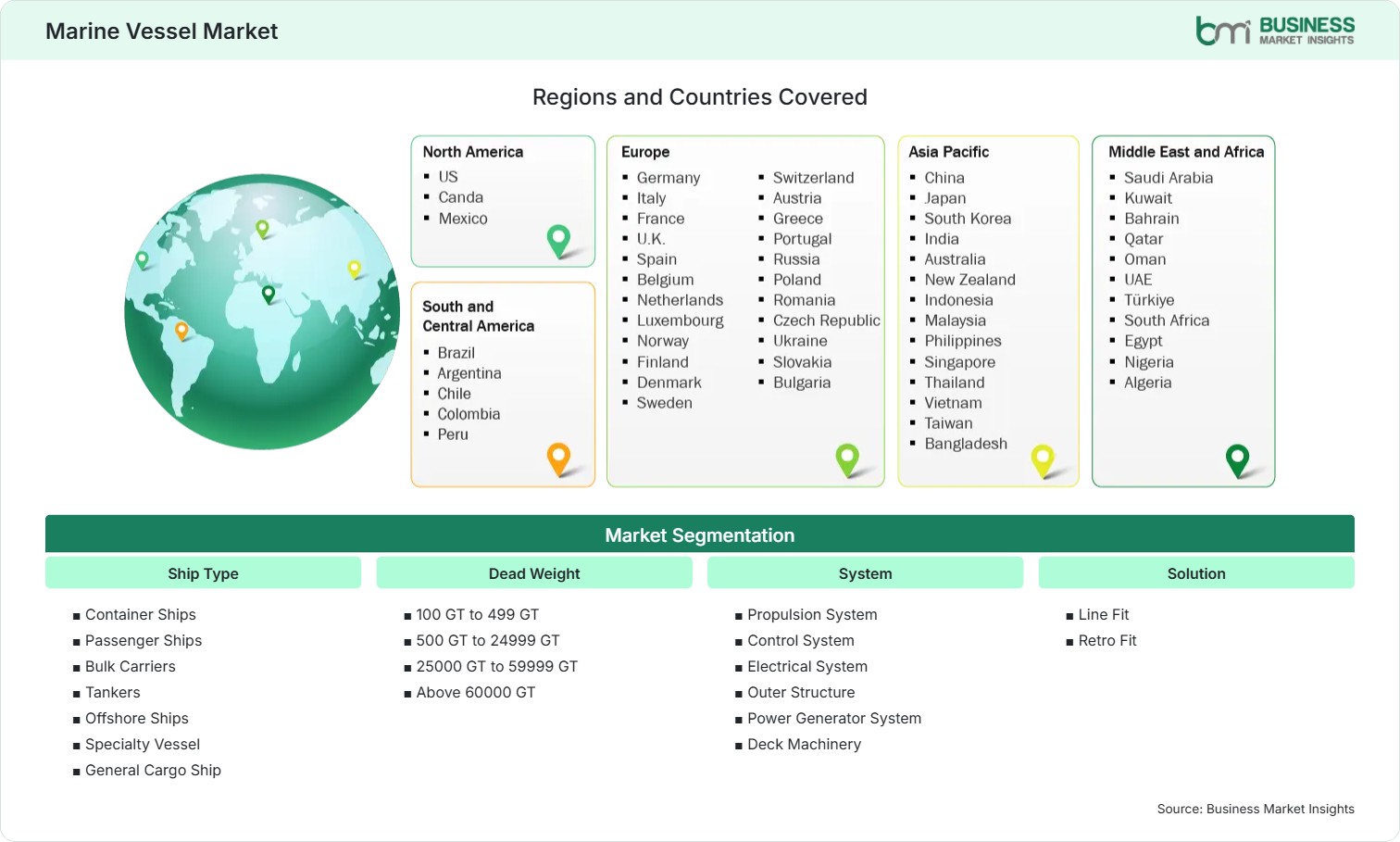
  • Ship Type: Container Ships, Passenger Ships, Bulk Carriers, Tankers, Offshore Ships, Specialty Vessel, General Cargo Ship
  • Dead Weight: 100 GT to 499 GT, 500 GT to 24999 GT, 25000 GT to 59999 GT, Above 60000 GT
  • System: Propulsion System, Control System, Electrical System, Outer Structure, Power Generator System, Deck Machinery
  • Solution: Line Fit, Retro Fit
US$ 184.36 Bn Market size in 2025
US$ 252.19 Bn Market Size by 2033
3.99% CAGR, 2026 - 2033
2026-2033 Forecast Period

AI Overview

Marine Vessel Market Summary

  • North America Region: North America holds a 19%–23% share of the Marine Vessel Market in 2025 and is projected to grow at a CAGR of 3%–5%, supported by naval modernization, commercial fleet renewal, offshore energy, Jones Act demand, port infrastructure, and defense procurement. The US represents most regional demand, expanding at 3%–5% CAGR through 2033 as naval investment, offshore activity, and domestic shipbuilding initiatives strengthen procurement.
  • Fastest Growing Region: Asia Pacific holds a 47%–51% share in 2025 and is expanding at a CAGR of 5%–7%, driven by shipbuilding leadership, seaborne trade, fleet replacement, offshore projects, defense modernization, environmental compliance, and expanding maritime infrastructure.
  • Leading Segment: Container Ships hold a 25%–29% share of the Marine Vessel Market in 2025 and are projected to expand at a CAGR of 4%–6%, supported by containerized trade, fleet renewal, larger vessels, fuel-efficiency requirements, route diversification, and demand for efficient cargo capacity.
  • High Growth Segment: Above 60,000 GT vessels hold a 20%–24% share in 2025 and are projected to advance at a CAGR of 5%–7%, supported by large container carriers, LNG infrastructure, bulk transportation, economies of scale, and fleet modernization.
  • Key Market Opportunity: Fleet decarbonization creates investment opportunities across alternative-fuel vessels, propulsion upgrades, digital monitoring, energy-efficiency systems, retrofit programs, shore-power compatibility, and integrated lifecycle services.
  • Major Market Players: BAE Systems; Mazagon Dock Shipbuilders Limited; Garden Reach Shipbuilders and Engineers Limited; Hyundai Heavy Industries Co., Ltd.; Hyundai Mipo Dockyard Co., Ltd.; General Dynamics NASSCO; Larsen & Toubro Limited; Navantia S.A., S.M.E.; thyssenkrupp Marine Systems GmbH; and Damen Shipyards Group.
Strategic Insights

Marine Vessel Market: Strategic Insights

Marine Vessel Market Strategic Framework
FREE PDF
Request your free sample
Request free sample
Stakeholder View

Key Takeaways

  • Shipbuilding remains concentrated across Asian yards, while naval construction, specialized vessels, offshore ships, and repair services provide differentiated regional opportunities. UNCTAD reports that China, Greece, and Japan controlled more than 40% of world fleet capacity by 2025, while three major flag states accounted for nearly half of registered capacity.
  • Retrofit programs are becoming commercially important because owners can improve propulsion efficiency, emissions performance, automation, and onboard systems without immediately replacing entire vessels. This creates recurring demand for propulsion, control, electrical, and deck machinery suppliers.
  • Alternative fuels, air lubrication, hybrid propulsion, digital twins, autonomous navigation, energy-management systems, and advanced vessel-control technologies are moving from demonstration projects toward commercial deployment as owners prioritize lifecycle economics.
  • Asia Pacific remains the strongest investment center because China, South Korea, and Japan combine shipyard capacity, marine engineering, component ecosystems, and established export relationships. India represents an emerging diversification opportunity as international owners consider alternative construction locations.
  • Strategic collaboration is increasing around shipbuilding capacity and naval technology. In April 2025, Huntington Ingalls Industries and Hyundai Heavy Industries signed an MOU covering commercial and defense shipbuilding cooperation, reflecting broader efforts to strengthen industrial capacity.
  • Vessel ownership economics are increasingly influenced by maintenance, retrofit, spare parts, digital monitoring, and through-life support. Shipbuilders that combine construction with lifecycle services can create more resilient revenue streams than those dependent solely on newbuild contracts.
Geographic Outlook

Marine Vessel Market Regional Highlights

North America Marine Vessel Market

North America holds a 19%–23% share in 2025 and is projected to grow at a CAGR of 3%–5% through 2033. The region benefits from defense procurement, commercial vessel replacement, offshore energy, domestic shipping requirements, and port infrastructure investment. The US is the primary market on the demand side, while Canada supports demand through commercial, offshore, and government vessels. The Marine Vessel Market benefits from the Navy's modernization efforts and domestic shipbuilding programs. Regulations that favor domestic production support the demand for yards, marine systems, and propulsion systems.

  • US naval modernization supports demand for specialized platforms, combat vessels, support ships, and associated propulsion and control technologies, creating a more stable procurement pipeline than commercial vessel cycles.
  • Offshore energy activity creates demand for service vessels, support craft, tankers, and specialized platforms capable of operating safely in increasingly complex marine environments.
  • Domestic shipbuilding initiatives are encouraging investment in yard productivity, workforce development, supply-chain localization, and advanced manufacturing capabilities to address long-standing capacity constraints.
  • Demand for efficient propulsion and onboard energy systems is increasing as operators face higher fuel costs, environmental requirements, and pressure to improve vessel operating economics.

US Marine Vessel Market

The US accounts for 71%-75% of North America's consumption in 2025 and has a compound annual growth rate (CAGR) of 3%-5% up to 2033. Factors driving the  Market include Navy acquisitions, internal cargo vessels, offshore work, and state-backed shipbuilding programs. Increasingly, the Marine Vessel Market growth depends on efforts to expand capacity at domestic shipyards and reduce reliance on foreign yards. US consumption is further driven by replacement needs, military expenditure, and the procurement of dedicated vessels for coast guards and for naval or offshore operations.

  • The US shipbuilding sector faces capacity constraints, investing in automation, workforce training, modular construction, and supplier localization strategically important for long-term fleet requirements.
  • Defense shipbuilding provides relatively predictable demand because major naval programs operate across long procurement cycles and require specialized engineering, propulsion, combat systems, and lifecycle support.
  • Offshore and coastal shipping create opportunities for service vessels, workboats, tankers, and specialized platforms where domestic construction and regulatory requirements influence procurement decisions.

Europe Marine Vessel Market

The Europe region accounts for 22% to 26% market share in 2025 and is expected to have a CAGR of 3% to 5% between 2024 and 2033. Countries like Germany, Spain, the Netherlands, France, Norway, and Italy are considered significant maritime hubs. Germany and Spain account for the highest levels of specialty shipbuilding, whereas Norway and the Netherlands offer ample opportunities in commercial and offshore shipbuilding. The marine vessel market share can be attributed to decarbonization regulations, naval upgradation, offshore wind farms, ferry replacements, and high-end propulsion systems.

  • Germany remains important for naval vessels, submarines, marine engineering, and high-value systems, with thyssenkrupp Marine Systems expanding its strategic role through European cooperation.
  • Spain's Navantia recorded €6.627 billion in contracts during 2025, four times its 2024 level, while its consolidated order backlog reached €12.826 billion, demonstrating strong naval demand.
  • The Netherlands benefits from shipbuilding specialization, offshore services, workboats, and naval support vessels, with Damen reporting 160 vessel deliveries in 2025.
  • European environmental regulation is encouraging investments in alternative fuels, energy-efficiency technologies, hybrid systems, shore-power compatibility, and retrofit solutions.

Asia Pacific Marine Vessel Market

Asia Pacific holds a 47%–51% share in 2025 and is projected to expand at a CAGR of 5%–7% through 2033. China, South Korea, and Japan dominate regional construction, while India is emerging as a strategic alternative manufacturing location. Marine Vessel Market benefits from extensive shipyard infrastructure, strong export demand, commercial fleet renewal, naval modernization, and expanding offshore energy activity. The region also has a dense ecosystem of marine engines, steel, electronics, propulsion systems, and shipbuilding suppliers.

  • China remains the largest shipbuilding power, supported by extensive yard capacity, domestic steel production, component availability, large export volumes, and strong government-backed maritime industrial infrastructure.
  • South Korea specializes in high-value commercial vessels, including LNG carriers and large container ships, while its naval ambitions are creating additional opportunities for defense shipbuilding partnerships.
  • Japan retains a strong position in efficient commercial vessel construction and marine engineering, with shipyards operating near capacity for several future production years.
  • India is pursuing shipbuilding expansion and diversification, with international shipping companies increasingly considering Indian yards for future commercial vessel programs.

Rest of World Marine Vessel Market

South and Central America constitute a smaller but strategically significant base of demand, driven by commodity shipments, offshore energy production, regional trade, fishing activities, and port development. Brazil is the major driver here, whereas Mexico and Chile offer supplementary demand for commercial, offshore, and specialty ships. Regional Marine Vessels Market growth is driven by energy projects, fleet replacement, and infrastructure investments. The offshore market in Brazil drives demand for platform supply vessels, tankers, and other support vessels, while regional ports require advanced cargo-handling facilities.

The Middle East & Africa offer opportunities for offshore energy, naval fleet upgrade, coastwise shipping, port development, and specialty vessels. Saudi Arabia & UAE are emerging as key investment destinations, while South Africa continues to be an important industrial and maritime hub. Rest of World demand is expected to grow at a CAGR of 2%-4% until 2033.

  • Gulf countries are investing in maritime infrastructure, naval capabilities, offshore projects, and industrial localization, supporting demand for specialized vessels and lifecycle maintenance services.
  • Brazil's offshore oil and gas activity creates recurring demand for support vessels, shuttle tankers, floating production infrastructure, and specialized marine engineering capabilities.
  • African coastal economies require modernized cargo, fishing, patrol, ferry, and support vessels as port infrastructure expands and regional trade networks mature.
  • Saudi Arabia's localization programs encourage technology transfer, domestic maintenance capability, training, and lifecycle support alongside new vessel procurement.
Global Market Geography
FREE PDF
Request your free sample
Request free sample
Segment Analysis

Marine Vessel Market Segmentation

Ship Type

Container Ships are leading, accounting for 25%-29% market share in 2025 and experiencing a 4%-6% CAGR through 2034. Demand is driven by fleet replacement, containerization of cargo trade, improved efficiency, and economies of scale. The scope of the Marine Vessel market expands to include custom-designed ships for specific trade routes.

  • Container Ships: Demand is supported by containerized trade, fleet renewal, larger vessel economics, route restructuring, and investments in fuel-efficient propulsion and cargo-handling systems.
  • Passenger Ships: Cruise, ferry, and regional passenger mobility demand supports replacement programs, with operators emphasizing energy efficiency, safety, digital navigation, and passenger experience.
  • Bulk Carriers: Commodity transportation requirements sustain demand, while owners increasingly prioritize efficient hull designs, fuel-saving systems, and propulsion technologies that reduce voyage costs.
  • Tankers: Oil, chemical, and product transportation requires specialized cargo systems, safety technologies, efficient propulsion, and compliance-oriented designs for evolving environmental standards.
  • Offshore Ships: Offshore energy and marine construction require platform supply vessels, service operation vessels, anchor handlers, and specialized craft with high maneuverability.
  • Specialty Vessel: Research, defense, rescue, dredging, cable-laying, and other specialized applications require customized designs, advanced equipment, and mission-specific system integration.
  • General Cargo Ship: General cargo vessels remain relevant for diversified regional trade, particularly where ports handle mixed cargoes and smaller-volume shipments.

Dead Weight

The 500 GT to 24,999 GT category represents a broad portion of vessel demand, while Above 60,000 GT is the high-growth category at a CAGR of 5%–7% of the Marine Vessel Market. Larger vessels benefit from economies of scale, cargo efficiency, and major trade routes, while smaller classes support regional and specialized maritime operations.

  • 100 GT to 499 GT: Small vessels support coastal transport, fishing, patrol, passenger movement, workboat operations, and specialized services requiring maneuverability and low operating complexity.
  • 500 GT to 24,999 GT: This range covers numerous commercial and specialized applications, supporting balanced demand across regional cargo, offshore services, passenger transport, and utility vessels.
  • 25,000 GT to 59,999 GT: Mid-to-large vessels serve bulk, tanker, cargo, and specialized routes, with design priorities increasingly focused on fuel efficiency and emissions compliance.
  • Above 60,000 GT: Large vessels benefit from economies of scale across container, bulk, tanker, and other long-distance applications, supporting demand for advanced propulsion and high-capacity cargo systems.

System

The propulsion system is the most important category among all system categories due to its direct effect on ship performance, fuel consumption, emissions, and life cycle costs. This category is forecast to grow at a CAGR of 4%-6% up to 2034. The marine vessel market trends are characterized by a growing emphasis on hybridization, alternative fuels, efficiency, digital control, and energy management systems.

  • Propulsion System: Advanced engines, hybrid systems, alternative fuels, and propulsion optimization are becoming central to reducing fuel consumption and meeting increasingly stringent emissions requirements.
  • Control System: Digital automation, navigation controls, integrated bridge systems, and remote monitoring improve operational reliability, safety, maneuverability, and maintenance planning.
  • Electrical system: Efficient generation, distribution, storage, and power management support increasingly electrified vessels and the growing electrical load from onboard digital technologies.
  • Outer Structure: Lightweight materials, hydrodynamic optimization, corrosion protection, and improved hull designs can reduce resistance and improve lifecycle performance.
  • Power Generator System: Efficient auxiliary generation supports reliable onboard power while enabling lower fuel consumption, hybrid integration, emissions reduction, and improved redundancy.
  • Deck Machinery: Cranes, winches, handling systems, and mooring equipment are increasingly automated to improve safety, productivity, and operating efficiency across commercial and specialized vessels.

Solution

Line Fit remains very important in newbuilds, while Retrofit is gaining strategic importance as owners modernize their fleets to meet emission compliance and efficiency targets. The demand for retrofit services comes from fleet age, fuel requirements, digital monitoring, improved propulsion technology, and lifecycle economics.

  • Line Fit: New vessels integrate propulsion, control, electrical, automation, and environmental technologies during construction, enabling optimized system compatibility and lower installation complexity.
  • Retro Fit: Existing vessels receive propulsion upgrades, emissions systems, automation, digital monitoring, and energy-efficiency technologies, extending useful life while supporting regulatory compliance.
Market Forces

Marine Vessel Market Dynamics

Key Market Drivers

Fleet Renewal and Aging Vessel Replacement

By January 2025, the global fleet stood at around 112,500 vessels and 2.44 billion deadweight tons. This represents a significant number of ships in need of replacement, updating, or maintenance. According to UNCTAD, fleet renewal and ship recycling are key issues in facilitating the shift to clean shipping. Owners have to consider the age of ships, their fuel efficiency, charter rates, regulatory compliance, and costs when making a choice between building new ships and fitting out old ones. Consequently, the Marine Vessel Market is fueled not only by replacement but also by modernization investments. Modern large-scale operators take into account the total cost of owning a vessel, rather than its purchase price alone. Old engines, poor hull design, outdated control systems, and poor environmental performance may diminish the competitiveness of older vessels during long trips.

Maritime Trade and Longer Shipping Routes

Sea-borne commerce continues to be an essential aspect of world trade, as about 80% of the world’s international goods trade is carried out through waterways. UNCTAD estimated that disruptions associated with geopolitical events led to longer shipping routes and a 5.9% increase in global shipping ton-miles. Longer shipping routes mean greater fuel use, ship utilization, maintenance exposure, and emissions; hence, the need for efficient ships becomes increasingly important. The Marine Vessel Market is therefore impacted by the range, cargo-carrying capacity, fuel efficiency, and route flexibility of vessels. Operators of containers, tankers, bulk carriers, and multipurpose vessels are increasingly seeking ships that enable them to operate efficiently across different routes. This also accounts for freight market volatility, given uncertainties surrounding vessel charter earnings.

Decarbonization and Alternative-Fuel Requirements

The IMO's Net-Zero Framework introduces a global fuel standard and a greenhouse gas pricing mechanism, targeting large ocean-going ships above 5,000 GT that account for approximately 85% of international shipping CO2 emissions. The framework is designed to accelerate the adoption of zero- and near-zero-emission fuels and technologies. The regulation directly impacts the ship's design, propulsion technology, fuel tanks, power supply, and retrofitting options. The Marine Vessel Market growth will increasingly depend on the extent of investment in LNG-compatible vessels, methanol-compatible engines, battery-hybridized ships, shore power installations, energy-efficient installations, and alternative fueling facilities. Additionally, uncertainty about which fuels will be most available and competitive in the future adds another element of risk for the shipowner. Ships are therefore increasingly designed to be fuel flexible and convertible.

Key Market Opportunities

Alternative-Fuel Vessel Construction

The shift towards low-emission maritime transport is an opportunity for shipbuilders and equipment makers to produce vessels that operate on alternative fuels. It requires a comprehensive solution to the problem of fuel availability, its storage space, safety, range, bunkering, and total cost of ownership. There is a range of fuels and technologies available – methanol, LNG, ammonia, hydrogen, battery, or hybrid drive. Marine Vessel Market Forecasts place increasing emphasis on equipment providers' ability to offer modular engines, fuel systems, energy management, and emissions control systems, in addition to separate components. Shipyard builders can stand out by producing ships with a fuel-ready hull and flexible propulsion system. Classification societies and regulations will be essential partners as new safety regulations are required to run on alternative fuels.

Retrofit and Lifecycle Modernization

The existing fleet offers many retrofit opportunities, allowing owners to improve the efficiency and performance of their ships without building new ones. They can be upgraded with more efficient propulsion systems, exhaust-cleaning systems, energy-efficient devices, automation, electric equipment, batteries, shore power connections, and monitoring systems. These needs will be driven by both the necessity to comply with emission regulations and the business need to extend the lifetime of their ships. Engineering know-how and a global service network will enable suppliers to earn recurring revenue from their products and services. Retrofits can also help ship owners defer investment in expensive new builds by allowing phased expenditures through retrofits. Shipyard companies that provide dry dock operations, engineering, component replacement, and software installation can offer a full life-cycle package of services. The most promising markets will be those in which regulatory compliance brings direct fuel savings and efficiency gains.

Digital Vessel Management and Smart Ship SystemsWith the advent of digitalization, there is an opportunity to improve vessel performance through continuous monitoring of propulsion systems, fuel consumption, machine health, efficient routes, and environmental metrics. Sensors and control systems help detect abnormalities before a system breaks down, reducing unexpected breakdowns and maintenance costs. The digital twin will help validate design, maintenance, crew training, and lifecycle management. Furthermore, ship owners will be able to conduct fleet-level analysis, plan voyages, and manage emissions. There are many opportunities ranging from onboard hardware to cloud solutions, cybersecurity, connectivity, analytics, and subscription-based vessel monitoring services. Remote operation and advanced decision support systems. The implementation route will vary by the age and class of each vessel, but rising costs of non-performance and regulatory compliance will make the digitalization of vessel management more appealing.

Market Restraints and Challenges

Shipyard Capacity and Skilled-Labor Constraints

Factor: Global shipbuilding capacity is concentrated in a limited number of countries, while major yards face long orderbooks, specialized equipment requirements, and shortages of skilled marine engineers, welders, designers, and technicians. Reuters reported in 2025 that China, South Korea, and Japan accounted for about 90% of global shipbuilding, while Japanese capacity was substantially committed into 2028.

Impact: Limited capacity can lengthen delivery schedules, raise construction costs, and constrain owners seeking rapid fleet replacement. Expanding capacity requires large capital investment, workforce development, supplier localization, and advanced production technologies. The US faces particularly significant capacity constraints, while Europe also identifies shipyard and technology bottlenecks. Partnerships, modular construction, automation, and international technology transfer can mitigate these pressures, but capacity expansion remains a multiyear process.

Fuel Transition Uncertainty and Capital Intensity

Factor: Shipowners face uncertainty over future fuel availability, pricing, bunkering infrastructure, technology maturity, and regulatory treatment across ammonia, methanol, hydrogen, LNG, batteries, and other propulsion pathways.

Impact: Uncertainty can delay ordering decisions and increase the risk of selecting propulsion systems that become commercially disadvantaged before a vessel reaches the end of its operating life. Alternative-fuel vessels can also require larger tanks, specialized safety systems, new crew competencies, and infrastructure investment. The IMO framework increases pressure to reduce emissions but does not eliminate uncertainty surrounding the commercial dominance of specific fuels. Owners therefore increasingly favor flexible designs, dual-fuel configurations, energy-efficiency technologies, and retrofit-ready architectures. This approach reduces technology lock-in but can increase initial capital expenditure and engineering complexity.

Company Analysis

Competitive Landscape

The Marine Vessel Market analysis shows competition spanning naval construction, commercial shipbuilding, specialized vessels, propulsion integration, lifecycle support, and advanced maritime systems. Competitive differentiation increasingly depends on shipyard capacity, engineering depth, delivery reliability, international partnerships, and lifecycle service capabilities.

Company Name

Overview

Products and Services relevant to this market

BAE Systems

UK-based defense technology company with extensive maritime and amphibious capabilities serving major naval customers.

Amphibious Combat Vehicles, naval platforms, combat systems, mission systems, engineering, sustainment, and maritime defense technologies.

Mazagon Dock Shipbuilders Limited

Indian public-sector shipbuilder specializing in naval platforms, submarines, and commercial vessels with expanding production capabilities.

Destroyers, frigates, submarines, offshore platforms, patrol vessels, commercial ships, repairs, modernization, and lifecycle support.

Garden Reach Shipbuilders and Engineers Limited

Indian government-owned shipbuilder with capabilities across warships, commercial vessels, and specialized maritime platforms.

Frigates, corvettes, patrol vessels, landing ships, ocean-going vessels, multi-purpose vessels, repairs, and shipbuilding services.

Hyundai Heavy Industries Co., Ltd.

South Korean shipbuilding leader serving commercial and defense markets with advanced large-vessel engineering capabilities.

Container ships, tankers, LNG carriers, naval vessels, propulsion integration, offshore platforms, and marine engineering services.

Hyundai Mipo Dockyard Co., Ltd.

South Korean shipbuilder focused on medium-sized commercial vessels and specialized maritime platforms.

Product tankers, container ships, LPG carriers, passenger vessels, offshore vessels, and specialized commercial shipbuilding.

General Dynamics NASSCO

US shipbuilder supporting commercial and government customers with large-vessel construction and repair capabilities.

Tankers, dry cargo ships, auxiliary vessels, naval support ships, maintenance, modernization, and lifecycle services.

Larsen & Toubro Limited

Indian engineering group with shipbuilding and defense capabilities serving domestic and international maritime programs.

Defense vessels, offshore platforms, patrol vessels, ship repair, engineering systems, marine infrastructure, and specialized platforms.

Navantia S.A., S.M.E.

Spanish state-owned naval shipbuilder providing design, construction, integration, and through-life support.

Frigates, submarines, offshore patrol vessels, corvettes, amphibious ships, combat systems, maintenance, and modernization.

thyssenkrupp Marine Systems GmbH

German naval technology provider specializing in submarines, frigates, naval electronics, and maritime defense systems.

Conventional submarines, frigates, naval systems, combat management, ship electronics, engineering, and lifecycle support.

Damen Shipyards Group

Dutch shipbuilding group with broad commercial, defense, offshore, and specialized vessel capabilities.

Tugs, patrol vessels, workboats, offshore vessels, naval auxiliaries, ferries, dredgers, ship repair, and lifecycle services.

Trust & Transparency

Research Methodology

The market analysis combines proprietary research with secondary data from government agencies, company disclosures, regulatory filings, industry databases and expert interviews. Market estimates are validated through data triangulation, cross-market benchmarking and analyst review.

View Full Research Methodology

Questions Answered

Frequently Asked Questions

How should investors use the Marine Vessel Market Report?

Investors should assess newbuild orderbooks, shipyard capacity, vessel mix, propulsion technology, retrofit exposure, defense procurement, geographic diversification, and lifecycle-service revenue. Companies with flexible production, alternative-fuel expertise, strong engineering capabilities, and recurring maintenance businesses can be better positioned across changing vessel cycles.

What is driving demand for vessel lifecycle services?

Fleet owners increasingly require maintenance, modernization, spare parts, digital monitoring, emissions upgrades, and technical support throughout vessel operating lives. Lifecycle contracts can reduce downtime and improve asset utilization while creating predictable revenue for shipbuilders and marine technology suppliers.

How are naval and commercial vessels influencing shipyard strategies differently?

Commercial vessels depend strongly on freight cycles, charter economics, fuel efficiency, and fleet replacement, while naval programs depend more heavily on national security budgets and long procurement cycles. Shipbuilders serving both markets can diversify revenue, but naval construction requires specialized engineering, security controls, and integration capabilities.

Why are large shipyards concentrated in Asia?

Asian shipbuilding leadership reflects decades of investment in large-scale yards, steel production, marine engineering, supplier ecosystems, workforce specialization, and export-oriented industrial policy. China, South Korea, and Japan collectively account for most global commercial shipbuilding capacity, creating substantial economies of scale and shorter supplier distances.

What factors determine whether a vessel should be replaced or retrofitted?

Owners typically compare remaining service life, fuel consumption, regulatory exposure, charter economics, technology compatibility, and dry-docking costs. Retrofit is attractive when upgrades materially improve efficiency or compliance without requiring a full hull replacement. Newbuilds become more compelling when structural aging, propulsion limitations, or operational requirements make modernization uneconomic.

Access the Full Marine Vessel Market Report

Get segment-level forecasts, regional estimates, competitive benchmarking, company profiles and downloadable Excel datasets.

Access the full Marine Vessel Market Report
350 pages PDF & Excel | 2026-09-02