
Marine Propeller Market Outlook: Size, Share, Trends, Growth Analysis, Competitive Landscape & Forecast, 2026-2033

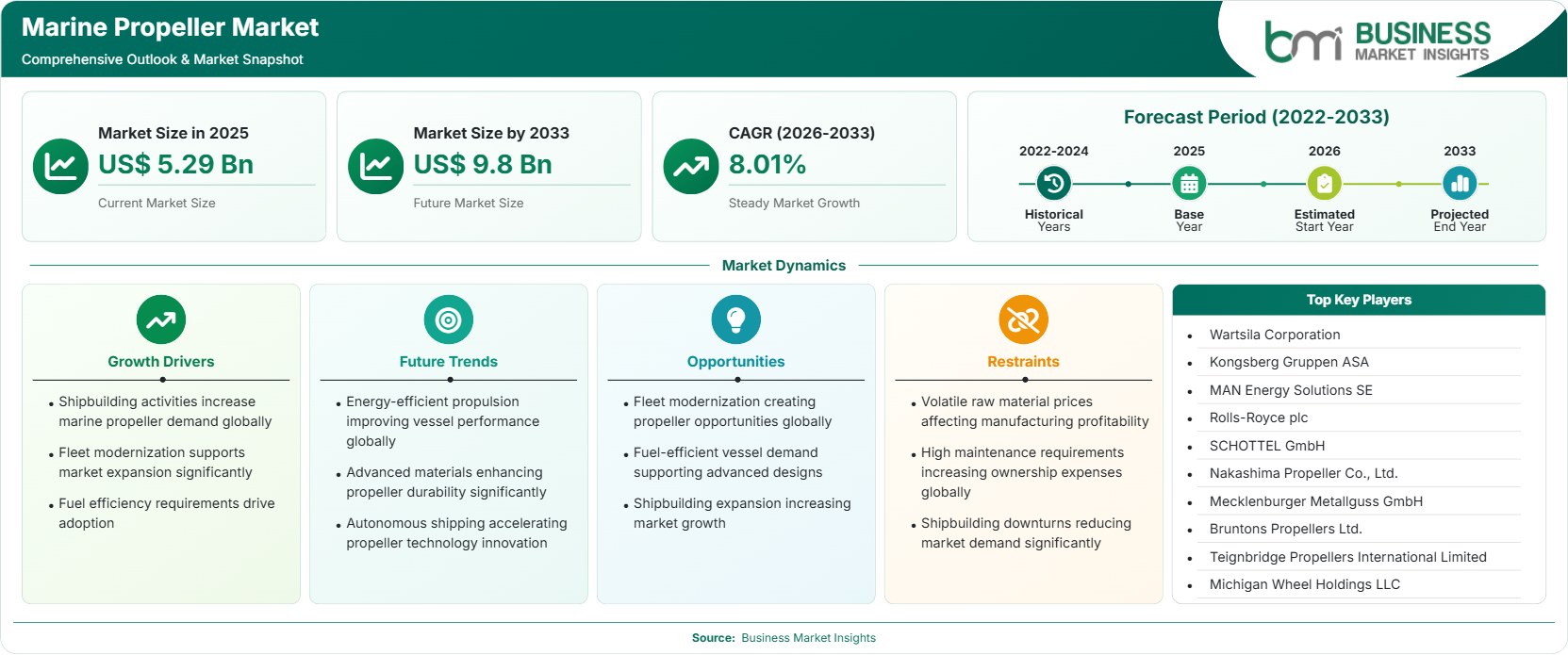
The Marine Propeller Market size was valued at US$ 5.29 Billion in 2025 and is projected to reach US$ 9.8 Billion by 2033, growing at a CAGR of 8.01% during 2026–2033, supported by fleet modernization, commercial shipbuilding, naval procurement, and demand for fuel-efficient propulsion systems.

Report Coverage
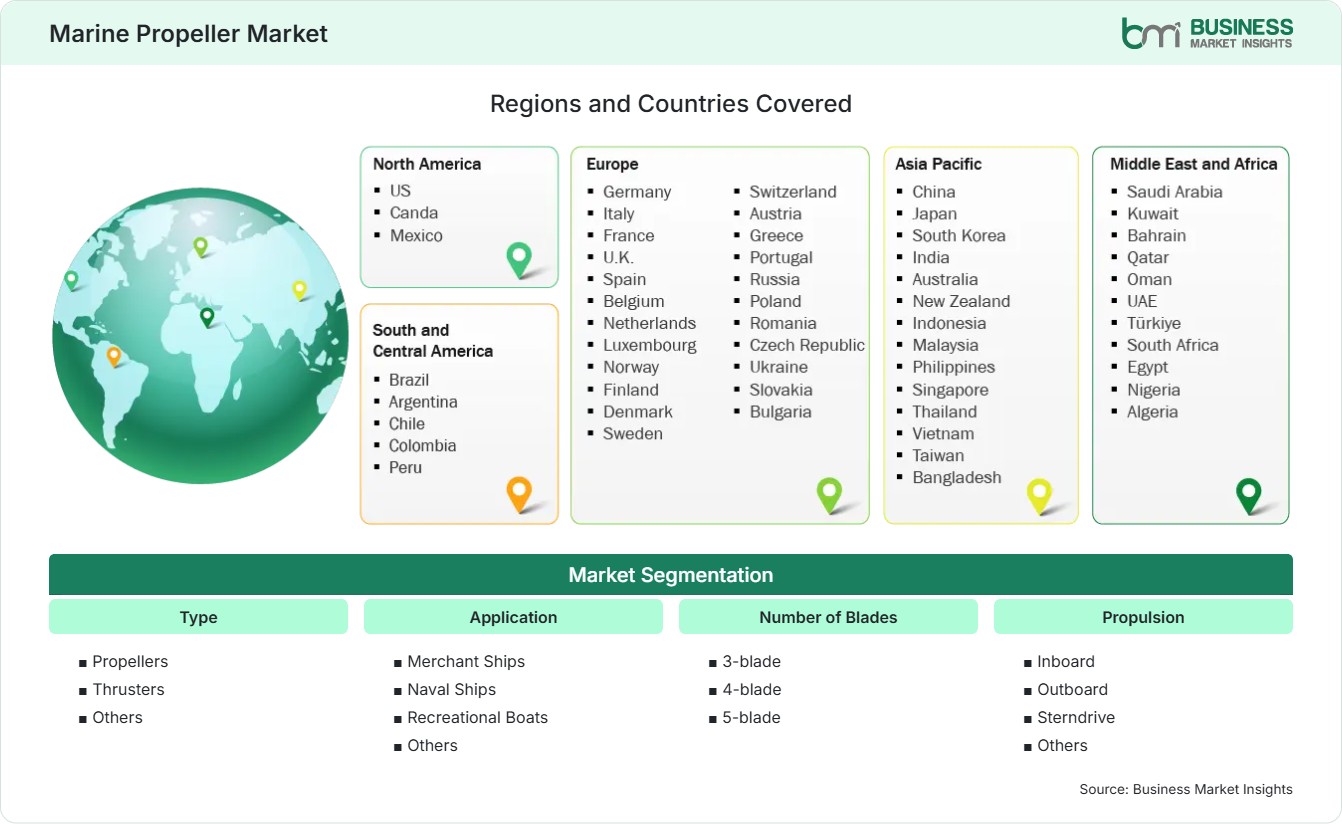
  • Type: Propellers, Thrusters, Others
  • Application: Merchant Ships, Naval Ships, Recreational Boats, Others
  • Number of Blades: 3-blade, 4-blade, 5-blade
  • Propulsion: Inboard, Outboard, Sterndrive, Others
  • Material: Stainless Steel, Aluminum, Bronze, Nickel-Aluminum Bronze, Others
US$ 5.29 Bn Market size in 2025
US$ 9.8 Bn Market Size by 2033
8.01% CAGR, 2026 - 2033
2026-2033 Forecast Period

AI Overview

Marine Propeller Market Summary

  • North America Region: North America holds an estimated 22%–26% Marine Propeller Market share in 2025, advancing at a 6.5%–7.5% CAGR through 2033 as naval fleet renewal, recreational boating, ship repair, and propulsion efficiency investments support demand. The United States benefits from defense procurement, commercial vessel maintenance, and replacement demand.
  • Fastest Growing Region: Asia Pacific accounts for an estimated 38%–42% share in 2025, with a 9.0%–10.5% CAGR through 2033, supported by shipyard capacity, merchant vessel construction, export-oriented manufacturing, and expanding maritime trade.
  • Leading Segment: Merchant ships represent an estimated 38%–43% share in 2025, with a 7.5%–8.5% CAGR through 2033. Container shipping, bulk carriers, tankers, and energy-efficient fleet upgrades sustain demand for reliable, high-performance propellers.
  • High Growth Segment: Thrusters hold an estimated 13%–17% share in 2025 and could advance at a 9.0%–11.0% CAGR through 2033, benefiting from dynamic positioning, offshore operations, maneuverability requirements, and electric propulsion integration.
  • Key Market Opportunity: Retrofitting existing vessels with optimized propeller designs, energy-saving devices, and condition-monitoring technologies creates opportunities for suppliers serving shipowners seeking lower fuel consumption, emissions compliance, and improved operational reliability.
  • Major Market Players: Wärtsilä Corporation, Kongsberg Gruppen ASA, MAN Energy Solutions SE, Rolls-Royce plc, SCHOTTEL GmbH, Nakashima Propeller Co., Ltd., Mecklenburger Metallguss GmbH, Bruntons Propellers Ltd., Teignbridge Propellers International Limited, and Michigan Wheel Holdings LLC.
Strategic Insights

Marine Propeller Market: Strategic Insights

Marine Propeller Market Strategic Framework
FREE PDF
Request your free sample
Request free sample
Stakeholder View

Key Takeaways

  • Supply-chain positioning: Competitive advantage depends on coordination among propeller designers, foundries, precision-machining specialists, engine manufacturers, and shipyards. Suppliers that combine design engineering with installation, balancing, repair, and lifecycle support can secure longer customer relationships.
  • Growth opportunities: Merchant vessels provide a substantial demand base, while thrusters and specialized propulsion systems offer attractive opportunities in offshore support, dynamic positioning, and vessels requiring precise maneuverability.
  • Technology direction: Computational fluid dynamics, improved blade geometry, controllable-pitch mechanisms, corrosion-resistant alloys, and digital monitoring are becoming important differentiators. Investment should prioritize verified vessel-level efficiency gains rather than isolated component specifications.
  • Regional investment: Asia Pacific offers access to large shipbuilding ecosystems, particularly in China, South Korea, Japan, and India. Local manufacturing partnerships and service centers can shorten delivery times and improve access to shipyard procurement programs.
  • Investment and acquisitions: Consolidation can expand product coverage and aftermarket reach. Nakashima Propeller's acquisition of the European business of Michigan Wheel in April 2025 illustrates how established suppliers can broaden their geographic presence and customer access.
  • Lifecycle economics: Propeller replacement, refurbishment, and retrofit optimization can provide revenue between newbuilding cycles. Suppliers with condition-monitoring capabilities and accessible spare parts are better positioned to serve operators managing maintenance budgets and vessel availability.
Geographic Outlook

Marine Propeller Market Regional Highlights

North America Marine Propeller Market

The North American Marine Propeller Market is forecast to capture 22% - 26% of the total global market revenue in 2025, growing at a CAGR of 6.5% - 7.5% from 2026 - 2033. The region has naval procurement, recreational boatbuilding, vessel maintenance, and marine engineering expertise to its advantage. The United States will remain the key region, aided by military shipbuilding and its large existing fleet. Canada will add its share with commercial shipping, fishing boats, and other maritime activities.

  • Naval modernization supports demand for precision-engineered propellers, specialized alloys, and reliable propulsion assemblies. Defense contractors and shipyards place strong emphasis on acoustic performance, durability, and supplier qualification, creating opportunities for technically capable manufacturers.
  • Recreational boating sustains demand for stainless-steel, aluminum, and bronze propellers. Performance expectations vary across fishing boats, leisure craft, and high-powered vessels, encouraging manufacturers to offer application-specific geometries and replacement products through established dealer networks.
  • Commercial fleet maintenance creates aftermarket opportunities through propeller repair, reconditioning, balancing, and replacement. Operators can extend equipment life when damage remains repairable, while service availability and turnaround times influence supplier selection.
  • Offshore energy and specialized workboats require dependable propulsion and maneuvering equipment. Demand depends on project schedules, vessel utilization, and investment in support fleets, making local technical assistance important for equipment suppliers.

US Marine Propeller Market

The United States Marine Propeller Market is expected to hold about 65% -70% of the total revenue share of the North America market by 2025, growing at 6.8% -7.8% CAGR by 2033. The requirement includes naval ships, commercial marine vessels, fishing fleets, workboats, and leisure craft. The defense budget is responsible for acquiring specialized propellers, whereas the private sector demands reliability and fuel efficiency. There is both manufacturing capability within the country and importation from foreign countries.

  • Defense procurement favors manufacturers capable of meeting stringent engineering, documentation, and reliability requirements. Qualification cycles can be lengthy, but approved supplier relationships may provide repeat orders for maintenance, overhaul, and vessel modernization programs.
  • Recreational marine demand is closely linked to household spending, boat ownership, and seasonal utilization. Replacement propellers offer recurring sales, while upgrades to blade configuration and material can address speed, load handling, and durability requirements.
  • Commercial operators increasingly assess propeller performance alongside hull condition, engine loading, and route characteristics. Integrated assessments help identify inefficient operating conditions and support retrofit decisions when fuel savings can justify downtime and installation costs.
  • Domestic repair facilities and distribution networks remain important to buyers managing vessels on tight schedules. Suppliers with accessible inventory and technically trained service personnel can compete effectively against lower-priced alternatives with longer lead times.

Europe Marine Propeller Market

Europe is estimated to hold 24%–28% of the total Marine Propeller Market share by 2025, growing at a CAGR of 7.0%–8.0% till 2033. There are established firms involved in marine engineering, commercial vessel operators, naval projects, and shipyards, which boost the demand for the product. In Europe, Germany, Norway, Finland, the Netherlands, and Italy will be responsible for supporting the manufacturing of vessels and propulsion systems. It is expected that growth in Norway will be relatively high, with a CAGR of 8.0%–9.5%, reflecting offshore operations and advanced vessel requirements. Regulatory pressure also encourages efficiency-oriented propulsion upgrades.

  • Germany benefits from marine engineering expertise, industrial vessel demand, and established manufacturing capabilities. Buyers often prioritize reliability, precision machining, and integration with existing propulsion equipment, supporting demand for engineered propellers and replacement components.
  • Norway's offshore support, fishing, and specialized vessel fleets create demand for robust propulsion and thruster systems. Equipment selection emphasizes maneuverability, operational availability, and performance in demanding sea conditions.
  • Finland and the Netherlands offer opportunities in commercial shipbuilding, short-sea shipping, and energy-efficient vessel design. Integrated propulsion packages can improve coordination between engines, gearboxes, propellers, and vessel control systems.
  • Italy contributes through recreational boats, yacht manufacturing, and specialized commercial vessels. Demand spans performance-oriented propellers and customized assemblies, while export activity exposes suppliers to changing international orders and luxury marine spending.
  • European decarbonization initiatives encourage vessel operators to examine fuel consumption, propulsion efficiency, and retrofit economics. Manufacturers that demonstrate performance under actual operating conditions can strengthen their position in fleet renewal and modernization programs.

Asia Pacific Marine Propeller Market

Asia Pacific marine propeller market is projected to account for 38%–42% of total global revenue by 2025, with a 2026-2033 CAGR of around 9.0%–10.5%. Shipbuilding in China, shipbuilding and production in South Korea, propulsion technology in Japan, and maritime infrastructure development in India contribute to the demand in the region. Both China and South Korea are involved in commercial shipbuilding, whereas Japan is technologically advanced.

  • China benefits from a large shipbuilding ecosystem spanning merchant vessels, specialized ships, marine engines, and component suppliers. Domestic production scale supports competitive manufacturing, although product qualification, quality consistency, and technical differentiation remain important.
  • South Korea's shipyards require precision propulsion equipment for large commercial vessels, including container ships, tankers, and gas carriers. Demand favors suppliers capable of meeting project schedules and coordinating designs with shipyard engineering teams.
  • Japan combines established propeller manufacturing expertise with commercial shipping and fishing vessel demand. Efficiency optimization, durability, and close cooperation between component manufacturers and ship operators support specialized product development.
  • India offers opportunities through shipbuilding investment, port development, naval procurement, and vessel maintenance. Local partnerships can improve access to procurement networks, while aftermarket support helps address the requirements of commercial and government fleets.
  • Southeast Asian maritime economies require propulsion equipment for ferries, fishing vessels, offshore support craft, and regional cargo shipping. Growth varies with infrastructure investment, financing availability, and fleet replacement cycles across individual countries.

Rest of World Marine Propeller Market

The Rest of the World, including South and Central America, the Middle East, and Africa, is forecast to account for 8% - 12% of global revenue by 2025, with a growth rate of 7.0% - 9.0% through 2033. Brazil’s participation would come from offshore oil, fisheries, and shipping. The Gulf nations will meet their needs through marine logistics, offshore activities, and their navies. South Africa and the rest of Africa would need propulsion equipment for commercial shipping, fisheries, and ports.

Demand for the South and Central America Marine Propeller Market depends on the needs of Brazil's offshore ships and other regions' fleets. Mexico and other coastal countries will require replacement propellers and other marine equipment. In the Middle East, the market will grow due to the need to develop ports, offshore energy, and the navy. Demand in Africa is highly inconsistent due to differences in fleet age, reliance on imports, and the availability of repair facilities across countries.

  • Brazil's offshore oil and gas sector supports demand for propulsion equipment used in support vessels and specialized marine craft. Project schedules, vessel specifications, and local service capability influence procurement decisions.
  • Gulf maritime investment creates opportunities for commercial propulsion, thrusters, and specialized vessel systems. Suppliers must account for high operating temperatures, saltwater exposure, maintenance requirements, and the technical standards of fleet operators.
  • Mexico's commercial shipping, fishing, and coastal vessel activity supports replacement demand. Distribution relationships and compatibility with existing installations can be more influential than advanced features for price-sensitive buyers.
  • South African ports, fishing fleets, and maritime services provide a base for aftermarket activity. Refurbishment and spare parts availability can reduce the cost and downtime associated with importing complete replacement assemblies.
  • Across smaller markets, project financing and limited technical infrastructure can delay purchases. Suppliers offering regional service agreements, practical training, and predictable parts availability can improve customer retention and reduce maintenance-related uncertainty.
Global Market Geography
FREE PDF
Request your free sample
Request free sample
Segment Analysis

Marine Propeller Market Segmentation

Type

The propellers remain the primary propulsion system, while the thrusters continue to handle maneuvering and positioning. It is expected that propellers will continue to account for 70%-76% of revenue in 2025, with a CAGR of 7.5%-8.5% through 2033. This growth will be driven by demand for new vessels and the replacement of old ones. The Marine Propeller Market scope includes conventional propulsion and specialized maneuvering equipment.

  • Propellers: Main propulsion propellers convert rotational power into thrust across commercial, naval, and recreational vessels. Blade geometry, diameter, pitch, and material determine performance, influencing selection and replacement decisions.
  • Thrusters: Tunnel, azimuth, and other thruster configurations support maneuvering, station keeping, and dynamic positioning. Offshore vessels, ferries, and specialized ships require responsive thrust and reliable operation in confined spaces.

Application

Merchant vessels are expected to account for 38%-43% of the revenues of the Marine Propeller Market by 2025, growing at a CAGR of 7.5%-8.5% until 2033. The requirement is influenced by fleet replacement, cargo transport activities, and the need to control fuel expenditure during operations. Naval and leisure vessels are required to perform in different ways.

  • Merchant Ships: Container ships, tankers, bulk carriers, and cargo vessels require durable propellers matched to engine output and hull design. Efficiency improvements can reduce operating costs across long voyages.
  • Naval Ships: Military vessels require propulsion systems engineered for reliability, maneuverability, and application-specific acoustic performance. Procurement depends on defense programs, technical qualification, security requirements, and long service lives.
  • Recreational Boats: Leisure craft and fishing boats use propellers designed for acceleration, cruising efficiency, and handling. Replacement demand follows boat ownership, seasonal use, and performance upgrades.
  • Others: Ferries, research vessels, patrol craft, and offshore support vessels require application-specific propulsion. Their operating profiles create demand for customized thrust characteristics, durability, and dependable service support.

Number of Blades

The blade design influences thrust, vibration, efficiency, and performance under different loads. The three-blade system remains popular for speed and efficiency, whereas four-blade and five-blade systems are used to address specific handling and loading problems. The selection of the propeller depends on the hull design, engine power, speed, and vibration level.

  • 3-blade: Three-blade propellers provide a widely used balance between efficiency, speed, and manufacturing cost. They suit many recreational and commercial applications where operating conditions permit conventional blade configurations.
  • 4-blade: Four-blade designs can improve grip, acceleration, and handling in selected applications. Operators may choose them where additional thrust, smoother operation, or performance at lower speeds outweighs other trade-offs.
  • 5-blade: Five-blade propellers can reduce vibration and improve thrust characteristics for demanding applications. Their suitability depends on vessel design, power requirements, cavitation constraints, and the performance objectives established during engineering.

Propulsion

Inboard systems account for 42%–48% of the Marine Propeller Market revenue share in 2025, owing to their use on commercial ships, workboats, and larger leisure boats. Outboard systems are relevant to leisure boat applications, whereas sterndrive systems cater to specific recreational boat applications. The propulsion system architecture plays an integral role in determining the shaft configuration, propeller compatibility, ease of maintenance, and installation.

  • Inboard: Inboard propulsion positions the engine within the vessel and transfers power through a shaft to the propeller. It is common in commercial vessels and larger boats requiring robust propulsion.
  • Outboard: Outboard systems combine the engine and propulsion unit in an external assembly. They serve recreational and smaller commercial craft, with demand influenced by portability, ease of maintenance, and available power ratings.
  • Sterndrive: Sterndrive systems connect an inboard engine to an externally mounted drive unit. They support selected recreational boats that require a compromise between onboard engine placement and external propulsion flexibility.

Material

Nickel-aluminum bronze and other bronze alloys continue to be used in commercial marine propulsion owing to their strength, corrosion resistance, and ability to produce large propellers. Stainless steel is suitable for more specialized uses, while aluminum is suitable for more economical uses. Material selection determines casting difficulty, repairability, longevity, and purchase cost. The Marine Propeller Market trends are geared towards choosing materials based on lifetime performance and not just cost.

  • Stainless Steel: Stainless-steel propellers provide strength and corrosion resistance for recreational and specialized vessels. Their durability and ability to support thin blade profiles make them attractive where performance matters.
  • Aluminum: Aluminum propellers offer relatively low weight and accessible pricing. They are widely used in smaller boats, although operating conditions, impact exposure, and repair economics influence replacement frequency.
  • Bronze: Bronze alloys provide established corrosion resistance and dependable performance in marine environments. Their application depends on vessel size, alloy specification, mechanical loading, and the operating conditions expected over the service life.
  • Nickel-Aluminum Bronze: Nickel-aluminum bronze is valued for mechanical strength, seawater corrosion resistance, and suitability for demanding commercial and naval applications. Casting quality and precision finishing remain important to performance.
  • Others: Other materials and specialized alloys serve applications requiring particular strength, weight, corrosion, or manufacturing characteristics. Adoption depends on validated engineering performance, availability, cost, and compatibility with vessel operating conditions.

End-User

Original Equipment Manufacturers are estimated to make up 58%-64% of the 2025 Marine Propeller Market sales, growing at a CAGR of 7.5%-8.5% until 2033. Ship-building agreements create demand in the first channel, while demand in the aftermarket will be created by ship usage, wear and tear, inspections, and maintenance programs. Both channels have unique selling points: the OEM supply focuses on engineering and fulfillment, while the aftermarket business relies on responsiveness and component availability.

  • OEM: OEM demand comes from shipyards, vessel builders, and propulsion-system integrators. Suppliers compete through design compatibility, manufacturing quality, delivery reliability, engineering collaboration, and the ability to meet vessel-specific specifications.
  • Aftermarket: The aftermarket includes replacement propellers, refurbishment, repair, balancing, and associated service work. Demand is linked to installed fleet size, operating intensity, maintenance budgets, and the availability of suitable spare parts.
Market Forces

Marine Propeller Market Dynamics

Key Market Drivers

Commercial Fleet Renewal and Shipbuilding Activity

The construction of new vessels creates demand for propulsion units, whereas ship replacements drive the selection of propellers that match the new hull and engine designs. The size of the blade, its composition, and pitch differ from one type of container ship, tanker, bulk carrier, or specialized cargo ship to another. The shipyards consider the choice of propulsion system in relation to the ship's hydrodynamics, thus giving a competitive edge to producers who meet all requirements. Consequently, investments in commercial shipping foster the Marine Propeller Market growth, despite the fact that the realization of orders depends on several factors.

Fuel Efficiency and Vessel Performance Optimization

Fuel remains a major operational cost for most commercial vessels, hence the need for improved fuel efficiency when using the propellers to push ships forward. The shape of the propeller, its surface quality, pitch setting, and alignment determine the amount of energy required to reach a given speed. Propeller performance can be improved by addressing other factors, such as hull fouling, engine load, and operating routes. The International Maritime Organization's efficiency measures encourage shipowners to evaluate improvements in operations and technology. Marine Propeller Market trends increasingly reflect lifecycle cost analysis, with buyers seeking evidence of savings under realistic vessel conditions.

Naval Modernization and Specialized Vessel Requirements

Defense procurement drives the demand for propulsion systems with reliability, maneuverability, durability, and acoustic properties related to their specific applications. On naval ships, parts need to withstand heavy loads and be engineered for a long lifespan. Modernization may involve changing assemblies, optimizing shaftlines, or incorporating them into new engines or controls. Companies need to be able to prove consistency in manufacturing, proper documentation, and adherence to procurement requirements. This raises the barrier to entry for suppliers, benefiting those with experienced engineers and an adequate production process. Marine Propeller Market demand may not react as sensitively to the recreational market, but procurement is still budget-driven.

Key Market Opportunities

Retrofitting Existing Vessels with Efficient Propulsion Systems

The current worldwide fleet offers an opening in addition to constructing new vessels. Owners can install new propellers through retrofitting if damage is identified during inspections, if vessel performance changes, or if efficiency studies warrant changes in equipment. The hydrodynamic assessment, blade redesign, surface treatment, and propeller installation can be performed by suppliers to ensure tangible results. The business justification for such activities is high when many operating trips are made, and fuel costs can cover the engineering costs and planned downtime. Marine Propeller Market Forecasts will depend partly on retrofit economics, vessel age, fuel prices, and the availability of financing for efficiency upgrades rather than newbuild orders alone.

Advanced Thrusters and Integrated Electric Propulsion

The use of electrification and hybrid drives opens avenues for thruster and propeller manufacturers to develop thrusters and propellers suitable for flexible power systems. It can be useful for ferries, offshore support vessels, research ships, and other specialized vessels where improved low-speed maneuverability and better power allocation could be an advantage. Propulsion drive packages could integrate electric motors, propulsion drives, thrusters, and the vessel's controls. However, successful integration would require efficient system design, sufficient power generation, and effective maintenance facilities. Business organizations that work with naval architects and shipyards at an early stage can have a say in how the equipment should be designed, even before a ship is built.

Regional Service Networks and Aftermarket Expansion

The company’s revenue stability can be bolstered by expanding the provision of repair, refurbishment, and replacement services near major ports and shipbuilding facilities. Such a regional service system can lead to lower transport costs, reduced time vessels spend being serviced, and better availability of technical inspections. Cooperation with distributors, shipyards, and marine engineering companies may be helpful for entering into markets that lack sales networks. Another means of differentiating oneself is through online inspection data and condition-based maintenance, which will provide services tailored to the needs of vessel operations. The need to invest in an area with many vessels is also crucial.

Market Restraints and Challenges

High Manufacturing Costs and Specialized Engineering Requirements

Factor: The construction of large marine propellers is highly dependent on large amounts of metal, specialized casting and forging procedures, high-accuracy machining, measuring, and engineering specific to the part's use. The use of specialized alloys, such as nickel-aluminum bronze, for marine components may make them vulnerable to fluctuations in input prices, and custom designs could eliminate some of the cost benefits associated with mass production. Impact: Production costs will rise, eating into profits and increasing costs for shipyards and marine businesses. It will be difficult for smaller organizations to finance their modeling, testing, and labor costs. The suppliers can reduce the risks involved through process control, material management, manufacturing partnership, and manufacturability design.

Long Procurement Cycles and Vessel Investment Uncertainty

Factor: Orders for propellers on new vessels, both commercial and naval, will depend on scheduling, financing, permitting, and equipment qualification. Delays in engine, transmission gear, and shipbuilding will delay the installation of propulsion systems, while reduced freight demand will affect new vessel orders. Impact: The manufacturers experience irregular order intake, funding requirements, and challenges in establishing production capacity. Even equipment customization may be limited to a particular vessel project, making it vulnerable to changes or cancellations. It is useful to diversify into original equipment manufacturing, aftermarket, leisure equipment, and repair.

Company Analysis

Competitive Landscape

The Marine Propeller Market analysis indicates that competition spans integrated marine technology groups, specialist propeller manufacturers, and suppliers serving recreational and commercial fleets. Differentiation rests on hydrodynamic design, manufacturing precision, material expertise, application coverage, and global service access. The following companies represent active participants across relevant propulsion categories.

Company Name

Overview

Products and Services relevant to this market

Wärtsilä Corporation

Marine technology group providing propulsion, power, and lifecycle solutions for commercial shipping and specialized vessels.

Fixed-pitch and controllable-pitch propellers, thrusters, integrated propulsion packages, optimization, and lifecycle services.

Kongsberg Gruppen ASA

Norwegian technology group with maritime systems serving commercial, offshore, and naval applications.

Propellers, tunnel and azimuth thrusters, waterjets, propulsion controls, and vessel integration solutions.

MAN Energy Solutions SE

Marine engineering supplier with engine and propulsion technologies for commercial and specialized vessels.

Marine propulsion systems, propeller-related engineering, engine integration, and support for vessel propulsion configurations.

Rolls-Royce plc

Engineering company with a long-standing marine propulsion heritage and specialized vessel technology capabilities.

Marine propulsion technologies and associated engineering solutions for selected commercial and naval applications.

SCHOTTEL GmbH

Specialist propulsion manufacturer focused on maneuverability and propulsion systems for diverse vessel classes.

Rudder propellers, thrusters, propulsion systems, and application-specific vessel maneuvering solutions.

Nakashima Propeller Co., Ltd.

Japanese manufacturer specializing in marine propellers and related propulsion equipment for commercial vessels.

Fixed-pitch and controllable-pitch propellers, thrusters, shafting systems, repair, and propulsion engineering.

Mecklenburger Metallguss GmbH

German manufacturer specializing in large marine propellers for demanding commercial and naval vessel applications.

Large fixed-pitch propellers, custom cast propellers, hydrodynamic design, machining, and repair services.

Bruntons Propellers Ltd.

UK-based marine propulsion specialist serving recreational, commercial, and specialized vessel operators.

Marine propellers, saildrive solutions, propulsion components, and associated engineering and support services.

Teignbridge Propellers International Limited

Marine propeller manufacturer serving commercial, leisure, and specialist vessel markets.

Propeller design and manufacture, repair, balancing, and customized propulsion components for different vessel requirements.

Michigan Wheel Holdings LLC

Marine propulsion supplier associated with propeller products for recreational and commercial vessel applications.

Marine propellers, replacement products, application-specific propulsion components, and related distribution and support services.

Trust & Transparency

Research Methodology

The market analysis combines proprietary research with secondary data from government agencies, company disclosures, regulatory filings, industry databases and expert interviews. Market estimates are validated through data triangulation, cross-market benchmarking and analyst review.

View Full Research Methodology

Questions Answered

Frequently Asked Questions

How does material selection affect propeller maintenance?

Material influences corrosion resistance, strength, repair procedures, and suitability for specific operating environments. Inspection frequency should reflect operating conditions, damage exposure, and manufacturer recommendations. Proper balancing, surface condition, and prompt repair can help maintain performance and reduce avoidable vibration.

What should buyers look for in a Marine Propeller Market Report?

Buyers should examine segmentation by application, material, propulsion configuration, blade count, and end-user, alongside regional demand, supplier capabilities, aftermarket coverage, and technology developments. Forecast assumptions and the treatment of replacement demand should be clear enough to support procurement and investment decisions.

Why do controllable-pitch propellers matter for commercial vessels?

Controllable-pitch propellers allow blade pitch to be adjusted while the propeller rotates, supporting changes in thrust without requiring the same adjustments as fixed-pitch arrangements. They can improve operational flexibility in vessels with varying loads, routes, and maneuvering requirements.

How can shipowners evaluate the return on a propeller retrofit?

Shipowners should compare baseline fuel consumption, vessel speed, engine loading, maintenance history, installation costs, and expected operating hours. A retrofit assessment should account for vessel downtime and verify performance under comparable operating conditions rather than relying solely on laboratory specifications.

What technical factors determine the selection of a marine propeller?

Selection depends on vessel displacement, hull geometry, engine power, shaft speed, operating profile, blade diameter, pitch, material, and cavitation limits. Engineers evaluate these factors together because improving one performance measure can affect thrust, vibration, efficiency, or handling elsewhere.

Access the Full Marine Propeller Market Report

Get segment-level forecasts, regional estimates, competitive benchmarking, company profiles and downloadable Excel datasets.

Access the full Marine Propeller Market Report
350 pages PDF & Excel | 2026-10-21
Similar Research

Related Market Reports