
Marine Hybrid Propulsion Market Outlook: Size, Share, Trends, Growth Analysis, Competitive Landscape & Forecast, 2026-2033

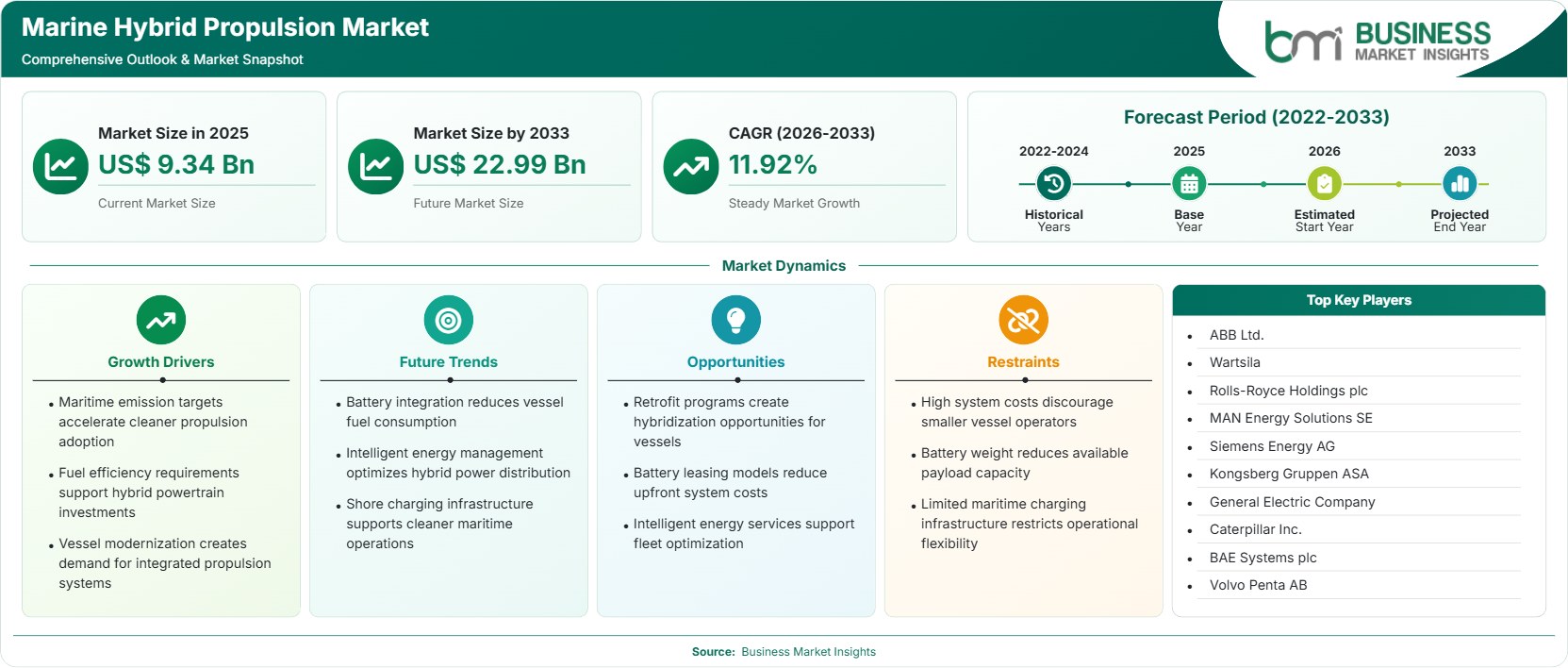
The Marine Hybrid Propulsion Market size was valued at US$ 9.34 Billion in 2025 and is projected to reach US$ 22.99 Billion by 2033, growing at a CAGR of 11.92% during 2026–2033, driven by decarbonization mandates, fuel-efficiency requirements, retrofit demand, battery integration, and electrification opportunities across commercial fleets.

Report Coverage
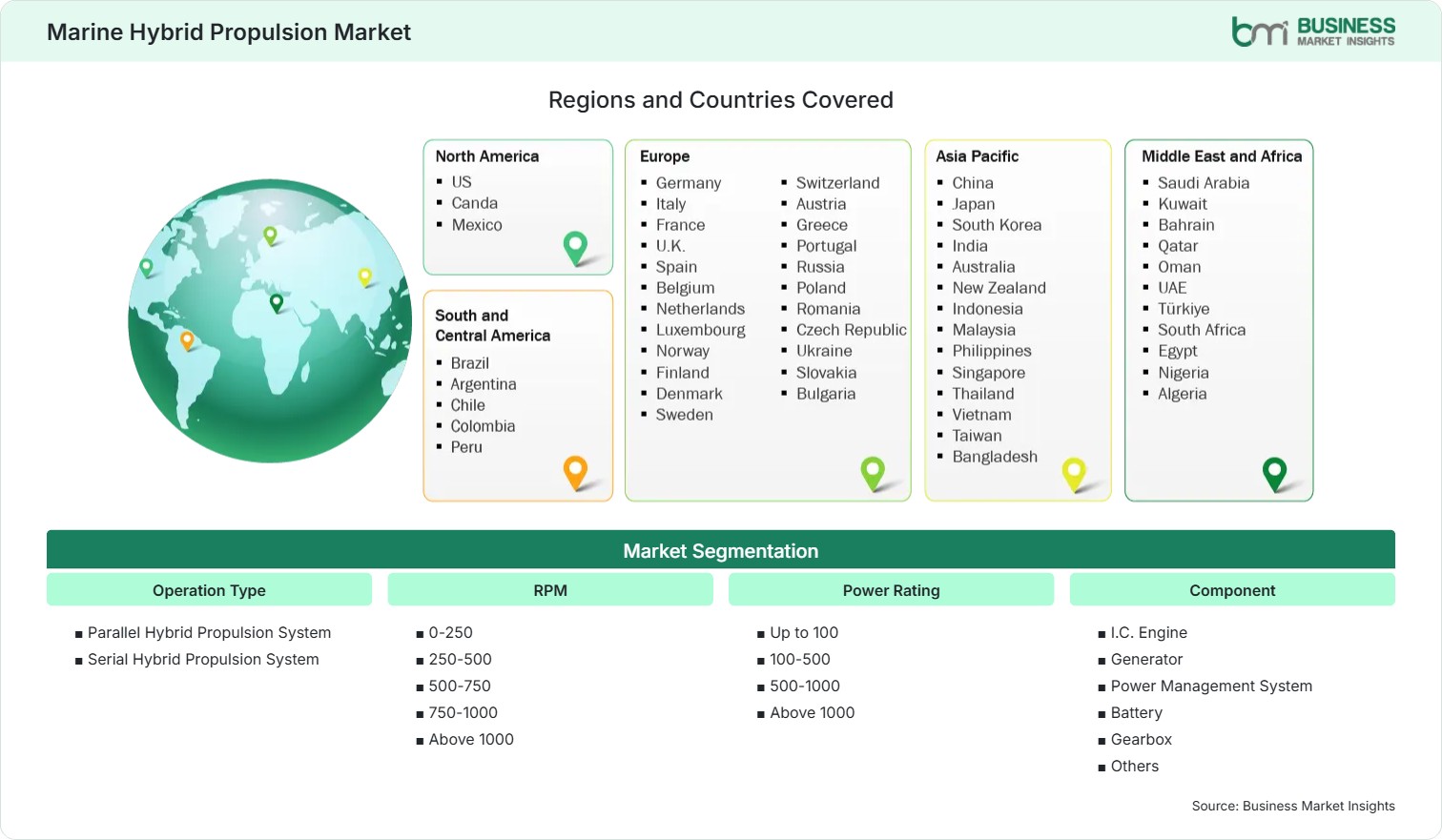
  • Operation Type: Parallel Hybrid Propulsion System, Serial Hybrid Propulsion System
  • RPM: 0-250, 250-500, 500-750, 750-1000, Above 1000
  • Power Rating: Up to 100, 100-500, 500-1000, Above 1000
  • Component: I.C. Engine, Generator, Power Management System, Battery, Gearbox, Others
  • Ship Type: Container Ship, Passenger Ship, Fishing Ship, Tugs, Offshore Support Vessels, Ferries, Yacht, Tanker, Others
US$ 9.34 Bn Market size in 2025
US$ 22.99 Bn Market Size by 2033
11.92% CAGR, 2026 - 2033
2026-2033 Forecast Period

AI Overview

Marine Hybrid Propulsion Market Summary

  • North America Region: North America holds a 20%–23% Marine Hybrid Propulsion Market share in 2025, growing at a 10.8%–11.8% CAGR, supported by ferry electrification, offshore vessel modernization, retrofit programs, fuel savings, and battery adoption. The US benefits from ferry renewal, offshore activity, domestic shipbuilding, and hybrid retrofit demand, supporting 11.0%–12.0% CAGR through 2033.
  • Fastest Growing Region: Asia Pacific holds a 33%–36% share in 2025 and is advancing at a 12.5%–13.5% CAGR, supported by shipbuilding capacity, coastal transport electrification, battery manufacturing, port modernization, and vessel-efficiency requirements.
  • Leading Segment: Offshore support vessels hold a 30%–34% share in 2025 and are advancing at a 12.0%–13.0% CAGR, supported by dynamic-positioning efficiency, fuel savings, reduced engine loading, offshore energy projects, and fleet modernization.
  • High Growth Segment: Retrofit installations hold a 62%–67% share in 2025 and are advancing at a 12.5%–13.5% CAGR, supported by aging fleets, emissions compliance, modular batteries, dry-dock opportunities, and lower capital requirements than full vessel replacement.
  • Key Market Opportunity: Fleet operators can combine batteries, shore power, optimized engine loading, and digital energy management to reduce fuel consumption while extending vessel utilization and preparing assets for stricter emissions requirements.
  • Major Market Players: ABB Ltd.; Wärtsilä Oyj Abp; Rolls-Royce Holdings plc; MAN Energy Solutions SE; Siemens Energy AG; Kongsberg Gruppen ASA; General Electric Company; Caterpillar Inc.; BAE Systems plc; Volvo Penta AB.
Strategic Insights

Marine Hybrid Propulsion Market: Strategic Insights

Marine Hybrid Propulsion Market Strategic Framework
FREE PDF
Request your free sample
Request free sample
Stakeholder View

Key Takeaways

  • Competitive advantage increasingly comes from integrating engines, batteries, generators, propulsion drives, controls, software, commissioning, and lifecycle services rather than supplying isolated components.
  • Retrofit programs across ferries, tugs, offshore support vessels, fishing fleets, and workboats offer strong upside because operators can modernize propulsion while retaining existing hulls and routes.
  • Intelligent energy-management systems are becoming central to performance because they coordinate battery state-of-charge, engine loading, propulsion demand, auxiliary loads, and charging.
  • Asia Pacific combines shipbuilding scale, battery manufacturing, large domestic fleets, and expanding maritime electrification, creating an attractive investment environment.
  • Capital is moving toward integrated electrification platforms combining energy storage, propulsion, automation, and lifecycle support, increasing the value captured by system integrators.
  • Certification expertise, safety engineering, cybersecurity, remote monitoring, and upgrade capability increasingly influence procurement decisions alongside equipment performance.
Geographic Outlook

Marine Hybrid Propulsion Market Regional Highlights

North America Marine Hybrid Propulsion Market

North America Marine Hybrid Propulsion Market represents a 20%–23% share in 2025 and is projected to expand at 10.8%–11.8% CAGR through 2033. Demand centers on ferries, offshore support vessels, workboats, and government fleets. Operators prioritize fuel savings, emissions compliance, and asset modernization. Canada contributes through coastal transportation initiatives, while the US provides the largest regional demand base through ferry replacement, offshore activity, and commercial vessel modernization.

  • Ferry operators benefit from predictable routes that allow battery capacity, charging requirements, and energy-management strategies to be optimized around repeated acceleration and docking cycles.
  • Offshore operators can use batteries during standby and transient loads, reducing inefficient engine operation while maintaining rapid power availability during demanding missions.
  • US shipbuilding programs provide opportunities for integrated propulsion suppliers offering domestic support, lifecycle service, advanced controls, and future electrification compatibility.
  • Canadian coastal fleets provide retrofit potential as operators address aging vessels, fuel costs, emissions requirements, and pressure to improve operating efficiency.

US Marine Hybrid Propulsion Market

The US Marine Hybrid Propulsion Market accounts for 68%–72% of North American market demand in 2025 and is expected to grow at a CAGR of 11.0%–12.0% through 2033. Modernization of ferries, offshore support vessels, government vessels, and commercial workboats is the major source of demand. The use of hybrid propulsion technology proves advantageous when there are well-defined routes, heavy auxiliary loads, and long standby times for vessels.

  • Domestic ferry replacement programs create recurring demand because predictable operating cycles simplify battery sizing, charging infrastructure, and fuel-saving calculations.
  • Offshore operators can combine hybrid propulsion with digital controls to reduce engine idling, stabilize transient loads, and improve vessel availability.
  • Government applications favor suppliers capable of delivering resilient power architectures, redundancy, safety engineering, cybersecurity, and long-term maintenance support.

Europe Marine Hybrid Propulsion Market

The Europe Marine Hybrid Propulsion Market holds a 24%-27% market share in 2025 and is expected to grow at a CAGR of 11.5%-12.5%. Norway, Denmark, Finland, Germany, the Netherlands, and the UK continue to be key markets. Norway and Finland are especially good examples with ferry electrification and maritime technologies know-how. FuelEU Maritime and EU ETS expenses make investments more rewarding, alongside the presence of the shipyard and hybrid propulsion industries.

  • Norway remains a leading high-growth country because of ferry electrification, short-sea routes, maritime technology expertise, and established charging infrastructure.
  • Germany combines shipbuilding, propulsion engineering, automation, and retrofit capabilities, supporting hybrid systems across commercial and specialized vessels.
  • Finland and Denmark benefit from ferry modernization, battery expertise, and technology partnerships connecting operators with propulsion and energy-management suppliers.
  • The UK offers opportunities across ferries, offshore vessels, naval applications, and workboats seeking incremental decarbonization without sacrificing range.

Asia Pacific Marine Hybrid Propulsion Market

The Asia Pacific Marine Hybrid Propulsion Market accounts for 33% - 36% of market share in 2025 and is expected to grow at a CAGR of 12.5% - 13.5%, making it the most rapidly growing region. Countries like China, Japan, South Korea, Singapore, and India come together with shipbuilding and marine manufacturing capabilities, battery ecosystems, and large fleet bases.

  • China provides a large manufacturing ecosystem covering batteries, power electronics, propulsion machinery, shipbuilding, and integration services.
  • Japan combines marine-engine expertise with advanced battery, automation, and energy-management capabilities across ferries, coastal vessels, and specialized craft.
  • South Korea benefits from major shipyards and offshore engineering expertise, supporting integrated hybrid systems in commercial and specialized newbuild vessels.
  • India and Singapore offer high-growth opportunities through port modernization, coastal shipping initiatives, vessel-efficiency programs, and advanced marine equipment demand.

Rest of World Marine Hybrid Propulsion Market

The Rest of World Marine Hybrid Propulsion market accounts for about 15%- 18% of 2025 demand and is expected to grow at a 10.5%- 12.0% CAGR. South & Central America present opportunities for ferries, offshore support, fishing, and coastal logistics. Brazil is noteworthy for its offshore operations. The Middle East & Africa present prospects in offshore energy, ports, workboats, and other marine operations; the UAE, Saudi Arabia, and South Africa offer opportunities for modernization.

  • Brazil combines offshore support demand with established maritime activity, creating opportunities where fuel expenditure and vessel utilization support hybrid economics.
  • The UAE and Saudi Arabia offer opportunities in offshore support, harbor craft, and specialized vessels linked to expanding maritime infrastructure.
  • South Africa provides retrofit potential across port service, fishing, offshore support, and coastal vessels requiring efficiency improvements.
  • Latin American ferry and fishing fleets represent longer-term adoption opportunities as battery costs decline and environmental requirements become more stringent.
Global Market Geography
FREE PDF
Request your free sample
Request free sample
Segment Analysis

Marine Hybrid Propulsion Market Segmentation

Operation Type

The parallel marine hybrid propulsion system is the preferred option in terms of market structure, occupying the 48%–52% share in the Marine Hybrid Propulsion Market in 2025 and the 11.5%–12.5% CAGR up to 2033. The serial configuration is an alternative when flexibility in electric power distribution is needed.

  • Parallel Hybrid Propulsion System: Combines engine and electric-motor operation, supporting high peak power, flexible maneuvering, and efficient operation across changing duty cycles.
  • Serial Hybrid Propulsion System: Uses generators to supply electric propulsion, providing flexible power distribution where propulsion and auxiliary loads vary substantially.

RPM

The 250-500 RPM range remains significant in commercial propulsion applications, especially for efficient low-speed operation. The hybrid technology enables optimal engine loading and electric boosting during transients. Requirements differ depending on the ship type, drive configuration, torque needs, and available machinery space.

  • 0-250: Low-speed configurations suit large vessels requiring high torque, controlled propulsion, and efficient low-speed performance.
  • 250-500: Supports commercial applications where electric assistance improves transient response, maneuvering efficiency, and engine loading.
  • 500-750: Relevant to workboats and smaller commercial vessels requiring compact hybrid machinery and responsive power delivery.
  • 750-1000: Supports ferries, yachts, and specialized craft where electric torque improves acceleration and maneuverability.
  • Above 1000: High-speed propulsion benefits from electric torque assistance while engines operate nearer efficient points during sustained demand.

Power Rating

Power rating influences system economics, battery sizing, equipment interfacing, and vessel application, depending on the power rating. Systems above 1,000 kW serve larger commercial and offshore ships that require complex energy management. The need for such systems arises from fuel-efficiency concerns and difficult operating cycles where the addition of electric assistance is necessary.

  • Up to 100: Targets small workboats, recreational craft, fishing vessels, and auxiliary applications requiring compact electrification.
  • 100–500: Suits ferries, fishing vessels, harbor craft, and smaller offshore vessels using batteries for peak shaving and maneuvering.
  • 500–1,000: Supports commercial applications requiring meaningful electric assistance, generator integration, and digitally controlled power flows.
  • Above 1,000: Serves offshore, tanker, container, ferry, and specialized vessels requiring integrated batteries, generators, drives, and energy management.

Component

Component development is now moving towards packages that include engines, generators, batteries, gearboxes, and power management systems. Power management systems have gained strategic significance because energy efficiency depends on software. Component demand will be driven by new-build electrification, retrofitting, lifecycle service offerings, and battery scalability.

  • I.C. Engine: Conventional engines remain essential range-extending components, with hybrid controls optimizing loading and reducing inefficient operating periods.
  • Generator: Generators supply electrical power for propulsion, hotel loads, charging, and peak-demand management across hybrid configurations.
  • Power Management System: Digital platforms coordinate engines, batteries, generators, drives, and loads, making software central to operational efficiency.
  • Battery: Batteries provide peak shaving, transient support, silent operation, and low-emission maneuvering, with modular capacity supporting future upgrades.
  • Gearbox: Hybrid-compatible gearboxes connect mechanical and electric power paths, enabling flexible propulsion configurations across vessel architectures.

Ship Type

Offshore support vessels are best suited for this application, owing to their dynamic positioning capabilities and standby loads. Ferries, tugs, fishing boats, passenger liners, yachts, and oil tankers are further examples that offer possibilities owing to their maneuverability and repetitive routes. The ship type makes for a good candidate due to the advantages of retrofits and upgrades without buying new vessels.

  • Container Ship: Hybrid systems can optimize auxiliary loads and propulsion support, particularly during port operations and slow-speed maneuvering.
  • Passenger Ship: High hotel loads and predictable schedules support batteries for peak demand, port operations, and quiet maneuvering.
  • Fishing Vessel: Hybridization can reduce fuel use during variable operations while enabling quieter electrical operation.
  • Tugs: Battery assistance can provide rapid power during demanding maneuvers while engines operate more efficiently.
  • Offshore support vessels: Dynamic-positioning standby creates strong hybrid economics by reducing prolonged low-load engine operation.
  • Ferries: Repeated routes and predictable schedules support optimized batteries, shore charging, and hybrid propulsion.
  • Yacht: Hybrid systems provide quiet operation, efficient hotel-load management, maneuverability, and lower emissions.
  • Tanker: Hybrid architectures can optimize auxiliary and propulsion energy use in coastal and specialized tanker operations.

Installment

Retrofit dominates the market, having a 62%–67% share of the Marine Hybrid Propulsion Market in 2025 and a 12.5%–13.5% CAGR till 2033. Demand is driven by old fleets, emission regulations, and the extended service life of vessels. The line-fit segment still plays an important role, as all systems can be installed during manufacturing at the shipyard, thereby optimizing their arrangement.

  • Line Fit: Newbuild integration enables optimized machinery layouts, battery placement, electrical systems, cooling, and control integration.
  • Retrofit: Existing fleets offer substantial opportunities because operators can modernize propulsion incrementally while retaining hulls, routes, and established assets.
Market Forces

Marine Hybrid Propulsion Market Dynamics

Key Market Drivers

Decarbonization and vessel-efficiency regulation

Fuel-efficiency regulation is strengthening the economic case for hybrid propulsion. FuelEU Maritime and EU ETS exposure increase the financial consequences of inefficient vessel operation, while IMO efficiency frameworks encourage carbon-intensity reduction. Marine Hybrid Propulsion Market growth is increasingly tied to regulatory and economic factors and fuel economy. High-utilization operators benefit from greater economies of scale because frequent maneuvering, standby time, and low loads offer more opportunities to use up stored electrical power. Regulatory forces thus transform hybrid technology into a real-world efficiency solution for certain ship types.

Battery integration and intelligent energy management

Batteries contribute to hybrid propulsion technology by enabling peak shaving, transient load management, silent maneuvering, and improved engine loading conditions. Marine hybrid propulsion market trends place more emphasis on energy management system platforms than batteries themselves. Controls can be smart enough to decide whether a battery charges, discharges, or helps propel the vessel. The system's modularity enables scaling capacity to meet the vessel's changing needs. It becomes useful for ferries, offshore support vessels, and harbor boats that have duty cycles with repeated high-power peaks.

Retrofit demand across aging commercial fleets

Fleets are opting for hybridization to prolong vessel lifespans and improve fuel economy without having to replace the entire vessel. The process entails preserving the existing hull, cargo configuration, familiar crew, and known route while improving the propulsion systems, batteries, generators, and power electronics, among other things. All these processes contribute to the Marine Hybrid Propulsion Market growth for ferries, tugs, fishing vessels, offshore support vessels, and workboats. Economies are achieved when the number of operating hours per year is high. Suppliers that manage engineering, certification, installation, commissioning, and lifecycle support are positioned to capture greater retrofit value.

Key Market Opportunities

Hybridization of high-utilization ferry fleets

The ferries represent an appealing business case due to the regular route, which makes battery sizing and energy management optimization easier. It is possible to use batteries alongside the engine to save fuel during acceleration, maneuvering, and work at ports, and to use standard power for longer distances. The technology is applicable in Northern Europe, North America, and the Asia-Pacific region. This comprehensive solution incorporates shore power and the potential for an all-electric ferry, in addition to phased decarbonization. Initially, operators can rely on hybrid propulsion and progressively add battery power as charging infrastructure is developed without compromising safety. This creates value through savings.

Digital energy management and lifecycle services

Energy management software presents a scalable business opportunity since life-cycle savings depend on how well the batteries, engines, generators, propulsion motors, and auxiliaries work together. Suppliers will be able to capitalize on monitoring, optimization, diagnosis, remote assistance, software upgrades, and predictive maintenance throughout the vessel's entire life cycle. Digital technology can also generate operational data to inform future battery upgrades, new fuel technologies, and shore power needs. Propulsion, automation, control, and service providers offering an integrated life-cycle solution can profit from it. This is especially true for fleets looking to adopt uniform performance monitoring and predictive maintenance across their multiple vessels.

Hybrid offshore vessels supporting energy-sector expansion

Offshore support vessels represent an attractive opportunity because dynamic positioning operations create transient and standby loads that can be efficiently managed with batteries. Energy storage can absorb rapid load changes and reduce prolonged low-load engine operation while maintaining rapid power availability. The growth of offshore wind energy means there is a greater need for efficient support vessels, according to forecasts from the Marine Hybrid Propulsion Market forecast. Manufacturers can market their products to fleets already in the energy sector through retrofits of modular batteries, power management systems, and propulsion systems. This is best applied to vessels that use a lot of fuel and are frequently used.

Market Restraints and Challenges

High upfront system and integration costs

Factor: Hybrid propulsion relies on batteries, power electronics, control systems, cooling, integration, safety features, engineering, and installation in addition to the usual machinery. Impact: High initial capital investment may delay adoption, as fuel cost savings do not yield a sufficient return on investment. This problem occurs especially with low-utilization ships and companies with insufficient financial means. Retrofit programs can encounter structural and electrical limitations that increase engineering costs. Choices about procurement still depend on the ship’s duty cycle, annual fuel consumption, battery replacement expectations, charging needs, and asset longevity.

Battery safety, lifecycle uncertainty, and infrastructure constraints

Factor: Marine batteries need heat management, fire prevention, monitoring, certification, installation space, and an available power supply. Impact: Technical complexity poses a threat to the project, particularly when retrofitting vessels with limited machinery space and sailing on unusual routes. Battery aging poses risks to replacement planning and the vessel's resale value. Class certification and crew training are among the issues involved in implementation. This may cause project delays and increase integration costs. The operators tend to go for suppliers that provide these services. Suppliers with engineering expertise, certification services, monitoring of lifecycle, maintenance, and upgrades will be preferred by the operators. Good engineering and after-sales service can mitigate technology risks and improve confidence in larger battery installations.

Company Analysis

Competitive Landscape

The Marine Hybrid Propulsion Market analysis indicates a competitive structure led by diversified propulsion and electrification companies capable of integrating engines, batteries, power electronics, automation, and lifecycle services. The competitive report landscape increasingly favors suppliers with broad engineering capabilities and established marine service networks.

Company Name

Overview

Products and Services relevant to this market

ABB Ltd.

Global electrification and automation provider with extensive marine power and propulsion integration capabilities.

Onboard DC Grid, power management, electric propulsion, drives, charging, automation, and hybrid integration.

Wärtsilä Oyj Abp

Marine technology provider offering integrated propulsion, storage, and lifecycle solutions across vessel classes.

Engines, batteries, energy management, drives, hybrid integration, retrofit engineering, and lifecycle services.

Rolls-Royce Holdings plc

Global power and marine technology group serving commercial and specialized vessel applications.

MTU engines, hybrid systems, automation, propulsion integration, energy storage, and digital monitoring.

MAN Energy Solutions SE

Propulsion specialist integrating engines, electrical systems, and hybrid technologies.

Marine engines, hybrid architectures, generators, power systems, controls, and propulsion engineering.

Siemens Energy AG

Energy technology company providing marine electrification and integrated power solutions.

Electric drives, power management, propulsion controls, automation, and electrification systems.

Kongsberg Gruppen ASA

Maritime technology group providing vessel automation, propulsion, and energy-management solutions.

Power management, electric propulsion, automation, control systems, and hybrid integration.

General Electric Company

Industrial technology company with marine propulsion and power-generation capabilities.

Marine turbines, power generation, propulsion technologies, electrical systems, and controls.

Caterpillar Inc.

Engine and marine power supplier with extensive global service and commercial vessel reach.

Marine engines, generators, hybrid technologies, controls, monitoring, and lifecycle support.

BAE Systems plc

Defense technology provider with specialized electric and hybrid propulsion expertise.

Electric propulsion, hybrid drive technologies, power electronics, energy management, and naval solutions.

Volvo Penta AB

Marine powertrain specialist serving leisure, commercial, and professional marine applications.

Marine engines, electric and hybrid propulsion, integrated controls, and vessel-management technologies.

Trust & Transparency

Research Methodology

The market analysis combines proprietary research with secondary data from government agencies, company disclosures, regulatory filings, industry databases and expert interviews. Market estimates are validated through data triangulation, cross-market benchmarking and analyst review.

View Full Research Methodology

Questions Answered

Frequently Asked Questions

How can hybrid propulsion support future alternative fuels?

Hybrid architectures provide an adaptable electrical and control platform for larger batteries, shore power, alternative fuels, and future zero-emission technologies. Operators can improve efficiency now while retaining flexibility for subsequent propulsion transitions.

Which vessels are most suitable for retrofit hybridization?

Retrofit opportunities are strongest where vessels have predictable operating profiles, high utilization, substantial fuel consumption, and sufficient electrical or machinery space. Ferries, tugs, offshore vessels, fishing vessels, and harbor craft are particularly relevant.

Why are energy-management systems strategically important?

They coordinate engines, generators, batteries, propulsion drives, and auxiliary loads. Control performance directly affects fuel savings, battery health, operational reliability, and the ability to integrate future technologies.

How does battery capacity influence vessel design?

Battery capacity determines electric-operation duration and peak-power capability. Optimal sizing depends on vessel duty cycle, charging availability, peak loads, operating speed, reserve requirements, and machinery-space constraints.

What vessel characteristics produce the strongest hybrid propulsion economics?

As per the Marine Hybrid Propulsion Market report, High utilization, frequent maneuvering, dynamic-positioning activity, predictable routes, and substantial auxiliary loads generally produce stronger economics. Ferries, tugs, offshore support vessels, and workboats are therefore attractive applications.

Access the Full Marine Hybrid Propulsion Market Report

Get segment-level forecasts, regional estimates, competitive benchmarking, company profiles and downloadable Excel datasets.

Access the full Marine Hybrid Propulsion Market Report
350 pages PDF & Excel | 2026-10-05
Similar Research

Related Market Reports