
Hybrid EV Battery Market Outlook: Size, Share, Trends, Growth Analysis, Competitive Landscape & Forecast, 2026-2033

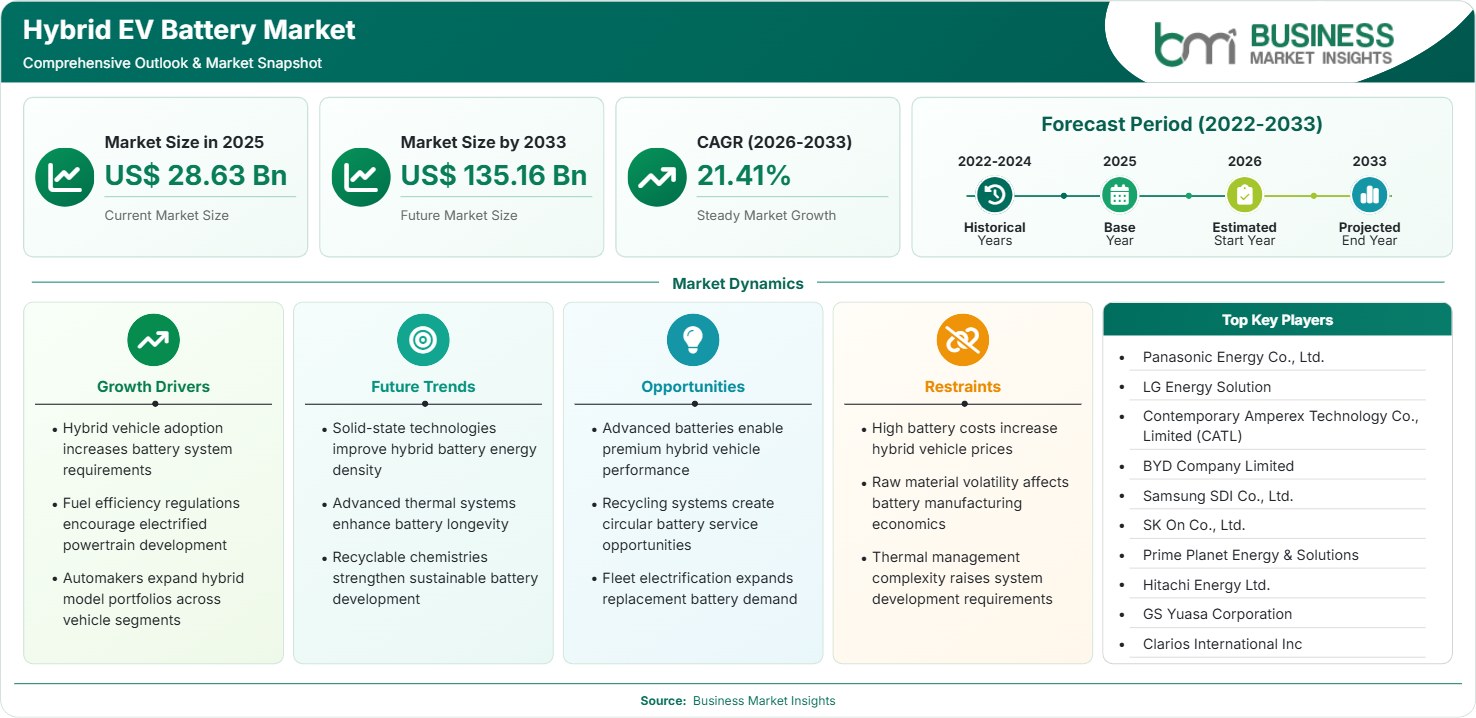
The Hybrid EV Battery Market size was valued at US$ 28.63 Billion in 2025 and is projected to reach US$ 135.16 Billion by 2033, growing at a CAGR of 21.41% during 2026–2033. Rising hybrid vehicle production, battery energy-density improvements, supportive emissions regulations, and localized battery manufacturing investments are accelerating industry expansion while creating opportunities across advanced lithium-ion technologies and next-generation battery management systems.

Report Coverage
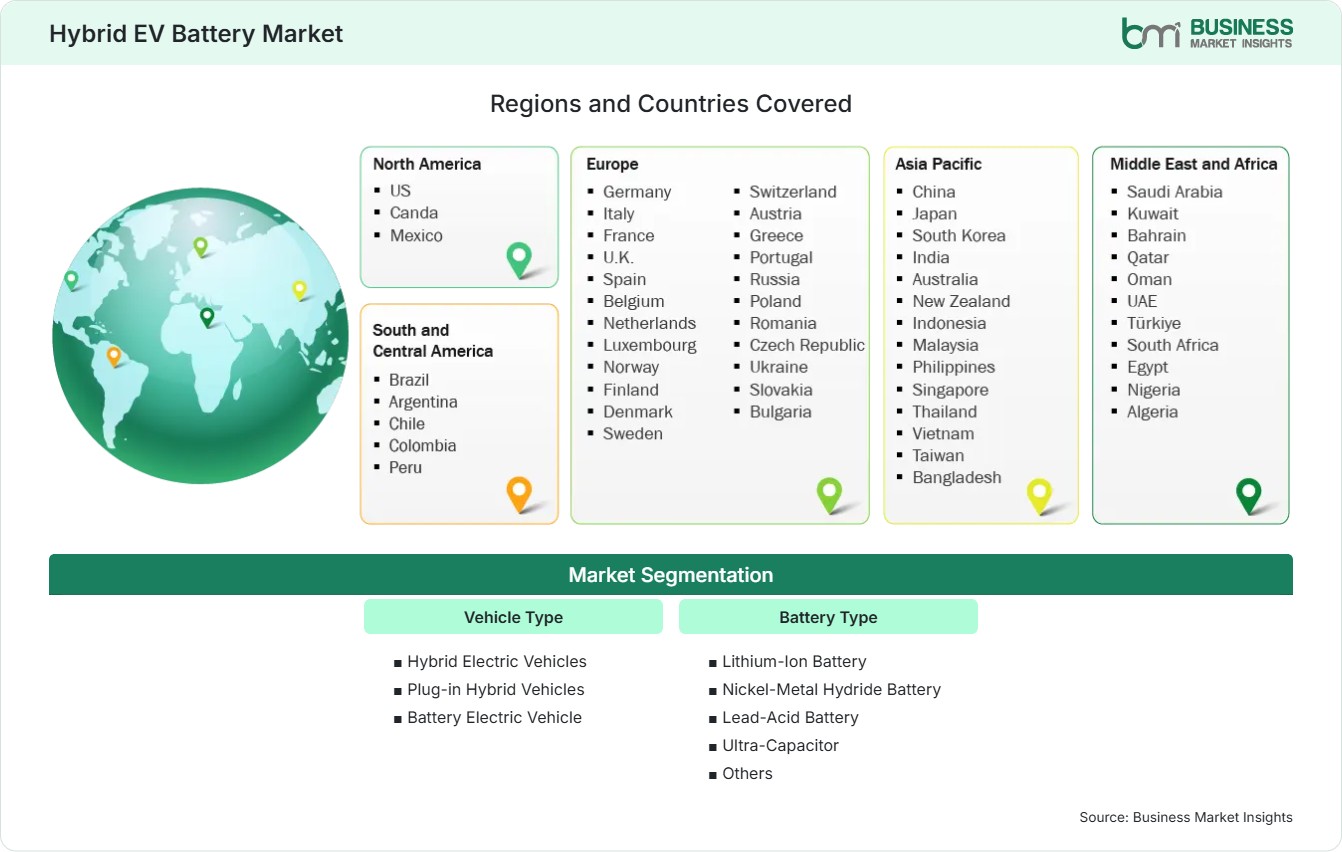
  • Vehicle Type: Hybrid Electric Vehicles, Plug-in Hybrid Vehicles, Battery Electric Vehicle
  • Battery Type: Lithium-Ion Battery, Nickel-Metal Hydride Battery, Lead-Acid Battery, Ultra-Capacitor, Others
US$ 28.63 Bn Market size in 2025
US$ 135.16 Bn Market Size by 2033
21.41% CAGR, 2026 - 2033
2026-2033 Forecast Period

AI Overview

Hybrid EV Battery Market Summary

  • North America Region: North America holds a market share of 28%–31% in 2025, growing with a CAGR of 19%–21% during 2026–2033, supported by domestic battery investments, vehicle electrification mandates, supply-chain localization, advanced manufacturing incentives, technological collaborations, fleet electrification programs, recycling infrastructure expansion, energy-security priorities, consumer demand growth, and research funding initiatives. The U.S. market benefits from automaker investments and is projected to advance at a CAGR of 19.5%–21.5%.
  • Fastest Growing Region: Asia Pacific holds a market share of 40%–43% in 2025, growing with a CAGR of 23%–25% during 2026–2033, driven by expanding automotive production, battery manufacturing scale advantages, government incentives, rising hybrid adoption, charging ecosystem development, localized supply chains, technology innovation, export strength, strategic investments, and industrial policy support.
  • Leading Segment: Lithium-Ion Battery holds a Hybrid EV Battery Market share of 68%–72% in 2025, growing with a CAGR of 22%–24% during 2026–2033, supported by superior energy density, declining production costs, enhanced safety features, vehicle platform compatibility, longer service life, rapid innovation cycles, premium vehicle adoption, manufacturing expansion, and strong automaker procurement commitments.
  • High Growth Segment: Plug-in Hybrid Vehicles (PHEV) hold a market share of 30%–34% in 2025, growing with a CAGR of 24%–26% during 2026–2033, encouraged by regulatory compliance requirements, extended driving flexibility, lower fuel consumption, attractive incentives, consumer transition preferences, expanding product portfolios, infrastructure readiness, fleet demand, emissions reduction goals, and technology improvements.
  • Key Market Opportunity: Expansion of localized battery manufacturing, battery recycling capacity, and advanced cathode-material production creates opportunities to improve supply security, reduce costs, strengthen sustainability targets, attract investment, and support regional automotive electrification strategies.
  • Major Market Players: Panasonic Energy Co., Ltd., LG Energy Solution, Contemporary Amperex Technology Co., Limited (CATL), BYD Company Limited, Samsung SDI Co., Ltd., SK On Co., Ltd., Prime Planet Energy & Solutions, Hitachi Energy Ltd., GS Yuasa Corporation, Clarios International Inc.
Strategic Insights

Hybrid EV Battery Market: Strategic Insights

Hybrid EV Battery Market Strategic Framework
FREE PDF
Request your free sample
Request free sample
Stakeholder View

Key Takeaways

  • The value chain is increasingly integrated, with automakers securing upstream materials, battery manufacturing partnerships, and recycling agreements to improve supply security and manage cost volatility.
  • Plug-in hybrid platforms present significant upside where charging infrastructure remains uneven, allowing consumers to access electrified mobility without complete dependence on public charging networks.
  • Innovation is shifting toward higher-density lithium-ion chemistries, advanced thermal management systems, silicon-enhanced anodes, and intelligent battery management software that improves lifecycle performance.
  • Asia Pacific continues to offer the strongest investment potential due to large-scale manufacturing ecosystems, favorable industrial policies, and strong automotive production capacity.
  • Strategic partnerships, joint ventures, and battery supply agreements are becoming more common as manufacturers seek scale efficiencies and long-term procurement certainty.
  • Sustainability is evolving into a competitive differentiator, with recycled materials, circular-economy initiatives, and carbon-footprint reduction increasingly influencing procurement decisions.
Geographic Outlook

Hybrid EV Battery Market Regional Highlights

North America Hybrid EV Battery Market

North America accounted for approximately 28%–31% of the Hybrid EV Battery Market share in 2025 and is anticipated to expand at a CAGR of 19%–21% through 2033. The region benefits from automotive electrification policies, battery manufacturing incentives, and accelerated gigafactory development. Supply-chain localization efforts have increased investment in cathode processing, cell manufacturing, and recycling. Major automakers continue expanding hybrid portfolios to meet regulatory compliance targets while reducing dependence on imported battery systems across key production centers.

  • U.S. and Canadian investments in battery manufacturing improve domestic supply security while supporting long-term vehicle electrification objectives and industrial competitiveness.
  • Federal incentives encourage production capacity expansion, advanced manufacturing deployment, and development of regional battery-material processing capabilities throughout North America.
  • Automotive manufacturers increasingly combine hybrid technologies with advanced energy-management systems to maximize efficiency and regulatory compliance.
  • Battery recycling capacity growth supports circular economy initiatives and reduces dependence on imported critical materials.

US Hybrid EV Battery Market

The United States represents approximately 78%–82% of regional demand within North America and is expected to record a CAGR of 19.5%–21.5% through 2033. Vehicle electrification commitments from major automakers, extensive battery investment announcements, and government support programs continue expanding production capacity. Growing consumer preference for fuel-efficient vehicles and stronger domestic battery ecosystems are supporting demand while creating opportunities for materials suppliers, technology developers, and recycling operators.

  • Major automotive manufacturers continue expanding hybrid and electrified vehicle portfolios to address fuel efficiency requirements and consumer demand.
  • Gigafactory developments strengthen domestic cell production capacity and improve resilience against international supply-chain disruptions.
  • Battery innovation initiatives support higher energy density, enhanced safety characteristics, and improved cost competitiveness.
  • Public and private investments encourage advanced manufacturing workforce development and technology commercialization.

Europe Hybrid EV Battery Market

Europe was estimated to have a market share of 22% - 25% in 2025 and is expected to grow at a CAGR of 20% - 22% between 2024 and 2033. Stricter vehicle emission norms, ambitious decarbonization objectives, and vehicle electrification policies will continue to be among the primary drivers of growth. Germany is a leading consumer region in Europe, and Eastern Europe continues to receive investments in battery manufacturing. France, Spain, and Italy are strengthening domestic production networks through industrial support programs designed to enhance competitiveness and reduce import dependence.

  • Germany remains the leading market, supported by automotive manufacturing strength and sustained investments in battery production capacity.
  • Poland and Hungary are among the fastest-growing battery manufacturing locations due to favorable investment environments and expanding supplier networks.
  • Regulatory frameworks encourage adoption of low-emission vehicles and accelerate demand for energy-efficient battery technologies.
  • Recycling initiatives and sustainability regulations are shaping procurement strategies across automotive and battery value chains.

Asia Pacific Hybrid EV Battery Market

The Asia Pacific region held a 40%-43% market share in 2025 and is projected to grow at a CAGR of 23%-25% through 2033. China is the largest manufacturer and consumer of batteries in the region, but India and Southeast Asia are becoming high-potential markets. The availability of manufacturing capabilities, supply chain ecosystems, and government support helps enhance the region's competitiveness. The region remains at the forefront of battery innovation, cost reduction, and export-driven manufacturing, supporting overall growth in the global Hybrid EV Battery Market.

  • China remains the dominant producer and consumer, supported by integrated supply chains and large-scale battery manufacturing ecosystems.
  • India demonstrates strong momentum through production-linked incentives and rapidly expanding electrified vehicle adoption.
  • South Korea and Japan maintain leadership in technology development, advanced materials, and premium battery solutions.
  • Southeast Asia attracts increasing investment as companies diversify manufacturing footprints and strengthen regional supply resilience.

Rest of World Hybrid EV Battery Market

The Rest of World accounted for 7%–10% of market share in 2025 and is expected to grow at a CAGR of 18%–20% through 2033. There is an increase in investment in critical minerals and electrification projects in South and Central America. In the Middle East and Africa, market development is fueled by vehicle electrification projects, industrial diversification, and the integration of renewable energy. Brazil leads regional adoption, while the United Arab Emirates and Saudi Arabia demonstrate accelerated investment activity.

  • Brazil benefits from expanding automotive production capacity and increasing adoption of fuel-efficient vehicle technologies.
  • Chile's critical-mineral ecosystem strengthens regional importance within global battery-material supply chains.
  • Gulf countries are investing in advanced manufacturing and sustainable mobility programs to diversify economic activity.
  • South Africa remains a key participant through automotive manufacturing capabilities and increasing electrification initiatives.
Global Market Geography
FREE PDF
Request your free sample
Request free sample
Segment Analysis

Hybrid EV Battery Market Segmentation

Vehicle Type

Vehicle Type generated the highest share of revenues amongst the demand applications. The category constitutes a vital part of the market, contributing more than 50% in 2025, with a CAGR of 21%–23% expected through 2033. The scope of the Hybrid EV Battery Market remains in growth due to increased adoption of electric-powered vehicle solutions that balance efficiency, performance, and operating flexibility.

  • Hybrid Electric Vehicles (HEV): Widely adopted for fuel-efficiency improvements without charging dependency, supported by mature technology, strong consumer familiarity, and broad availability across passenger vehicle categories.
  • Plug-in Hybrid Vehicles (PHEV): Combining battery-powered driving capability with combustion-engine flexibility, this category benefits from regulatory incentives, fleet adoption, and growing consumer interest in transitional electrification solutions.
  • Battery Electric Vehicle (BEV): Influences battery innovation and manufacturing economies of scale, accelerating technology development and reducing overall production costs throughout the battery ecosystem.

Battery Type

Battery Type remains the key factor influencing performance, safety, and lifecycle economics. The Battery Type technology segmentation factor accounts for 68%-72 % of market share through lithium-ion technologies and is expected to grow at a CAGR of 22%-24%. Hybrid EV Battery Market trends point towards a growing preference for new chemistries that deliver higher energy density and enhanced lifecycle performance.

  • Lithium-Ion Battery: Dominates industry adoption owing to high energy density, longer operational life, declining manufacturing costs, and compatibility with evolving vehicle platform architectures.
  • Nickel-Metal Hydride Battery: Maintains relevance in established hybrid vehicle models due to reliability, safety advantages, and proven long-term operational performance.
  • Lead-Acid Battery: Primarily utilized in auxiliary vehicle functions where cost efficiency and established recycling infrastructure support continued deployment.
  • Ultra-Capacitor: Gains attention in specialized applications requiring rapid charging capability, high power delivery, and efficient regenerative braking performance.
Market Forces

Hybrid EV Battery Market Dynamics

Key Market Drivers

Vehicle Electrification Policies Accelerating Adoption

Fuel efficiency and emissions-reduction regulations have been consistently tightened around the world, driving manufacturers to develop their hybrid and electric vehicles. According to the International Energy Agency, the use of electric cars is increasing, creating demand for batteries for passenger and commercial vehicles. Hybrids are becoming more popular in places where the charging infrastructure is not well developed. The Hybrid EV Battery Market growth is driven by regulations, consumer demand, and investments by automobile manufacturers. The right conditions have been created for battery companies due to policy, technology, and vehicle growth.

Advancements in Battery Chemistry and Energy Density

Investment in continuous research and development is leading to improvements in energy density, charging capability, safety, and durability throughout their life cycle. Car makers are adopting high-efficiency cathode materials, silicon-based anodes, and state-of-the-art battery management system software to improve car efficiency. The increased efficiency is allowing car makers to fine-tune hybrid systems while saving on costs and weight. The increased use of lithium-ion batteries is due to their superior performance compared to traditional batteries. As innovation cycles accelerate, battery suppliers gain opportunities to differentiate products through efficiency improvements, reliability enhancements, and integrated software capabilities that maximize usable energy throughout battery lifecycles

Expansion of Localized Manufacturing Ecosystems

Regional manufacturing capabilities have become increasingly important for battery and automobile producers to minimize logistical and supply risks. There is an increase in investment in gigafactories, cathode plants, recycling centers, and mineral processing facilities across North America, Europe, and the Asia-Pacific region. The trend helps reduce supply chain costs, improve supply chain visibility, and advance the national industrial strategy. Hybrid EV Battery Market trends have emerged due to government localization efforts through incentives and industrial policies. Enhanced regional ecosystems also support workforce development, technology transfer, and collaboration among suppliers, research institutions, and vehicle manufacturers.

Key Market Opportunities

Battery Recycling and Circular Economy Expansion

The increased number of electrified vehicles presents a significant chance for battery recycling firms. Lithium, nickel, cobalt, and other raw materials recovered from these batteries can supplement materials mined from the earth, thereby reducing environmental impact. Sustainability considerations in regulatory frameworks are motivating companies to invest in recycling infrastructure. Circular Economy Contribution to the Hybrid EV Battery Market Forecasts reflects the trend of increasing competitiveness through this channel. Companies that can recycle materials within their manufacturing process will be able to stabilize costs, increase sustainability, and improve supply chain resilience.

Emerging Automotive Markets Creating New Demand Pools

Increased urbanization, increased number of cars, and government initiatives are promoting the use of electrified vehicles in developing countries. Many countries in Southeast Asia, India, and Latin America, as well as some parts of the Middle East, have adopted policies that promote the use of more environmentally friendly modes of transportation. Hybrid models can serve as an interim solution due to the lack of charging infrastructure. Increased demand in such countries allows battery companies to enter into local partnerships and establish manufacturing plants. Early market entry may provide a durable competitive advantage as electrification strategies mature and vehicle demand increases.

Advanced Software and Battery Management Integration

Battery performance now depends on advanced software that can optimize charging, thermal management, energy consumption, and maintenance. Advanced data analytics will enhance reliability and extend battery life, creating value for both manufacturers and customers. The integration of artificial intelligence into battery management systems opens avenues for creating distinct products. Companies that invest in software performance optimization can save on costs while generating new service business models. As connected vehicle ecosystems expand, intelligent battery management will become a critical component of product competitiveness and lifecycle value creation.

Market Restraints and Challenges

Critical Mineral Price Volatility and Supply Risks

Factor: Battery production depends on base materials such as lithium, nickel, cobalt, and graphite, whose prices are prone to fluctuations. Impact: Such price fluctuations can affect producers' profit margins, how the material will be procured, and vehicle pricing. Since the capability to process these materials is regionally concentrated, firms face greater uncertainty. Firms respond to this challenge by signing long-term agreements for the procurement of these materials, recycling, and diversification. However, continued volatility poses issues for production and investment planning, particularly for manufacturers expanding capacity across multiple markets simultaneously.

Technology Obsolescence and Capital Intensity

Factor: The battery production process requires significant capital investment in production machinery, research facilities, quality control systems, and supply chains. Impact: The rapid pace of technological development might shorten the technology's lifespan and increase the risk of obsolescence. There will always be a need to invest more to keep up with the competition as new technologies are developed. Smaller players might find it difficult to achieve economies of scale. Besides, there are higher compliance costs due to changing regulations. These pressures can restrict market entry and contribute to competitive consolidation throughout the industry.

Company Analysis

Competitive Landscape

Hybrid EV Battery Market analysis indicates competition is centered on technology leadership, manufacturing scale, supply-chain integration, and strategic automotive partnerships.

Company Name

Overview

Products and Services relevant to this market

Panasonic Energy Co., Ltd.

Leading automotive battery manufacturer with extensive global partnerships and advanced lithium-ion production capabilities.

Automotive lithium-ion cells, battery packs, energy storage technologies, battery development services.

LG Energy Solution

Global battery supplier serving major vehicle manufacturers through diversified production operations.

EV batteries, battery systems, battery management technologies, manufacturing solutions.

Contemporary Amperex Technology Co., Limited (CATL)

Large-scale battery producer with strong technology portfolio and integrated supply-chain capabilities.

Lithium-ion batteries, battery packs, energy storage systems, battery technologies.

BYD Company Limited

Vertically integrated mobility and battery company with substantial manufacturing capacity.

Blade batteries, battery packs, energy storage solutions, vehicle battery systems.

Samsung SDI Co., Ltd.

Advanced battery developer focused on high-performance automotive battery applications.

Lithium-ion cells, battery modules, battery management solutions.

SK On Co., Ltd.

Fast-growing battery manufacturer supporting global automotive electrification programs.

Automotive batteries, cell production, battery engineering services.

Prime Planet Energy & Solutions

Joint venture specializing in hybrid and electrified vehicle battery technologies.

Hybrid vehicle batteries, lithium-ion batteries, battery systems integration.

Hitachi Energy Ltd.

Technology provider supporting energy storage and advanced power solutions.

Battery control technologies, power management systems, energy solutions.

GS Yuasa Corporation

Established battery manufacturer with extensive automotive battery expertise.

Lithium-ion batteries, industrial batteries, automotive energy solutions.

Clarios International Inc.

Global energy-storage company with strong automotive battery portfolio.

Advanced batteries, vehicle energy storage systems, battery recycling services.

Trust & Transparency

Research Methodology

The market analysis combines proprietary research with secondary data from government agencies, company disclosures, regulatory filings, industry databases and expert interviews. Market estimates are validated through data triangulation, cross-market benchmarking and analyst review.

View Full Research Methodology

Questions Answered

Frequently Asked Questions

Why is the Hybrid EV Battery Market Report important for investors?

The Market Report helps investors evaluate technology shifts, regional opportunities, supply-chain developments, competitive positioning, and future demand patterns affecting long-term returns.

What makes plug-in hybrid vehicles attractive to consumers?

They provide electric driving capability while retaining conventional engine flexibility, reducing range concerns and easing adoption in regions with limited charging coverage.

How important is recycling to future industry economics?

Recycling improves material security, reduces environmental impact, lowers raw-material dependence, and supports compliance with sustainability requirements.

Which region offers the strongest long-term growth potential?

Asia Pacific presents the most compelling growth profile due to manufacturing scale, government support, expanding vehicle production, and integrated battery supply chains.

What battery chemistry currently dominates hybrid vehicle applications?

Lithium-ion technology leads due to higher energy density, improved lifecycle performance, declining production costs, and compatibility with modern vehicle architectures.

Access the Full Hybrid EV Battery Market Report

Get segment-level forecasts, regional estimates, competitive benchmarking, company profiles and downloadable Excel datasets.

Access the full Hybrid EV Battery Market Report
350 pages PDF & Excel | 2026-09-16
Similar Research

Related Market Reports