Marine Parallel Hybrid Propulsion Market Regional Highlights
North America Marine Parallel Hybrid Propulsion Market
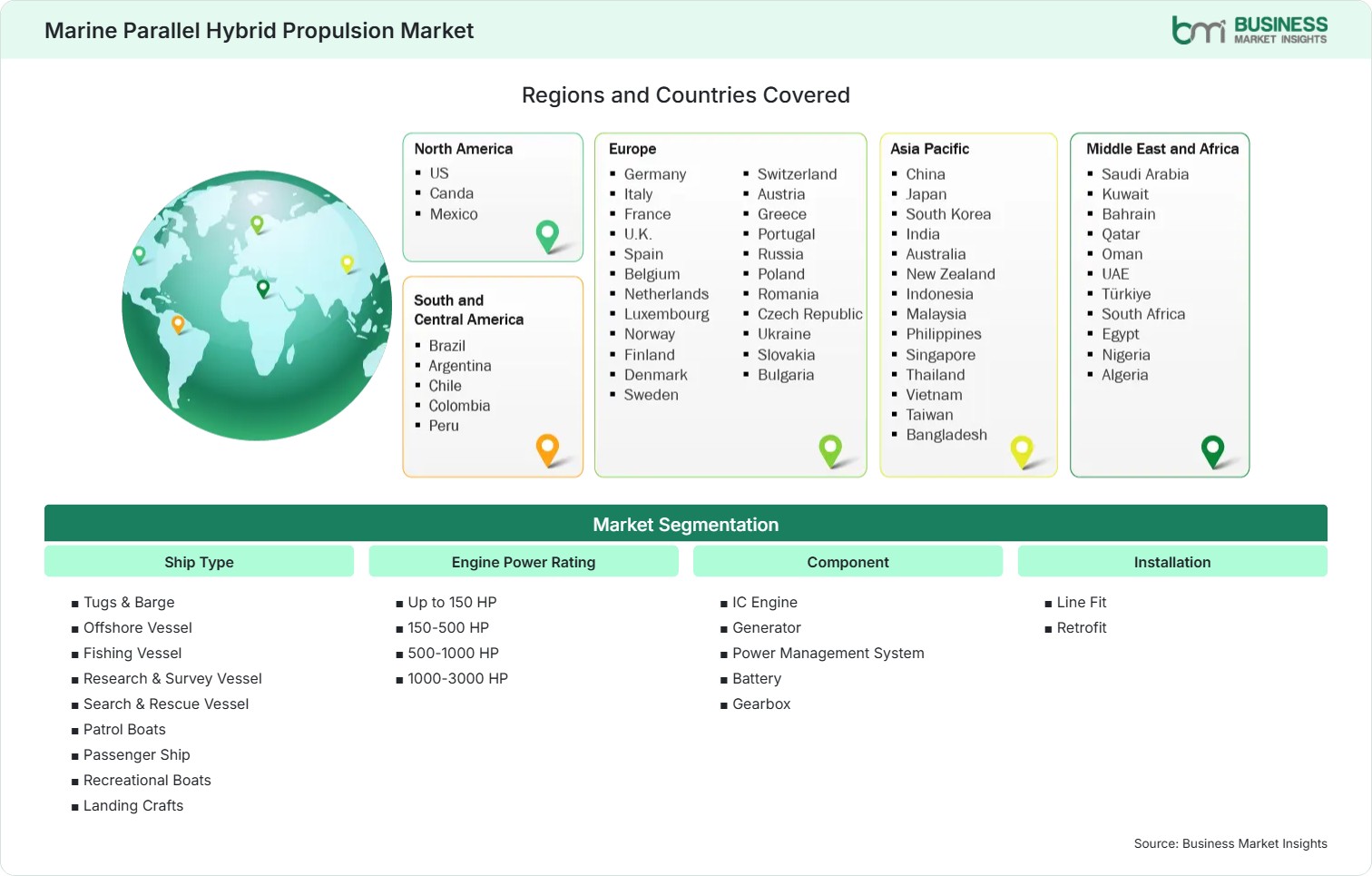
North America accounts for approximately 34%–37% Marine Parallel Hybrid Propulsion Market share in 2025 and is anticipated to expand at a CAGR of 11.8%–12.4% through 2033. Regional adoption is supported by environmental compliance requirements, vessel electrification projects, ferry modernization investments, and government sustainability initiatives. Strong presence of propulsion technology providers and growing implementation of hybrid systems in patrol boats, offshore vessels, and passenger vessels continue supporting demand. The region maintains technological leadership through significant investments in smart propulsion controls, energy storage integration, and fleet efficiency optimization initiatives.
- Ferry electrification projects improve operational efficiency and support broader deployment of advanced propulsion systems across coastal transportation networks.
- Naval modernization programs stimulate demand for hybrid propulsion integration, particularly in mission-critical vessels requiring enhanced operational flexibility.
- Rising fuel costs strengthen business cases for efficient propulsion technologies across commercial and government-operated fleets.
- Investments in sustainable port infrastructure support adoption of advanced propulsion solutions and associated charging ecosystems.
US Marine Parallel Hybrid Propulsion Market
The United States represents approximately 68%–72% of North American demand in 2025 and is forecast to register a 12.0%–12.6% CAGR through 2033. Marine Parallel Hybrid Propulsion Market growth is driven by vessel electrification initiatives, coastal emission requirements, military modernization programs, and commercial fleet optimization objectives. Ferry operators, offshore service providers, and government agencies increasingly adopt hybrid solutions to improve fuel economy and operational flexibility. Domestic innovation strengths in battery technologies, propulsion controls, and energy management systems continue supporting commercialization across multiple vessel classes and marine environments.
- Federal sustainability initiatives encourage deployment of low-emission propulsion technologies across public transportation and government-operated maritime fleets while strengthening demand for advanced energy management solutions.
- Maritime operators increasingly prioritize lifecycle cost reduction, creating strong demand for hybrid systems capable of lowering fuel consumption and maintenance expenses across vessel operations.
- Investments in smart ports and electrification infrastructure improve compatibility between hybrid-powered vessels and supporting marine logistics ecosystems.
- Growing coastal transportation demand supports wider adoption of fuel-efficient propulsion platforms in ferries, passenger vessels, and workboats.
Europe Marine Parallel Hybrid Propulsion Market
Europe holds approximately 29%–32% Marine Parallel Hybrid Propulsion Market share in 2025 and is expected to grow at a 12.3%–12.9% CAGR through the forecast period. Leadership in regional development in maritime sustainability, ship electrification, and environmental legislation creates a positive backdrop for the adoption of new technologies. The leading countries in implementing hybrid propulsion in ferries, offshore vessels, and passenger ships include Norway, Germany, and the Netherlands. Finland and Denmark show strong investment dynamics in the area. Collaboration between shipbuilders and other stakeholders also plays an important role.
- Norway remains the largest national contributor, supported by ferry electrification initiatives and strong policy frameworks encouraging low-emission marine transport solutions.
- Germany benefits from industrial capabilities, engineering expertise, and increasing demand for sustainable commercial marine operations.
- Denmark records one of the strongest growth trajectories, supported by green shipping investments and fleet modernization initiatives.
- European ports continue investing in sustainability infrastructure, encouraging vessel operators to adopt hybrid propulsion technologies that improve environmental performance.
- Regional shipbuilders increasingly integrate battery systems and digital energy management platforms into new vessel designs.
Asia Pacific Marine Parallel Hybrid Propulsion Market
Asia Pacific accounts for approximately 27%–30% Marine Parallel Hybrid Propulsion Market share in 2025 and is projected to achieve the fastest regional expansion at a 14.2%–14.8% CAGR. A high level of shipbuilding activities, expansion of maritime business, government decarbonization goals, and development of coastal transport systems will drive increased demand. China, Japan, and South Korea lead in production capacity within the region, while India and Southeast Asian countries are emerging growth regions. Significant investments in green shipping technologies, port development, and vessel replacements create market opportunities.
- China remains the largest market, supported by extensive shipbuilding capabilities and increasing investments in sustainable marine technologies.
- Japan leverages advanced engineering expertise and strong maritime infrastructure to accelerate deployment of hybrid propulsion systems.
- India demonstrates high-growth potential due to coastal transportation expansion, fleet modernization activities, and environmental policy initiatives.
- Regional governments increasingly support low-carbon transport policies that encourage adoption of efficient propulsion solutions.
- Growing passenger transport and offshore operational requirements create favorable demand conditions across diverse vessel categories.
Rest of World Marine Parallel Hybrid Propulsion Market
Rest of World contributes approximately 8%–10% Marine Parallel Hybrid Propulsion Market share in 2025 and is forecast to expand at a 11.5%–12.1% CAGR through 2033. Modernizing fleets and offshore operations are some of the benefits associated with South and Central America. In the Middle East and Africa, implementation is enabled by port development projects, diversification of maritime operations, and the adoption of new ship technologies. Brazil and the United Arab Emirates lead in regional implementation, whereas Saudi Arabia and South Africa are considered promising for future market growth.
- Brazil benefits from offshore energy operations requiring efficient support vessels capable of reducing fuel consumption and operating costs.
- The United Arab Emirates supports adoption through smart port development, sustainability initiatives, and investment in advanced maritime infrastructure.
- Saudi Arabia's maritime diversification programs create opportunities for propulsion technology providers serving commercial and industrial marine sectors.
- African coastal economies increasingly explore modern vessel technologies to improve transportation efficiency and environmental performance.
- Regional governments continue supporting transport modernization projects, creating favorable conditions for long-term market development.