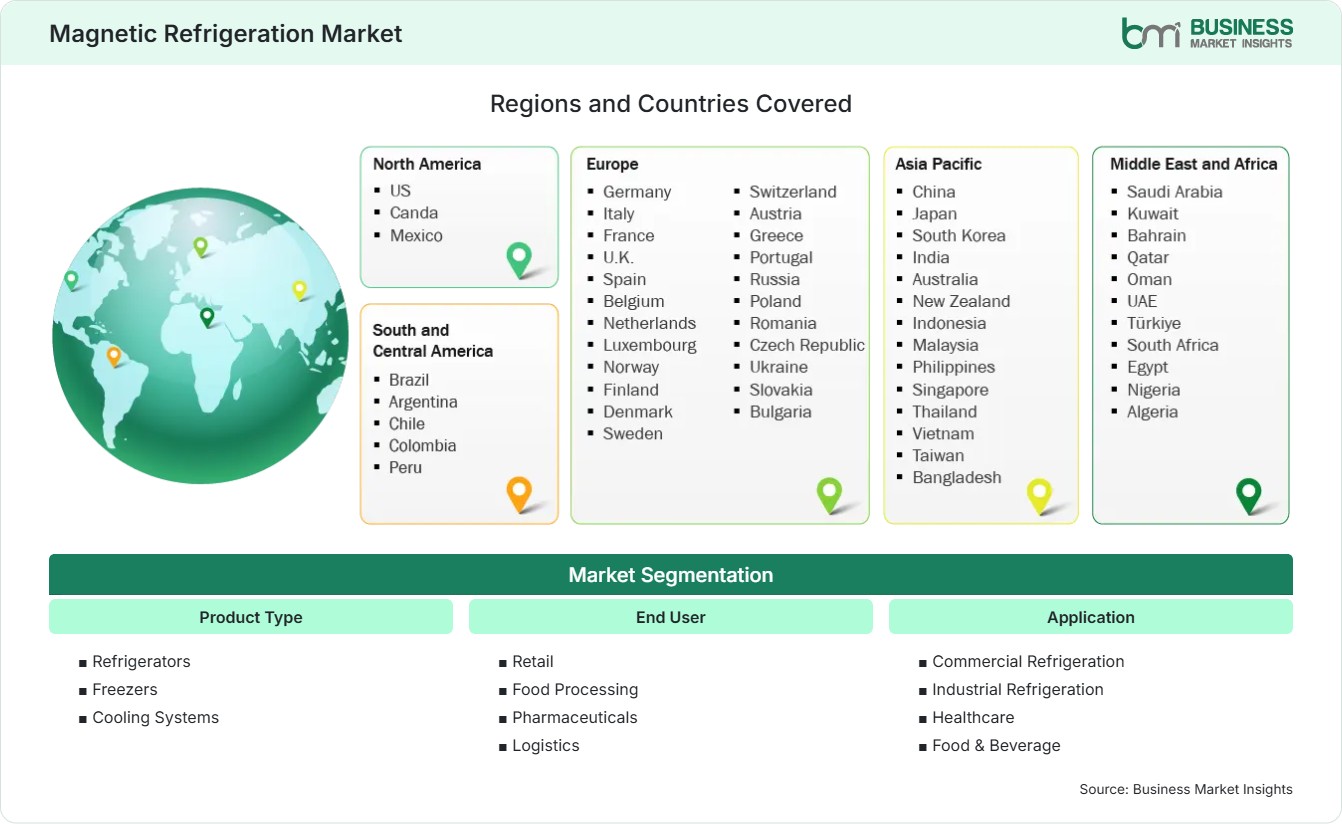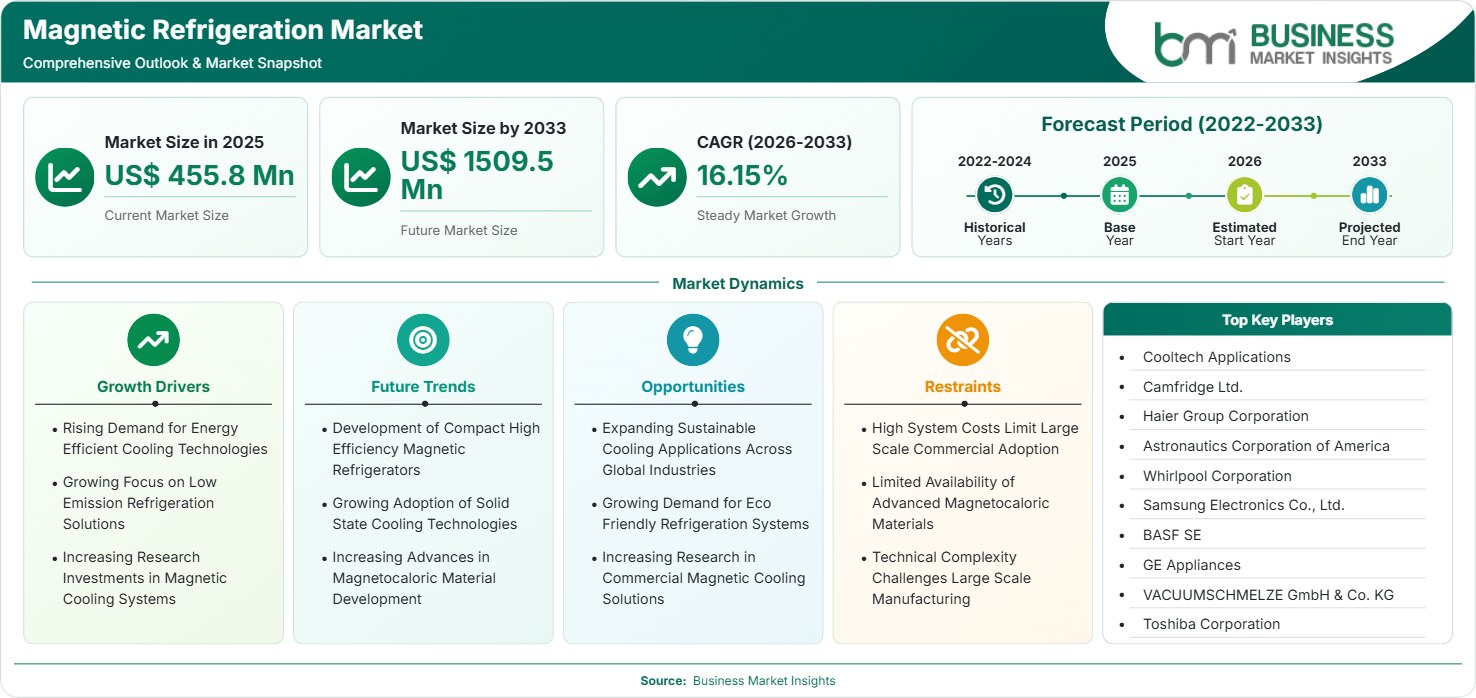
Magnetic Refrigeration Market Regional Highlights
North America Magnetic Refrigeration Market
North America accounts for 35%–38% Magnetic Refrigeration Market share in 2025 and is projected to expand at a CAGR of 14.5%–15.5% through 2033. Strong environmental regulations, growing adoption of energy-efficient refrigeration systems, and significant research investments support regional leadership. Food retail modernization, pharmaceutical cold storage expansion, and sustainable cooling initiatives continue driving demand.
- Federal and state-level energy efficiency programs encourage adoption of alternative cooling technologies while supporting commercialization initiatives focused on reducing energy consumption and environmental impacts across commercial refrigeration infrastructure.
- Supermarket chains are investing in sustainable refrigeration upgrades to meet corporate carbon reduction targets, creating favorable conditions for advanced cooling systems and pilot-scale deployments.
- Pharmaceutical manufacturing and biologics distribution require highly reliable temperature control, encouraging investment in innovative refrigeration technologies capable of improving operational efficiency.
- Research institutions and private companies continue advancing magnetocaloric material performance, supporting commercialization pathways and expanding potential applications across industrial cooling environments.
- Growing focus on refrigerant alternatives aligns with environmental regulations, strengthening demand for systems capable of reducing greenhouse gas emissions and improving sustainability outcomes.
US Magnetic Refrigeration Market
The United States represents approximately 74%–78% of regional revenue and is forecast to grow at a CAGR of 14.8%–15.8% through 2033. Strong innovation ecosystems, significant intellectual property activity, and increasing sustainability investments support market expansion.
- Food retail operators are pursuing energy-efficient refrigeration upgrades to reduce operating costs and improve sustainability metrics across large-scale store networks.
- Healthcare providers increasingly require advanced temperature management systems for pharmaceuticals, biologics, and laboratory applications with stringent storage requirements.
- Technology developers benefit from collaboration opportunities with universities, research laboratories, and appliance manufacturers focused on commercialization.
- Corporate sustainability initiatives are encouraging investment in environmentally friendly cooling systems that reduce dependence on conventional refrigerants.
Europe Magnetic Refrigeration Market
Europe holds 29%–32% market share in 2025 and is expected to expand at a CAGR of 15.5%–16.5% during 2026–2033. Germany remains the leading market with growth around 15.5%–16.5%, while France demonstrates strong innovation activity. The United Kingdom is among the higher-growth national markets, advancing at approximately 16.5%–17.5% due to research commercialization and industrial partnerships.
- European Union climate initiatives encourage development and deployment of sustainable cooling technologies with reduced environmental footprints.
- Manufacturers are investing in advanced refrigeration platforms to comply with increasingly stringent refrigerant regulations and efficiency standards.
- Strong academic and industrial collaboration supports magnetocaloric research, material innovation, and commercialization activities.
- Food processing and pharmaceutical sectors are exploring alternative refrigeration technologies to improve energy performance and sustainability.
- Industrial decarbonization strategies continue supporting investments in next-generation cooling solutions across multiple end-use sectors.
Asia Pacific Magnetic Refrigeration Market
Asia Pacific accounts for 26%–29% of market revenue in 2025 and is anticipated to grow at a CAGR of 18.5%–19.5% through 2033, making it the fastest-expanding regional market. Rapid urbanization, expanding cold-chain networks, and growing demand for energy-efficient appliances support adoption. China leads regional revenue generation, while India exhibits one of the highest growth rates at approximately 19.5%–20.5%.
- Expanding supermarket networks and organized retail development create demand for advanced commercial refrigeration technologies.
- Governments are promoting energy-efficient infrastructure and sustainability initiatives that support adoption of innovative cooling systems.
- Pharmaceutical manufacturing growth is increasing requirements for reliable temperature-controlled storage and transportation solutions.
- Rising disposable incomes and appliance modernization trends encourage interest in environmentally friendly refrigeration alternatives.
- Industrial expansion and logistics modernization continue creating opportunities for advanced refrigeration technologies across diverse applications.
Rest of World Magnetic Refrigeration Market
The Rest of World region accounts for 7%–10% market share in 2025 and is projected to grow at a CAGR of 16.0%–17.0% through 2033. South and Central America are benefiting from cold-chain investments supporting food exports and pharmaceutical distribution. Brazil remains the largest market within the region. Middle East and Africa adoption is supported by infrastructure development, healthcare expansion, and sustainability initiatives.
- Agricultural export industries require reliable refrigeration infrastructure, encouraging adoption of advanced cooling technologies across logistics networks.
- Healthcare modernization programs are increasing demand for temperature-controlled storage and transportation solutions in emerging economies.
- Infrastructure investments across Gulf countries support deployment of energy-efficient technologies in commercial and industrial facilities.
- Sustainability objectives and energy conservation initiatives are creating favorable conditions for alternative refrigeration technologies.
- Growth in food processing and logistics sectors continues strengthening demand for advanced refrigeration systems throughout developing markets.