Market Summary
Executive Summary and Global Market Analysis
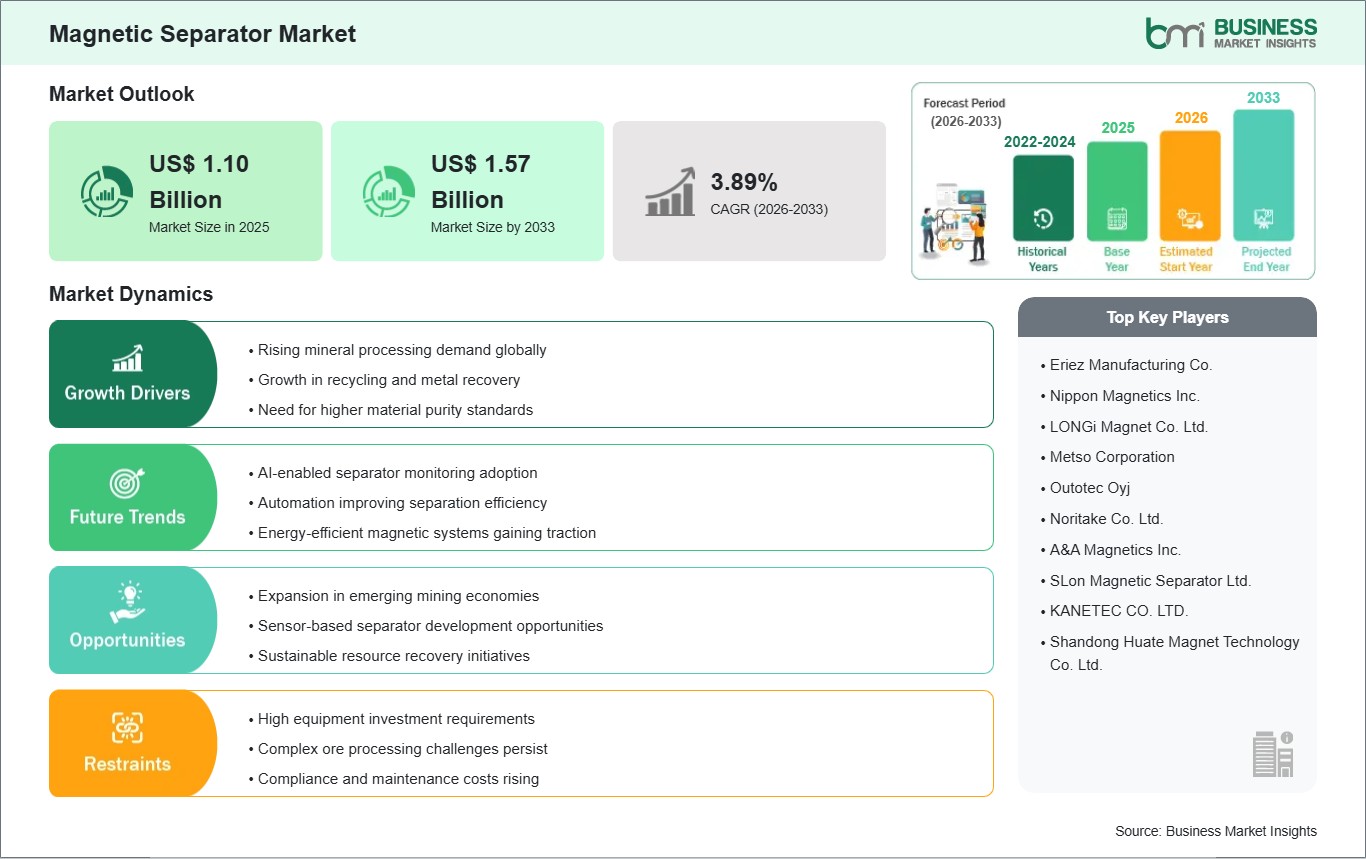
Magnetic separators are industrial systems designed to isolate ferrous or weakly magnetic materials from mixed material streams. They are deployed to improve product purity, protect downstream equipment, and recover usable material across mining, recycling, and process handling environments. Their functional value lies in combining separation efficiency with operational continuity, particularly where material consistency and equipment protection directly influence plant performance.
Market momentum is shaped by tighter contamination control standards, greater attention to resource recovery, and broader mechanization in bulk material operations. Facilities handling ores, construction debris, municipal waste, and industrial feedstocks are expanding deployment of magnetic separation to reduce metal carryover and limit unplanned maintenance. This creates consistent demand for equipment that can operate reliably under abrasive, high-throughput, and compositionally variable conditions.
Segmentation patterns indicate broad relevance across product architecture, processing condition, and end-use setting. Magnetic drum separators remain central in continuous bulk handling lines, while overband and cross belt systems are selected where tramp metal removal is operationally critical. Wet configurations align with slurry-based mineral processing, whereas dry formats fit conveyor-based recovery and sorting environments. Waste management and processing industry applications account for the most consistent utilization profile.
Technology development in this sector is moving toward stronger field control, modular system layouts, and improved adaptability to finer particle streams. Suppliers are refining magnet assemblies, drum geometry, belt integration, and control interfaces to improve separation consistency while reducing service interruptions. Design emphasis is also shifting toward application-specific engineering, allowing users to match separator performance more precisely with ore characteristics, recyclate composition, and line speed requirements.
Competitive positioning is defined by engineering depth, installed base credibility, and the ability to address both standardized and customized separation requirements. Market participants compete through application expertise, equipment durability, and lifecycle support rather than through broad product claims alone. As end users seek higher recovery efficiency and lower process disruption, differentiation increasingly depends on how effectively suppliers align machine configuration with site-specific material behavior.
Segment Analysis
Magnetic Separator Market Segmentation
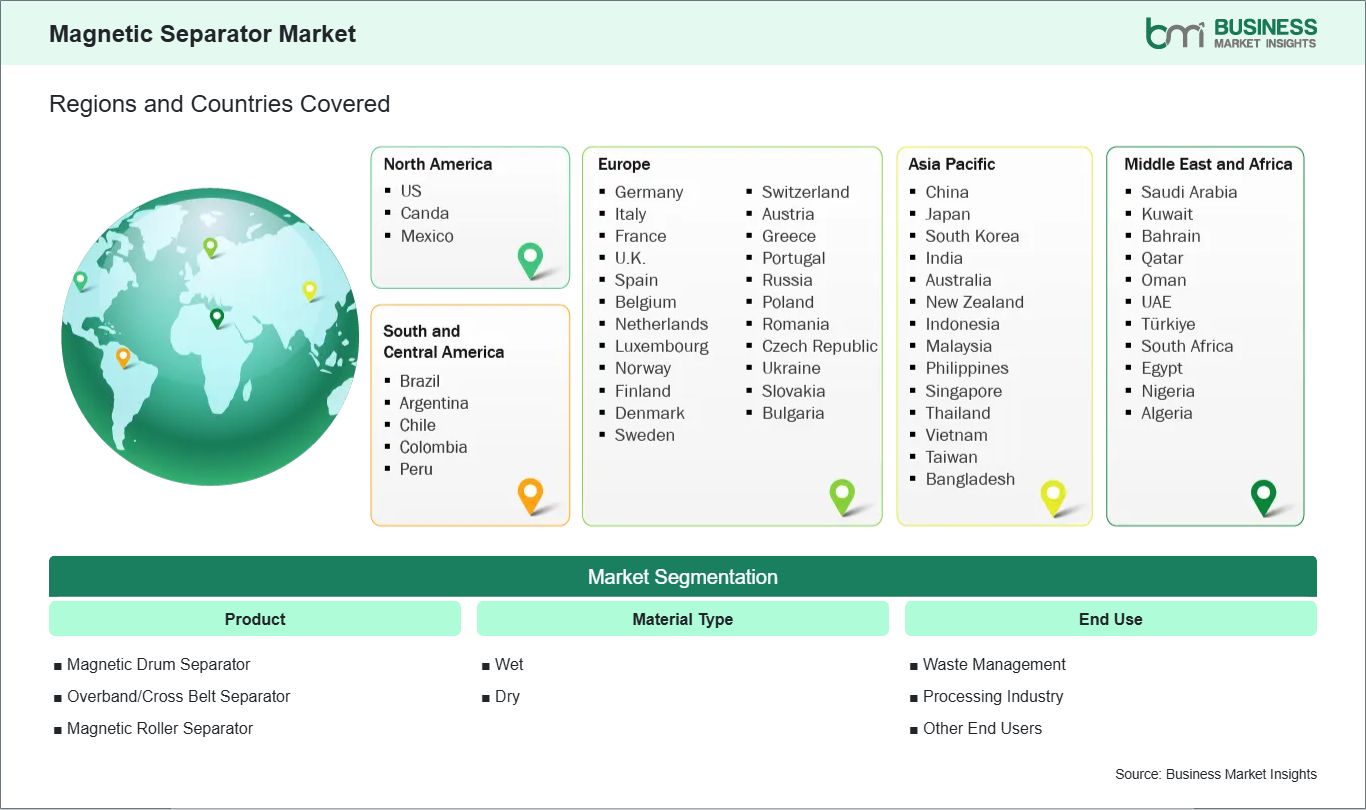
The magnetic separator market is segmented by product, material type, and end use. Each category reflects distinct operating conditions and separation priorities.
By Product
- Magnetic Drum Separator : Preferred for continuous separation in bulk material handling lines.
- Overband or Cross Belt Separator : Removes tramp iron efficiently from conveyor-based processing streams.
- Magnetic Roller Separator : Supports finer separation where particle selectivity shapes output quality.
By Material Type
- Wet : Suited to slurry processing where fine particle recovery influences plant yield.
- Dry : Fits conveyor and free-flowing applications requiring straightforward contaminant removal.
By End Use
- Waste Management : Strengthens metal recovery and contamination control in mixed waste streams.
- Processing Industry : Supports purity management across minerals, aggregates, and industrial feedstock lines.
- Other End Users : Addresses site-specific separation needs in specialized handling environments.
Market Forces
Magnetic Separator Market Drivers and Opportunities
Higher Focus on Contamination Control in Material Processing
Material handling systems across mining, recycling, and industrial processing are under pressure to limit ferrous contamination before it reaches critical equipment. This need has elevated the role of magnetic separators in upstream protection and downstream purification. Operators increasingly select separation systems that reduce metal carryover, preserve product specifications, and support continuous throughput under demanding plant conditions.
The impact extends beyond equipment safety into maintenance planning, recovery efficiency, and process reliability. In facilities where abrasive feed or mixed waste streams create separation complexity, magnetic systems improve operational discipline without adding excessive process burden. Their relevance is strongest where contamination events can disrupt production quality, accelerate component wear, or reduce the recoverable value of processed material.
Equipment Innovation for Resource Recovery and Line Flexibility
Advances in separator design are expanding how magnetic systems are used in recovery-focused operations. Stronger magnet arrangements, compact modular builds, and more adaptable belt and drum configurations are improving fit across waste sorting, ore beneficiation, and industrial purification workflows. These developments enable use cases where material composition changes frequently and where stable separation performance must be maintained across shifting operating loads.
Future scope is linked to broader deployment in circular processing systems, higher-purity industrial inputs, and more automated recovery lines. As operators seek cleaner output streams and better material reclamation economics, magnetic separators can extend into additional plant stages rather than remain limited to protective roles. This expands their strategic importance in facilities balancing throughput, recovery value, and process consistency.
Size and Share Analysis
Magnetic Separator Market Size and Share Analysis
The magnetic separator market size is expected to reach US$ 1.57 Billion by 2033 from US$ 1.10 Billion in 2025, registering a CAGR of 3.89% from 2026 to 2033. This trajectory reflects measured expansion supported by replacement demand, process optimization priorities, and continued investment in contamination control across industrial material handling environments.
Within the segment structure, magnetic drum separators hold a leading position because they align well with continuous-duty operations and established plant layouts. Wet systems maintain strong relevance in mineral processing settings, while dry systems remain integral to conveyor-based recovery lines. This balance shows how equipment selection depends less on broad preference and more on the physical behavior of the processed material.
From an application standpoint, waste management and processing industry installations account for the clearest concentration of usage. These environments require reliable metal extraction to protect machinery, improve recovered stream quality, and stabilize downstream operations. Other end users contribute additional demand where separation performance supports product cleanliness, operational continuity, or material reclaim objectives in specialized processing settings.
Report Coverage
Magnetic Separator Market Report Coverage and Deliverables
The " Magnetic Separator Market Size and Forecast (2022:2033)" report provides a detailed analysis of the market covering below areas:
- Market size and forecast at global, regional, and country levels for all the key market segments covered under the scope
- Market trends, as well as market dynamics such as drivers, restraints, and key opportunities
- Market analysis covering key market trends, global and regional framework, major players, regulations, and recent market developments
- Industry landscape and competition analysis covering market concentration, heat map analysis, prominent players, and recent developments for the market
- Detailed company profiles, including SWOT analysis
Geographic Insights
Magnetic Separator Market Geographic Insights
The magnetic separator market shows diverse regional adoption patterns influenced by industrial structure, material recovery priorities, and process engineering maturity. Across global markets, deployment reflects the need to improve metal removal efficiency, protect capital equipment, and raise output purity in handling systems exposed to mixed or abrasive feed. Adoption therefore follows the rhythm of industrial processing intensity rather than a uniform expansion pattern.
North America benefits from established recycling infrastructure, advanced aggregate operations, and mature processing industries that prioritize uptime and contamination control. Market demand is supported by operators seeking dependable separator performance in facilities where unplanned downtime carries high operating cost. Equipment replacement, process upgrades, and plant modernization create a stable environment for solutions that improve recovery quality and shield downstream assets.
Asia Pacific remains the most operationally dynamic regional market, shaped by large mineral processing capacity, expanding waste handling systems, and broad industrial manufacturing activity. The region favors separator solutions that can handle variable feed characteristics while supporting high-throughput plant environments. As processing lines become more sophisticated, demand increasingly shifts toward systems that combine ruggedness with more application-specific separation performance.
Europe shows steady demand linked to material recovery discipline, cleaner secondary raw material streams, and tighter process quality expectations. Emerging markets in the Middle East and Africa, along with South and Central America, contribute through mining activity, infrastructure materials processing, and gradual upgrades in waste sorting capability. These regions do not develop identically, yet each expands the market where separation reliability supports resource use efficiency and operating resilience.
Industry Activity
Recent Developments
Recent developments reflect continued emphasis on modular plant design and higher-efficiency separation equipment. The market is also seeing broader alignment between magnetic separation systems and resource recovery objectives.
- In June 2026, Researchers at Lulea University of Technology have developed a completely new material separation method by combining flotation and magnetic separation in a single system. The technology could reduce chemical use in the mining industry while enabling the recovery of valuable raw materials from both mine waste and spent batteries.
- In October 2024, Bunting, a global leader in magnetic separation and metal detection equipment, announces the launch of two upgraded products: the Liquid Magnetic Separator and the Performer Weigh checkweigher. These enhanced models will debut at Pack Expo 2024 in Chicago this November, offering improved performance for food, pharmaceutical, and ceramic industries.
Trust & Transparency
Research Methodology
The market analysis combines proprietary research with secondary data from government agencies, company disclosures, regulatory filings, industry databases and expert interviews. Market estimates are validated through data triangulation, cross-market benchmarking and analyst
review.
View Full Research Methodology
Key Sources Referred:
Automotive electronics and mobility technology journals Aviation safety and avionics regulatory publications Industrial automation and control systems research papers Government transportation safety data publications Academic studies on human-machine interface systems Electronics and display technology industry white papers Global mobility and infrastructure development reports