Low‑Frequency Sound‑Absorbing Insulation Materials Market Outlook (2022-2033)

Historic Data: 2022-2024   |   Base Year: 2025   |   Forecast Period: 2026-2033
Report Content: Market Scope, Market Segmentation, Market Dynamics, and Competitive Analysis

Report Coverage:
  • Material (Foam, Other Materials)
  • Application (Engine & Under the Bonnet, Interior)

No. of Pages: 410
Report Code: BMIPUB00034029
Category: Chemicals and Materials
Low‑Frequency Sound‑Absorbing Insulation Materials Market

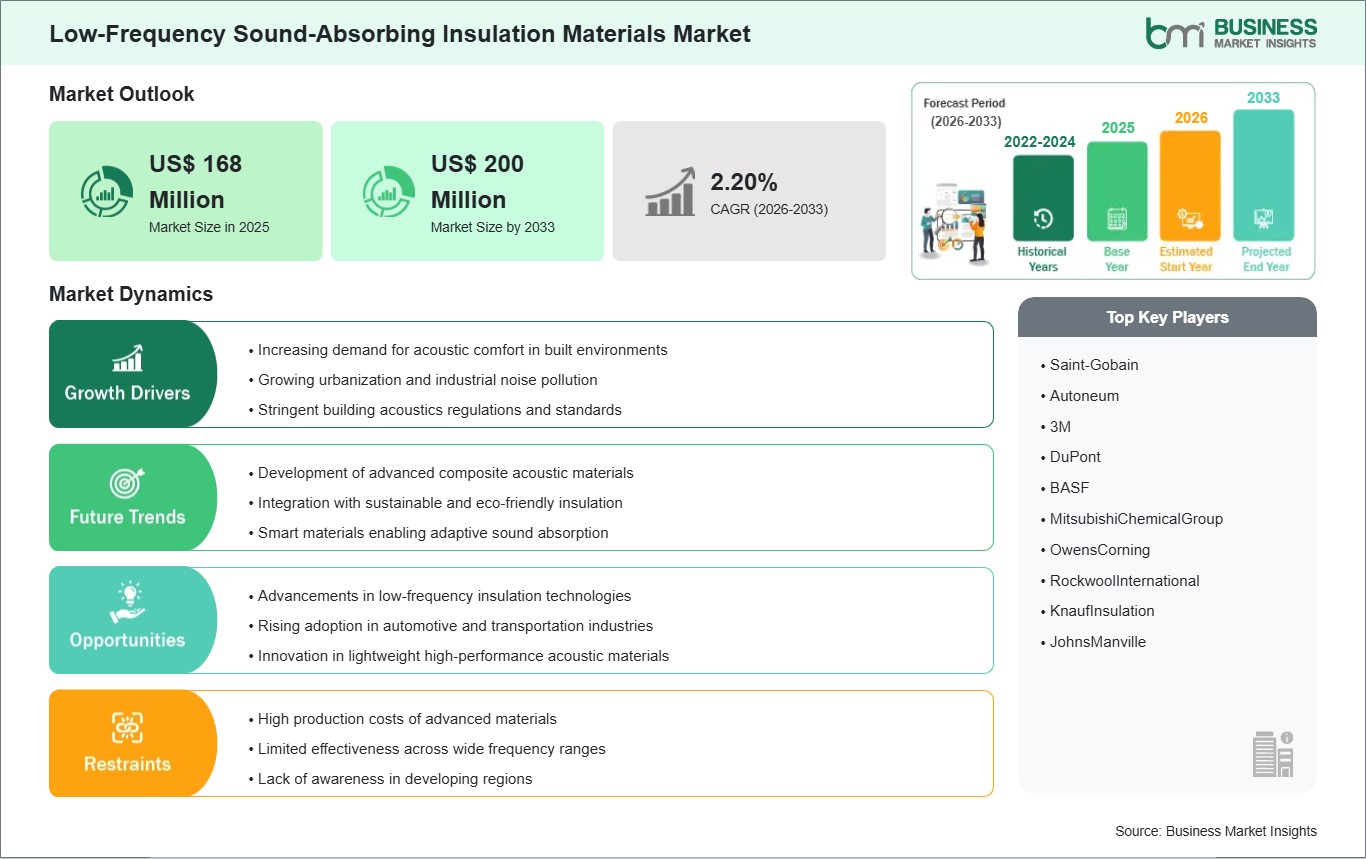
The Low-Frequency Sound-Absorbing Insulation Materials Market size is expected to reach US$ 200 Million by 2033 from US$ 168 Million in 2025. The market is estimated to record a CAGR of 2.20% from 2026 to 2033.

Executive Summary and Global Market Analysis:

The market for global low-frequency sound-absorbing insulation materials continues its strong growth as the awareness of noise pollution and indoor acoustic quality increases across all sectors, including residential, commercial, industrial and transportation. Low-frequency sound waves (generally less than 500Hz) are difficult to mitigate using standard insulation materials, and this has resulted in the need for specialist solutions for their absorption. The uses for these types of materials are numerous and vary from high precision environments, such as recording studios, to theaters, industrial plants, HVAC systems, and transportation cabins. Controlling low-frequency noises in these types of environments enhances comfort levels, promotes productivity, and assists in regulatory compliance. Recent technology advancements in fibrous, porous, and composite materials have improved sound absorption efficiencies, fire resistance, durability, and ease of installation.

Sustainability remains a focal point as companies are now developing recyclable, low-VOC, and environmentally friendly products, which help to meet green building standards and governmental regulations. Continuing trends such as increasing urbanization and industrialization, along with the adoption of smart building technologies, will also support market growth through integrated noise management solutions. Competitive strategies include research and development of hybrid materials, customized product development, and collaboration with the construction and transportation industries. Manufacturers that are successfully balancing innovation, performance, and sustainability will be in the best position to capitalize on opportunities, delivering high-value acoustic solutions that will address low-frequency noise issues in a wide range of high-demand global applications.

Low‑Frequency Sound‑Absorbing Insulation Materials Market - Strategic Insights:

global-market-strategic-framework
Get more information on this report

Low‑Frequency Sound‑Absorbing Insulation Materials Market Segmentation Analysis:

Key segments that contributed to the derivation of the low‑frequency sound‑absorbing insulation materials market analysis are type and application segments.

  • Material, the low‑frequency sound‑absorbing insulation materials market is segmented into foam and others. The foam segment dominated the market in 2025.
  • Application, the low‑frequency sound‑absorbing insulation materials market is classified into engine & under the bonnet and interior. The interior segment dominated the market in 2025.

Low‑Frequency Sound‑Absorbing Insulation Materials Market Drivers and Opportunities:

Increasing demand for acoustic comfort in built environments

The global market for low-frequency sound-absorbing insulation materials is being driven by the increased awareness of sound comfort in residential, commercial, and industrial spaces. Low-frequency sound, which is commonly generated by machinery, traffic, and industrial activities, is a problem that cannot be effectively solved by conventional insulation materials, thereby creating a market for sound-absorbing materials. In commercial and infrastructure constructions, it has become increasingly important for spaces to be planned in a way that ensures the elimination of vibrations and low-frequency sounds, which are necessary for meeting performance and safety criteria in such spaces. This has made building planners incorporate advanced insulation solutions in the early stages of designing and renovating spaces, which ensures sound management in a way that does not compromise the structural and aesthetic requirements of the space.

The use of low-frequency sound-absorbing materials has also become increasingly common in industrial spaces, including manufacturing and processing units, where noise-related disruptions are a problem, and it has become necessary for these spaces to be designed in a way that ensures the elimination of noise-related disruptions, thereby creating a market for sound-absorbing materials in these spaces as well.

Advancements in low-frequency insulation technologies

There are a number of technological innovations in the area of low-frequency sound-absorbing insulation products, which are creating a number of market opportunities. Manufacturers are developing products with increased density, thickness, and design, which are effective in addressing low-frequency vibrations. The technology used in the production of these products is helping to increase their application in various industries, including buildings, plants, and transportation. Manufacturers are carrying out research to develop innovative products that incorporate conventional materials, along with composites, to increase performance in the area of low-frequency vibrations. The integration of this technology is helping to create innovative products that meet specific needs without compromising performance in other areas, such as thermal, fire, and durability.

Furthermore, increased collaboration between developers of various materials and industry players, including construction, is helping to increase the rate of acceptance of innovative products. The technology used in the production of innovative products is helping to create customized products that meet specific needs, including addressing unique low-frequency issues, such as vibrations from HVAC systems. The various technological innovations are helping to create a positive market environment for the industry, which is expected to sustain its growth.

Low‑Frequency Sound‑Absorbing Insulation Materials Market Size and Share Analysis:

The Low‑Frequency Sound‑Absorbing Insulation Materials Market demonstrates steady growth, with size and share analysis highlighting evolving trends and competitive dynamics among key players. The report examines subsegments categorized within material and application, offering insights into their contribution to overall market performance.

By Material, the foam subsegment dominated the market in 2025, driven by foam`s versatility, ease of installation, and effectiveness in absorbing low‑frequency noise across automotive and other applications.

Based on Application, the interior subsegment dominated the market in 2025, supported by increasing use of sound‑absorbing insulation materials in components such as floor coverings, underbody cladding, and door trims to enhance interior acoustic comfort.

Low‑Frequency Sound‑Absorbing Insulation Materials Market Report Highlights:

Report Attribute Details
Market size in 2025 US$ 168 Million
Market Size by 2033 US$ 200 Million
Global CAGR (2026 - 2033)2.20%
Historical Data 2022-2024
Forecast period 2026-2033
Segments Covered By Material
  • Foam
  • Other Materials
By Application
  • Engine & Under the Bonnet
  • Interior
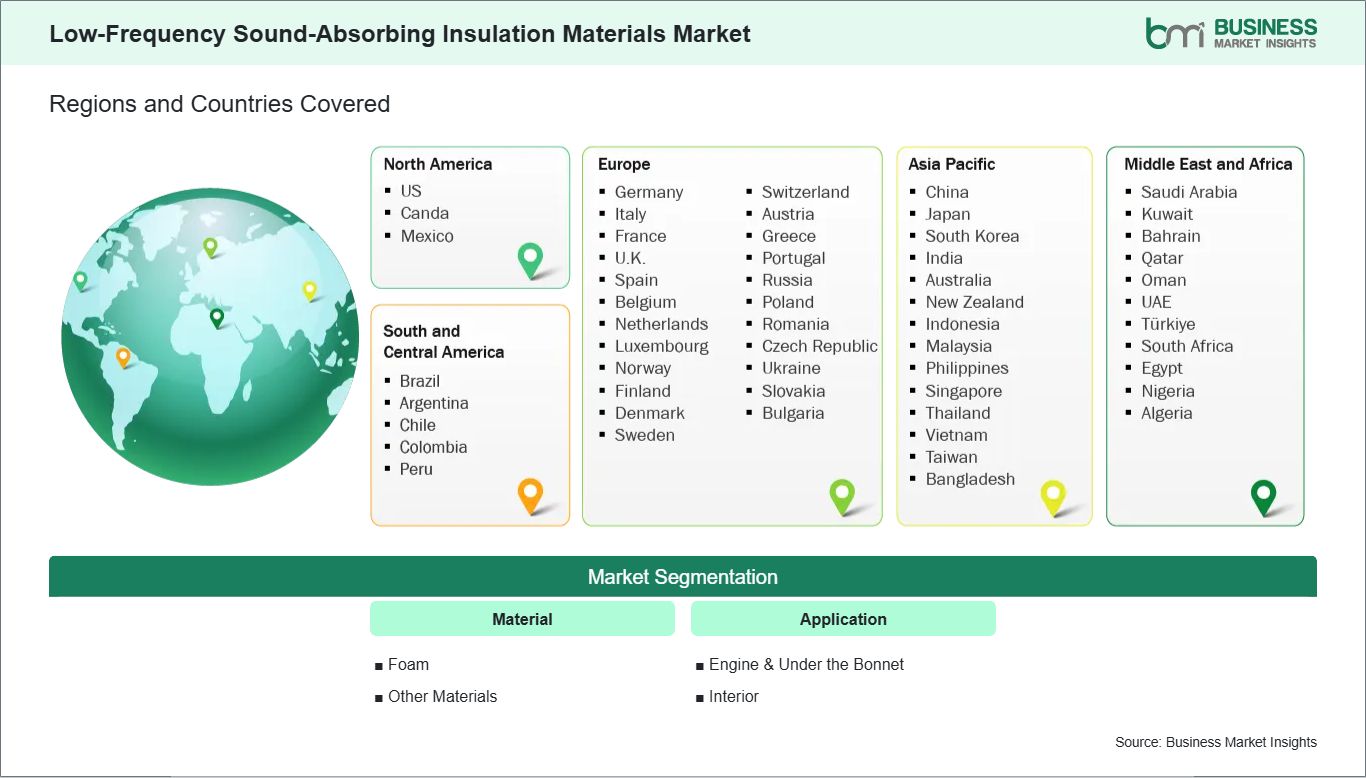
Regions and Countries Covered
North America US, Canada, Mexico
Europe Belgium, Austria, Finland, Denmark, Greece, Poland, Romania, Russia, Ukraine, Czech Republic, Slovakia, Bulgaria, Italy, Luxembourg, Germany, Switzerland, France, Netherlands, Norway, Portugal, Spain, Sweden, United Kingdom
Asia-Pacific Australia, China, India, Japan, South Korea, Indonesia, Malaysia, Philippines, Singapore, Thailand, Vietnam, Bangladesh, New Zealand, Taiwan
South and Central America Brazil, Argentina, Peru, Chile, Colombia
Middle East and Africa Bahrain, Kuwait, Oman, Qatar, Saudi Arabia, United Arab Emirates, Turkiye, South Africa, Egypt, Algeria, Nigeria
Market leaders and key company profiles
  • Saint-Gobain
  • Autoneum
  • 3M
  • DuPont
  • BASF
  • MitsubishiChemicalGroup
  • OwensCorning
  • RockwoolInternational
  • KnaufInsulation
  • JohnsManville
Get more information on this report

Low‑Frequency Sound‑Absorbing Insulation Materials Market Report Coverage and Deliverables:

The "Low‑Frequency Sound‑Absorbing Insulation Materials Market Size and Forecast (2022 - 2033)" report provides a detailed analysis of the market covering below areas:

  • Low‑Frequency Sound‑Absorbing Insulation Materials Market size and forecast at global, regional, and country levels for all the key market segments covered under the scope
  • Low‑Frequency Sound‑Absorbing Insulation Materials Market trends, as well as drivers, restraints, and opportunities
  • Low‑Frequency Sound‑Absorbing Insulation Materials Market analysis covering key trends, global and regional framework, major players, regulations, and recent developments
  • Industry landscape and competition analysis covering market concentration, heat map analysis, prominent players, and recent developments for the Low‑Frequency Sound‑Absorbing Insulation Materials Market
  • Detailed company profiles, including SWOT analysis

Low‑Frequency Sound‑Absorbing Insulation Materials Market Geographic Insights:

The geographical scope of the Low‑Frequency Sound‑Absorbing Insulation Materials Market report is divided into North America, Asia Pacific, Europe, Middle East & Africa, and South & Central America. North America held the largest share in 2025.

Regional trends in the low-frequency sound-absorbing insulation materials market highlight differences in industrial focus, construction standards, and regulatory environments. North America is the leading region, driven by stringent building codes, industrial noise regulations, and demand for high-performance acoustic materials in commercial, residential, and automotive sectors. The U.S. and Canada are investing in hybrid and composite absorptive solutions tailored for low-frequency control. Europe maintains strong demand, led by Germany, France, and the UK, where sustainable construction practices, indoor environmental quality standards, and industrial noise mitigation policies drive adoption of eco-friendly, high-performance materials.

In Asia Pacific, rapid urbanization, industrial expansion, and infrastructure projects in China, Japan, South Korea, and India are increasing the need for low-frequency acoustic solutions, particularly in commercial buildings, factories, and transportation systems. Middle East & Africa is emerging, with demand focused on luxury residential projects, commercial offices, and transport hubs, supported by rising awareness of noise management and indoor comfort. South & Central America, led by Brazil and Mexico, is gradually adopting advanced low-frequency insulation materials in urban construction and industrial applications. Across all regions, performance, sustainability, and regulatory compliance remain critical drivers shaping adoption and competitive positioning.

global-market-geography
Get more information on this report

Low‑Frequency Sound‑Absorbing Insulation Materials Market Research Report Guidance:

  • The report includes qualitative and quantitative data in the Low‑Frequency Sound‑Absorbing Insulation Materials Market across material, application and geography.
  • The report starts with the key takeaways (chapter 2), highlighting key trends and outlook of the Low‑Frequency Sound‑Absorbing Insulation Materials Market.
  • Chapter 3 focuses on the research methodology of the study.
  • Chapter 4 includes ecosystem analysis.
  • Chapter 5 highlights the major industry dynamics in the Low‑Frequency Sound‑Absorbing Insulation Materials Market, including factors that are driving the market, prevailing deterrents, potential opportunities, as well as future trends. Impact analysis of these drivers and restraints is also covered in this section.
  • Chapter 6 discusses the Low‑Frequency Sound‑Absorbing Insulation Materials Market scenario, in terms of historical market revenues, and forecast till the year 2033.
  • Chapters 7 to 9 cover Low‑Frequency Sound‑Absorbing Insulation Materials Market segments across material, application and geography across North America, Asia Pacific, Europe, the Middle East & Africa, and South & Central America. They cover the market revenue forecast and factors driving the market.
  • Chapter 10 describes the competitive analysis along with the heat map analysis for the key players operating in the market.
  • Chapter 11 describes the industry landscape analysis. It provides detailed descriptions of business activities such as market initiatives, new developments, mergers, and joint ventures globally, along with a competitive landscape.
  • Chapter 12 provides detailed profiles of the major companies operating in the Low‑Frequency Sound‑Absorbing Insulation Materials Market. Companies have been profiled on the basis of their key facts, business descriptions, products, financial overview, SWOT analysis, and key developments.
  • Chapter 13, i.e., the appendix, is inclusive of a brief overview of the company, a list of abbreviations, and a disclaimer.

Low‑Frequency Sound‑Absorbing Insulation Materials Market News and Key Development:

The Low‑Frequency Sound‑Absorbing Insulation Materials Market is evaluated by gathering qualitative and quantitative data post primary and secondary research, which includes important corporate publications, association data, and databases. A few of the key developments in the low‑frequency sound‑absorbing insulation materials market are:

  • In July 2025, Autoneum introduced Flexi‑Light PET, a new lightweight and sustainable sound‑insulation material based on recycled polyester felt, showcased at the Automotive Acoustics Conference in Germany. The product delivers acoustic performance comparable to traditional polyurethane foams while enhancing recyclability and shapeability for automotive interior components.
  • In September 2025, TIKIDAN launched two high‑performance acoustic insulation products, M.A.D and Impactodan, engineered to reduce low‑frequency airborne and impact noise in residential, commercial, and institutional buildings. These sheet‑based solutions offer scalable soundproofing for floors, walls, and ceilings while addressing comfort and privacy needs in modern interiors.

Key Sources Referred:

  • International Organization for Standardization (ISO)
  • American Society for Testing and Materials (ASTM International)
  • Bureau of Indian Standards (BIS)
  • Environmental Protection Agency (EPA), USA
  • European Chemicals Agency (ECHA)
  • Central Pollution Control Board (CPCB), India
  • Ministry of Chemicals and Fertilizers, India
  • American Chemistry Council (ACC)
  • Indian Chemical Council (ICC)
  • European Chemical Industry Council (Cefic)
  • Specialty Chemical Association of India (SCAI)
  • Company Websites
  • Company Annual Reports
  • Company Investor Presentations
The List of Companies - Low‑Frequency Sound‑Absorbing Insulation Materials Market
  • Saint-Gobain
  • Autoneum
  • 3M
  • DuPont
  • BASF
  • MitsubishiChemicalGroup
  • OwensCorning
  • RockwoolInternational
  • KnaufInsulation
  • JohnsManville
Frequently Asked Questions
How big is the Low‑Frequency Sound‑Absorbing Insulation Materials Market?

The Low‑Frequency Sound‑Absorbing Insulation Materials Market is valued at US$ 168 Million in 2025, it is projected to reach US$ 200 Million by 2033.

What is the CAGR for Low‑Frequency Sound‑Absorbing Insulation Materials Market by (2026 - 2033)?

As per our report Low‑Frequency Sound‑Absorbing Insulation Materials Market, the market size is valued at US$ 168 Million in 2025, projecting it to reach US$ 200 Million by 2033. This translates to a CAGR of approximately 2.20% during the forecast period.

What segments are covered in this report?

The Low‑Frequency Sound‑Absorbing Insulation Materials Market report typically cover these key segments-

  • Material (Foam, Other Materials)
  • Application (Engine & Under the Bonnet, Interior)

What is the historic period, base year, and forecast period taken for Low‑Frequency Sound‑Absorbing Insulation Materials Market?

The historic period, base year, and forecast period can vary slightly depending on the specific market research report. However, for the Low‑Frequency Sound‑Absorbing Insulation Materials Market report:

  • Historic Period : 2022-2024
  • Base Year : 2025
  • Forecast Period : 2026-2033
  • Who are the major players in Low‑Frequency Sound‑Absorbing Insulation Materials Market?

    The Low‑Frequency Sound‑Absorbing Insulation Materials Market is populated by several key players, each contributing to its growth and innovation. Some of the major players include:

  • Saint-Gobain
  • Autoneum
  • 3M
  • DuPont
  • BASF
  • MitsubishiChemicalGroup
  • OwensCorning
  • RockwoolInternational
  • KnaufInsulation
  • JohnsManville
  • Who should buy this report?

    The Low‑Frequency Sound‑Absorbing Insulation Materials Market report is valuable for diverse stakeholders, including:

    • Investors: Provides insights for investment decisions pertaining to market growth, companies, or industry insights. Helps assess market attractiveness and potential returns.
    • Industry Players: Offers competitive intelligence, market sizing, and trend analysis to inform strategic planning, product development, and sales strategies.
    • Suppliers and Manufacturers: Helps understand market demand for components, materials, and services related to concerned industry.
    • Researchers and Consultants: Provides data and analysis for academic research, consulting projects, and market studies.
    • Financial Institutions: Helps assess risks and opportunities associated with financing or investing in the concerned market.

    Essentially, anyone involved in or considering involvement in the Low‑Frequency Sound‑Absorbing Insulation Materials Market value chain can benefit from the information contained in a comprehensive market report.

    Available Report Formats

    pdf-format excel-format pptx-format
    Buy Now
    Sales Assistance
    +1 646 791 7070 (US & UK)
    Customization Form

    Please tell us your area of interest
    (Market Segments/ Regions and Countries/ Companies)