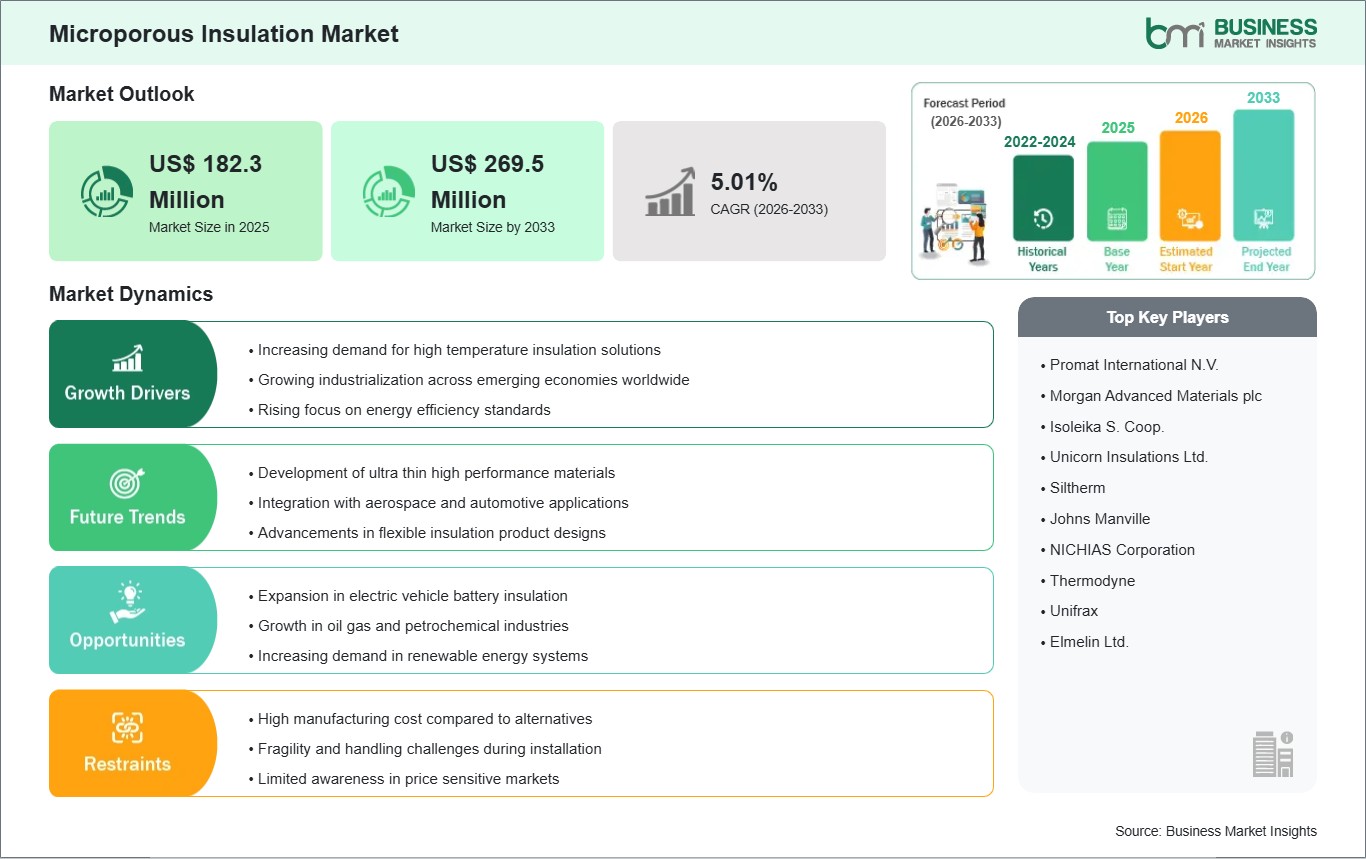
The Microporous Insulation Market size is expected to reach US$ 269.5 Million by 2033 from US$ 182.3 Million in 2025. The market is estimated to record a CAGR of 5.01% from 2026 to 2033.
The microporous insulation market is experiencing strong growth driven by the increasing demand for high-performance thermal insulation solutions across industrial, construction, and energy sectors. Microporous materials are prized for their ultra-low thermal conductivity, high-temperature resistance, and compact profile, enabling enhanced energy efficiency and space optimization in applications where conventional insulation materials fall short. Key drivers include stringent energy efficiency regulations, rising awareness of operational cost reduction, and the need for lightweight yet highly effective insulation in industries such as oil & gas, power generation, automotive, and aerospace. Technological advancements, including aerogel-based formulations, flexible composites, and environmentally friendly binders, are expanding the applicability of microporous insulation in both industrial and commercial environments.
Additionally, the shift toward sustainable building practices and reduction of carbon footprints is pushing adoption in construction and infrastructure projects. Challenges remain, including high production costs, complex installation requirements, and sensitivity to moisture and mechanical stress, which necessitate specialized handling. Market participants are increasingly focusing on R&D for cost-effective, durable, and versatile solutions while offering technical support and training services to end-users. Strategic collaborations with equipment manufacturers and energy-intensive industries are fostering tailored solutions that meet both thermal performance and regulatory compliance. Overall, the microporous insulation market outlook is positive, underpinned by rising energy efficiency initiatives, industrial modernization, and the demand for space-saving, high-performance thermal insulation solutions.

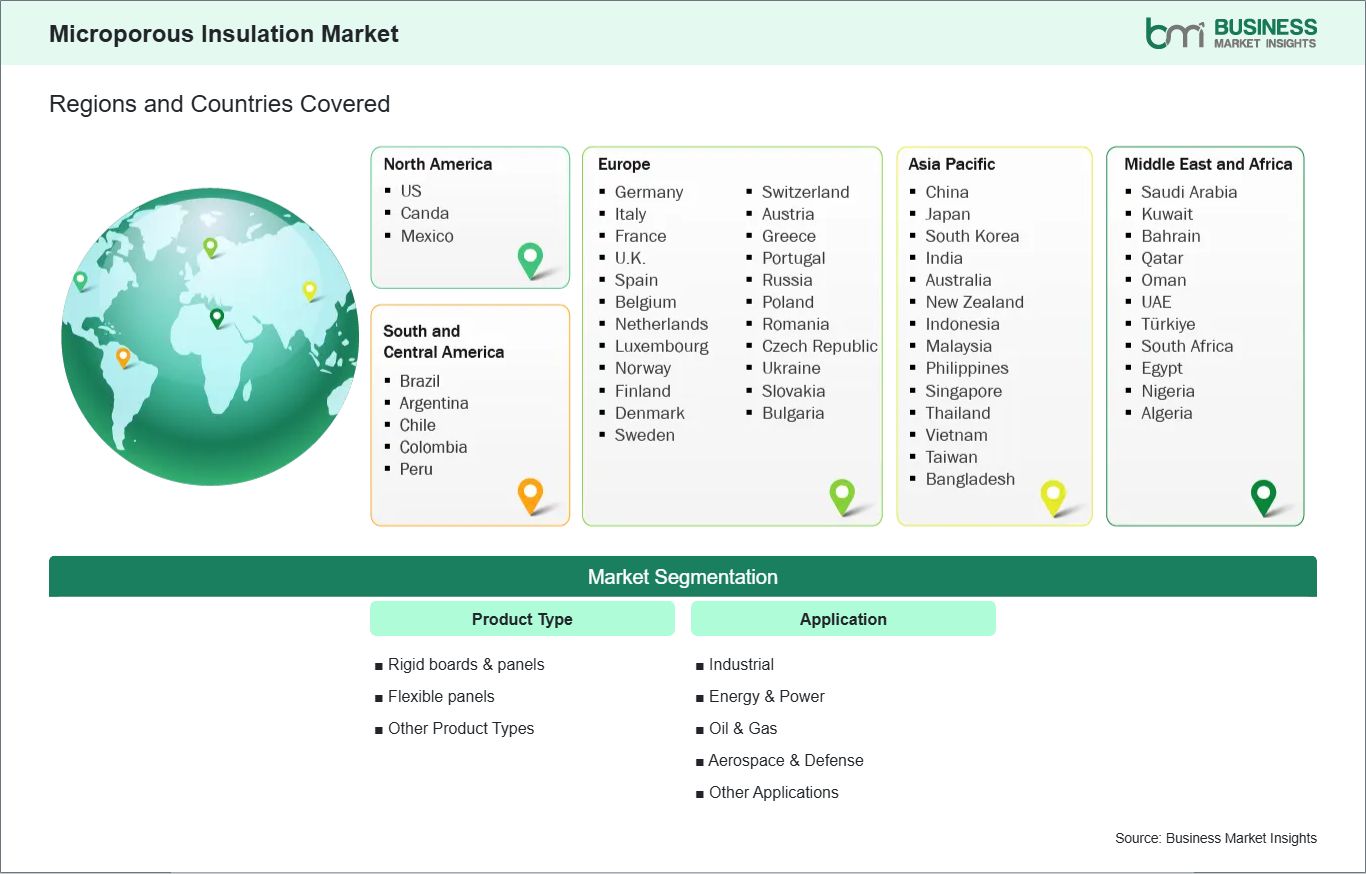
Key segments that contributed to the derivation of the microporous insulation market analysis are product type, application.
Growing demand for effective thermal control from the industrial sector has compelled many industries to convert to microporous insulation. The low thermal conductivity of these insulation products allows for high performing thermal insulation of equipment like furnaces, boilers, pipelines and other processing equipment that operate at elevated temperatures. This results in enhanced energy efficiency, which is important to industries as they strive to reduce their operational costs and reach their sustainability goals through reducing heat loss.
The compact and lightweight nature of microporous insulation mean that it can be installed into tight spaces or complex areas where traditional forms of insulation may not be as effective or practical. The material has a proven track record of performing well in environments that experience high temperatures, and where mechanical stress and vibration would normally wear on the material, therefore will last longer than other insulation products in areas subject to extended continuous operations. Furthermore, microporous insulation`s resistance to moisture and thermal cycling will greatly reduce maintenance requirements, and provide long-term protection for both the equipment itself and the investment in the equipment over its lifetime.
The ability to conserve energy and reduce emissions makes microporous insulation highly valuable for industries focusing on environmental responsibility. It also enables more efficient system designs, optimizing space usage without compromising performance. Industrial operations benefit from the material`s consistency, durability, and adaptability to various equipment configurations.
As the sector emphasizes energy efficiency, safety, and cost optimization, microporous insulation is emerging as a key solution for industrial thermal management. Its combination of superior performance, reliability, and space-saving design allows industries to achieve operational efficiency while adhering to regulatory standards and sustainability goals. The material`s versatility positions it as an indispensable component in modern industrial applications requiring precise heat control and long-term energy savings.
Microporous insulation is gaining popularity in transportation and construction sectors due to its lightweight structure, high thermal efficiency, and space-saving characteristics. In transportation, it is used in engine compartments, exhaust systems, and battery enclosures to manage heat effectively without adding significant weight. This improves fuel efficiency, enhances safety, and extends the operational lifespan of vehicles and equipment.
In construction, microporous insulation is increasingly applied in walls, roofs, and facades to improve energy efficiency in both residential and commercial buildings. Its low thermal conductivity reduces heating and cooling energy requirements, while its fire-resistant properties and stability under temperature fluctuations enhance safety and structural performance. The material`s versatility allows architects and engineers to design energy-efficient buildings without compromising on space or aesthetics.
The durability and performance consistency of microporous insulation are key factors that make it popular in various applications. The fact that the insulation can be formulated to satisfy particular needs is also important. As the world is focusing on saving energy, cutting costs, and being environmentally sustainable, microporous insulation is becoming popular. Its performance, energy-saving capabilities, and durability are key factors that make it a vital part of modern transportation and building projects.

The microporous insulation market demonstrates steady growth, with size and share analysis highlighting evolving trends and competitive dynamics among key players. The report examines subsegments categorized within product type and application, offering insights into their contribution to overall market performance.
By Product Type, the rigid boards & panels subsegment dominated the market in 2025, driven by high thermal performance and wide adoption across industrial insulation applications.
Based on Application, the industrial subsegment dominated the market in 2025, supported by increasing demand for energy-efficient insulation solutions in manufacturing and process industries.
| Report Attribute | Details |
|---|---|
| Market size in 2025 | US$ 182.3 Million |
| Market Size by 2033 | US$ 269.5 Million |
| Global CAGR (2026 - 2033) | 5.01% |
| Historical Data | 2022-2024 |
| Forecast period | 2026-2033 |
| Segments Covered | By Product Type
|
|
Regions and Countries Covered
| |
| North America | US, Canada, Mexico |
| Europe | Belgium, Austria, Finland, Denmark, Greece, Poland, Romania, Russia, Ukraine, Czech Republic, Slovakia, Bulgaria, Italy, Luxembourg, Germany, Switzerland, France, Netherlands, Norway, Portugal, Spain, Sweden, United Kingdom |
| Asia-Pacific | Australia, China, India, Japan, South Korea, Indonesia, Malaysia, Philippines, Singapore, Thailand, Vietnam, Bangladesh, New Zealand, Taiwan |
| South and Central America | Brazil, Argentina, Peru, Chile, Colombia |
| Middle East and Africa | Bahrain, Kuwait, Oman, Qatar, Saudi Arabia, United Arab Emirates, Turkiye, South Africa, Egypt, Algeria, Nigeria |
| Market leaders and key company profiles |
|
The "Microporous Insulation Market Size and Forecast (2022 - 2033)" report provides a detailed analysis of the market covering below areas:
The geographical scope of the Microporous Insulation Market report is divided into North America, Asia Pacific, Europe, Middle East & Africa, and South & Central America. North America held the largest share in 2025.
Regional-level dynamics in the microporous insulation market reveal diverse growth patterns influenced by industrial development, regulatory frameworks, and energy efficiency initiatives. North America is the dominant region, supported by stringent building codes, advanced industrial infrastructure, and the adoption of high-performance insulation in oil & gas, power generation, and aerospace applications. The United States leads the market with consistent investment in energy-efficient solutions.
Europe shows steady growth, driven by sustainability mandates, energy conservation regulations, and the integration of microporous insulation in construction, manufacturing, and renewable energy sectors, with Germany, France, and the UK spearheading adoption.
Asia Pacific is the fastest-growing region, fueled by rapid industrialization, expanding construction projects, and rising demand in automotive and electronics manufacturing in China, Japan, and South Korea. Increasing focus on reducing operational energy costs and compliance with green building standards further supports regional growth.
Middle East & Africa demonstrates moderate growth, driven by high-temperature industrial applications and the need for thermal management in power plants, refineries, and petrochemical industries.
South & Central America is emerging, with gradual adoption in commercial construction and industrial insulation, particularly in Brazil and Argentina, though cost sensitivity and limited technical expertise constrain accelerated expansion.
Across all regions, market growth is shaped by technological innovation, regulatory compliance, and the rising importance of energy-efficient thermal management solutions.

The Microporous Insulation Market is evaluated by gathering qualitative and quantitative data post primary and secondary research, which includes important corporate publications, association data, and databases. A few of the key developments in the microporous insulation market are:
The Microporous Insulation Market is valued at US$ 182.3 Million in 2025, it is projected to reach US$ 269.5 Million by 2033.
As per our report Microporous Insulation Market, the market size is valued at US$ 182.3 Million in 2025, projecting it to reach US$ 269.5 Million by 2033. This translates to a CAGR of approximately 5.01% during the forecast period.
The Microporous Insulation Market report typically cover these key segments-
The historic period, base year, and forecast period can vary slightly depending on the specific market research report. However, for the Microporous Insulation Market report:
The Microporous Insulation Market is populated by several key players, each contributing to its growth and innovation. Some of the major players include:
The Microporous Insulation Market report is valuable for diverse stakeholders, including:
Essentially, anyone involved in or considering involvement in the Microporous Insulation Market value chain can benefit from the information contained in a comprehensive market report.
Please tell us your area of interest
(Market Segments/ Regions and Countries/ Companies)