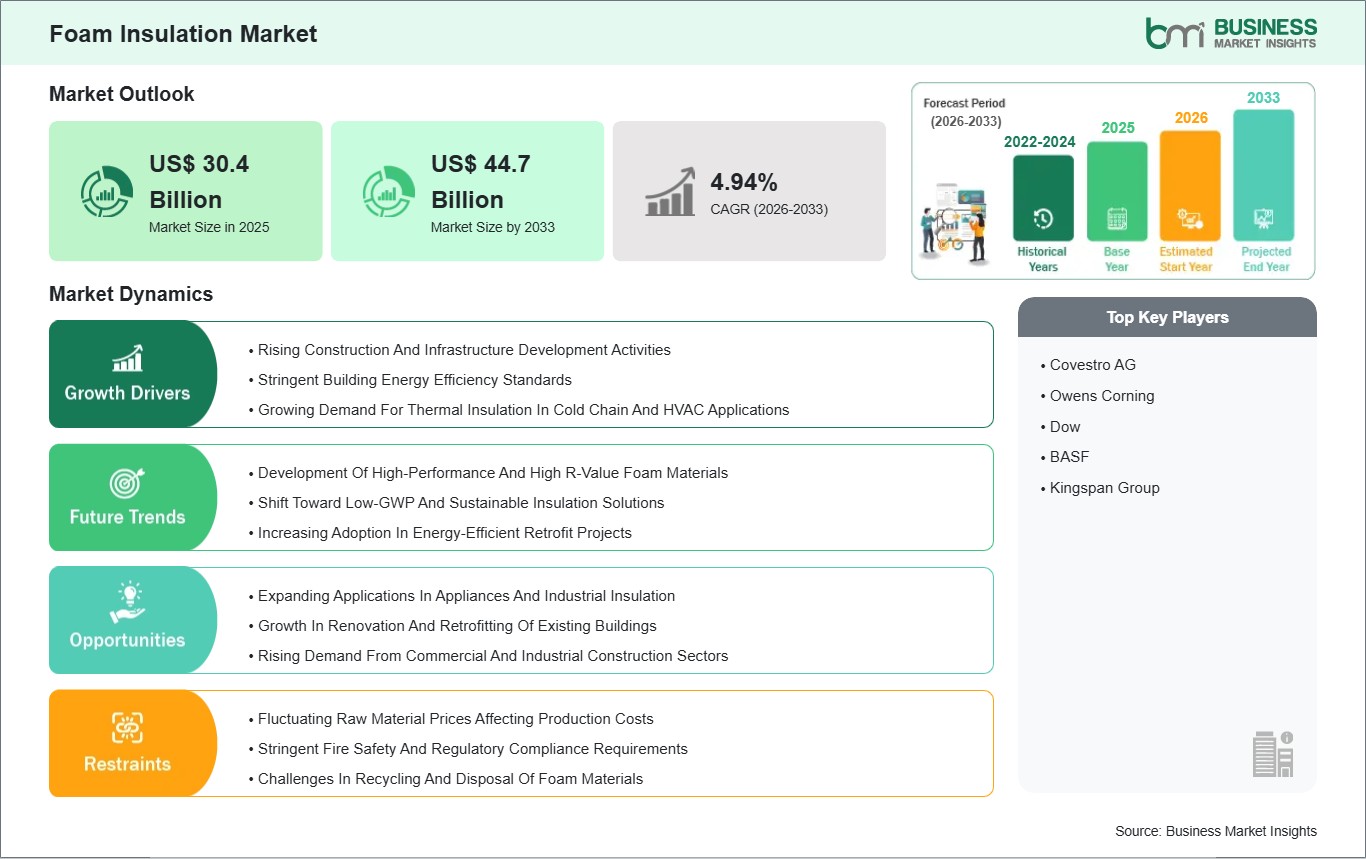
The Foam Insulation Market size is expected to reach US$ 44.7 Billion by 2033 from US$ 30.4 Billion in 2025. The market is estimated to record a CAGR of 4.94% from 2026 to 2033.
The global foam insulation market is a major segment of the construction industry. This industry has been witnessing growth owing to an increase in demand for efficient building materials. Insulation materials such as polyurethane, polyisocyanurate, and polystyrene are commonly used owing to their superior insulating properties. These materials are commonly used in building constructions such as residential, commercial, and industrial buildings. In addition, foam insulation materials are used in refrigeration, HVAC, and cold chain logistics. There has been a significant increase in awareness about saving energy and reducing greenhouse gas emissions. This has led to an increase in demand for foam insulation materials. Moreover, building codes and environmental regulations are promoting efficient building materials. This has increased the demand for foam insulation materials.
In addition, foam insulation materials provide long-term building efficiency. Concerns regarding the environmental impact of certain foam insulation materials, particularly related to chemical composition and disposal, present challenges for manufacturers. Fluctuations in raw material availability and pricing can also affect production stability. Furthermore, the need for proper installation and skilled labor can limit adoption in some regions. Despite these challenges, continuous innovation in eco-friendly formulations and increasing investment in sustainable construction practices are expected to support the steady expansion of the global foam insulation market.

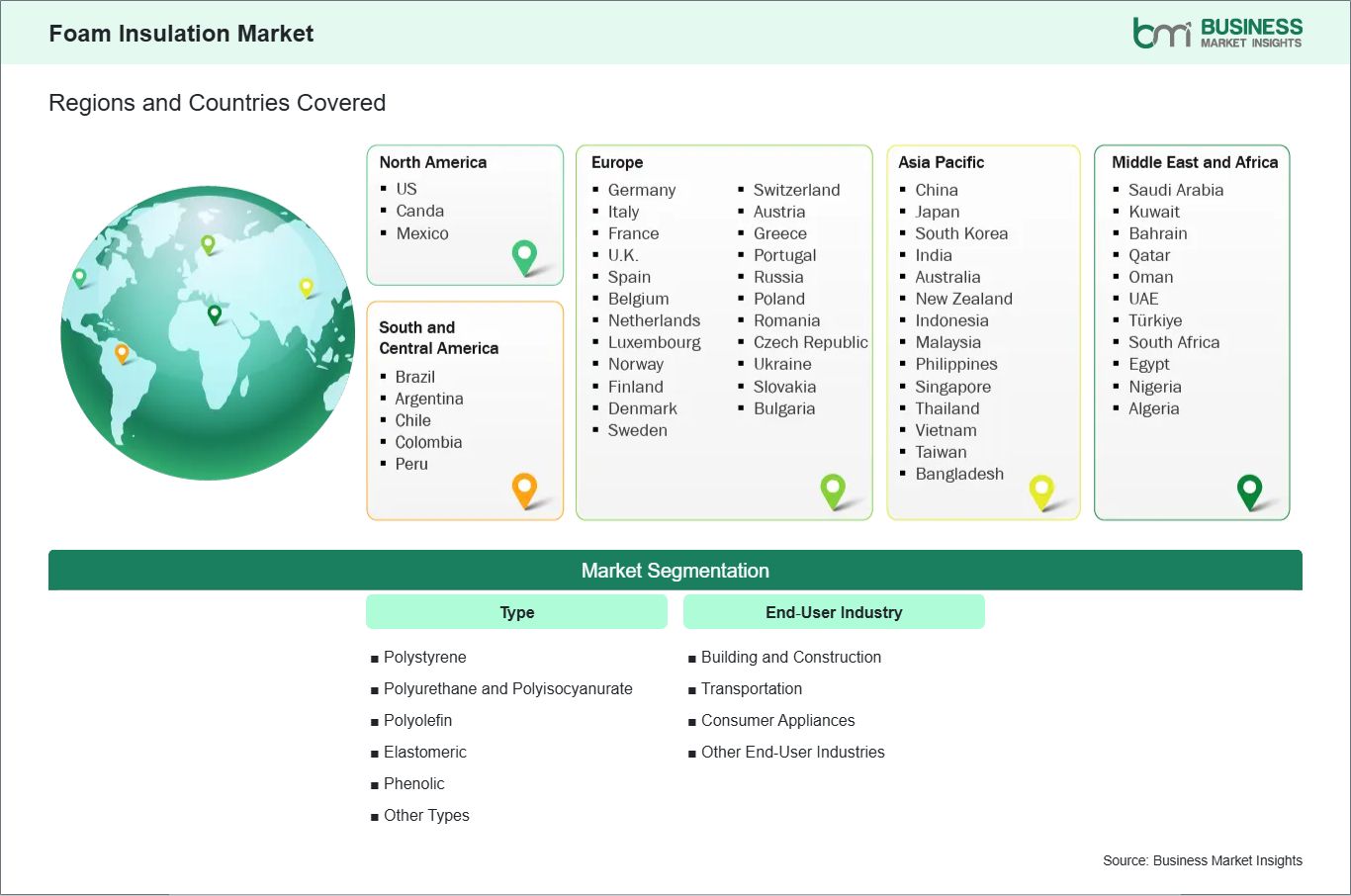
Key segments that contributed to the derivation of the foam insulation market analysis are type and end‑use industry.
The global foam insulation market is gaining momentum as construction practices shift toward materials that support design efficiency and faster project execution. Foam insulation stands out due to its ability to expand, seal, and adapt to irregular geometries, making it particularly useful in complex architectural layouts and space-constrained structures. Unlike traditional insulation materials, spray and rigid foam solutions can be directly applied to surfaces, reducing installation steps and minimizing gaps that may compromise building integrity. This makes foam insulation especially valuable in projects requiring airtight construction and precision application, such as high-density residential buildings and specialized commercial facilities.
Regional construction dynamics further influence product adoption. In densely built urban environments, foam insulation is used in narrow wall cavities and layered façade systems where space optimization is essential. In rapidly developing construction markets, it is increasingly applied in large housing clusters and mixed-use developments due to its ability to accelerate installation timelines and reduce on-site labor complexity. Meanwhile, in regions focused on infrastructure durability, foam insulation is utilized in transportation corridors, including tunnels and transit systems, where it provides structural reinforcement alongside insulation performance.
Innovation in materials is also contributing to this section of the market. There is innovation in closed-cell and open-cell foams that can be made to possess specific features, such as increased rigidity or flexibility, as needed for specific construction projects. Foam insulation is also being made to stick well to various materials, thereby enabling its use in concrete, metal, and composite materials constructions. As construction becomes more design-driven and efficiency-oriented, foam insulation is increasingly being used not only for insulation but as a material that can contribute to increased speed, accuracy, and flexibility in construction.
The application of foam insulation is expanding significantly in appliances and industrial systems, driven by its ability to deliver uniform internal coverage and structural integration. In appliance manufacturing, foam insulation is not just used for temperature control but also as a core structural component that enhances rigidity and reduces vibration. Its injection-based application allows manufacturers to fill enclosed cavities seamlessly, improving product durability and enabling compact designs without additional support materials. This makes it particularly valuable in appliances where internal space optimization and long-term reliability are essential.
Regional manufacturing trends highlight different priorities for the use of the product. For instance, in the regions with the most advanced manufacturing systems, foam insulation is used in precision appliances and machines that need consistency and repetition in their functions. In regions with increasing manufacturing output, the product is mainly used in cold chain logistics equipment and containers that need consistent internal conditions during transportation and storage. Moreover, in regions with industrial zones and equipment usage, the product is used for insulation and housing machines and equipment to reduce noise and provide consistent internal machine environments.
Ongoing developments in formulation are helping to increase the industrial significance of foam insulation. For example, dense foam materials are being developed to provide load-carrying capacities, along with specific materials providing resistance to chemicals, vibrations, and mechanical stresses. This helps to provide a wider range of uses for foam insulation in more demanding conditions, such as process plants, transport systems, and equipment enclosures. As the industry continues to develop in terms of integrated, compact, and highly efficient systems, foam insulation is helping to provide a multifunctional solution to support not just insulation but also structural efficiency and product design innovation.

The foam insulation market is experiencing steady growth, with market size and share analysis reflecting evolving treatment preferences and competitive dynamics among key players. The report evaluates important subsegments categorized within type and end‑use industry, highlighting their respective contributions to overall market performance.
By type, the Polyurethane and Polyisocyanurate subsegment dominated the Foam Insulation market in 2025. Polyurethane and polyisocyanurate offer excellent thermal insulation, high energy efficiency, and structural strength, making them highly suitable for a wide range of insulation applications, which drives their widespread adoption.
Based on end user industry, the Building and Construction subsegment dominated the Foam Insulation market in 2025. Building and construction applications demand energy-efficient, durable, and high-performance insulation materials, making this segment highly suitable for residential and commercial structures, which drives its widespread adoption.
| Report Attribute | Details |
|---|---|
| Market size in 2025 | US$ 30.4 Billion |
| Market Size by 2033 | US$ 44.7 Billion |
| Global CAGR (2026 - 2033) | 4.94% |
| Historical Data | 2022-2024 |
| Forecast period | 2026-2033 |
| Segments Covered | By Type
|
|
Regions and Countries Covered
| |
| North America | US, Canada, Mexico |
| Europe | Belgium, Austria, Finland, Denmark, Greece, Poland, Romania, Russia, Ukraine, Czech Republic, Slovakia, Bulgaria, Italy, Luxembourg, Germany, Switzerland, France, Netherlands, Norway, Portugal, Spain, Sweden, United Kingdom |
| Asia-Pacific | Australia, China, India, Japan, South Korea, Indonesia, Malaysia, Philippines, Singapore, Thailand, Vietnam, Bangladesh, New Zealand, Taiwan |
| South and Central America | Brazil, Argentina, Peru, Chile, Colombia |
| Middle East and Africa | Bahrain, Kuwait, Oman, Qatar, Saudi Arabia, United Arab Emirates, Turkiye, South Africa, Egypt, Algeria, Nigeria |
| Market leaders and key company profiles |
|
The "Foam Insulation Market Size and Forecast (2022 - 2033)" report provides a detailed analysis of the market covering below areas:
The geographical scope of the Foam Insulation market report is divided into five regions: North America, Asia Pacific, Europe, Middle East & Africa, and South & Central America. The Foam Insulation market in North America is expected to grow during the forecast period.
North America dominates the global foam insulation market, supported by its well-established construction industry, strong regulatory framework, and widespread adoption of energy-efficient building practices. The region has been at the forefront of implementing stringent building energy codes and sustainability standards, which drive the demand for high-performance insulation materials. Foam insulation is widely used in residential and commercial construction projects across the region, particularly in roofing, wall insulation, and foundation systems, where thermal efficiency and moisture resistance are critical. In addition to construction, the developed cold chain infrastructure and HVAC industry in the region also contribute to the increased demand for foam insulation materials.
The manufacturers in North America focus on the development of advanced insulation materials with enhanced properties such as fire resistance, environmental friendliness, and durability. The cooperation between insulation material manufacturers and regulatory bodies plays a key role in the successful implementation of innovative insulation materials that meet the dynamic building needs of the region.
Although environmental concerns about the chemical composition of the insulation materials and higher installation costs of the materials act as barriers to the growth of the insulation market in the region, North America maintains its position in the global foam insulation market due to the importance it places on sustainability and technological advancements.

The foam insulation market is evaluated by gathering qualitative and quantitative data post primary and secondary research, which includes important corporate publications, association data, and databases. A few of the key developments in the foam insulation market are:
The Foam Insulation Market is valued at US$ 30.4 Billion in 2025, it is projected to reach US$ 44.7 Billion by 2033.
As per our report Foam Insulation Market, the market size is valued at US$ 30.4 Billion in 2025, projecting it to reach US$ 44.7 Billion by 2033. This translates to a CAGR of approximately 4.94% during the forecast period.
The Foam Insulation Market report typically cover these key segments-
The historic period, base year, and forecast period can vary slightly depending on the specific market research report. However, for the Foam Insulation Market report:
The Foam Insulation Market is populated by several key players, each contributing to its growth and innovation. Some of the major players include:
The Foam Insulation Market report is valuable for diverse stakeholders, including:
Essentially, anyone involved in or considering involvement in the Foam Insulation Market value chain can benefit from the information contained in a comprehensive market report.
Please tell us your area of interest
(Market Segments/ Regions and Countries/ Companies)