
Long Range Camera Market Outlook: Size, Share, Trends, Growth Analysis, Competitive Landscape & Forecast, 2026-2033

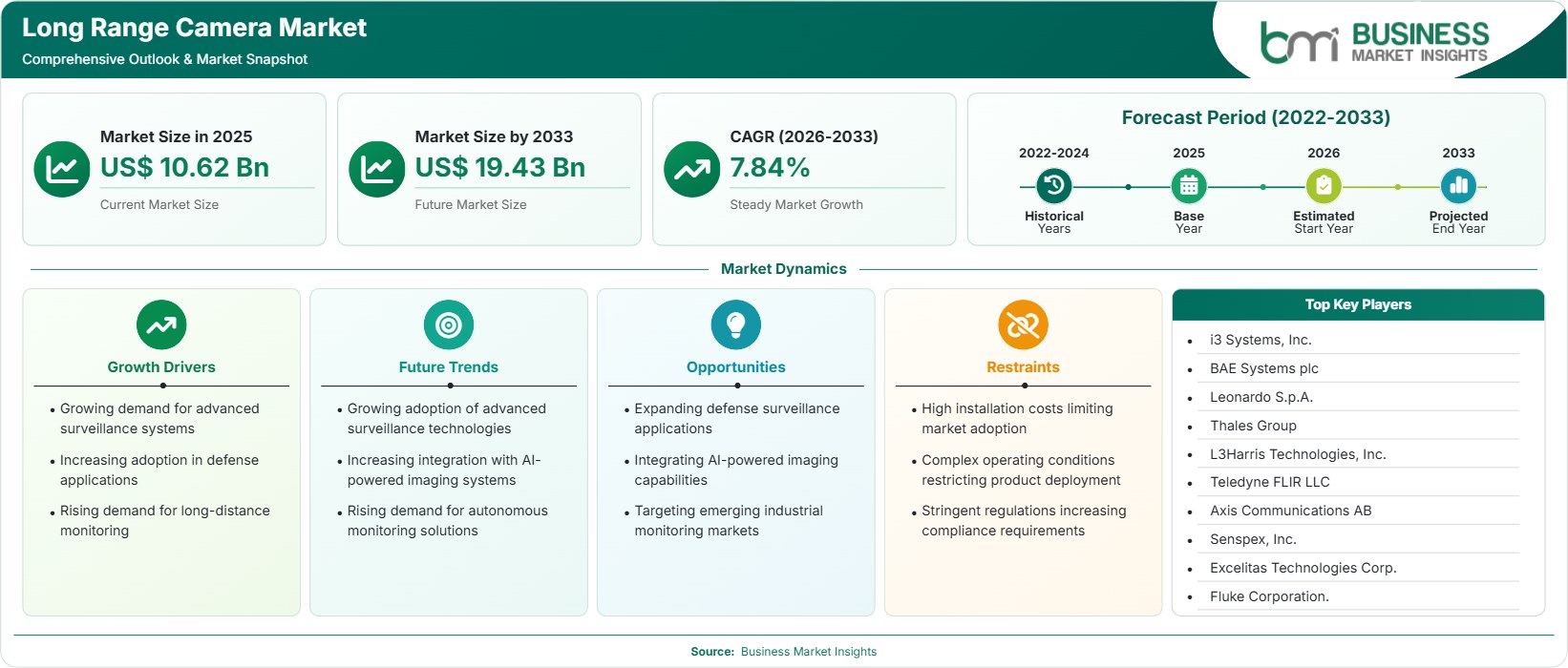
The Long Range Camera Market size was valued at US$ 10.62 Billion in 2025 and is projected to reach US$ 19.43 Billion by 2033, growing at a CAGR of 7.84% during 2026–2033. Rising defense modernization initiatives, increasing deployment of advanced surveillance infrastructure, and growing demand for long-distance monitoring solutions are supporting market expansion.

Report Coverage
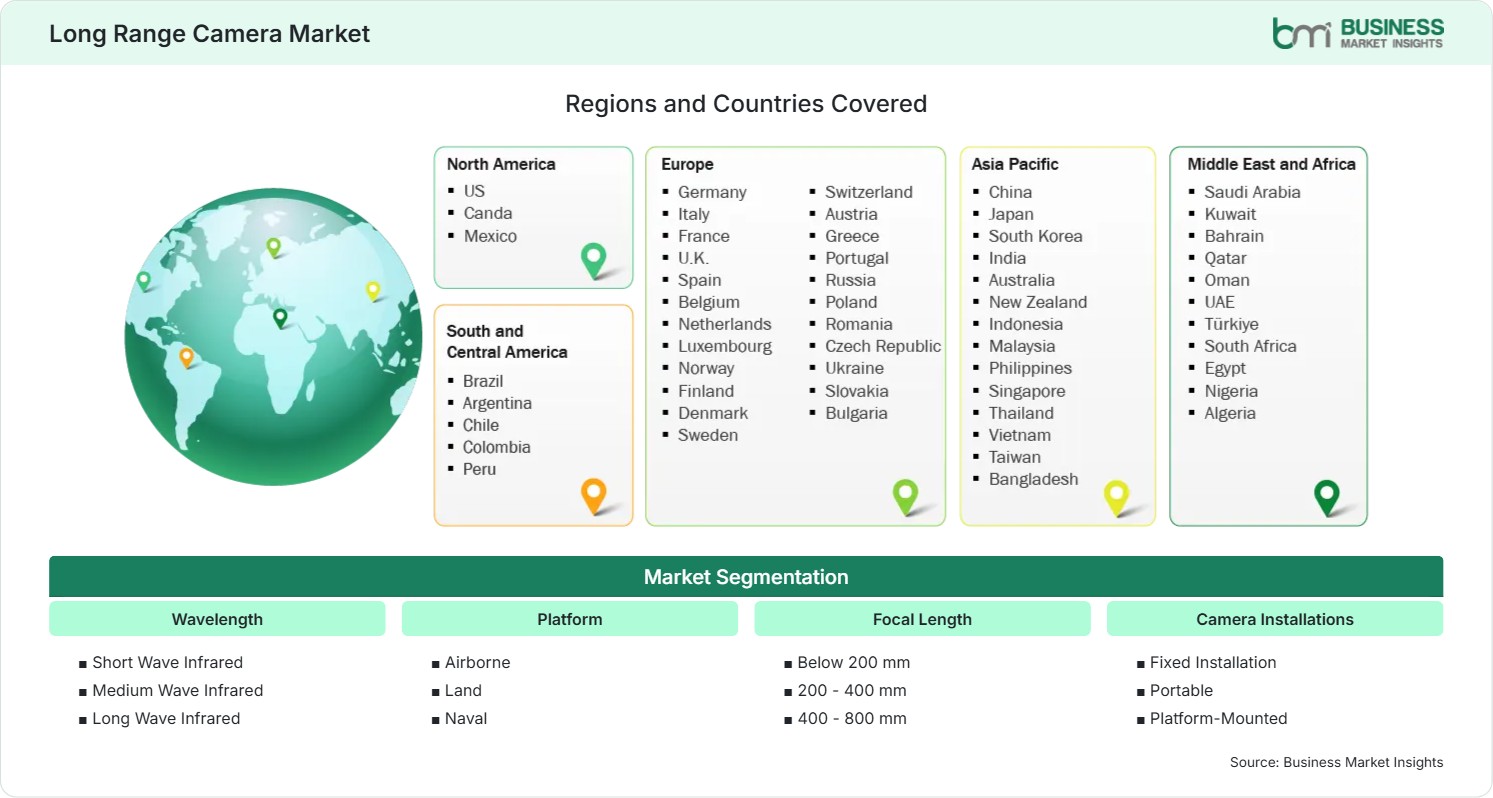
  • Wavelength: Short Wave Infrared, Medium Wave Infrared, Long Wave Infrared
  • Platform: Airborne, Land, Naval
  • Focal Length: Below 200 mm, 200 - 400 mm, 400 - 800 mm
  • Camera Installations: Fixed Installation, Portable, Platform-Mounted
  • Application: Designated Marksman Target Spotting & Range Detection, Intelligence, Surveillance, Target Acquisition etc.
US$ 10.62 Bn Market size in 2025
US$ 19.43 Bn Market Size by 2033
7.84% CAGR, 2026 - 2033
2026-2033 Forecast Period

AI Overview

Long Range Camera Market Summary

  • North America Region: North America holds 34%–37% share in 2025, growing at a 7.0%–7.5% CAGR during 2026–2033. Strong defense spending, border protection investments, infrastructure surveillance programs, and technological advancements in electro-optical systems continue supporting demand. The US market benefits from military modernization and homeland security applications, recording a CAGR of 7.1%–7.6%.
  • Fastest Growing Region: Asia Pacific accounts for 24%–27% share in 2025 and is expected to expand at a 9.0%–9.6% CAGR during 2026–2033. Increasing defense budgets, growing border surveillance deployment, smart-city programs, industrial security initiatives, and rising geopolitical concerns continue driving technology adoption.
  • Leading Segment: Defense represents 47%–50% share in 2025 and is projected to advance at a 8.0%–8.5% CAGR during 2026–2033. Growing ISR requirements, advanced reconnaissance missions, military modernization programs, and enhanced battlefield awareness capabilities continue supporting segment leadership.
  • High Growth Segment: Airborne platforms account for 29%–32% share in 2025 and are expected to register a 8.8%–9.4% CAGR during 2026–2033. Increasing UAV deployment, aerial intelligence requirements, border patrol operations, and real-time surveillance missions continue accelerating adoption.
  • Key Market Opportunity: Integration of artificial intelligence, automated threat detection, predictive analytics, multi-sensor imaging systems, and cloud-connected surveillance platforms is creating substantial opportunities across defense, industrial, and public security applications.
  • Major Market Players: i3 Systems, Inc., BAE Systems plc, Leonardo S.p.A., Thales Group, L3Harris Technologies, Inc., Teledyne FLIR LLC, Axis Communications AB, Senspex, Inc., Excelitas Technologies Corp., Fluke Corporation.
Strategic Insights

Long Range Camera Market: Strategic Insights

Long Range Camera Market Strategic Framework
FREE PDF
Request your free sample
Request free sample
Stakeholder View

Key Takeaways

  • The industry is characterized by a specialized value chain involving infrared sensor manufacturers, optical lens providers, thermal imaging developers, software analytics firms, and system integrators. Long-term defense contracts and certified supply networks remain critical for sustaining profitability and market positioning.
  • Airborne surveillance applications are expected to generate the strongest revenue opportunities through 2033. The increasing deployment of unmanned aerial vehicles for reconnaissance, border security, and intelligence gathering continues creating sustained demand for advanced long-range imaging systems.
  • Manufacturers are investing heavily in artificial intelligence, image enhancement algorithms, automated target recognition, sensor fusion, and edge computing capabilities. These advancements are enabling faster data interpretation, improved situational awareness, and reduced operator workload.
  • Asia Pacific continues to present one of the most attractive investment destinations due to rising military expenditure, territorial monitoring requirements, critical infrastructure expansion, and increasing procurement of advanced surveillance technologies across major economies.
  • Strategic collaborations between defense contractors, imaging technology providers, and software developers are becoming increasingly common. These partnerships accelerate product innovation and support integrated surveillance solutions capable of meeting evolving operational requirements.
  • Demand diversification beyond defense is becoming increasingly important. Industrial monitoring, wildlife conservation, transportation infrastructure oversight, and environmental surveillance applications are creating additional revenue streams for market participants.
Geographic Outlook

Long Range Camera Market Regional Highlights

North America Long Range Camera Market

North America accounted for 34%–37% Long Range Camera Market share in 2025 and is projected to expand at a 7.0%–7.5% CAGR during 2026–2033. The region maintains a leadership position due to advanced defense capabilities, mature surveillance infrastructure, and continuous investment in electro-optical technologies. Demand remains particularly strong across military reconnaissance, border security, critical infrastructure protection, and maritime surveillance operations in Long Range Camera Market.

  • Defense agencies continue investing in advanced long-range surveillance systems capable of supporting reconnaissance, intelligence gathering, and battlefield awareness across diverse operational environments.
  • Border protection authorities are increasing deployment of thermal imaging and infrared monitoring technologies to improve perimeter security and threat detection capabilities.
  • Growing adoption of AI-assisted surveillance platforms is improving operational efficiency through automated detection, real-time analytics, and enhanced situational awareness.
  • Expansion of unmanned surveillance platforms is creating sustained demand for compact, lightweight, and high-performance long-range imaging payloads.
  • Critical infrastructure operators are increasingly deploying long-range monitoring systems to protect transportation hubs, energy facilities, and strategic assets.

US Long Range Camera Market

The United States represented 74%–78% share within North America in 2025 and is anticipated to grow at a 7.1%–7.6% CAGR during 2026–2033. Strong government funding, extensive military modernization programs, and established defense technology capabilities continue driving adoption. The country remains a leading center for electro-optical innovation and advanced imaging research. Continued deployment across airborne, land-based, and naval applications supports robust Long Range Camera Market demand.

  • Military modernization initiatives remain a primary growth catalyst for advanced surveillance and reconnaissance systems.
  • Homeland security investments continue strengthening border monitoring and critical infrastructure protection capabilities.
  • UAV-based surveillance platforms are increasing demand for high-resolution long-range imaging technologies.
  • Sensor fusion and AI-enabled surveillance systems are becoming standard requirements across advanced defense applications.

Europe Long Range Camera Market

Europe held 28%–31% share in 2025 and is expected to register a 7.4%–8.0% CAGR during 2026–2033. Growing security concerns, modernization of military surveillance programs, and increasing demand for border management solutions continue supporting market development. Regional governments are investing in advanced thermal imaging, infrared surveillance, and integrated monitoring systems to strengthen operational readiness and national security capabilities.

  • France and the United Kingdom remain leading regional adopters due to significant defense procurement budgets and technology investments.
  • Eastern European countries are emerging as high-growth markets supported by strengthening surveillance and security capabilities.
  • Maritime monitoring applications continue expanding across coastal defense and vessel tracking operations.
  • Critical infrastructure security requirements are increasing deployment across transportation, utilities, and public facilities.
  • Growing research activity in thermal imaging and sensor technologies supports regional innovation and competitiveness.

Asia Pacific Long Range Camera Market

Asia Pacific accounted for 24%–27% share in 2025 and is projected to expand at a 9.0%–9.6% CAGR during 2026–2033, making it the fastest-growing regional market. Increasing defense budgets, border surveillance investments, maritime security concerns, and infrastructure protection initiatives continue supporting demand across major economies.. Growing domestic manufacturing capabilities and strategic technology partnerships further contribute to regional Long Range Camera Market expansion.

  • China remains one of the largest markets, supported by substantial investments in defense modernization and advanced surveillance technologies.
  • India continues experiencing strong demand due to border security programs, military procurement initiatives, and infrastructure protection projects.
  • Japan and South Korea are increasing investments in next-generation surveillance and electro-optical imaging technologies.
  • Smart-city development projects are supporting adoption of long-range monitoring systems in transportation and public safety applications.
  • Industrial security and critical infrastructure protection requirements are creating new commercial opportunities throughout the region.

Rest of World Long Range Camera Market

Rest of World accounted for 8%–10% share in 2025 and is expected to register a 7.7%–8.3% CAGR during 2026–2033. The Middle East continues investing heavily in border surveillance, critical infrastructure protection, and military modernization programs. In South America, improving public security initiatives and environmental monitoring projects are increasing demand for advanced imaging systems are supporting broader adoption throughout the region in Long Range Camera Market.

  • Gulf Cooperation Council countries continue strengthening perimeter security through advanced surveillance deployments.
  • Saudi Arabia and the UAE remain key adopters due to defense modernization and infrastructure security investments.
  • Brazil leads adoption in South America through public security and environmental monitoring initiatives.
  • Energy, mining, and transportation operators are increasingly utilizing long-range monitoring technologies to enhance operational safety.
  • Forestry and wildlife conservation agencies are expanding use of advanced imaging solutions for environmental observation and protection.
Global Market Geography
FREE PDF
Request your free sample
Request free sample
Segment Analysis

Long Range Camera Market Segmentation

Wavelength

Wavelength technologies accounted for 32%–35% share in 2025 and are expected to expand at a CAGR of 8.1%–8.7% during 2026–2033. Demand is increasing due to growing deployment of infrared-based surveillance systems across defense, border security, maritime monitoring, and industrial inspection applications. Improvements in thermal sensitivity, image quality, and environmental performance continue supporting adoption across multiple operational environments.

  • Short Wave Infrared: Widely adopted for low-light imaging, haze penetration, and enhanced object visibility, supporting surveillance operations where traditional optical systems face performance limitations.
  • Medium Wave Infrared: Preferred for long-distance thermal detection applications requiring high sensitivity, accurate target recognition, and superior imaging performance across defense and security missions.
  • Long Wave Infrared: Extensively utilized for all-weather monitoring, perimeter security, and long-range observation applications where thermal imaging remains critical for operational effectiveness.

Platform

Platform deployments represented 29%–32% share in 2025 and are projected to grow at a CAGR of 8.8%–9.4% during 2026–2033. Continued integration across airborne, land-based, and naval surveillance systems is supporting market growth. Expanding military reconnaissance requirements, border security modernization programs, and maritime monitoring activities continue driving procurement of advanced long-range imaging systems.

  • Airborne: Growing adoption across UAVs, reconnaissance aircraft, and aerial monitoring platforms continues supporting segment expansion and operational flexibility.
  • Land: Remains essential for border observation, facility security, tactical surveillance, and critical infrastructure monitoring applications worldwide.
  • Naval: Increasing deployment across coastal monitoring, vessel tracking, and maritime security missions strengthens demand for advanced imaging capabilities.

Focal Length

Focal Length solutions held 24%–27% share in 2025 and are anticipated to register a CAGR of 7.7%–8.3% during 2026–2033. End users increasingly seek enhanced detection range, image clarity, and target identification performance. Technological progress in optical engineering and stabilization systems continues improving operational effectiveness across long-distance surveillance requirements.

  • Below 200 mm: Suitable for short-to-medium-range surveillance operations requiring broader field-of-view capabilities and flexible deployment options.
  • 200 - 400 mm: Serves a wide range of defense, industrial, and security applications where balanced observation distance and image quality are required.
  • 400 - 800 mm: Preferred for advanced surveillance missions requiring extended-range target detection, tracking, and identification capabilities.

Camera Installations

Camera Installations accounted for 26%–29% share in 2025 and are forecast to grow at a CAGR of 7.6%–8.2% during 2026–2033. Increasing deployment across defense installations, transportation networks, industrial facilities, and border monitoring infrastructure is supporting adoption. Organizations continue prioritizing flexible surveillance architectures capable of addressing evolving operational requirements.

  • Fixed Installation: Commonly used for critical infrastructure protection, border security operations, and permanent surveillance installations.
  • Portable: Supports rapid deployment requirements across tactical missions, emergency response operations, and temporary monitoring projects.
  • Platform-Mounted: Enables integration on vehicles, naval vessels, aircraft, and unmanned systems for mobile surveillance applications.

Application

Application-based demand represented 34%–37% share in 2025 and is projected to expand at a CAGR of 8.3%–8.9% during 2026–2033. Expanding operational requirements for intelligence gathering, surveillance, target acquisition, and long-distance detection continue driving investment. Advancements in imaging quality and real-time data transmission capabilities are supporting broader adoption across security-focused sectors.

  • Designated Marksman Target Spotting & Range Detection: Enhances precision operations through improved observation, target verification, and range assessment capabilities.
  • Intelligence: Supports information gathering activities, reconnaissance operations, and mission planning requirements across defense organizations.
  • Surveillance: Represents one of the most widely utilized applications due to growing demand for continuous monitoring and threat assessment.
  • Target Acquisition: Enables accurate identification, tracking, and engagement support across complex military and security environments.

End User

End users accounted for 47%–50% share in 2025 and are expected to grow at a CAGR of 8.0%–8.5% during 2026–2033. Defense organizations remain the dominant purchasers due to increasing investment in intelligence, surveillance, and reconnaissance capabilities. Growing adoption among homeland security agencies, conservation programs, and specialized civilian applications is further diversifying demand in Long Range Camera Market forecasts.

  • Defense: Largest revenue contributor due to sustained spending on surveillance, reconnaissance, and battlefield awareness technologies.
  • Homeland Security: Increasingly deploys long-range monitoring systems for border control, public safety, and critical infrastructure protection.
  • Shooting Sports: Utilizes advanced imaging solutions to support target observation, performance evaluation, and accuracy improvement.
  • Forestry & Wildlife Conservation: Expanding adoption for species monitoring, environmental research, habitat protection, and conservation management activities.
Market Forces

Long Range Camera Market Dynamics

Key Market Drivers

Growing demand for advanced surveillance systems

The growing complexity of security threats across defense, homeland security, border control, and critical infrastructure sectors is increasing demand for advanced surveillance technologies. Long range cameras enable long-range monitoring, making it possible to observe an area continuously and increasing threat detection and situational awareness. Governments and security organizations are now investing in surveillance systems capable of producing high-resolution images even in adverse environmental conditions. The Long Range Camera Market trends indicate rising preference for integrated surveillance ecosystems that combine advanced imaging systems with analytics software, enabling faster decision-making and improved situational awareness across mission-critical operations worldwide.

Increasing adoption in defense applications

Defense organizations continue to represent the largest users of long-range camera technologies due to growing requirements for intelligence, surveillance, reconnaissance, and target acquisition missions. In contemporary military missions, electro-optical devices with high accuracy in long-range visual detection play an important role. Technologies for long distance imaging facilitate activities such as reconnaissance patrol, border security, military base protection, and battlefield awareness campaigns. The increased use of unmanned vehicles on land, in the air, and in the water is contributing to that trend. The Long Range Camera Market growth outlook remains supported by defense modernization programs focused on improving operational readiness, enhancing force protection capabilities, and enabling more effective surveillance across evolving security environments.

Rising demand for long-distance monitoring

The entities that handle securing of critical infrastructures, transportation routes, energy installations, and even remote assets need more often a long-distance surveillance option. Long-range cameras help in improving the security while reducing the dependency on heavy manning of the ground staffs. Advances in optical zoom capabilities, sensors, and image-processing algorithms have enhanced the effectiveness of surveillance systems across various environmental conditions. The industrial sector is increasing its adoption of these surveillance systems in order to get better coverage at their large operational areas. Environmental monitoring and conservation organizations are also using such imaging systems to monitor activities in remote areas.

Key Market Opportunities

Expanding defense surveillance applications

The expanding investments in defense surveillance infrastructure are providing many lucrative opportunities for technology suppliers. Military forces worldwide have been enhancing their surveillance, intelligence gathering, and perimeter security to meet new geopolitical challenges. Long-range camera systems are used extensively in border, naval, and reconnaissance surveillance. There is a growing demand for multi-domain imaging systems. The suppliers that offer highly sophisticated surveillance systems which are durable, long-range, and integrated easily will get benefited through future procurements.

Integrating AI-powered imaging capabilities

Artificial intelligence technology has revolutionized surveillance by enabling automatic object detection, target recognition, behavior analysis, and predictive monitoring. The implementation of artificial intelligence decreases the load on operators and increases response and efficiency of the system. Imaging systems from long-range camera providers are increasingly equipped with machine learning, edge computing, and analytics technologies. It helps to interpret images and make decisions in a timely manner. As more users seek intelligent monitoring, AI-based solutions can become a key differentiator in the industry.

Targeting emerging industrial monitoring markets

Long-range imaging technology is becoming popular across industries for its effectiveness in enhancing safety, security, and visibility. Industrial facilities in the energy, mining, transportation, manufacturing, and utility sectors need to be monitored continuously in locations where standard surveillance systems cannot provide effective coverage. Long-range cameras can help enhance incident detection, operational control, and security management. Rising understanding about the importance of advanced surveillance solutions will increase adoption of such solutions even outside the military sector. These firms specializing in providing imaging solutions for industries have access to new markets and less reliance on government purchases.

Market Restraints and Challenges

High installation costs limiting market adoption

Factor: Long-range camera systems often require advanced sensors, specialized optics, communication infrastructure, installation services, and system integration support. These components contribute significantly to project costs, particularly for large-scale surveillance deployments. Impact: High implementation costs may limit usage among those that are cost-conscious. The cost aspect might lead to delays in purchasing decisions and preference of less costly options. The costs incurred for maintenance, upgrades, software integration, and personnel training add up to the ownership costs.

Complex operating conditions restricting product deployment

Factor: Long-range cameras are frequently deployed in demanding environments characterized by extreme temperatures, harsh weather conditions, dust, fog, vibration, and challenging terrain. These conditions can negatively influence imaging performance and operational reliability. Impact: End users may require additional system customization, protective equipment, calibration, and maintenance support to ensure consistent performance. Operational complexity can increase deployment costs and lengthen implementation timelines. Addressing performance limitations in difficult environments remains critical for market participants seeking wider adoption across military, industrial, and infrastructure monitoring applications worldwide.

Company Analysis

Competitive Landscape

The Long Range Camera Market analysis reflects a competitive environment characterized by continuous investments in thermal imaging innovation, infrared sensor development, electro-optical surveillance capabilities, AI-powered analytics, and multi-platform integration technologies. Market participants are focused on enhancing detection range, image quality, and operational reliability while expanding their presence across defense, homeland security, industrial, and infrastructure monitoring applications.

Company Name

Overview

Products and Services Relevant to the Market

i3 Systems, Inc.

Infrared imaging specialist serving defense, surveillance, and security applications globally.

Infrared cameras, thermal imaging systems, surveillance payloads, electro-optical solutions.

BAE Systems plc

Leading defense technology provider with extensive sensing and surveillance expertise.

ISR systems, electro-optical sensors, surveillance platforms, integrated defense solutions.

Leonardo S.p.A.

Aerospace and defense company focused on advanced surveillance technologies.

Imaging systems, reconnaissance solutions, targeting technologies, surveillance equipment.

Thales Group

Global security and defense provider offering mission-critical monitoring technologies.

Thermal cameras, intelligence systems, surveillance networks, advanced sensing solutions.

L3Harris Technologies, Inc.

Major provider of defense electronics and surveillance systems.

ISR payloads, long-range sensors, electro-optical systems, tactical imaging technologies.

Teledyne FLIR LLC

Recognized leader in thermal imaging and infrared sensing technologies.

Thermal cameras, infrared monitoring solutions, security surveillance systems.

Axis Communications AB

Security technology company with strong imaging and monitoring portfolio.

Network cameras, intelligent video surveillance, security monitoring solutions.

Senspex, Inc.

Surveillance systems provider specializing in critical infrastructure security applications.

Long-range surveillance solutions, integrated monitoring platforms, sensor systems.

Excelitas Technologies Corp.

Technology company focused on advanced photonics and sensing solutions.

Infrared detectors, optical technologies, imaging components, sensing platforms.

Fluke Corporation

Industrial technology provider supporting monitoring and inspection applications.

Imaging instruments, thermal monitoring equipment, inspection and diagnostic solutions.

Trust & Transparency

Research Methodology

The market analysis combines proprietary research with secondary data from government agencies, company disclosures, regulatory filings, industry databases and expert interviews. Market estimates are validated through data triangulation, cross-market benchmarking and analyst review.

View Full Research Methodology

Questions Answered

Frequently Asked Questions

What are the major challenges facing market participants?

High installation costs, complex operating environments, maintenance requirements, integration challenges, and budget constraints remain major barriers influencing broader market adoption.

How is artificial intelligence influencing market development?

Artificial intelligence enhances surveillance performance through automated threat detection, target recognition, image analytics, predictive monitoring, and operational decision support capabilities.

Which platform segment shows the fastest growth potential?

Airborne platforms represent the fastest-growing segment, supported by increasing deployment of unmanned aerial vehicles and advanced aerial surveillance operations.

Which region dominates the Long Range Camera Market report?

North America leads the market due to significant defense spending, advanced surveillance infrastructure, strong technological capabilities, and ongoing military modernization programs.

What is the primary factor driving the Long Range Camera Market?

The market is primarily driven by rising demand for advanced surveillance systems across defense, homeland security, border monitoring, and critical infrastructure protection applications.

Access the Full Long Range Camera Market Report

Get segment-level forecasts, regional estimates, competitive benchmarking, company profiles and downloadable Excel datasets.

Access the full Long Range Camera Market Report
350 pages PDF & Excel | 2026-08-24
Similar Research

Related Market Reports