
CCTV Camera Market Outlook: Size, Share, Trends, Growth Analysis, Competitive Landscape & Forecast, 2026-2033

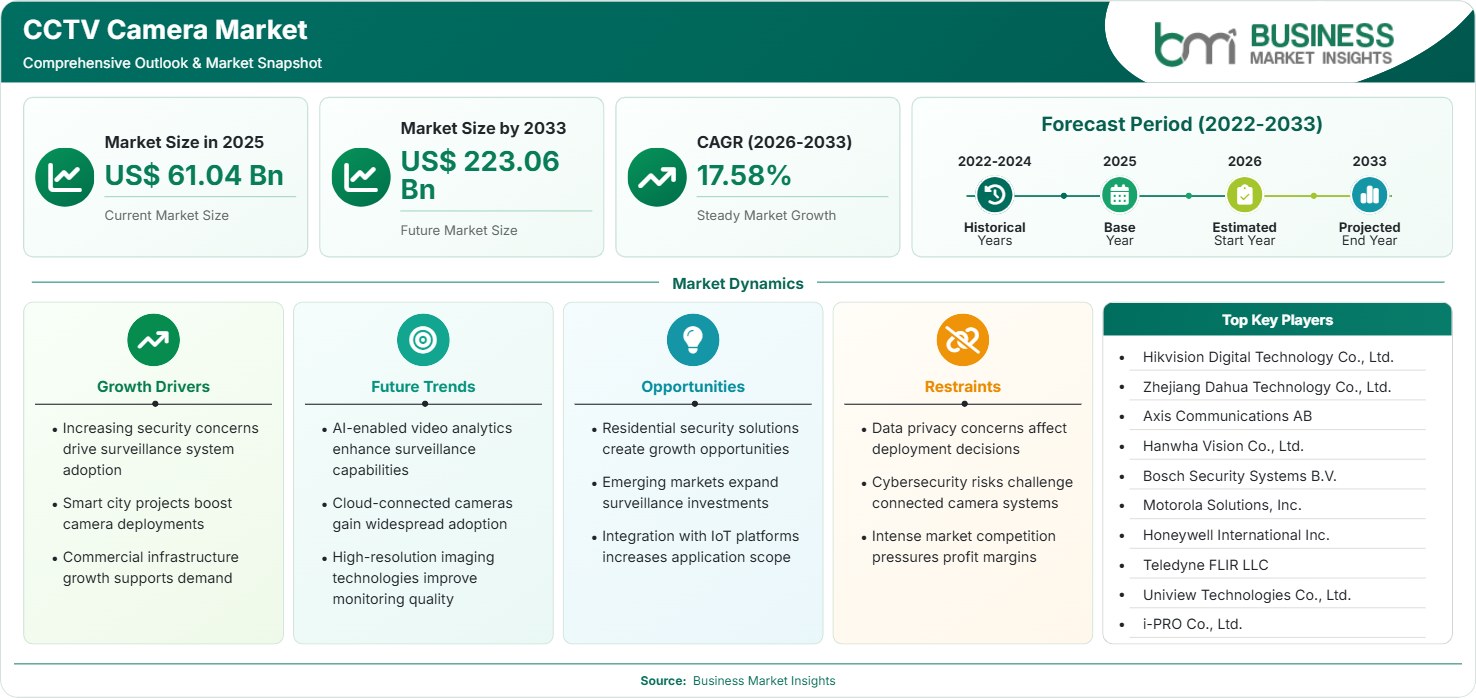
The CCTV Camera Market size was valued at US$ 61.04 Billion in 2025 and is projected to reach US$ 223.06 Billion by 2033, growing at a CAGR of 17.58% during 2026–2033. Growth is supported by AI-enabled video analytics, smart city deployment, critical infrastructure protection, cloud surveillance adoption, and expanding residential security investments, creating substantial long-term commercial opportunities.

Report Coverage
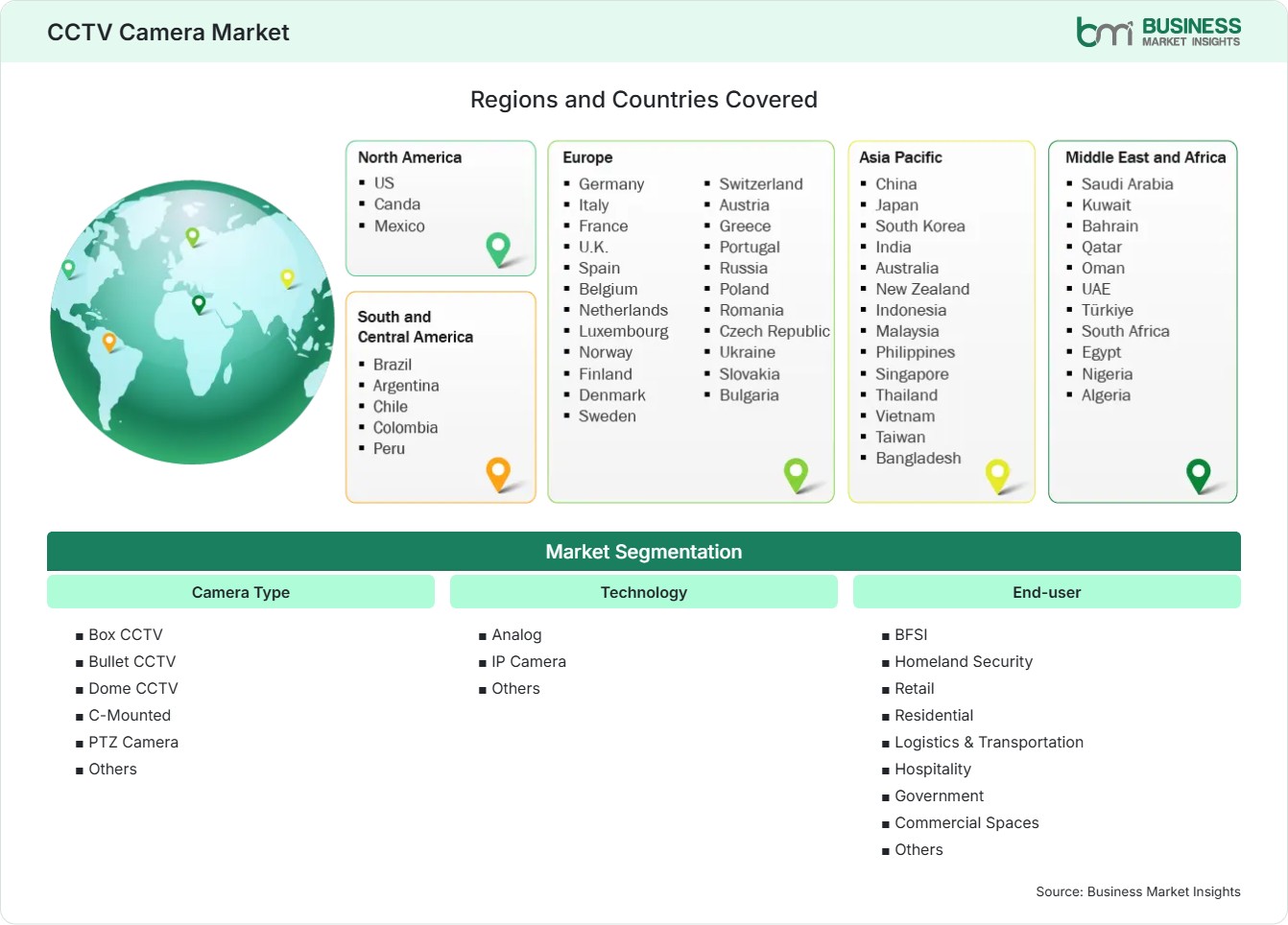
  • Camera Type: Box CCTV, Bullet CCTV, Dome CCTV, C-Mounted, PTZ Camera, Others
  • Technology: Analog, IP Camera, Others
  • End-user: BFSI, Homeland Security, Retail, Residential, Logistics & Transportation, Hospitality, Government, Commercial Spaces, Others
US$ 61.04 Bn Market size in 2025
US$ 223.06 Bn Market Size by 2033
17.58% CAGR, 2026 - 2033
2026-2033 Forecast Period

AI Overview

CCTV Camera Market Summary

  • North America Region: North America holds a market share of 33%–36% in 2025, growing at a CAGR of 15.8%–16.8% during 2026–2033. Key drivers include enterprise security modernization, AI analytics adoption, public infrastructure surveillance upgrades, and cloud monitoring expansion. Opportunities arise from critical infrastructure protection and smart city investments. The U.S. remains the largest contributor, supported by commercial security spending and an estimated CAGR of 16.0%–17.0%.
  • Fastest Growing Region: Asia Pacific holds a CCTV Camera Market share of 28%–31% in 2025, growing at a CAGR of 19.5%–20.5% during 2026–2033. Rapid urbanization, transportation infrastructure projects, manufacturing expansion, and government-backed surveillance initiatives continue accelerating deployment across emerging and developed economies.
  • Leading Segment: IP Camera holds a market share of 48%–52% in 2025, growing at a CAGR of 18.5%–19.5% during 2026–2033. Demand is driven by network connectivity, remote monitoring capabilities, superior image quality, cybersecurity improvements, and integration with intelligent analytics platforms.
  • High Growth Segment: PTZ Camera holds a CCTV Camera Market share of 15%–18% in 2025, growing at a CAGR of 20.0%–21.0% during 2026–2033. Increasing requirements for large-area monitoring, automatic tracking, infrastructure security, and AI-assisted incident management are driving accelerated adoption.
  • Key Market Opportunity: Expansion of AI-powered edge surveillance across transportation hubs, industrial sites, commercial facilities, and smart cities enables real-time threat identification, operational intelligence, lower monitoring costs, and scalable security architectures worldwide.
  • Major Market Players: Hikvision Digital Technology Co., Ltd.; Zhejiang Dahua Technology Co., Ltd.; Axis Communications AB; Hanwha Vision Co., Ltd.; Bosch Security Systems B.V.; Motorola Solutions, Inc.; Honeywell International Inc.; Teledyne FLIR LLC; Uniview Technologies Co., Ltd.; i-PRO Co., Ltd.
Strategic Insights

CCTV Camera Market: Strategic Insights

CCTV Camera Market Strategic Framework
FREE PDF
Request your free sample
Request free sample
Stakeholder View

Key Takeaways

  • Supply chains are shifting toward vertically integrated ecosystems where manufacturers combine imaging hardware, AI software, storage platforms, and managed surveillance services.
  • Transportation, logistics, critical infrastructure, and commercial facilities present the strongest revenue upside due to expanding requirements for continuous monitoring and incident response automation.
  • Product innovation is increasingly centered on edge AI processing, advanced compression, cloud interoperability, and real-time analytics rather than pure camera hardware differentiation.
  • Asia Pacific offers one of the most compelling investment opportunities because of large-scale urbanization programs, smart city investments, and industrial capacity expansion.
  • Mergers, acquisitions, and strategic partnerships continue strengthening market concentration as vendors seek analytics, cybersecurity, and cloud-video capabilities.
  • Demand for privacy-focused surveillance architectures is increasing, encouraging investments in secure data management, encryption technologies, and compliance-oriented monitoring systems.
Geographic Outlook

CCTV Camera Market Regional Highlights

North America CCTV Camera Market

North America holds 33%-36% market share in 2025 and is expected to grow at a CAGR of 15.8%-16.8% till 2033. There remains significant investment in commercial security, critical infrastructure, educational institutions, healthcare, and transportation systems to support deployment. There is a deployment of advanced AI-enabled surveillance systems rather than conventional analog systems. The modernization programs in the public sector, along with rising awareness of cybersecurity and the demands of remote surveillance, have increased the adoption of advanced technology. CCTV Camera Market growth in the region also benefits from strong spending capacity and rapid migration toward cloud-managed security architectures.

  • Enterprise adoption of AI analytics continues expanding due to labor shortages, security automation requirements, and the need for real-time operational intelligence.
  • Transportation agencies increasingly deploy intelligent cameras for passenger monitoring, perimeter security, and traffic management throughout airports and metropolitan transit systems.
  • Cloud-based video management systems are gaining traction as organizations prioritize scalability, centralized monitoring, and streamlined maintenance.
  • Critical infrastructure operators continue investing in high-resolution monitoring systems to address evolving physical security risks.

US CCTV Camera Market

The U.S. accounts for 74%–78% of demand in the region and is expected to grow at a 16.0%–17.0% CAGR through 2033. Commercial establishments, education establishments, municipalities, and logistics providers continue to be significant buyers. Demand from older infrastructure upgrade projects sustains purchases. Infrastructure resilience regulations add fuel to the adoption of artificial intelligence-based monitoring systems.

  • Data center expansion increases demand for intelligent surveillance systems capable of supporting physical security compliance and operational monitoring.
  • Schools and universities continue upgrading systems with analytics-enabled monitoring, emergency response capabilities, and centralized management.
  • Warehousing and e-commerce facilities increasingly rely on surveillance automation to reduce shrinkage and strengthen operational visibility.

Europe CCTV Camera Market

Europe accounts for 24%–27% market share in 2025 and is projected to witness a CAGR of 15.0%–16.0% over 2033. Modernization of security, monitoring transport, and implementation of smart cities continue to be the major growth drivers. Germany is the leading adopter of the CCTV Camera Market in the region, while Poland shows strong growth momentum due to its higher-than-average CAGR. Compliance with the GDPR is driving the adoption of secure surveillance solutions.

  • AI-enabled cameras supporting privacy-preserving analytics are gaining acceptance across commercial and government sectors.
  • Railway modernization projects contribute significantly to surveillance procurement throughout Western and Central Europe.
  • Industrial and manufacturing facilities increasingly deploy intelligent monitoring systems to improve safety compliance.
  • Retail operators invest in advanced analytics solutions to enhance loss prevention and customer behavior monitoring.

Asia Pacific CCTV Camera Market

Asia-Pacific is estimated to have 28% to 31% market share in 2025, with a CAGR of 19.5% to 20.5% through 2033, positioning it as the most rapidly growing region. China dominates the market while India boasts the most impressive growth potential. Urbanization, industrial development, transport infrastructure projects, and smart city projects facilitate installation.

  • Smart city investments continue accelerating installation of large-scale monitoring networks across metropolitan areas.
  • Manufacturing expansion generates demand for surveillance systems supporting safety, asset protection, and process monitoring.
  • Residential adoption increases through affordable connected camera offerings and smartphone-integrated monitoring platforms.
  • Public transportation modernization remains a major procurement channel across developing economies.

Rest of World CCTV Camera Market

Rest of World CCTV Camera Market accounts for 11%–14% share in 2025 and is forecast to expand at a 17.5%–18.5% CAGR through 2033. South & Central America benefit from growing urban security initiatives and commercial modernization projects.

Middle East and Africa markets are supported by infrastructure investments, airport development, tourism expansion, and critical facility protection requirements. Saudi Arabia and the UAE lead regional demand while South Africa demonstrates increasing technology adoption.

  • Mega infrastructure projects across Gulf countries support large-scale deployment of advanced surveillance systems.
  • Commercial real estate modernization strengthens demand for integrated security solutions.
  • Airport and port expansion continues creating opportunities for high-performance monitoring installations.
  • Public safety programs encourage adoption of intelligent surveillance systems across metropolitan areas.
Global Market Geography
FREE PDF
Request your free sample
Request free sample
Segment Analysis

CCTV Camera Market Segmentation

Camera Type

The segment holds around 34%-37% market share in 2025 and is expected to grow at a CAGR of 17.0%-18.0%. Factors that affect demand include security needs by application, infrastructure complexity, the need for monitoring, and AI capabilities. The scope of the CCTV Camera Market is continually widening with the adoption of specialized cameras for commercial, industrial, transport, and safety applications.

  • Box CCTV: Preferred for customized surveillance installations requiring interchangeable lenses and flexible deployment across industrial and commercial facilities.
  • Bullet CCTV: Widely adopted for outdoor applications due to long-range visibility, weather resistance, and effective perimeter monitoring performance.
  • Dome CCTV: Commonly deployed in retail, hospitality, and commercial buildings because of compact design, vandal resistance, and broad viewing angles.
  • C-Mounted: Selected for specialized monitoring environments requiring adaptable lenses, extended viewing distances, and higher imaging precision.
  • PTZ Camera: Supports dynamic monitoring through pan, tilt, and zoom functions, enabling effective large-area surveillance and incident tracking.

Technology

Technology represents the largest segment with 48%–52% market share in 2025 and is expected to record a 18.5%–19.5% CAGR. Migration toward network-enabled platforms, cloud management, cybersecurity enhancements, and advanced analytics is reshaping purchasing behavior. CCTV Camera Market trends increasingly favor intelligent connected solutions capable of supporting remote monitoring and operational analytics.

  • Analog: Continues to maintain relevance in budget-sensitive installations and legacy surveillance environments requiring incremental upgrades.
  • IP Camera: Experiences strong adoption due to superior image quality, remote accessibility, analytics integration, and scalable deployment capabilities.

End-user

The end-user market accounts for 29-32% of the market share in 2025 and grows at a CAGR of 17.8-18.8%. The adoption depends on regulatory requirements, the need for asset protection, safety concerns, and complexity. The industry-specific requirement is the key feature of the surveillance market.

  • BFSI: Uses advanced surveillance to support compliance, fraud prevention, branch monitoring, and customer safety objectives.
  • Homeland Security: Deploys large-scale monitoring infrastructure focused on border protection, critical assets, and public safety operations.
  • Retail: Adopts intelligent surveillance for loss prevention, customer analytics, workforce management, and operational visibility.
  • Residential: Demand is fueled by connected security ecosystems, mobile monitoring applications, and affordable smart surveillance devices.
  • Logistics & Transportation: Utilizes surveillance for asset tracking, facility monitoring, cargo protection, and operational efficiency improvements.
  • Hospitality: Implements monitoring systems to strengthen guest safety, property protection, and service quality management.
  • Government: Invests extensively in surveillance infrastructure supporting public administration, security, and urban management initiatives.
  • Commercial Spaces: Prioritize integrated surveillance platforms to improve workplace security, access management, and operational oversight.
Market Forces

CCTV Camera Market Dynamics

Key Market Drivers

Growing Smart City and Public Surveillance Investments

Countries around the world are investing more in smart city infrastructure, intelligent transport systems, and security, resulting in a consistent demand for sophisticated surveillance equipment. Deployment of large-scale urban surveillance solutions requires high-quality cameras, a video management system, and AI analytics for situational awareness and emergency response. Airports, railway stations, seaports, and urban areas have begun adopting intelligent surveillance systems to enhance security coverage. The expansion of the CCTV Camera Market is driven by urban digitalization, including surveillance, traffic management, and public safety solutions. Investment in infrastructure in Asia-Pacific, North America, and the Middle East is increasing demand for these solutions.

Rapid Adoption of AI-Powered Video Analytics

AI is evolving the role of surveillance technology from simply recording events to a more proactive approach, where the system can identify anomalies, intrusions, suspicious activity, and operational inefficiencies in real time. Modern organizations are looking for systems that will reduce dependence on human surveillance and increase the accuracy of incident responses. The advanced analytics capabilities for facial attributes, people counting, object categorization, and license plate detection have become key criteria in purchasing decisions. The CCTV Camera Market trends indicate significant development in favor of edge computing and AI-driven decisions that rely less on central computing power.

Increasing Security Requirements Across Commercial and Industrial Facilities

The pressure is increasing on industries to safeguard their people, property, infrastructure, and information against any security risks. Increasing surveillance in commercial buildings, manufacturing facilities, data centers, warehouses, financial institutions, and educational campuses is becoming a norm due to operational needs and compliance regulations. Growing concerns about theft, vandalism, accidents, and perimeter security are driving organizations to invest in advanced monitoring tools. Organizations are increasingly favoring security systems that integrate surveillance, access control, and incident management. The growing use of remote monitoring tools and centralized command center solutions is adding more momentum. As a result, the surveillance infrastructure is fast becoming an important security investment decision.

Key Market Opportunities

Expansion of Cloud-Based Video Surveillance Services

Surveillance-as-a-Service is one of the most promising directions for development, as companies need more scalable and cost-effective options than traditional on-premises installations. Video Surveillance as a Service systems will help companies reduce hardware costs and enjoy benefits such as centralized management, remote access, and automatic software updates. Small and medium-sized companies, in particular, will be interested in subscription-based security services. The CCTV Camera Market forecasts reveal fast-growing usage of cloud architecture in retail shops, schools and universities, hotels, and other businesses. Providers can earn money via monitoring services, analytics subscriptions, cybersecurity services, and cloud storage.

Deployment of Edge AI Surveillance in Critical Infrastructure

Critical infrastructure needs systems for real-time threat detection and localized decision-making. Power plants, utility infrastructure, transport routes, airports, and industries are using edge AI cameras that process information locally at the camera level. Such an approach helps reduce latency and bandwidth usage. The investments being made in projects aimed at infrastructure modernization in the fields of energy, transportation, and utilities are contributing to a positive environment for the deployment of advanced surveillance systems. Companies that provide end-to-end solutions in imaging, analytics, and cybersecurity will benefit greatly from increased demand.

Rising Residential Adoption of Connected Security Ecosystems

The residential sector is progressing from simple home security systems towards advanced connected security ecosystems that incorporate smartphones, smart locks, sensor systems, and voice-enabled technologies. Consumer awareness of home security systems has increased considerably, leading to a rise in demand for low-cost installation systems with surveillance capabilities. Technological advances in wireless communications, cloud services, and applications have improved the user interface. New market regions offer considerable opportunities due to rising disposable incomes and increasing technology adoption. Technology providers can take advantage of these through subscription-based models, AI-driven alarms, and smart-home ecosystems.

Market Restraints and Challenges

Privacy Regulations and Data Protection Compliance Risks

Factor: Growing regulatory scrutiny regarding video surveillance, facial recognition technologies, and personal data collection creates compliance complexities for manufacturers and end users. Impact: Organizations must invest in secure storage, encryption, access controls, and privacy management capabilities, increasing deployment and operating costs. Regulations governing data retention, monitoring practices, and cross-border information transfers vary across jurisdictions, creating implementation challenges for multinational enterprises. Public concerns regarding privacy rights can also delay surveillance deployments in certain sectors. Compliance failures may result in financial penalties, reputational damage, and legal liabilities. Consequently, vendors are required to balance advanced monitoring capabilities with increasingly stringent privacy expectations and regulatory obligations.

Cybersecurity Vulnerabilities and High System Integration Costs

Factor: Modern surveillance networks are highly connected and vulnerable to cybersecurity threats including unauthorized access, malware attacks, and data breaches. Impact: Security incidents can compromise sensitive video data, disrupt operations, and undermine user confidence. Organizations must allocate additional resources toward network security, software updates, and system monitoring to reduce risk exposure. Integration challenges also arise when connecting cameras with legacy infrastructure, access control systems, analytics platforms, and cloud environments. These complexities increase implementation timelines and total ownership costs. Budget-sensitive customers may postpone upgrades due to integration expenses, limiting near-term deployment rates despite strong long-term demand fundamentals across multiple industry sectors.

Company Analysis

Competitive Landscape

CCTV Camera Market analysis reflects a competitive environment characterized by AI integration, cloud surveillance innovation, cybersecurity enhancements, and expanding managed security offerings.

Company Name

Overview

Products and Services relevant to this market

Hikvision Digital Technology Co., Ltd.

Global surveillance technology provider with extensive AIoT and video security portfolio.

Network cameras, PTZ cameras, video analytics, storage systems, integrated security platforms.

Zhejiang Dahua Technology Co., Ltd.

Major video surveillance manufacturer serving government, commercial, and industrial customers.

IP cameras, AI cameras, thermal imaging, VMS platforms, smart city solutions.

Axis Communications AB

Pioneer in network video surveillance and intelligent security technologies.

IP cameras, analytics software, access control systems, network audio solutions.

Hanwha Vision Co., Ltd.

Advanced imaging and AI surveillance solutions provider.

AI cameras, PTZ systems, analytics tools, cloud-connected security solutions.

Bosch Security Systems B.V.

Leading security technology company focused on enterprise applications.

Intelligent cameras, video management software, analytics, integrated security systems.

Motorola Solutions, Inc.

Expanding video security ecosystem through platform integration and acquisitions.

Video surveillance, access control, cloud security, analytics, incident management.

Honeywell International Inc.

Diversified technology company with extensive building security capabilities.

CCTV systems, integrated monitoring, building automation security solutions.

Teledyne FLIR LLC

Specialized imaging company serving security and critical infrastructure markets.

Thermal cameras, perimeter monitoring systems, intelligent surveillance technologies.

Uniview Technologies Co., Ltd.

Global supplier with focus on IP surveillance solutions.

Network cameras, NVRs, AI video surveillance systems, monitoring software.

i-PRO Co., Ltd.

Professional security imaging provider emphasizing reliability and analytics.

AI-powered cameras, edge analytics, enterprise surveillance and monitoring solutions.

Trust & Transparency

Research Methodology

The market analysis combines proprietary research with secondary data from government agencies, company disclosures, regulatory filings, industry databases and expert interviews. Market estimates are validated through data triangulation, cross-market benchmarking and analyst review.

View Full Research Methodology

Questions Answered

Frequently Asked Questions

What does a CCTV Camera Market Report typically evaluate?

A comprehensive Market Report assesses market size, competitive positioning, segmentation trends, regional demand patterns, technology evolution, investment opportunities, and industry risks.

How are cloud platforms influencing adoption?

Cloud surveillance platforms reduce infrastructure complexity, enable remote management, improve scalability, and support advanced analytics through centralized data access.

Which region offers the highest growth potential?

Asia Pacific presents the strongest long-term expansion opportunities due to urbanization, infrastructure development, industrial growth, and government-backed surveillance projects.

What technology segment is creating the strongest revenue contribution?

IP cameras currently generate the largest revenue contribution due to their network connectivity, analytics integration, cloud compatibility, and superior image quality.

What is driving demand for advanced surveillance solutions?

AI-enabled analytics, smart city initiatives, public safety requirements, transportation modernization, and growing enterprise security investments are accelerating adoption across multiple industries.

Access the Full CCTV Camera Market Report

Get segment-level forecasts, regional estimates, competitive benchmarking, company profiles and downloadable Excel datasets.

Access the full CCTV Camera Market Report
350 pages PDF & Excel | 2026-08-31