
Airport Thermal Camera Market Outlook: Size, Share, Trends, Growth Analysis, Competitive Landscape & Forecast, 2026-2033

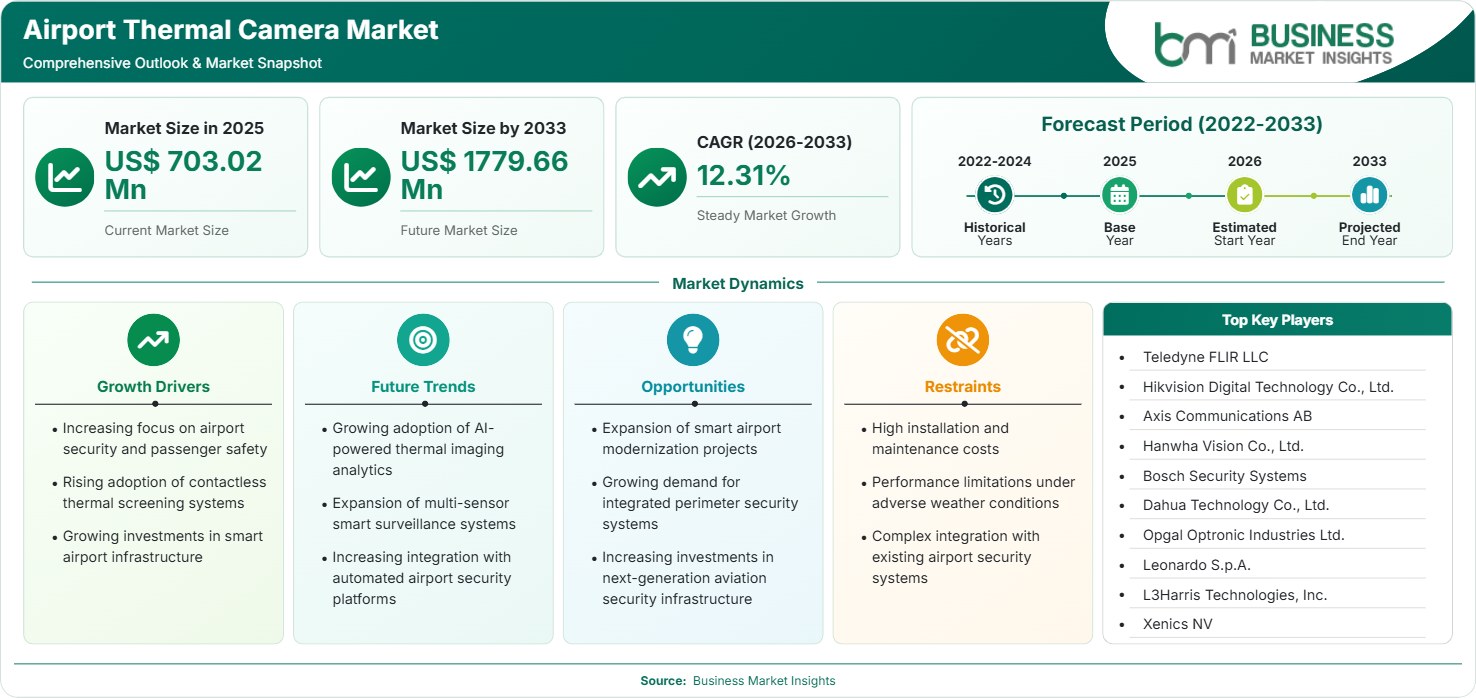
The Airport Thermal Camera Market size was valued at US$ 703.02 Million in 2025 and is projected to reach US$ 1779.66 Million by 2033, growing at a CAGR of 12.31% from 2026 to 2033. The growth is driven by increasing focus on airport security and passenger safety, rising adoption of contactless thermal screening systems, and growing investments in smart airport infrastructure.

Report Coverage
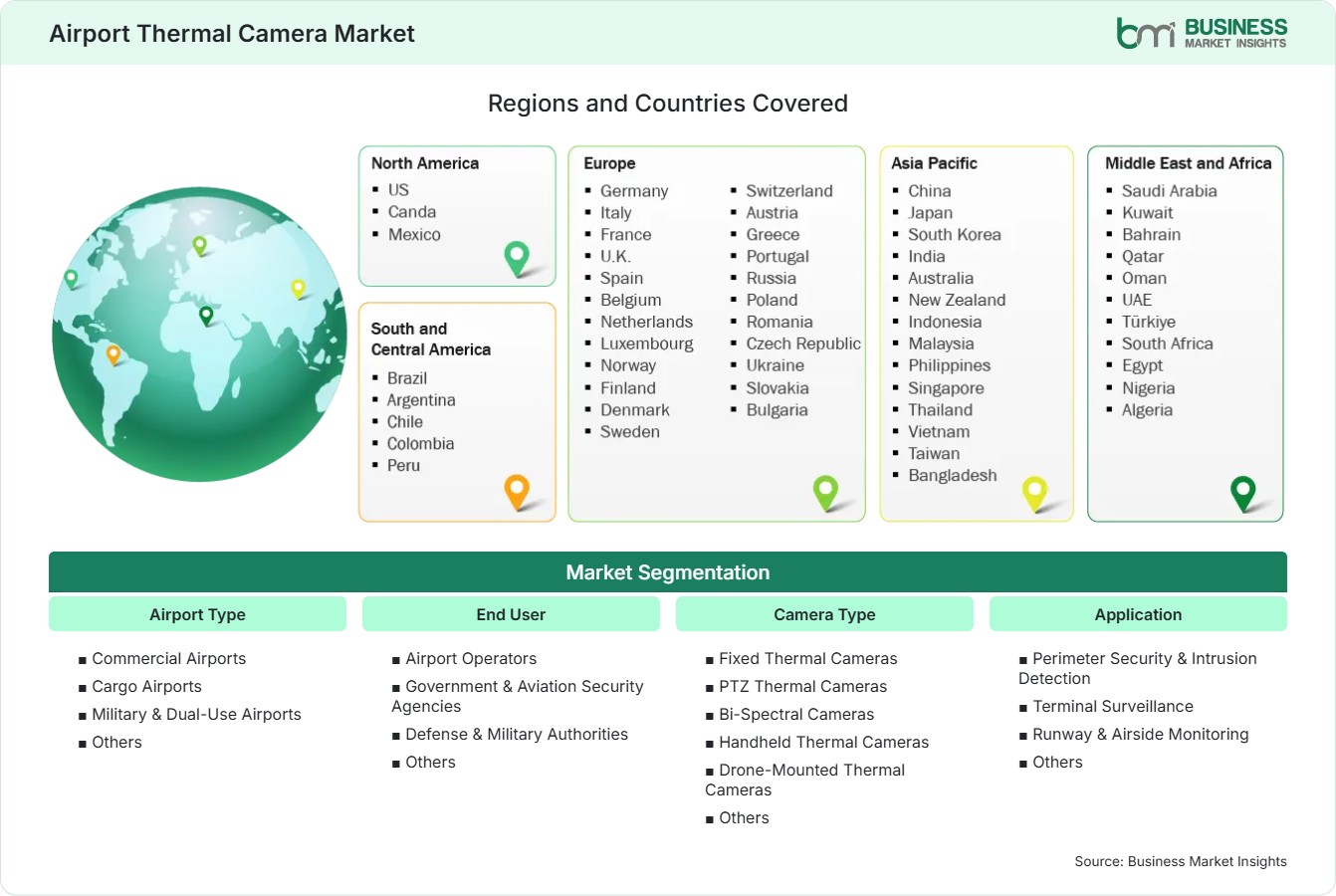
  • Airport Type: Commercial Airports, Cargo Airports, Military & Dual-Use Airports, Others
  • End User: Airport Operators, Government & Aviation Security Agencies, Defense & Military Authorities, Others
  • Camera Type: Fixed Thermal Cameras, PTZ Thermal Cameras, Bi-Spectral Cameras, Handheld Thermal Cameras, Drone-Mounted Thermal Cameras, Others
  • Application: Perimeter Security & Intrusion Detection, Terminal Surveillance, Runway & Airside Monitoring, Others
US$ 703.02 Mn Market size in 2025
US$ 1779.66 Mn Market Size by 2033
12.31% CAGR, 2026 - 2033
2026-2033 Forecast Period

01 AI Overview

Airport Thermal Camera Market Summary

  • North America Region: North America accounted for a significant share of the Market in 2025 due to advanced airport infrastructure, high security standards, and increasing adoption of intelligent surveillance systems.
  • Fastest Growing Region: Asia Pacific is expected to witness strong growth during the forecast period due to airport expansion projects, increasing passenger traffic, and investments in smart airport modernization.
  • Leading Segment: Commercial Airports represent a major airport type segment due to increasing deployment of advanced security and monitoring systems across large passenger airports.
  • High Growth Segment: Perimeter Security & Intrusion Detection is expected to witness strong growth due to rising concerns regarding unauthorized access, security threats, and airport boundary protection.
  • Key Market Opportunity: Expansion of smart airport modernization projects, increasing demand for integrated perimeter security systems, and investments in next-generation aviation security infrastructure are creating growth opportunities.
  • Major Market Players: Teledyne FLIR LLC, Hikvision Digital Technology Co., Ltd., Axis Communications AB, Hanwha Vision Co., Ltd., Bosch Security Systems, Dahua Technology Co., Ltd., Opgal Optronic Industries Ltd., Leonardo S.p.A., L3Harris Technologies, Inc., and Xenics NV.
02 Strategic Insights

Airport Thermal Camera Market: Strategic Insights

Airport Thermal Camera Market Strategic Framework
FREE PDF
Request your free sample
Request free sample
03 Stakeholder View

Key Takeaways

  • The market is driven by increasing airport security requirements and the adoption of advanced surveillance technologies.
  • Thermal cameras are becoming important solutions for perimeter monitoring, intrusion detection, and airside security.
  • Commercial airports represent a major application area due to increasing passenger traffic and security requirements.
  • Smart airport modernization projects are creating new opportunities for thermal camera manufacturers.
  • Government agencies and defense authorities are increasing adoption for aviation security and critical infrastructure protection.
  • Integration of thermal cameras with other security systems is expected to improve airport monitoring capabilities.
04 Geographic Outlook

Airport Thermal Camera Market Regional Highlights

North America Airport Thermal Camera Market

The North America accounted for approximately 34%–37% market share in 2025 and is projected to grow at a CAGR of 11.80%–12.40% from 2026 to 2033. The region represents one of the leading markets due to the presence of advanced airport infrastructure, strict aviation security regulations, and increasing adoption of intelligent surveillance systems. Airports across the United States and Canada are investing in thermal imaging technologies to improve perimeter security, passenger monitoring, and operational safety.

  • The United States represents the largest contributor due to extensive airport networks and higher investments in aviation security infrastructure.
  • Airport operators are increasingly integrating thermal cameras with video surveillance and security management platforms.
  • Growing concerns regarding unauthorized access and security threats are supporting demand for advanced monitoring solutions.
  • Defense and government agencies are also adopting thermal imaging technologies for aviation security applications.

US Airport Thermal Camera Market

The US region accounted for approximately 30%–33% of the North American market in 2025 and is expected to grow at a CAGR of 12.00%–12.60% during 2026–2033. The United States market is supported by high airport security spending, modernization of aviation infrastructure, and increasing adoption of smart surveillance technologies. Airports are deploying thermal cameras for runway monitoring, perimeter protection, and security operations.

  • Major airports are investing in integrated security systems combining thermal cameras, radar, and video analytics.
  • Increasing focus on passenger safety and operational efficiency is supporting adoption.
  • Government security programs are encouraging deployment of advanced airport monitoring solutions.
  • Growing demand for automated threat detection systems is creating opportunities for technology providers.

Europe Airport Thermal Camera Market

The Europe regionaccounted for approximately 25%–28% market share in 2025 and is projected to grow at a CAGR of 11.50%–12.10% from 2026 to 2033. Growth is supported by increasing airport modernization initiatives, rising security requirements, and adoption of advanced surveillance systems across European airports. Countries in the region are focusing on improving aviation security while enhancing operational efficiency.

  • European airports are investing in smart security infrastructure and automated monitoring systems.
  • Increasing regulatory focus on airport safety is supporting adoption of thermal imaging solutions.
  • Defense and aviation authorities are using thermal cameras for critical infrastructure protection.
  • Integration of thermal systems with existing airport surveillance networks is increasing.

Asia Pacific Airport Thermal Camera Market

The Asia Pacific accounted for approximately 27%–30% market share in 2025 and is expected to grow at a CAGR of 13.20%–13.90% from 2026 to 2033. The region is expected to witness strong growth due to increasing airport expansion projects, rising passenger traffic, and growing investments in smart airport infrastructure. Countries such as China, India, Japan, South Korea, and Southeast Asian economies are upgrading aviation facilities with advanced security and surveillance technologies to improve safety and operational efficiency.

  • China represents a major contributor due to large-scale airport development projects and increasing adoption of advanced security systems.
  • India is witnessing rising demand due to airport modernization initiatives, expansion of regional airports, and increasing focus on aviation security.
  • Southeast Asian countries are investing in airport infrastructure upgrades to support growing tourism and international travel.
  • Increasing adoption of integrated surveillance systems combining thermal cameras, video analytics, and automated monitoring is supporting regional growth.
  • Government agencies and airport operators are focusing on improving perimeter security and reducing security risks.

Rest of World Airport Thermal Camera Market

The Rest of World region accounted for approximately 9%–12% market share in 2025 and is projected to grow at a CAGR of 10.80%–11.50% during 2026–2033. Growth in Latin America, the Middle East, and Africa is supported by increasing airport development projects, rising aviation activity, and growing investments in security infrastructure. Governments and aviation authorities are focusing on improving airport safety and adopting advanced surveillance technologies.

  • Middle Eastern countries are investing in modern airport facilities and advanced security systems as part of aviation infrastructure development.
  • Latin American airports are adopting thermal cameras to improve perimeter monitoring and operational security.
  • African markets are gradually increasing adoption due to expanding air transportation networks and infrastructure investments.
  • Growing demand for cost-effective security solutions is creating opportunities for thermal camera manufacturers.
Global Market Geography
FREE PDF
Request your free sample
Request free sample
05 Segment Analysis

Airport Thermal Camera Market Segmentation

Airport Type

The Airport Type segment was led by Commercial Airports, which accounted for approximately 45%–50% market share in 2025 and is expected to grow at a CAGR of 12.50%–13.20% from 2026 to 2033. Growth is supported by increasing passenger traffic, expansion of airport facilities, and rising security requirements at large passenger terminals. Commercial airports are deploying thermal cameras for perimeter protection, terminal surveillance, runway monitoring, and operational safety.

  • Commercial Airports: Commercial airports represent the largest segment due to increasing passenger movement and the need for continuous security monitoring.
  • Cargo Airports: The segment is witnessing growth due to increasing air cargo activities and the requirement for secure monitoring of cargo facilities, loading areas, and restricted zones.
  • Military & Dual-Use Airports: Military and dual-use airports are adopting thermal cameras for enhanced security, perimeter protection, and defense-related monitoring.

End User

The End User segment was dominated by Airport Operators, which accounted for approximately 40%–45% market share in 2025 and is projected to grow at a CAGR of 12.40%–13.00% during 2026–2033. Airport operators are investing in thermal cameras to improve security management, reduce operational risks, and enhance monitoring capabilities across airport facilities.

  • Airport Operators: Airport operators are the leading users due to increasing demand for advanced security systems, passenger safety solutions, and efficient airport operations.
  • Government & Aviation Security Agencies: These organizations are adopting thermal imaging systems for aviation security, threat detection, and compliance with safety requirements.
  • Defense & Military Authorities: Defense organizations use thermal cameras for protecting military airports, monitoring restricted zones, and enhancing security capabilities.

Camera Type

The Airport Thermal Camera Market by Camera Type was led by Fixed Thermal Cameras, which accounted for approximately 35%–40% market share in 2025 and is expected to grow at a CAGR of 11.80%–12.50% from 2026 to 2033. Fixed thermal cameras are widely deployed due to their reliability, continuous monitoring capabilities, and suitability for perimeter security applications.

  • Fixed Thermal Cameras: These cameras are commonly used for airport perimeter monitoring, restricted area surveillance, and continuous security operations.
  • PTZ Thermal Cameras: PTZ thermal cameras are gaining adoption due to their ability to provide flexible coverage, remote control capabilities, and monitoring of large airport areas.
  • Bi-Spectral Cameras: These cameras combine thermal imaging and visible-light imaging, providing enhanced detection capabilities for complex security environments.
  • Handheld Thermal Cameras: Handheld devices are used for inspection, maintenance activities, and mobile security applications.
  • Drone-Mounted Thermal Cameras: Drone-mounted thermal cameras are emerging due to increasing demand for aerial surveillance and rapid monitoring of large airport areas.

Application

The Airport Thermal Camera Market by Application was led by Perimeter Security & Intrusion Detection, which accounted for approximately 40%–45% market share in 2025 and is projected to grow at a CAGR of 12.80%–13.50% from 2026 to 2033. Increasing concerns regarding unauthorized access, security threats, and protection of airport boundaries are driving adoption of thermal cameras in this application.

  • Perimeter Security & Intrusion Detection: Thermal cameras are increasingly used for monitoring airport boundaries, detecting unauthorized movement, and improving response capabilities.
  • Terminal Surveillance: Airports are adopting thermal cameras for monitoring passenger areas, improving security visibility, and supporting crowd management.
  • Runway & Airside Monitoring: Thermal cameras help monitor runways, aircraft movement areas, and airside operations, especially during low-light or adverse weather conditions.
06 Market Forces

Airport Thermal Camera Market Dynamics

Key Market Drivers

Increasing focus on airport security and passenger safety

The growing emphasis on airport security and passenger safety is one of the major factors driving the growth of the market. Airports worldwide are facing increasing security challenges, including unauthorized access, perimeter breaches, and operational safety concerns. Thermal cameras provide advanced monitoring capabilities by detecting heat signatures, allowing security teams to identify potential threats even in low-light environments, nighttime conditions, and areas with limited visibility. Government authorities and aviation security agencies are also strengthening security standards and investing in advanced monitoring solutions. The increasing focus on protecting critical aviation infrastructure is encouraging airports to adopt thermal imaging systems for perimeter protection, terminal surveillance, and airside monitoring applications.

Rising adoption of contactless thermal screening systems

The increasing adoption of contactless thermal screening systems is supporting the expansion of the Airport Thermal Camera Market trends. Thermal cameras enable temperature monitoring without physical contact, making them useful for passenger screening, operational monitoring, and security applications. Airports are increasingly adopting contactless technologies to improve passenger experience while maintaining safety standards. The demand for thermal screening solutions increased as airports focused on implementing faster and safer monitoring processes. Modern thermal cameras equipped with advanced analytics can identify temperature variations, monitor large groups of people, and support automated screening processes. These capabilities are encouraging airports to invest in advanced thermal imaging technologies.

Growing investments in smart airport infrastructure

Increasing investments in smart airport infrastructure are creating significant growth opportunities for the Airport Thermal Camera Market. Airports are undergoing digital transformation by adopting connected technologies, automated systems, and intelligent security solutions to improve operational efficiency and passenger safety. Thermal cameras are becoming an important component of smart airport ecosystems due to their ability to provide continuous monitoring and integrate with centralized security platforms. Airport modernization projects increasingly include advanced surveillance systems designed to improve security management, reduce operational costs, and enhance real-time visibility. The development of next-generation airports in emerging economies is further supporting market growth.

Key Market Opportunities

Expansion of smart airport modernization projects

The expansion of smart airport modernization projects represents a major opportunity for companies operating in the Airport Thermal Camera Market. Airports across developed and developing regions are investing in digital infrastructure upgrades to improve security, automate operations, and enhance passenger experiences. Modern airport projects are increasingly incorporating advanced surveillance systems, artificial intelligence platforms, and automated monitoring technologies. Thermal cameras play an important role in these initiatives by providing continuous monitoring capabilities across large airport areas, including terminals, runways, and restricted zones. Emerging economies are witnessing significant airport development activities due to increasing air passenger demand and government investments in transportation infrastructure.

Growing demand for integrated perimeter security systems

The increasing demand for integrated perimeter security systems is creating growth opportunities in the market. Airports require advanced solutions to protect large boundaries, restricted areas, and critical infrastructure from unauthorized access and security threats. Thermal cameras are increasingly being combined with radar systems, video analytics, access control systems, and artificial intelligence platforms to create comprehensive security networks. These integrated solutions improve threat detection capabilities and allow security teams to respond quickly to potential incidents. The rising focus on automated security monitoring is encouraging airport operators to replace traditional surveillance methods with advanced thermal imaging technologies

Increasing investments in next-generation aviation security infrastructure

Increasing investments in next-generation aviation security infrastructure are expected to create significant opportunities for the Airport Thermal Camera Market forecasts. Governments, airport operators, and defense organizations are focusing on improving aviation security through advanced technologies and intelligent monitoring solutions. Next-generation airport security systems are increasingly incorporating artificial intelligence, automation, and advanced imaging technologies. Thermal cameras support these developments by providing reliable detection capabilities in challenging environments, including darkness, fog, and restricted visibility conditions. The growing need to protect airports from security threats while improving operational efficiency is encouraging investments in advanced surveillance infrastructure

Market Restraints and Challenges

High installation and maintenance costs

Factor: High installation and maintenance costs remain a major challenge for the Airport Thermal Camera Market. Advanced thermal camera systems require significant investments in equipment, installation infrastructure, software integration, and regular maintenance activities. Impact: High costs can limit adoption, especially among smaller airports and facilities with restricted security budgets. Maintenance requirements, software upgrades, and calibration needs can further increase operational expenses. Manufacturers are focusing on developing cost-effective solutions, improving system durability, and offering scalable deployment models to address this challenge.

Performance limitations under adverse weather conditions

Factor: Performance limitations under certain adverse weather conditions can affect the effectiveness of thermal cameras. Extreme weather conditions such as heavy rain, dense fog, high humidity, and environmental temperature variations may reduce detection accuracy and image quality. Impact: These limitations can create challenges for airports operating in regions with unpredictable weather conditions. Airport operators may require additional technologies and advanced image processing solutions to maintain reliable monitoring performance. Manufacturers are investing in improved sensors, advanced analytics, and enhanced thermal imaging technologies to overcome these limitations.

07 Company Analysis

Competitive Landscape

The Airport Thermal Camera Market analysis is highly competitive, with leading companies focusing on developing advanced thermal imaging solutions, improving detection accuracy, integrating artificial intelligence capabilities, and expanding applications across airport security systems. Companies are also focusing on partnerships with airport operators, government agencies, and security solution providers to strengthen their presence in the aviation security sector.

Company Name

Overview

Products and Services relevant to this market

Teledyne FLIR LLC

A leading thermal imaging technology provider specializing in advanced sensing and imaging solutions.

Provides thermal cameras, infrared imaging systems, security surveillance solutions, and advanced monitoring technologies for airport and critical infrastructure applications.

Hikvision Digital Technology Co., Ltd.

A global provider of video surveillance and security solutions.

Offers thermal cameras, hybrid imaging systems, perimeter protection solutions, and intelligent security platforms for aviation and infrastructure monitoring.

Axis Communications AB

A network technology company specializing in security cameras and surveillance solutions.

Provides thermal network cameras, video management solutions, and integrated security systems for airport monitoring applications.

Hanwha Vision Co., Ltd.

A security technology company offering advanced video surveillance products.

Provides thermal imaging cameras, AI-powered surveillance solutions, and security monitoring systems for airports and critical facilities.

Bosch Security Systems

A provider of security, safety, and communication technologies.

Offers thermal cameras, video surveillance systems, intelligent analytics, and integrated airport security solutions.

Dahua Technology Co., Ltd.

A global security solution provider specializing in video surveillance technologies.

Provides thermal imaging cameras, AI-based monitoring systems, and perimeter security solutions for aviation applications.

Opgal Optronic Industries Ltd.

A thermal imaging technology company specializing in infrared solutions.

Offers thermal cameras, infrared detection systems, and specialized imaging solutions for security and industrial applications.

Leonardo S.p.A.

A global aerospace and defense technology company.

Provides advanced surveillance systems, defense imaging technologies, and security solutions for aviation and government applications.

L3Harris Technologies, Inc.

A technology company providing aerospace, defense, and communication solutions.

Offers advanced sensing technologies, surveillance systems, and security solutions for defense and aviation sectors.

Xenics NV

A provider of infrared imaging solutions and thermal sensing technologies.

Provides infrared cameras, thermal imaging systems, and specialized solutions for security, industrial, and research applications.

10 Trust & Transparency

Research Methodology

The market analysis combines proprietary research with secondary data from government agencies, company disclosures, regulatory filings, industry databases and expert interviews. Market estimates are validated through data triangulation, cross-market benchmarking and analyst review.

View Full Research Methodology

11 Questions Answered

Frequently Asked Questions

6. What challenges affect the adoption of airport thermal cameras?

High installation costs, maintenance requirements, and performance limitations under extreme weather conditions are key challenges affecting adoption. Airport operators need cost-effective and reliable solutions to achieve long-term operational benefits.

How are smart airport projects influencing the adoption of thermal cameras?

Smart airport projects are increasing adoption by integrating thermal cameras with artificial intelligence, video analytics, automated monitoring platforms, and centralized security systems.

What is the fastest-growing application segment in the Airport Thermal Camera Market share?

Perimeter Security & Intrusion Detection is expected to witness strong growth due to increasing concerns regarding unauthorized access, airport boundary protection, and the need for automated security monitoring systems.

Which airport type represents the largest opportunity in the Market?

Commercial airports represent a major opportunity due to increasing passenger traffic, expansion of airport facilities, and growing investments in security infrastructure. Large passenger airports require advanced surveillance systems to improve safety and manage security operations effectively.

Why are airports adopting thermal cameras?

Airports are adopting thermal cameras because they provide continuous monitoring, improve perimeter security, support intrusion detection, and enhance operational safety. These cameras can detect heat signatures and provide visibility in darkness or poor lighting conditions where traditional cameras may have limitations.

What factors are driving growth in the Airport Thermal Camera Market Reports?

The market is growing due to increasing focus on airport security, rising passenger safety requirements, adoption of smart airport infrastructure, and increasing demand for advanced surveillance technologies.

Access the Full Airport Thermal Camera Market Report

Get segment-level forecasts, regional estimates, competitive benchmarking, company profiles and downloadable Excel datasets.

Access the full Airport Thermal Camera Market Report
350 pages PDF & Excel | 2026-08-12