
Locomotive Market Outlook: Size, Share, Trends, Growth Analysis, Competitive Landscape & Forecast, 2026-2033

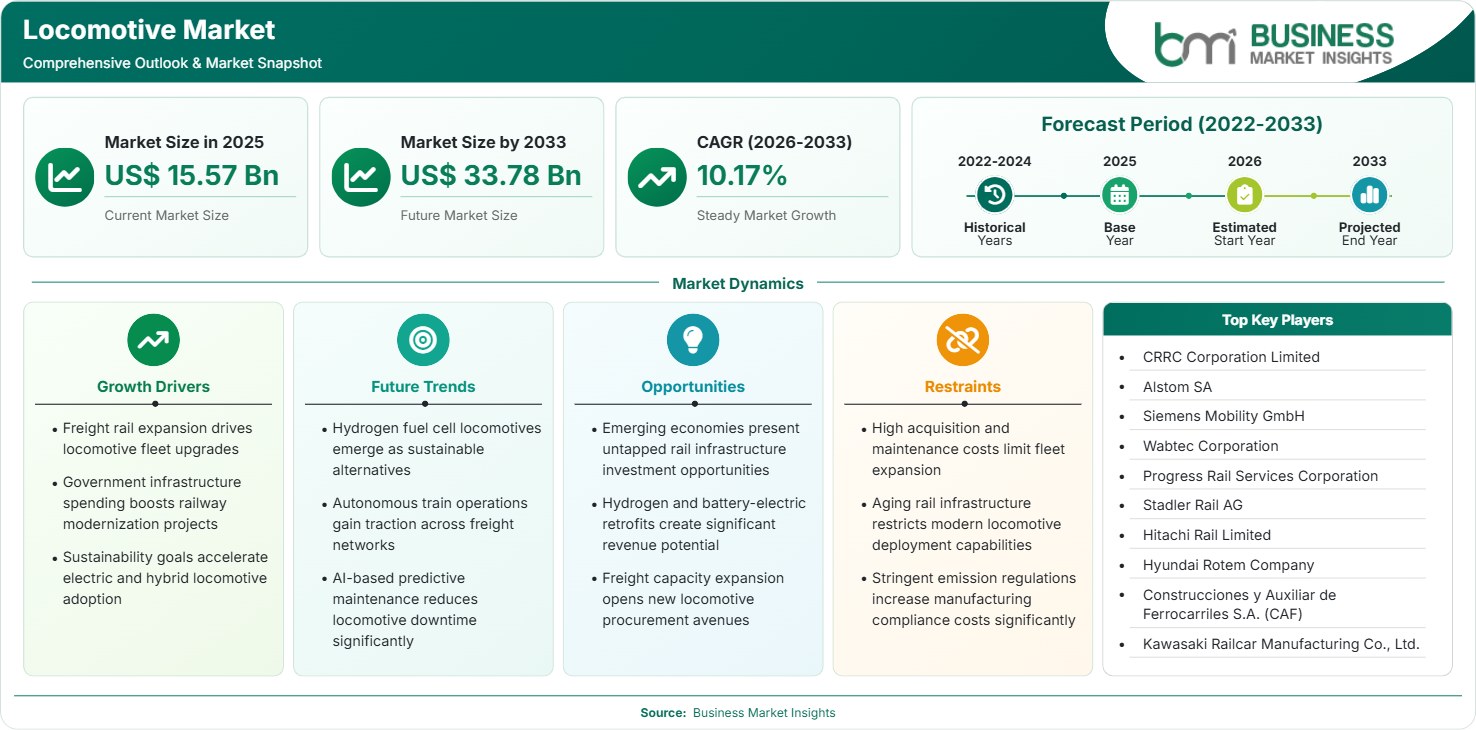
The Locomotive Market size was valued at US$ 15.57 Billion in 2025 and is projected to reach US$ 33.78 Billion by 2033, growing at a CAGR of 10.17% during 2026–2033, driven by rail electrification programs, freight modernization, decarbonization mandates, digital fleet management adoption, and opportunities emerging from hydrogen-powered locomotives, cross-border rail investments, and high-capacity freight corridor development.

Report Coverage
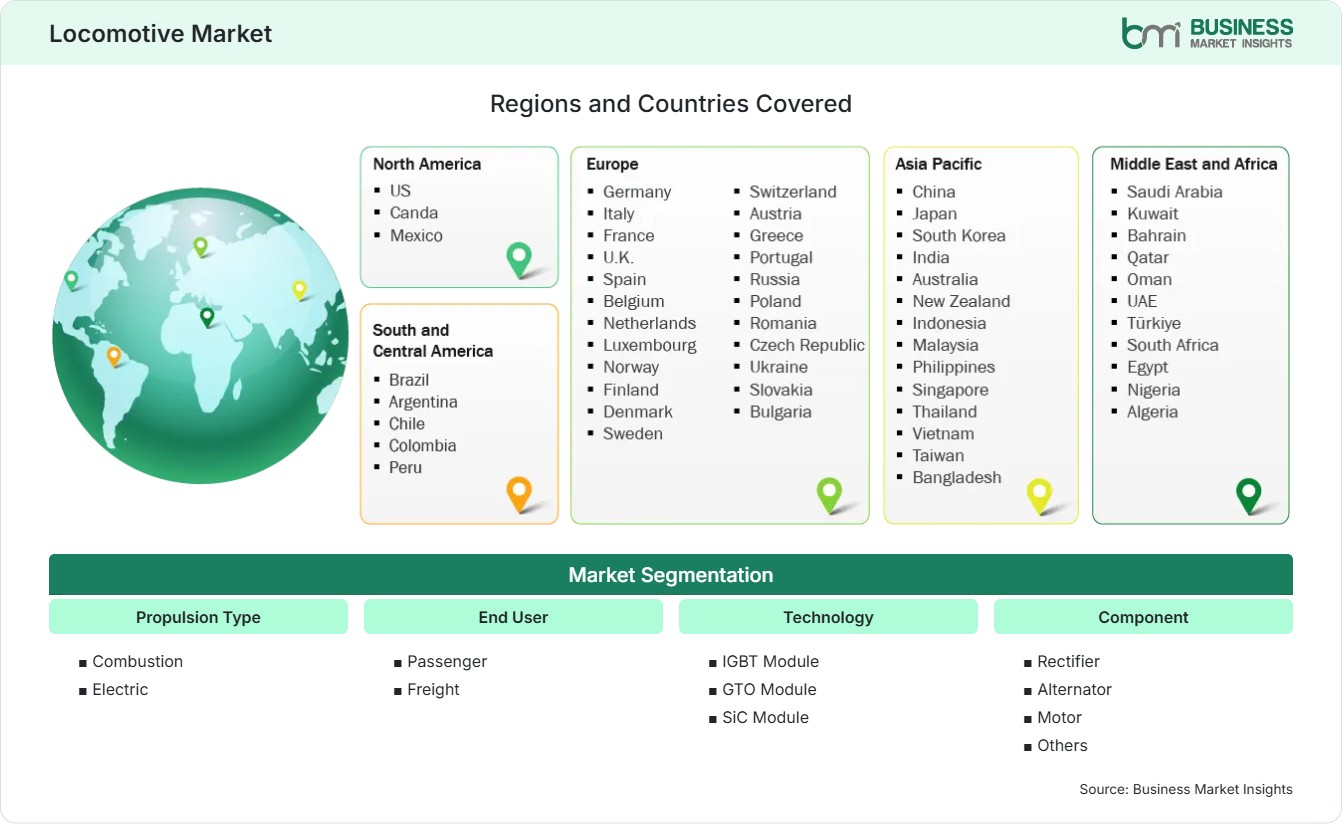
  • Propulsion Type: Combustion, Electric
  • End User: Passenger, Freight
  • Technology: IGBT Module, GTO Module, SiC Module
  • Component: Rectifier, Alternator, Motor, Others
US$ 15.57 Bn Market size in 2025
US$ 33.78 Bn Market Size by 2033
10.17% CAGR, 2026 - 2033
2026-2033 Forecast Period

AI Overview

Locomotive Market Summary

  • North America Region: North America holds a market share of 32%–35% in 2025, growing at a CAGR of 8.8%–9.4% during 2026–2033. Demand is supported by heavy-haul freight operations, locomotive replacement cycles, digital rail technologies, sustainability initiatives, network upgrades, and investments in rail efficiency, capacity expansion, and emissions reduction. The US dominates regional demand through freight rail modernization and fleet digitization, advancing at a CAGR of 8.9%–9.5%.
  • Fastest Growing Region: Asia Pacific holds a market share of 28%–31% in 2025, expanding at a CAGR of 11.8%–12.6% during 2026–2033. Growth is supported by railway electrification, urbanization, industrial freight requirements, government infrastructure programs, cross-border connectivity projects, domestic manufacturing strengths, and increasing passenger rail capacity investments.
  • Leading Segment: Electric propulsion accounts for 56%–60% market share in 2025 and advances at a CAGR of 10.8%–11.5% through 2033. Adoption benefits from lower operating costs, decarbonization goals, renewable electricity integration, efficiency advantages, maintenance savings, and expanding rail electrification corridors worldwide.
  • High Growth Segment: SiC Module technology represents 12%–15% share in 2025 and records a CAGR of 13.5%–14.5% through 2033. Growth stems from superior power density, energy efficiency improvements, compact system architectures, thermal performance advantages, and next-generation traction system requirements.
  • Key Market Opportunity: Expanding hydrogen locomotive deployment creates opportunities for manufacturers, component suppliers, energy partners, rail operators, infrastructure developers, and technology providers supporting low-emission freight and passenger transport modernization globally.
  • Major Market Players: CRRC Corporation Limited, Alstom SA, Siemens Mobility GmbH, Wabtec Corporation, Progress Rail Services Corporation, Stadler Rail AG, Hitachi Rail Limited, Hyundai Rotem Company, Construcciones y Auxiliar de Ferrocarriles S.A. (CAF), Kawasaki Railcar Manufacturing Co., Ltd.
Strategic Insights

Locomotive Market: Strategic Insights

Locomotive Market Strategic Framework
FREE PDF
Request your free sample
Request free sample
Stakeholder View

Key Takeaways

  • The value chain in the industry is becoming more integrated, with the original equipment manufacturers, the providers of traction systems, the suppliers of software, and the rail operators working together to optimize lifecycle costs and maintain fleet availability.
  • The most promising commercial opportunities are found in electrified passenger rail networks and in heavy-haul freight routes because of the large-scale replacement and expansion programs underway.
  • Wide-bandgap semiconductor technologies, especially those based on silicon carbide for use in traction applications, are now a major focus of research due to the improvements in operational efficiency.
  • The case for investing in the railway sectors of India, China, and Southeast Asia is strong since there is an expansion of rail infrastructure and high demand for freight transport.
  • The capability in locomotive manufacturing, the range of digital services and after-sales revenue streams are all being enhanced through strategic acquisitions and technology partnerships.
  • Hydrogen propulsion demonstrations are helping to open the way for future low-carbon rail transport and are aiding the development of alternative energy ecosystems.
Geographic Outlook

Locomotive Market Regional Highlights

North America Locomotive Market

North America accounted for approximately 32%–35% of the Locomotive Market share in 2025 and is expected to expand at a CAGR of 8.8%–9.4% through 2033. Large freight rail networks, replacement of aging fleets, and investment in digital train control systems support regional demand. Freight rail operators continue to adopt fuel-efficient locomotives and predictive maintenance technologies. Regulatory pressure to reduce emissions and improve rail efficiency further stimulates technology upgrades and procurement activity.

  • The freight companies based in the United States and Canada are putting money into modernizing their locomotives to enhance reliability, fuel efficiency, and network productivity.
  • Attention is being given to battery-electric and hydrogen pilot projects as railways look for alternatives that have lower emissions.
  • Digital monitoring systems enhance operational visibility and lead to a reduction in downtime along freight corridors.
  • Investment in public infrastructure increases the demand for passenger rail equipment and the related technologies.

US Locomotive Market

The US represents roughly 78%–82% of the North American Locomotive Market and is projected to grow at 8.9%–9.5% CAGR through 2033. Strong Class I freight rail operations, automation initiatives, and sustainability objectives continue to support procurement activity. Rail operators prioritize energy efficiency improvements and lifecycle cost optimization. Modernization of freight corridors and intermodal networks enhances long-term industry prospects.

  • The Class I railroads are still upgrading their fleets with advanced traction and diagnostics technologies.
  • The demand for freight transport leads to spending on replacement and refurbishment by the major railway operators.
  • Interest in using alternative fuels is becoming more active as part of decarbonization strategies.
  • Fleet utilization and maintenance planning can both be improved through the use of digital asset management.

Europe Locomotive Market

Europe holds 24%–27% Locomotive Market share in 2025 and is forecast to register a CAGR of 9.5%–10.2% during 2026–2033. Strong sustainability policies, rail electrification initiatives, and cross-border freight integration support investment. Germany leads regional demand, while Eastern European countries demonstrate faster growth due to network modernization projects. Public funding programs encourage the adoption of efficient electric locomotives and advanced traction technologies.

  • Germany is still the leading market, due to the modernization of its freight services and investments in its rail infrastructure.
  • Poland and Romania are showing higher growth rates which are over 10 per cent as a result of the increasing improvements to their railways.
  • The aims of decarbonization are causing the deployment of electric traction systems to speed up.
  • The need for interoperability across borders leads to the acquisition of technically advanced locomotives.

Asia Pacific Locomotive Market

Asia Pacific accounts for 28%–31% of Locomotive Market revenue in 2025 and represents the fastest-growing region with a CAGR of 11.8%–12.6%. China leads regional demand owing to extensive railway manufacturing capacity and infrastructure spending. India records robust expansion through freight corridor development and electrification efforts. Growing passenger mobility requirements, industrialization, and government-backed rail projects strengthen market fundamentals.

  • China retains its leadership due to its large-scale capacity in the production and export of railways.
  • India's growth, which is over 12 percent, is due to the expansion of its freight corridors.
  • The rail investments of the countries in Southeast Asia are being increased to enhance regional connectivity.
  • The need for urbanization and industrial logistics is helping to justify further locomotive purchases.
  • The initiatives aimed at localisation help to strengthen the domestic manufacturing ecosystems.

Rest of World Locomotive Market

Rest of World holds approximately 11%–14% Locomotive Market share in 2025 and advances at a CAGR of 9.8%–10.7% through 2033. The Middle East increasingly invests in freight connectivity and industrial rail networks. South and Central America continue focusing on mining and commodity transportation infrastructure. National railway development plans support procurement activity and modernization initiatives across several emerging markets.

  • Saudi Arabia and the UAE are expanding their freight rail infrastructure and this is increasing the demand for locomotives.
  • Brazil is leading the way in South America with respect to its investments in the transport of commodities.
  • The freight activities associated with mining lead to the procurement of heavy-haul locomotives.
  • International funding is used to support rail development projects in a number of African economies.
Global Market Geography
FREE PDF
Request your free sample
Request free sample
Segment Analysis

Locomotive Market Segmentation

Propulsion Type

This segment reflects the ongoing transition toward cleaner and more efficient rail transportation technologies. Electric propulsion holds the leading position with 56%–60% market share in 2025 and is projected to grow at 10.8%–11.5% CAGR. The Locomotive Market scope continues expanding as operators prioritize emissions reduction, operational efficiency, and lower maintenance requirements while selectively deploying alternative-fuel platforms.

  • Combustion (Diesel and Hydrogen): Diesel remains essential for non-electrified routes, while hydrogen locomotives gain momentum through pilot projects focused on emissions reduction, operational flexibility, and long-distance rail transportation applications.
  • Electric: Growing electrification programs, lower operating costs, improved efficiency, and regulatory support continue strengthening adoption across passenger and freight railway networks worldwide.

End User

Passenger and freight operators each influence procurement strategies differently. Freight applications account for the larger share, estimated at 58%–62% in 2025, supported by industrial logistics and commodity transportation. Continued trade growth and network modernization support long-term expansion with a CAGR of 10.2%–10.8%.

  • Passenger: Increasing urbanization, intercity connectivity investments, and sustainability objectives support demand for efficient passenger locomotives and advanced rail transportation systems.
  • Freight: Expansion of industrial production, intermodal logistics, and heavy-haul transportation strengthens adoption across mining, agriculture, manufacturing, and container transport applications.

Technology

Technology selection significantly affects locomotive performance and energy efficiency. IGBT solutions currently dominate with 47%–51% share in 2025, while silicon carbide platforms record the highest growth. The segment reflects continuous innovation toward compact, efficient, and digitally connected traction architectures with strong future prospects.

  • IGBT Module: Established reliability, broad deployment experience, and cost effectiveness support continued use across numerous locomotive platforms and modernization programs.
  • GTO Module: Existing infrastructure compatibility sustains demand in legacy railway systems undergoing phased technology transitions and performance upgrades.
  • SiC Module: The Locomotive Market trends increasingly favor silicon carbide technologies due to efficiency improvements, reduced energy losses, thermal advantages, and compact system integration.

Component

Component demand mirrors fleet production volumes and modernization activity. Traction motors represent the largest revenue contribution with approximately 30%–34% Locomotive Market share in 2025 and a CAGR of 10.5%–11.2%. Growth stems from performance optimization, energy efficiency requirements, and increased investment in advanced propulsion systems.

  • Rectifier: Supports efficient power conversion within traction systems and remains critical for reliable locomotive operation across multiple propulsion architectures.
  • Alternator: Essential for onboard power generation and operational efficiency, particularly across diesel-powered locomotive fleets serving freight transportation routes.
  • Motor: Continuous efficiency enhancements and advanced materials contribute to a stronger demand for modern traction motor technologies.
Market Forces

Locomotive Market Dynamics

Key Market Drivers

Rail Electrification and Decarbonization Programs

Rail investment is being boosted by governments all over the world to cut down on transport emissions and to help achieve their sustainable mobility objectives. Since electric rail systems have lower operating costs than road freight on a large number of routes, they are increasingly being favored. In both Asia and Europe, national infrastructure plans are still giving priority to the expansion of rail transport, which in turn leads to a higher demand for electric locomotives, traction systems, and related equipment. The fact that environmental regulations are becoming more stringent, along with commitments to reduce carbon emissions and meet energy efficiency targets, is driving more procurement. Rail operators are now replacing their outdated diesel fleets with more advanced electric ones, thus contributing to continued growth in the industry and strengthening the long-term competitiveness of rail transport in both the passenger and freight areas worldwide.

Growth in Freight Transportation Networks

The growing level of industrial production, higher cross-border trade and an expansion of intermodal logistics are leading to greater demand for efficient freight transport. Rail is still a cost-effective method of moving bulk commodities over long distances. The mining, agricultural, manufacturing and energy sectors are continuing to make investments in improving freight connectivity. The use of modern locomotives enables operators to boost their fuel efficiency, hauling capacity, operational reliability and network utilisation. The expansion of dedicated freight corridors in the major economies also helps to support procurement activities. The structural transportation needs currently serve to reinforce the long-term demand foundations for advanced locomotive platforms and the related technologies.

Digitalization and Predictive Maintenance Adoption

Railway companies are increasingly using data analytics, intelligent diagnostics, remote monitoring, and predictive maintenance systems. The result of these technologies is a decrease in unexpected failures, together with better use of assets and improved management of the asset lifecycle. Sophisticated software platforms allow for immediate insights into performance and the development of maintenance optimization strategies. The original equipment manufacturers are broadening their digital services to set up ongoing sources of revenue and to give their products a distinct advantage. By integrating sensors, connectivity solutions, and artificial intelligence, reliability and operational efficiency are enhanced. Management of the fleet through the use of technology is having an ever-greater influence on purchasing decisions and is thus speeding up modernization on railway networks worldwide.

Key Market Opportunities

Commercialization of Hydrogen Rail Ecosystems

Hydrogen-powered locomotives present significant opportunities as governments and operators pursue low-emission transportation alternatives. Pilot deployments are expanding across multiple regions alongside investments in hydrogen production, storage, and refueling infrastructure. Strategic partnerships between rail operators, energy companies, and technology developers create new value chains. As technology matures and infrastructure availability improves, broader commercialization may accelerate adoption. Long-term Locomotive Market Forecasts increasingly account for the potential contribution of hydrogen mobility solutions toward net-zero transportation objectives.

Expansion of Emerging Economy Rail Corridors

In Asia, the Middle East, Africa, and Latin America large infrastructure projects are still generating a demand for locomotives and associated systems. Governments see railways as essential assets for promoting industrial development, achieving trade integration and enhancing urban connectivity. International financial institutions and public-private partnerships are helping to carry out the projects. The needs regarding fleets go beyond that of locomotives to include maintenance services, digital systems and traction components. Those manufacturers who are able to offer local production and support throughout the lifetime of the equipment gain a competitive edge in these swiftly developing markets.

Advanced Power Electronics Deployment

The shift to more efficient traction systems offers opportunities for manufacturers of advanced power semiconductors and control systems. Silicon carbide technology enhances energy efficiency, thermal performance, and the compactness of the system. Rail operators are looking for technologies which will reduce their total ownership costs as well as improve their operational performance. Innovation in traction inverters, intelligent controllers, and energy management systems leads to an expansion of the markets available. Ongoing research and commercialisation efforts help ensure the long-term acceptance of the technology in new locomotive platforms and in retrofit programmes.

Market Restraints and Challenges

High Capital Costs and Slower Replacement Cycles

Getting locomotives involves a large initial outlay covering the cost of the vehicles themselves, the necessary maintenance facilities, the integration of technology, and the training of the workforce. Because of budget limitations, decisions about replacing the fleet are frequently postponed, especially among smaller operators and in developing economies. Uncertainty about the economy can also cause the procurement process to take longer. Although rail transport has long-term advantages in terms of efficiency, its high capital requirements continue to hinder quick implementation. The availability of financing, support from public funds, and an analysis of the total lifecycle costs all have a major effect on purchasing decisions. As a result, replacement cycles can be prolonged even when there is strong operational demand, which in turn slows down near-term market growth.

Infrastructure Gaps and Adoption Constraints

The extent to which advanced propulsion technologies are effective is determined by the availability of supporting infrastructure. Since electrification involves substantial network investment, and hydrogen deployment requires both production and refuelling facilities, many areas are still dependent on outdated rail systems which must first be modernised if large-scale technology implementation is to become possible. Limitations regarding infrastructure can delay the carrying out of projects and add to the complexity of their deployment. It is possible for operators to delay their investments until the associated networks have been developed. These constraints have an impact on the rate at which technologies are adopted and result in differences between regions in their procurement practices throughout the industry.

Company Analysis

Competitive Landscape

The Locomotive Market analysis indicates competition centered on traction innovation, electrification capability, digital services, fleet modernization expertise, and global manufacturing scale.

Company Name

Overview

Products and Services relevant to this market

CRRC Corporation Limited

Leading global rail equipment manufacturer with extensive locomotive production footprint and export capabilities.

Electric locomotives, diesel locomotives, traction systems, rail technologies, maintenance services.

Alstom SA

Global rail mobility company with diversified rolling stock and signaling portfolio.

Electric locomotives, rail systems, signaling solutions, maintenance and modernization services.

Siemens Mobility GmbH

Technology-focused rail mobility leader serving passenger and freight operators globally.

Vectron locomotives, digital rail solutions, maintenance services, traction systems.

Wabtec Corporation

Major freight rail technology provider with strong locomotive and aftermarket presence.

Freight locomotives, modernization services, digital monitoring, propulsion technologies.

Progress Rail Services Corporation

Caterpillar subsidiary serving global railway markets.

Diesel locomotives, maintenance services, signaling and component solutions.

Stadler Rail AG

European rolling stock manufacturer with expanding locomotive portfolio.

Electric locomotives, hybrid platforms, maintenance and fleet support services.

Hitachi Rail Limited

Global railway technology provider focused on sustainable mobility systems.

Rail vehicles, digital solutions, fleet management and infrastructure services.

Hyundai Rotem Company

Railway equipment manufacturer serving domestic and international markets.

Electric locomotives, rolling stock, propulsion and rail engineering services.

Construcciones y Auxiliar de Ferrocarriles S.A. (CAF)

Established rail manufacturer with diversified mobility solutions portfolio.

Locomotives, rail vehicles, modernization support and maintenance services.

Kawasaki Railcar Manufacturing Co., Ltd.

Long-standing railway equipment producer with global project experience.

Rail vehicles, propulsion technologies, engineering and support solutions.

Trust & Transparency

Research Methodology

The market analysis combines proprietary research with secondary data from government agencies, company disclosures, regulatory filings, industry databases and expert interviews. Market estimates are validated through data triangulation, cross-market benchmarking and analyst review.

View Full Research Methodology

Questions Answered

Frequently Asked Questions

What does a Locomotive Market Report typically evaluate?

A comprehensive Locomotive Market Report assesses demand drivers, technology developments, competitive positioning, regional opportunities, investment activity, regulatory factors, and future growth prospects.

How does freight transportation influence demand?

Growing commodity movement, intermodal logistics activity, and industrial expansion require higher-capacity rail transportation, increasing demand for advanced locomotive fleets and modernization programs.

What factors encourage adoption of silicon carbide technology?

Silicon carbide modules improve energy efficiency, reduce thermal losses, enable compact designs, and enhance overall traction system performance in next-generation locomotives.

Which region is expected to grow the fastest?

Asia Pacific is projected to record the strongest expansion, supported by large-scale infrastructure investment, railway electrification, urbanization, and freight network development initiatives.

Which propulsion category currently leads industry demand?

Electric propulsion leads due to efficiency benefits, lower operating costs, emissions reduction advantages, and ongoing railway electrification programs across major passenger and freight corridors.

Access the Full Locomotive Market Report

Get segment-level forecasts, regional estimates, competitive benchmarking, company profiles and downloadable Excel datasets.

Access the full Locomotive Market Report
350 pages PDF & Excel | 2026-09-23
Similar Research

Related Market Reports