
Locomotive Maintenance Market Outlook: Size, Share, Trends, Growth Analysis, Competitive Landscape & Forecast, 2026-2033

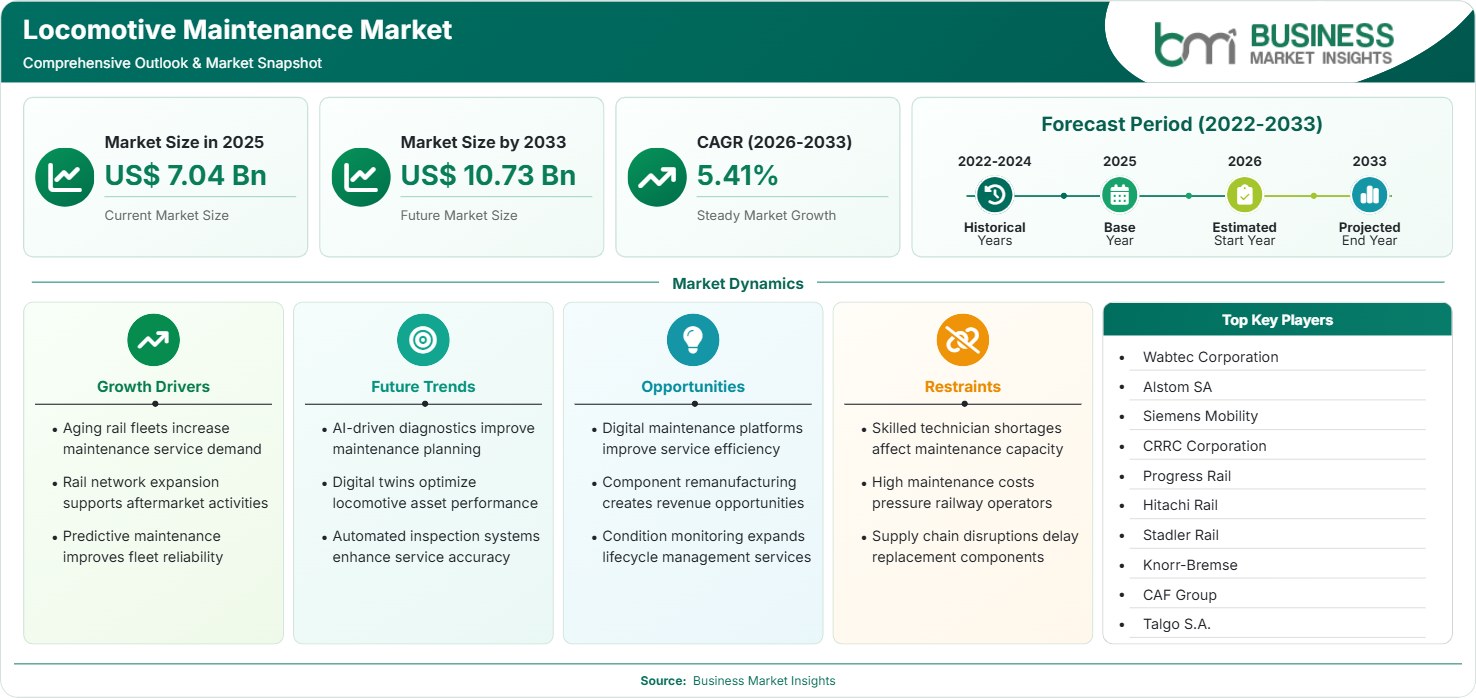
The Locomotive Maintenance Market size was valued at US$ 7.04 billion in 2025 and is projected to reach US$ 10.73 billion by 2033, growing at a CAGR of 5.41% during 2026–2033. Aging rail fleets, railway modernization programs, predictive maintenance adoption, and increasing investments in freight and passenger rail infrastructure are creating new service opportunities worldwide.

Report Coverage
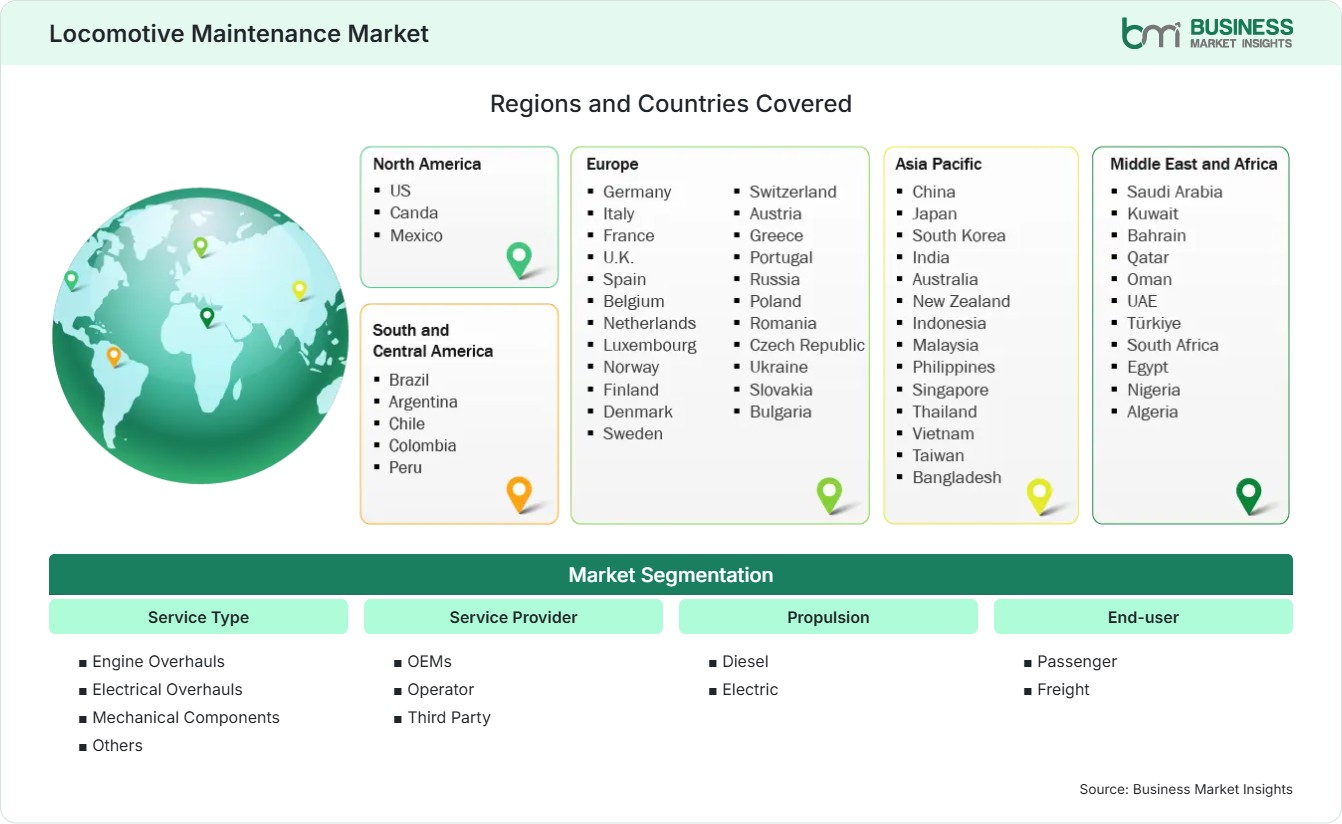
  • Service Type: Engine Overhauls, Electrical Overhauls, Mechanical Components, Others
  • Service Provider: OEMs, Operator, Third Party
  • Propulsion: Diesel, Electric
  • End-user: Passenger, Freight
US$ 7.04 Bn Market size in 2025
US$ 10.73 Bn Market Size by 2033
5.41% CAGR, 2026 - 2033
2026-2033 Forecast Period

AI Overview

Locomotive Maintenance Market Summary

  • North America Region: North America holds 31%–34% market share in 2025 and is projected to grow at a CAGR of 5.0%–5.5% during 2026–2033. Fleet modernization, freight rail activity, and digital maintenance adoption support regional expansion. The U.S. represents the largest contributor with a CAGR of 5.1%–5.6%, supported by Class I rail operators upgrading aging locomotive assets and adopting predictive maintenance systems.
  • Fastest Growing Region: Asia Pacific accounts for 27%–30% market share in 2025 and is expected to register a CAGR of 6.1%–6.6% due to railway expansion projects, high-speed rail investments, fleet electrification, and increasing demand for reliable passenger and freight transportation.
  • Leading Segment: Engine Overhauls represents 28%–31% market share in 2025 and is anticipated to grow at a CAGR of 5.4%–5.9%, driven by aging locomotive fleets, extended asset lifecycles, and demand for improved operational efficiency.
  • High Growth Segment: Electric Propulsion accounts for 44%–47% market share in 2025 and is projected to expand at a CAGR of 6.2%–6.7%, supported by railway electrification initiatives, emission reduction targets, and increasing electric locomotive deployment.
  • Key Market Opportunity: Digital maintenance platforms, predictive analytics, component remanufacturing, and condition monitoring solutions are creating opportunities for service providers to improve locomotive reliability and reduce lifecycle costs.
  • Major Market Players: Wabtec Corporation, Alstom SA, Siemens Mobility, CRRC Corporation, Progress Rail, Hitachi Rail, Stadler Rail, Knorr-Bremse, CAF Group, and Talgo S.A.
Strategic Insights

Locomotive Maintenance Market: Strategic Insights

Locomotive Maintenance Market Strategic Framework
FREE PDF
Request your free sample
Request free sample
Stakeholder View

Key Takeaways

  • Railway operators are shifting from traditional corrective maintenance models toward preventive and predictive approaches, creating demand for digital diagnostics and monitoring solutions across locomotive fleets.
  • Freight rail expansion and passenger transportation upgrades are generating strong opportunities for maintenance providers offering specialized overhaul, repair, and lifecycle management services.
  • Integration of artificial intelligence, sensor-based monitoring, and real-time analytics is transforming maintenance strategies by improving failure prediction and reducing unexpected downtime.
  • Asia Pacific presents strong investment potential due to rapid railway infrastructure development, electrification projects, and government initiatives supporting sustainable transportation networks.
  • Strategic partnerships between locomotive manufacturers, technology providers, and railway operators are increasing as companies seek integrated maintenance capabilities and long-term service contracts.
  • Component refurbishment and remanufacturing are gaining importance as operators aim to extend locomotive service life while controlling replacement and capital expenditure costs.
Geographic Outlook

Locomotive Maintenance Market Regional Highlights

North America Locomotive Maintenance Market

North America represents 31%–34% Locomotive Maintenance Market share in 2025 and is expected to grow at a CAGR of 5.0%–5.5% during 2026–2033. The region benefits from extensive freight rail networks, aging locomotive fleets, and increasing adoption of digital maintenance technologies. The U.S. remains the dominant contributor due to large freight operators, modernization programs, and rising investments in locomotive reliability improvement initiatives.

  • Freight rail operators are investing in predictive maintenance systems to improve asset utilization and reduce operational interruptions.
  • Aging locomotive fleets are increasing demand for overhaul, repair, and refurbishment services across major rail networks.
  • OEMs and third-party providers are expanding service capabilities through digital monitoring and maintenance contracts.
  • Rail infrastructure modernization programs continue supporting aftermarket maintenance activities.

US Locomotive Maintenance Market

The U.S. contributes 82%–85% of North American demand and is projected to register a CAGR of 5.1%–5.6% through 2033. Strong freight transportation activity, extensive locomotive fleets, and investments in technology-enabled maintenance solutions continue supporting market development. Rail operators are increasingly adopting condition-based maintenance approaches to improve efficiency and reduce lifecycle expenses.

  • Class I rail companies are adopting advanced analytics for locomotive performance monitoring.
  • Demand for engine overhaul services remains strong due to fleet aging.
  • Maintenance providers are expanding digital service offerings to improve customer support.
  • Government focus on rail safety continues encouraging regular inspection and maintenance programs.

Europe Locomotive Maintenance Market

Europe accounts for 24%–27% locomotive maintenance market share in 2025 and is projected to grow at a CAGR of 4.8%–5.3% during the forecast period. Railway electrification, sustainability initiatives, and modernization of passenger rail systems continue supporting maintenance demand. Germany leads regional activity, while Eastern European countries are witnessing higher growth due to rail infrastructure upgrades and fleet renewal programs.

  • Rail electrification projects are increasing demand for specialized electric locomotive maintenance services.
  • European operators are adopting digital platforms for predictive asset management.
  • Government sustainability targets support long-term railway modernization programs.
  • OEM service agreements remain important for maintaining advanced locomotive systems.

Asia Pacific Locomotive Maintenance Market

Asia Pacific holds 27%–30% locomotive maintenance market share in 2025 and is expected to achieve the fastest 6.1%–6.6% CAGR through 2033. Expanding rail networks, urban transportation development, and freight corridor investments are increasing maintenance requirements. China remains the largest market, while India demonstrates rapid growth through railway modernization, electrification programs, and increasing passenger rail capacity.

  • Large-scale railway infrastructure investments are expanding locomotive service requirements.
  • Electrification projects are increasing demand for specialized maintenance expertise.
  • Growing freight transportation networks require reliable locomotive availability.
  • Digital railway initiatives are accelerating adoption of advanced maintenance technologies.

Rest of World Locomotive Maintenance Market

The Rest of World region contributes 8%–11% market share in 2025 and is projected to grow at a CAGR of 5.3%–5.8% during 2026–2033. Latin America, the Middle East, and Africa are witnessing increased railway investments, particularly in freight transportation and mineral logistics. Modernization programs are encouraging operators to improve locomotive performance through maintenance and refurbishment services.

  • Brazil continues expanding freight rail operations, supporting locomotive maintenance demand.
  • Middle Eastern countries are investing in rail networks requiring long-term service capabilities.
  • African railway modernization projects are creating aftermarket maintenance opportunities.
  • Mining transportation networks continue generating demand for heavy-duty locomotive servicing.
Global Market Geography
FREE PDF
Request your free sample
Request free sample
Segment Analysis

Locomotive Maintenance Market Segmentation

Service Type

The service type segment plays a critical role in maintaining locomotive reliability, operational safety, and asset longevity across passenger and freight rail networks. It accounted for 28%–31% market share in 2025 and is expected to expand at a CAGR of 5.4%–5.9% during 2026–2033. Increasing locomotive age, rising overhaul requirements, and adoption of preventive maintenance strategies are shaping Locomotive Maintenance Market scope across global railway systems.

  • Engine Overhauls: Represents the largest service category due to increasing demand for engine refurbishment, performance restoration, fuel efficiency improvement, and extension of locomotive operational lifecycles.
  • Electrical Overhauls: Gains importance with increasing locomotive electrification and integration of advanced electrical systems requiring regular inspection, repair, and component replacement.
  • Mechanical Components: Supports steady demand through maintenance of braking systems, transmission units, wheel assemblies, suspension components, and other mechanical systems affecting locomotive reliability.

By Service Provider

Service providers influence maintenance efficiency through technical expertise, spare parts availability, and lifecycle support capabilities. This segment is projected to maintain steady expansion with a CAGR of 5.2%–5.7% during 2026–2033, supported by increasing outsourcing trends, OEM service agreements, and demand for specialized maintenance solutions. The growing complexity of locomotive systems is encouraging operators to collaborate with experienced service providers.

  • OEMs: Maintain strong demand due to original equipment expertise, genuine component availability, warranty support, and advanced maintenance programs for modern locomotive fleets.
  • Operator: Railway operators continue performing internal maintenance activities to control costs, maintain operational flexibility, and manage routine inspection and repair requirements.
  • Third Party: Independent maintenance providers are expanding through specialized services, competitive pricing, refurbishment capabilities, and support for aging locomotive fleets.

By Propulsion

The propulsion segment reflects changing railway technologies as operators transition toward cleaner and more efficient locomotive systems. It accounted for 44%–47% locomotive maintenance market share in 2025 and is projected to register a CAGR of 6.2%–6.7% during 2026–2033. Electrification initiatives, emission reduction targets, and modernization programs are increasing demand for advanced maintenance capabilities across propulsion systems.

  • Diesel: Continues generating maintenance demand due to widespread fleet deployment, particularly in freight operations, regional transportation, and routes lacking electrified infrastructure.
  • Electric: Experiences faster adoption as railway operators invest in electrification, energy efficiency, emission reduction, and advanced electric locomotive technologies requiring specialized maintenance services.

By End-user

The end-user segment is shaped by passenger mobility demand, freight transportation growth, and railway infrastructure investments. Increasing focus on operational reliability and service continuity is supporting maintenance requirements across both applications. The segment is projected to grow at a CAGR of 5.4%–5.9% during 2026–2033, driven by fleet modernization and lifecycle management initiatives.

  • Passenger: Demand is increasing due to expansion of urban rail networks, high-speed rail projects, and government investments focused on improving passenger transportation reliability.
  • Freight: Remains a major maintenance contributor as freight operators require continuous locomotive availability for industrial transportation, mining operations, and logistics networks.
Market Forces

Locomotive Maintenance Market Dynamics

Key Market Drivers

Aging rail fleets increase maintenance service demand

Many railway companies across the globe have aging locomotives that need constant checking, replacement of parts, and maintenance activities for efficient performance. Longevity of assets is leading to higher needs for overhauling, repair work, and modernization of such fleets. Operators are now considering maintenance techniques that will ensure reliability while minimizing capital outlay. Aging infrastructure and increasing freight transportation requirements are encouraging investment in specialized maintenance capabilities. These factors are strengthening Locomotive Maintenance Market growth by creating sustained demand for lifecycle support services, spare components, and technical expertise from OEMs and third-party providers.

Rail network expansion supports aftermarket activities

Expansion of passenger and freight rail networks is increasing the requirement for reliable locomotive servicing and aftermarket support. Investment in railways, urban transport and logistics services by governments and transportation agencies is resulting in more chances for maintenance companies. New locomotives need a long-term service contract, maintenance schedule and support of their parts during the whole period of operation. Higher connectivity of industrial regions and logistics centers raises the need for reliable rail transport. Maintenance companies are developing capabilities for various types of locomotives, creating more chances for the aftermarket on different levels of development of railway transport.

Predictive maintenance improves fleet reliability

Rail operators are increasingly adopting predictive maintenance technologies to identify potential failures before they impact operations. Sensor-based monitoring, digital diagnostics, and real-time performance tracking enable maintenance teams to optimize repair schedules and reduce unexpected downtime. These solutions improve asset availability by providing insights into engine performance, electrical systems, and mechanical components. The adoption of data-driven maintenance approaches is becoming a major part of Locomotive Maintenance Market trends, as operators seek improved safety, lower operating costs, and longer equipment lifecycles. Technology providers and maintenance specialists are developing integrated platforms that support smarter railway asset management.

Key Market Opportunities

Digital maintenance platforms improve service efficiency

Digital maintenance platforms are creating new opportunities by enabling centralized monitoring, automated reporting, and improved decision-making for railway operators. Cloud-based systems, artificial intelligence tools, and connected diagnostic solutions help maintenance teams manage complex locomotive assets more efficiently. These platforms support remote inspections, predictive analytics, and optimized scheduling, reducing operational disruptions. As railway networks become more technology-driven, service providers offering digital maintenance solutions can expand their value proposition beyond traditional repair services. Increasing adoption of connected rail technologies is expected to create long-term opportunities for companies developing advanced maintenance management platforms.

Component remanufacturing creates revenue opportunities

Component remanufacturing is gaining importance as railway operators seek cost-effective alternatives to purchasing new equipment. Refurbishing engines, electrical systems, and mechanical components helps extend locomotive lifespans while reducing waste and replacement expenses. Maintenance providers with remanufacturing expertise can support operators managing aging fleets and improving asset utilization. Growing focus on sustainability and resource efficiency is encouraging wider adoption of refurbished components across railway applications. This opportunity is particularly relevant in markets where fleet replacement cycles are longer and operators prioritize economical maintenance strategies.

Condition monitoring expands lifecycle management services

Condition monitoring technologies are expanding lifecycle management opportunities by providing continuous visibility into locomotive health and performance. Advanced monitoring systems allow operators to track component conditions, identify maintenance requirements, and optimize repair activities. These solutions support proactive decision-making and improve reliability across passenger and freight operations. Maintenance providers are increasingly combining monitoring services with inspection, repair, and advisory solutions to deliver integrated lifecycle management packages. As railway operators focus on maximizing asset value, condition monitoring is becoming an important opportunity area for technology-enabled maintenance service providers.

Market Restraints and Challenges

Skilled technician shortages affect maintenance capacity

Factor: The railway maintenance industry faces shortages of skilled technicians with expertise in advanced locomotive systems, electrical components, and digital diagnostic technologies. Limited availability of experienced professionals increases training requirements and workforce development costs for operators and service providers. Impact: Technician shortages can delay maintenance activities, reduce service capacity, and create operational challenges for railway companies managing large fleets. Organizations are investing in workforce training programs, automation tools, and knowledge transfer initiatives to address skill gaps and maintain efficient maintenance operations.

High maintenance costs pressure railway operators

Factor: Complex locomotive systems, specialized components, and frequent inspection requirements increase the overall cost of maintaining modern railway assets. Rising labor expenses, replacement component costs, and technology integration requirements create additional financial pressure for operators. Impact: Higher maintenance expenditure can affect profitability, particularly for operators managing extensive fleets or operating in cost-sensitive markets. Companies are adopting predictive maintenance solutions, optimized service schedules, and component refurbishment strategies to control expenses while maintaining locomotive reliability.

Company Analysis

Competitive Landscape

The competitive environment includes locomotive manufacturers, railway technology providers, and specialized maintenance service companies focusing on fleet reliability, modernization, and lifecycle management. Locomotive Maintenance Market analysis highlights increasing competition around predictive maintenance capabilities, digital monitoring solutions, component refurbishment, and long-term service agreements as operators seek cost-effective solutions for extending locomotive operational life.

Company Name

Overview

Products and Services relevant to this market

Wabtec Corporation

Global railway technology provider offering locomotive systems, maintenance solutions, and digital technologies for freight and transit operators.

Locomotive overhaul services, fleet modernization, digital monitoring platforms, locomotive components, and lifecycle maintenance solutions.

Alstom SA

International rail transportation company providing integrated railway systems, rolling stock, and maintenance services worldwide.

Locomotive maintenance programs, predictive maintenance solutions, spare parts, modernization services, and fleet support solutions.

Siemens Mobility

Railway technology company delivering mobility solutions, automation systems, and maintenance services for global rail operators.

Locomotive servicing, digital rail maintenance platforms, diagnostics, fleet management, and component lifecycle services.

CRRC Corporation

China-based rail equipment manufacturer with extensive locomotive production and maintenance capabilities.

Locomotive refurbishment, repair services, spare components, electric and diesel locomotive maintenance solutions.

Progress Rail

Caterpillar subsidiary specializing in railway products, locomotive services, and fleet optimization solutions.

Locomotive overhaul, remanufacturing, maintenance programs, propulsion systems, and railway technology solutions.

Hitachi Rail

Global railway solutions provider supporting passenger and freight operators with advanced rail technologies.

Predictive maintenance, train servicing, digital monitoring, component replacement, and lifecycle management services.

Stadler Rail

Swiss rail vehicle manufacturer providing customized rolling stock and maintenance support services.

Locomotive maintenance contracts, repair services, spare parts, fleet modernization, and technical support solutions.

Knorr-Bremse

Railway systems supplier specializing in braking technology and advanced rail components.

Brake system maintenance, component servicing, diagnostics, rail system upgrades, and aftermarket solutions.

CAF Group

Spanish railway manufacturer providing rolling stock solutions and maintenance services across international markets.

Fleet maintenance, overhaul services, spare parts, modernization programs, and railway engineering support.

Talgo S.A.

Railway manufacturer focused on passenger trains and lifecycle maintenance services.

Train maintenance contracts, technical assistance, refurbishment services, and fleet reliability solutions.

Trust & Transparency

Research Methodology

The market analysis combines proprietary research with secondary data from government agencies, company disclosures, regulatory filings, industry databases and expert interviews. Market estimates are validated through data triangulation, cross-market benchmarking and analyst review.

View Full Research Methodology

Questions Answered

Frequently Asked Questions

What does the Locomotive Maintenance Market Report cover?

The Market Report covers market dynamics, segmentation analysis, regional trends, competitive developments, technology adoption, investment opportunities, and future industry outlook across global railway maintenance services.

How are digital technologies changing locomotive maintenance?

Digital platforms, connected sensors, and analytics tools are enabling real-time monitoring, automated inspections, and improved maintenance planning, allowing operators to manage complex railway assets more efficiently.

Which service type holds major importance in locomotive maintenance?

Engine overhauls remain highly important due to aging locomotive fleets and the need to restore performance, improve efficiency, and extend the operational lifespan of existing railway assets.

Why are predictive maintenance solutions important for railway operators?

Predictive maintenance helps operators identify potential equipment failures earlier, reduce unexpected downtime, improve safety, optimize repair schedules, and extend locomotive service life through data-driven monitoring.

What is driving demand for locomotive maintenance services?

Increasing fleet age, railway infrastructure expansion, growing freight transportation requirements, and adoption of predictive maintenance technologies are driving demand for professional locomotive maintenance services worldwide.

Access the Full Locomotive Maintenance Market Report

Get segment-level forecasts, regional estimates, competitive benchmarking, company profiles and downloadable Excel datasets.

Access the full Locomotive Maintenance Market Report
350 pages PDF & Excel | 2026-08-21
Similar Research

Related Market Reports