
Automotive Torque Converter Market Outlook: Size, Share, Trends, Growth Analysis, Competitive Landscape & Forecast, 2022-2033

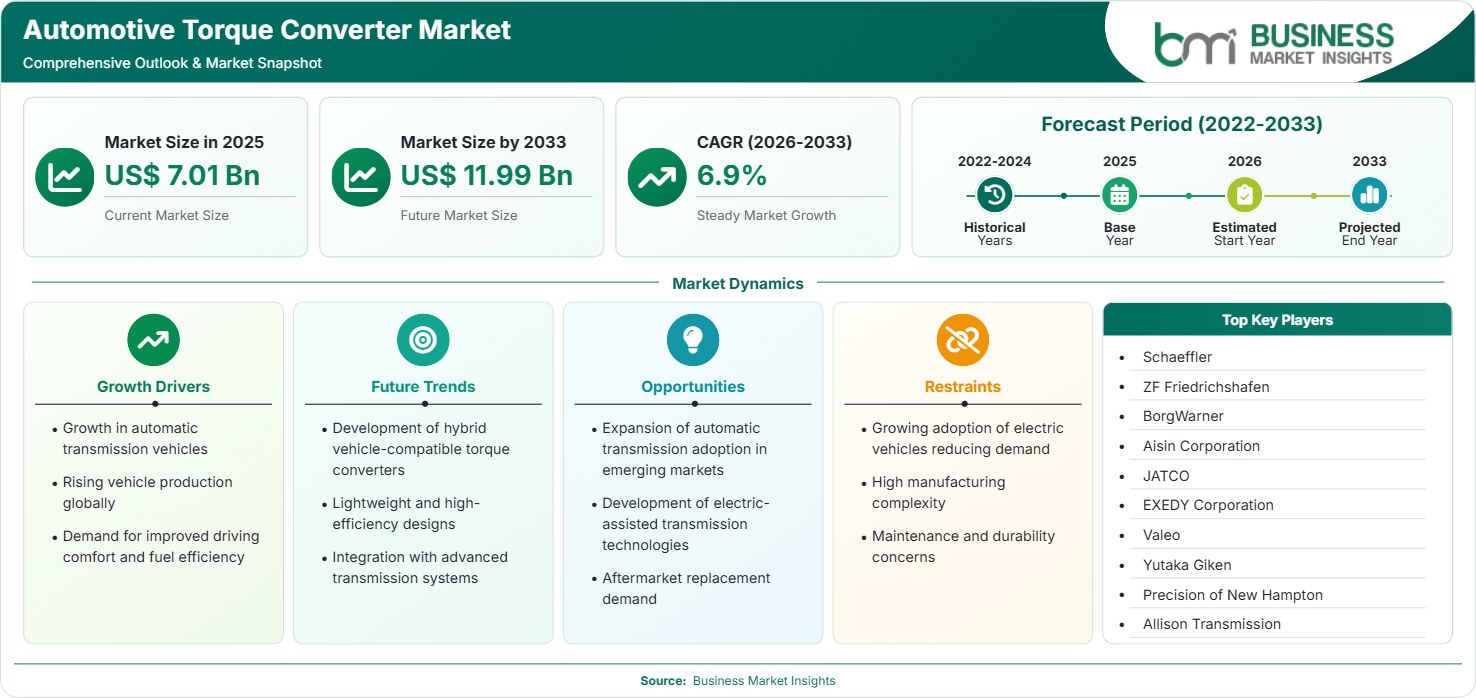
The Automotive Torque Converter Market was valued at USD 7.01 Billion in 2025 and is projected to reach USD 11.99 Billion by 2033, growing at a CAGR of 6.9% during 2026–2033. Market growth is driven by rising automatic transmission adoption, increasing vehicle production, fuel-efficiency regulations, and investments in hybrid drivetrains, creating opportunities for advanced lock-up clutch technologies and aftermarket solutions.

Report Coverage
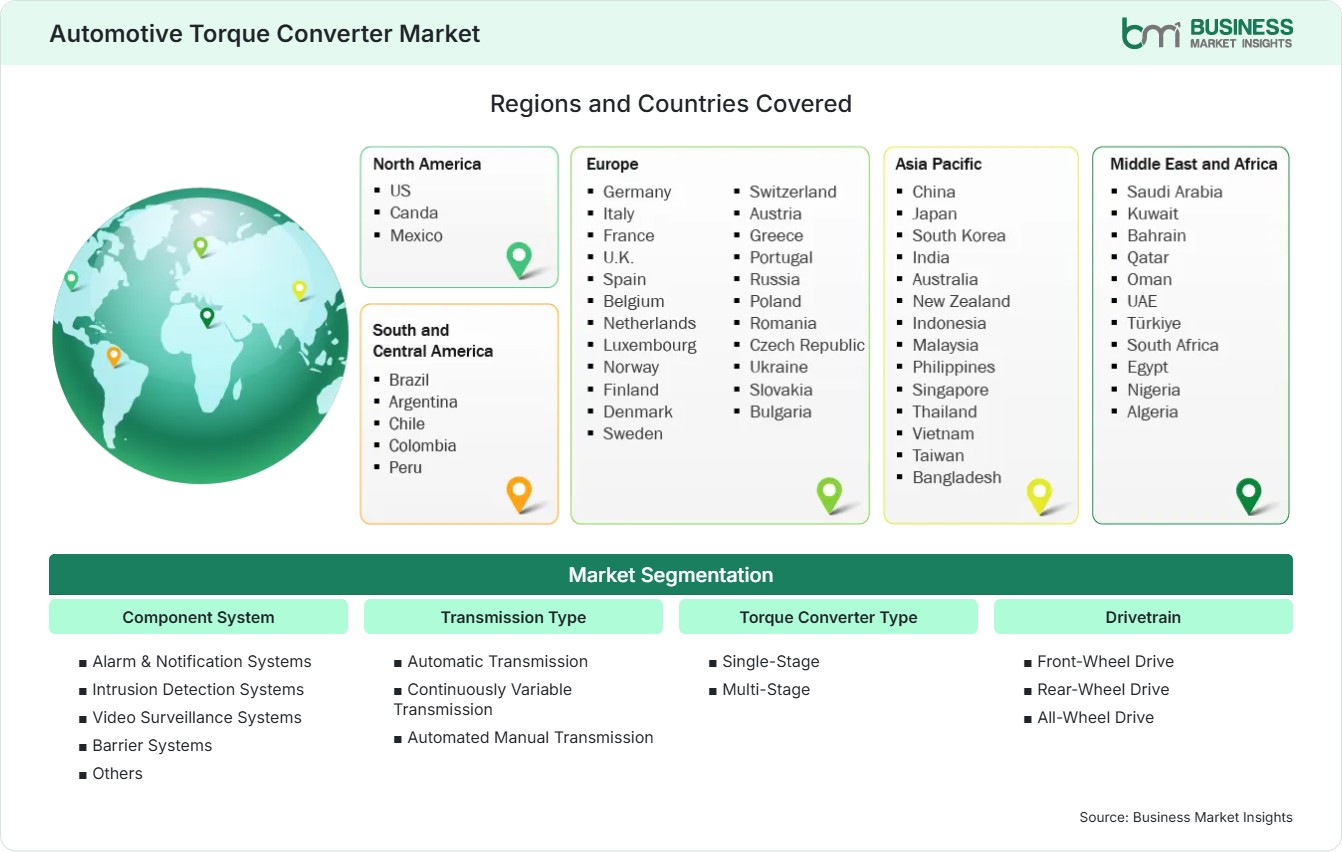
  • Component System: Alarm & Notification Systems, Intrusion Detection Systems, Video Surveillance Systems, Barrier Systems, Others
  • Transmission Type: Automatic Transmission, Continuously Variable Transmission, Automated Manual Transmission
  • Torque Converter Type: Single-Stage, Multi-Stage
  • Drivetrain: Front-Wheel Drive, Rear-Wheel Drive, All-Wheel Drive
  • Component: Complete Torque Converter Assembly, Lock-Up Clutch/TC Module Assembly
US$ 7.01 Bn Market size in 2025
US$ 11.99 Bn Market Size by 2033
6.9% CAGR, 2026 - 2033
2026-2033 Forecast Period

AI Overview

Automotive Torque Converter Market Summary

  • North America Region: North America holds 31%–34% of the market in 2025 and is expected to grow at a CAGR of 6.2%–6.8% during 2026–2033. Growth is supported by strong pickup truck demand, widespread automatic transmission adoption, manufacturing investments, and expanding hybrid vehicle production. The United States leads the region with a CAGR of 6.3%–6.9%.
  • Fastest Growing Region: Asia Pacific accounts for 29%–32% of the market in 2025 and is projected to grow at a CAGR of 7.5%–8.2% during 2026–2033, driven by expanding automotive manufacturing, increasing vehicle ownership, localized transmission production, and supportive industrial policies.
  • Leading Segment: Automatic Transmission represents 63%–66% of the market in 2025 and is forecast to grow at a CAGR of 6.9%–7.3%, supported by rising consumer preference, premium vehicle production, and improved transmission efficiency.
  • High Growth Segment: SUVs contribute 37%–40% of vehicle demand in 2025 and are expected to register a CAGR of 7.4%–7.9% through 2033 due to growing SUV sales, hybrid launches, and higher automatic transmission adoption.
  • Key Market Opportunity: Rising hybrid vehicle production creates opportunities for compact, lightweight, electronically optimized torque converters that improve drivetrain efficiency, reduce fuel consumption, and support advanced transmission systems.
  • Major Market Players: Schaeffler AG, ZF Friedrichshafen AG, BorgWarner Inc., Aisin Corporation, JATCO Ltd., EXEDY Corporation, Valeo SE, Yutaka Giken Co., Ltd., Precision of New Hampton, Inc., Allison Transmission Holdings Inc.
Strategic Insights

Automotive Torque Converter Market: Strategic Insights

Automotive Torque Converter Market Strategic Framework
FREE PDF
Request your free sample
Request free sample
Stakeholder View

Key Takeaways

  • Supply chains are becoming more regionalized, enabling stronger collaboration between OEMs, transmission manufacturers, component suppliers, and precision machining specialists to improve production flexibility.
  • The strongest long-term opportunity lies in automatic transmissions used in SUVs, premium passenger vehicles, and hybrid platforms, where higher efficiency supports fuel economy and lower operating costs.
  • Product innovation focuses on lightweight housings, optimized turbine blade geometry, advanced lock-up clutch systems, and digitally engineered hydraulic controls to improve efficiency while reducing vibration and energy loss.
  • Asia Pacific offers the most attractive investment opportunities due to expanding manufacturing capacity, rising vehicle demand, supportive industrial incentives, and continued localization of transmission production.
  • Strategic partnerships between OEMs and Tier-1 suppliers are accelerating technology commercialization, while investments in automation and precision machining strengthen competitiveness across OEM and aftermarket channels.
  • Sustainability initiatives encourage recyclable materials, energy-efficient production, predictive maintenance, and digital quality inspection systems to improve operational performance and regulatory compliance.
Geographic Outlook

Automotive Torque Converter Market Regional Highlights

North America Automotive Torque Converter Market

North America accounts for 31%–34% of the global market in 2025 and is projected to grow at a CAGR of 6.2%–6.8% during 2026–2033. The region benefits from a mature automatic transmission industry, strong light truck production, and continued investments by Tier-1 drivetrain suppliers. High automatic transmission adoption across passenger vehicles, SUVs, pickup trucks, and commercial vehicles supports its leading market position.

  • High automatic transmission penetration supports steady OEM demand, while replacement requirements for aging vehicle fleets strengthen aftermarket revenues and remanufactured torque converter demand.
  • Strong manufacturing capabilities across the United States and Mexico support efficient regional supply chains, lowering logistics costs and enabling localized production.
  • Rising hybrid vehicle adoption encourages development of lightweight lock-up clutch systems and advanced hydraulic technologies that improve transmission efficiency while meeting fuel economy standards.
  • Investments in Industry 4.0, precision machining, robotics, and automated quality inspection improve production efficiency and product quality.
  • Stable demand from logistics, construction, and industrial sectors supports heavy-duty automatic transmission production.

US Automotive Torque Converter Market

The United States represents approximately 25%–27% of global demand in 2025 and is projected to register a CAGR of 6.3%–6.9% through Automotive Torque Converter Market Forecasts. Domestic vehicle manufacturing, high automatic transmission penetration, and strong aftermarket replacement demand reinforce the country's leadership. Growing investments in hybrid vehicle production further stimulate demand for advanced torque converter technologies designed for improved drivetrain efficiency.

  • Major OEM manufacturing facilities continue increasing production of SUVs and pickup trucks, sustaining demand for high-capacity torque converters across multiple vehicle platforms.
  • Growing investments in automated transmission assembly lines improve manufacturing productivity while supporting next-generation converter designs with enhanced lock-up functionality and reduced rotational losses.
  • Independent repair networks and remanufacturing specialists expand aftermarket opportunities by offering cost-effective replacement solutions for aging passenger and commercial vehicle fleets.
  • Federal fuel economy standards encourage suppliers to develop lighter and more efficient converter assemblies capable of supporting reduced emissions without compromising vehicle performance.

Europe Automotive Torque Converter Market

Europe holds 24%–27% of the Automotive Torque Converter Market share in 2025 and is forecast to grow at a CAGR of 6.1%–6.7% through 2033. Germany leads regional production, while Central and Eastern Europe continue attracting automotive manufacturing investments. Advanced engineering capabilities, premium vehicle production, and increasing hybrid adoption support regional growth.

  • Germany remains the leading manufacturing hub, expanding at approximately 6.2%–6.7% CAGR.
  • Poland and Hungary continue attracting automotive component investments due to competitive production costs and expanding export-oriented manufacturing.
  • Premium vehicle manufacturers increasingly adopt advanced multi-stage torque converters to improve performance and fuel efficiency.
  • Strict EU emission standards continue driving innovation in lightweight materials, hydraulic systems, and electronically controlled lock-up clutch technologies.

Asia Pacific Automotive Torque Converter Market

Asia Pacific accounts for 29%–32% of global revenue in 2025 and is projected to register the fastest CAGR of 7.5%–8.2% during 2026–2033. Expanding automotive production across China, India, Japan, South Korea, and Southeast Asia, along with investments in localized transmission manufacturing, continues to strengthen regional Automotive Torque Converter Market growth.

  • China remains the largest regional producer with expanding automatic transmission manufacturing and hybrid vehicle production, growing at approximately 7.6%–8.2% CAGR.
  • India is among the fastest-growing markets as automatic transmission adoption increases across passenger vehicles and SUVs.
  • Japanese manufacturers continue advancing high-efficiency torque converter technologies through precision engineering and hybrid drivetrain development.
  • Southeast Asian countries strengthen regional supply chains by attracting foreign investment in automotive and transmission component manufacturing.

Rest of World Automotive Torque Converter Market

The Rest of World accounts for 11%–14% of global Automotive Torque Converter Market revenue in 2025 and is expected to grow at a CAGR of 6.5%–7.1% through 2033. South and Central America benefit from recovering automotive production, while the Middle East and Africa continue investing in commercial vehicle fleets and localized vehicle assembly.

Brazil leads South America, while Saudi Arabia, the UAE, and South Africa continue expanding automotive manufacturing through industrial diversification and vehicle assembly investments.

  • Brazil records stable demand through growing automatic transmission adoption and domestic passenger vehicle production.
  • Mexico strengthens export-oriented automotive manufacturing through integrated North American supply chains.
  • Gulf Cooperation Council countries continue investing in logistics and commercial transportation, supporting heavy-duty automatic transmission demand.
  • South Africa remains a key automotive manufacturing hub supported by export-oriented vehicle assembly and supplier development.
  • Rising vehicle ownership across emerging economies supports both OEM production and aftermarket torque converter replacement demand.
Global Market Geography
FREE PDF
Request your free sample
Request free sample
Segment Analysis

Automotive Torque Converter Market Segmentation

Vehicle Type

The Vehicle Type segment accounted for 34%–37% of the Automotive Torque Converter Market in 2025 and is projected to grow at a CAGR of 7.0%–7.5% during 2026–2033. Passenger vehicles remain the primary demand driver as automatic transmissions gain popularity for improved comfort, efficiency, and reduced driver fatigue. Growth in SUVs and commercial vehicles continues to expand market opportunities.

  • Hatchback/Sedan: Passenger cars remain a major demand segment due to rising automatic transmission adoption, improved fuel efficiency, and consumer preference for smoother urban driving.
  • SUVs: SUVs generate strong demand through higher torque requirements, expanding hybrid SUV launches, premium vehicle sales, and growing global consumer preference.
  • LCVs: Light commercial vehicles increasingly adopt automatic transmissions to improve fleet productivity, reduce driver fatigue, and enhance operational efficiency.
  • HCVs: Heavy commercial vehicles rely on high-capacity torque converters for improved load handling, drivetrain durability, and smoother power delivery across freight, mining, and construction applications.

Transmission Type

Transmission Type represents the largest segment with approximately 63%–66% Automotive Torque Converter Market share in 2025 and is forecast to register a CAGR of 6.9%–7.3% through 2033. Automatic transmissions dominate owing to superior driving comfort, fuel optimization, and widespread adoption across passenger vehicles, premium automobiles, and commercial transportation fleets worldwide.

  • Automatic Transmission: Dominates industry demand through broad OEM adoption, superior shift quality, compatibility with hybrid drivetrains, and continuous improvements in electronic transmission control technologies.
  • Continuously Variable Transmission: Gains traction in compact passenger vehicles because seamless power delivery, improved fuel economy, and lightweight transmission architecture support efficient urban mobility solutions.
  • Automated Manual Transmission: Continues serving cost-sensitive vehicle categories by combining mechanical efficiency with automated clutch operation, particularly across selected commercial and emerging market applications.

Torque Converter Type

Single-stage torque converters account for approximately 58%–61% market share in 2025 and are expected to grow at a CAGR of 6.6%–7.0% through the forecast period. Manufacturers increasingly optimize converter geometry, hydraulic flow characteristics, and lock-up clutch integration to improve efficiency while reducing rotational energy losses in modern automatic transmissions.

  • Single-Stage: Preferred for mainstream passenger vehicles due to balanced performance, manufacturing simplicity, lower production costs, and compatibility with modern automatic transmission architectures.
  • Multi-Stage: Increasingly adopted in high-performance vehicles, heavy commercial applications, and premium drivetrains requiring greater torque multiplication and enhanced operational efficiency.

Drivetrain

Front-wheel-drive applications contribute approximately 46%–49% of total demand in 2025 and are projected to grow at a CAGR of 6.8%–7.2% through 2033. Growing passenger vehicle production and compact vehicle manufacturing continue supporting drivetrain-specific torque converter demand while hybrid drivetrain development creates additional technology advancement opportunities.

  • Front-Wheel Drive: Maintains strong adoption because compact packaging, lower manufacturing costs, and widespread deployment across passenger cars improve overall drivetrain efficiency.
  • Rear-Wheel Drive: Remains important for premium sedans, sports utility vehicles, and commercial platforms requiring enhanced towing capability, balanced weight distribution, and higher torque handling capacity.
  • All-Wheel Drive: Experiences increasing demand from crossover vehicles and premium SUVs where enhanced traction, stability, and performance justify advanced automatic transmission integration.

Component

Complete torque converter assemblies hold approximately 68%–71% market share in 2025 while expanding at a CAGR of 6.8%–7.2% during the forecast period. OEM production continues emphasizing integrated assemblies that improve manufacturing efficiency, quality assurance, and long-term drivetrain reliability across passenger and commercial vehicle platforms.

  • Complete Torque Converter Assembly: Represents the primary OEM procurement category because integrated assemblies simplify vehicle production while ensuring consistent transmission performance and durability.
  • Lock-Up Clutch/TC Module Assembly: Experiences increasing adoption through efficiency-focused transmission upgrades, reduced slippage, improved fuel economy, and enhanced electronic transmission control integration.

By Sales Channel

OEM sales account for approximately 72%–75% of industry revenue in 2025 and are forecast to register a CAGR of 6.7%–7.1% through 2033. Vehicle production growth, long-term supply agreements, and increasing automatic transmission penetration continue supporting OEM procurement, while replacement demand steadily strengthens the independent aftermarket.

  • OEM: Original equipment manufacturers dominate procurement through long-term supplier partnerships, stringent quality standards, and growing production volumes across global automotive manufacturing facilities.
  • Aftermarket: Replacement demand expands steadily as aging vehicle fleets require remanufactured and replacement torque converters, creating opportunities for independent distributors, repair specialists, and transmission service providers.
Market Forces

Automotive Torque Converter Market Dynamics

Key Market Drivers

Growth in automatic transmission vehicles

The increasing adoption of automatic transmissions remains the primary driver of the Automotive Torque Converter Market growth. Consumers prefer automatic vehicles for greater driving comfort, smoother gear shifts, and reduced fatigue, particularly in urban traffic. Increasing automobile production, along with growing use of automatic transmissions, is contributing to market expansion. There is a development of small and efficient torque converters that are suitable for both regular power trains and hybrid power trains.

Rising vehicle production globally

Growing automotive production continues to generate steady demand for torque converters across passenger and commercial vehicles. Investments in manufacturing across China, India, Mexico, Southeast Asia, and Eastern Europe have strengthened regional supply chains and production efficiency. More vehicle production spurs investment by Tier-1 suppliers into automation and high-precision machine tooling, casting, and quality inspection. Vehicle manufacturers also want dependable suppliers that have manufacturing capabilities across several vehicle models.

Demand for improved driving comfort and fuel efficiency

Today's consumers expect cars to deliver smooth handling, low fuel consumption, and minimal emissions. The modern torque converters that use electronically-controlled lock-up clutches ensure low hydraulic losses and higher drivetrain efficiency. Automotive regulatory policies established by North American, European, Japanese, and other Asia-Pacific countries continue to motivate automotive companies to focus on enhancing transmission efficiency as part of their vehicle efficiency policies. The consistent innovation in materials such as friction materials, turbine blade configurations, alloys, and hydraulics ensures that carmakers can improve the durability of converters and increase their torque capacities.

Key Market Opportunities

Expansion of automatic transmission adoption in emerging markets

Emerging economies present one of the most attractive long-term investment opportunities as rising disposable incomes, expanding urbanization, and increasing vehicle ownership accelerate automatic transmission adoption. Countries including India, Indonesia, Thailand, Brazil, and several Middle Eastern markets continue witnessing strong growth in passenger vehicle demand supported by improving transportation infrastructure. These structural Automotive Torque Converter Market trends create favorable conditions for market forecasts, particularly as regional OEMs expand localized transmission manufacturing.

Development of electric-assisted transmission technologies

While battery-electric vehicles do away with traditional torque converters, hybrid electric vehicles still require advanced transmission systems to manage the output from combustion engines and provide support with electric motors. Companies that develop converters for hybrid applications can leverage their expertise in the growth of electric car manufacturing without relying solely on powertrain needs. Upcoming products will be based on lightweighting, minimal hydraulic energy loss, electronic control integration, and efficient thermal management systems that suit future-generation hybrid transmissions.

Aftermarket replacement demand

The aging vehicle fleets of North America, Europe, Latin America, and certain areas in Asia have ensured continued, stable demand for replacement applications of torque converters and other transmission components. The trend towards preventive maintenance among commercial fleet operators is rising due to the need to reduce downtime and prolong drivetrain lifespan. There is an increased effort on the part of independent repair shops and remanufacturers to invest in better diagnostics, automation of rebuild services, and high-quality replacement parts.

Market Restraints and Challenges

Growing adoption of electric vehicles reducing demand

Factor: Accelerating battery electric vehicle adoption reduces reliance on conventional automatic transmissions that require torque converters.

Impact: As governments strengthen zero-emission vehicle policies and manufacturers expand battery electric vehicle portfolios, long-term demand from traditional internal combustion platforms gradually moderates. While hybrid vehicles continue supporting industry revenues, the increasing penetration of pure electric drivetrains represents a structural challenge for suppliers focused primarily on conventional transmission technologies.

High manufacturing complexity

Factor: Precision engineering requirements, advanced metallurgy, and stringent quality standards significantly increase manufacturing complexity and production costs.

Impact: Torque converters require high-precision machining, balanced rotating assemblies, specialized welding, and rigorous quality validation to ensure durability and performance. Rising raw material prices, skilled labor shortages, and increasing energy costs further pressure manufacturer margins.

Company Analysis

Competitive Landscape

The competitive environment reflects ongoing Automotive Torque Converter Market analysis, characterized by strategic partnerships with OEMs, investments in lightweight transmission technologies, manufacturing automation, and hybrid-compatible drivetrain solutions. Leading suppliers continue expanding global production footprints while strengthening research capabilities to improve efficiency, durability, and transmission performance.

Company Name

Overview

Products and Services Relevant to this Market

Schaeffler AG

Global automotive technology supplier specializing in drivetrain, chassis, and transmission innovations for passenger and commercial vehicles.

Torque converters, transmission systems, clutch technologies, hybrid drivetrain components, precision bearings, and powertrain engineering solutions.

ZF Friedrichshafen AG

Leading transmission manufacturer supplying advanced mobility technologies across global automotive and commercial vehicle markets.

Torque converters, automatic transmissions, hybrid transmission systems, driveline technologies, and electronic control solutions.

BorgWarner Inc.

Tier-1 automotive supplier focused on propulsion efficiency and advanced transmission technologies.

Torque converter systems, lock-up clutch assemblies, transmission controls, hybrid propulsion technologies, and drivetrain solutions.

Aisin Corporation

Major Japanese automotive component manufacturer with extensive automatic transmission expertise.

Automatic transmissions, torque converters, transmission modules, hydraulic systems, and drivetrain components.

JATCO Ltd.

Specialized transmission manufacturer serving major automotive OEMs worldwide.

Automatic transmissions, continuously variable transmissions, torque converter technologies, and transmission engineering services.

EXEDY Corporation

Global supplier specializing in drivetrain and transmission components for passenger and commercial vehicles.

Torque converters, clutch systems, transmission components, friction materials, and aftermarket replacement products.

Valeo SE

International automotive technology company emphasizing electrification and powertrain efficiency.

Hybrid drivetrain technologies, transmission control systems, electronic components, and mobility solutions supporting transmission performance.

Yutaka Giken Co., Ltd.

Japanese automotive component manufacturer supporting drivetrain and powertrain production.

Transmission components, precision automotive assemblies, drivetrain parts, and engineered manufacturing solutions.

Precision of New Hampton, Inc.

North American manufacturer specializing in precision torque converter manufacturing and remanufacturing services.

Heavy-duty torque converters, remanufactured assemblies, OEM replacement products, and customized transmission solutions.

Allison Transmission Holdings Inc.

Global leader in commercial vehicle automatic transmission technologies.

Heavy-duty automatic transmissions, torque converters, propulsion systems, transmission electronics, and fleet support services.

Industry Activity

Recent Developments

November 2025

ZF Friedrichshafen AG announced the further development of its 8HP evo automatic transmission at IAA Mobility 2025. The updated transmission was designed for hybrid vehicle applications, featuring a modular architecture and improved efficiency to support the growing adoption of hybrid powertrains. The development highlights continued innovation in automatic transmission systems, including technologies related to torque transfer and lock-up functionality.

June 2025

ZF Friedrichshafen AG presented its hybrid drive solutions, including the advanced 8HP evo transmission concept, focusing on improved efficiency, flexible hybrid integration, and reduced emissions. The technology demonstrates the continued evolution of automatic transmissions for electrified vehicles.

January 2025

Allison Transmission Holdings Inc. launched the Allison 6000 Series transmission for the wide-body dump truck market. The transmission incorporates Allison’s patented torque converter technology and Continuous Power Technology to deliver smooth high-torque starts, improved durability, and performance in heavy-duty off-highway applications.

July 2024

BorgWarner Inc. announced that it is supplying a wet clutch and hydraulic control module for Buick’s new 2-speed hybrid transmission used in the GL8 PHEV van. Production began in June 2024, with the system designed to improve efficiency through low-drag torque, a compact design, and advanced hydraulic control technology for hybrid propulsion applications.

Trust & Transparency

Research Methodology

The market analysis combines proprietary research with secondary data from government agencies, company disclosures, regulatory filings, industry databases and expert interviews. Market estimates are validated through data triangulation, cross-market benchmarking and analyst review.

View Full Research Methodology

Questions Answered

Frequently Asked Questions

What does the Automotive Torque Converter Market Report help stakeholders evaluate?

The report enables manufacturers, investors, distributors, suppliers, and OEMs to assess competitive positioning, technology developments, regional opportunities, investment priorities, evolving customer demand, and future business strategies across the global industry.

How are hybrid vehicles influencing industry development?

Hybrid vehicles continue creating demand for lightweight, electronically controlled torque converters capable of improving drivetrain efficiency while supporting seamless interaction between internal combustion engines and electric motors. This trend encourages continuous product innovation among leading suppliers.

Which transmission category leads industry demand?

Automatic Transmission remains the dominant segment because it provides smoother driving performance, improved fuel economy, higher consumer acceptance, and broad compatibility with both conventional internal combustion and hybrid vehicle platforms.

Which region is expected to experience the fastest expansion?

Asia Pacific is projected to register the fastest growth due to expanding vehicle production, increasing automatic transmission penetration, supportive manufacturing policies, and investments in localized automotive supply chains across China, India, Japan, and Southeast Asia.

What are the primary factors driving the Automotive Torque Converter Market?

Increasing adoption of automatic transmissions, rising SUV production, stricter fuel-efficiency regulations, growing hybrid vehicle manufacturing, and continuous improvements in lock-up clutch technology are the primary demand drivers. Expanding global automotive production further supports OEM and aftermarket opportunities.

Access the Full Automotive Torque Converter Market Report

Get segment-level forecasts, regional estimates, competitive benchmarking, company profiles and downloadable Excel datasets.

Access the full Automotive Torque Converter Market Report
350 pages PDF & Excel | 2026-08-31
Similar Research

Related Market Reports