
LNG Bunkering Market Outlook: Size, Share, Trends, Growth Analysis, Competitive Landscape & Forecast, 2022-2033

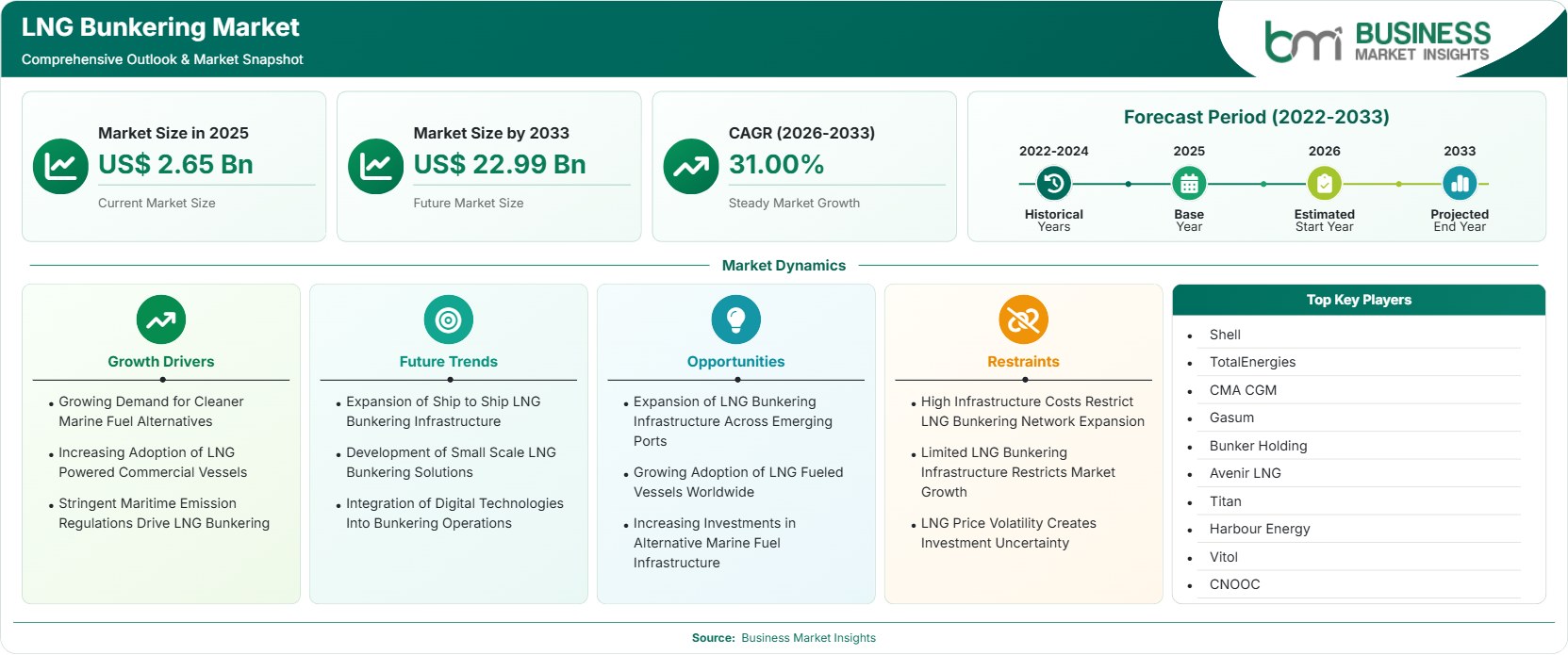
The LNG Bunkering Market size was valued at US$ 2.65 billion in 2025 and is projected to reach US$ 22.99 billion by 2033, growing at a CAGR of 31.00% during 2026–2033, driven by stricter marine emissions rules, fleet decarbonization, cleaner fuel adoption, port infrastructure expansion, and investment in alternative marine fuels.

Report Coverage
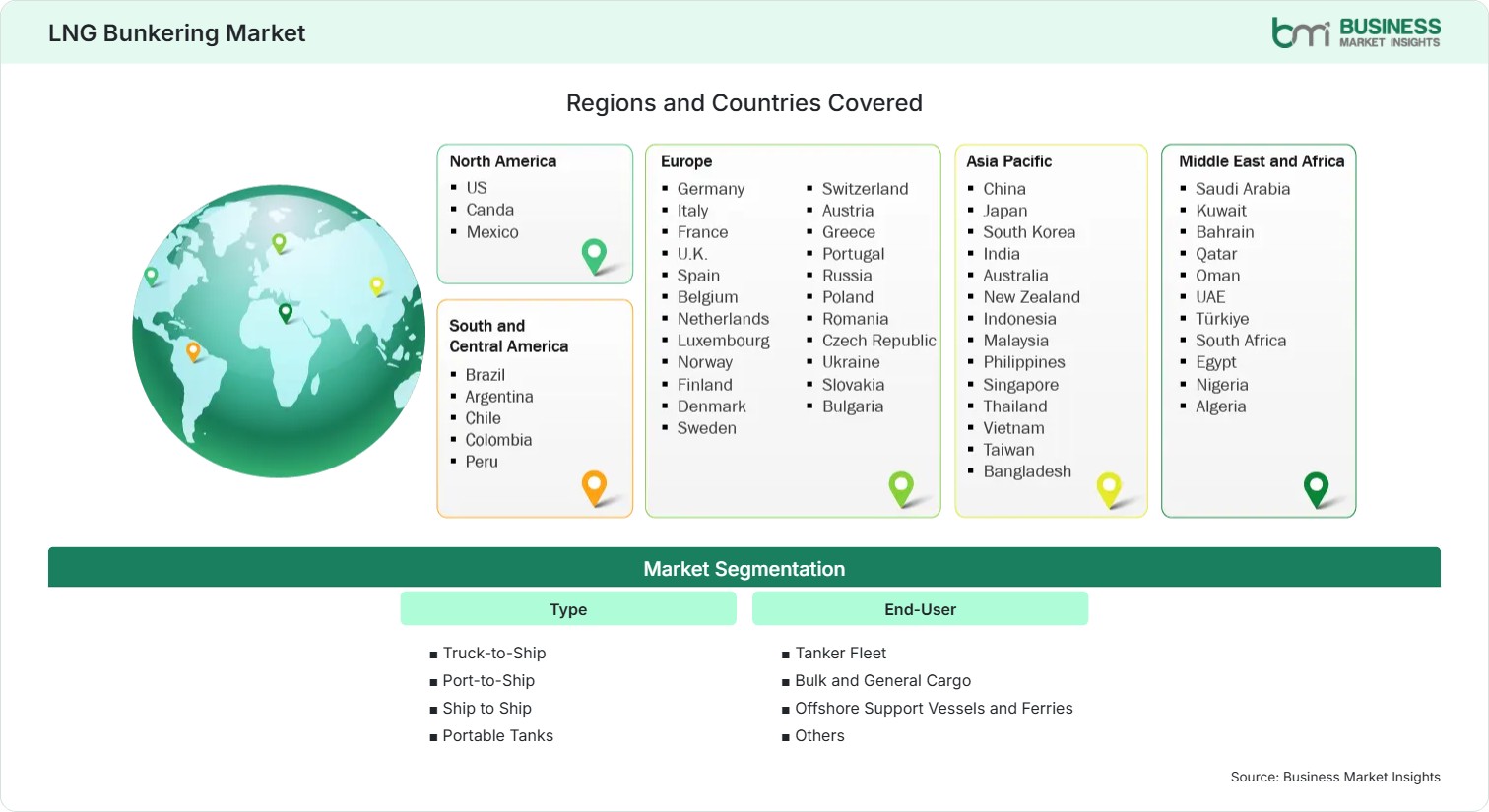
  • Type: Truck-to-Ship, Port-to-Ship, Ship to Ship, Portable Tanks
  • End-User: Tanker Fleet, Bulk and General Cargo, Offshore Support Vessels and Ferries, Others
US$ 2.65 Bn Market size in 2025
US$ 22.99 Bn Market Size by 2033
31.00% CAGR, 2026 - 2033
2026-2033 Forecast Period

01 AI Overview

LNG Bunkering Market Summary

  • North America Region: North America held an estimated 16%–20% share in 2025 and is projected to grow at a 28%–32% CAGR, supported by expanding LNG availability, marine fuel transition, Gulf Coast infrastructure, and increasing regulatory pressure. The U.S. market is projected to grow at a 29%–33% CAGR, supported by LNG supply availability, port development, and maritime decarbonization initiatives.
  • Fastest Growing Region: Asia Pacific held an estimated 42%–46% share in 2025 and is projected to expand at a 33%–37% CAGR, driven by extensive shipping activity, growing LNG vessel fleets, new bunkering infrastructure, and investment in cleaner marine fuels across major ports.
  • Leading Segment: Truck-to-Ship represented an estimated 38%–42% share in 2025 and is projected to grow at a 29%–33% CAGR, supported by flexible delivery, lower initial infrastructure requirements, port accessibility, and increasing bunkering demand from smaller LNG-powered vessels.
  • High Growth Segment: Offshore Support Vessels and Ferries represented an estimated 25%–29% share in 2025 and are projected to grow at a 32%–36% CAGR, supported by regional ferry networks, offshore operations, emission reduction targets, and fleet renewal programs.
  • Key Market Opportunity: Expansion of bunkering networks across emerging ports can unlock LNG adoption by improving fuel availability, reducing vessel deviation risks, and supporting shipping corridors.
  • Major Market Players: Shell plc, TotalEnergies SE, CMA CGM S.A., Gasum Oy, Bunker Holding A/S, Avenir LNG Limited, Titan LNG, Harbour Energy plc, Vitol Group, China National Offshore Oil Corporation.
02 Strategic Insights

LNG Bunkering Market: Strategic Insights

lng-bunkering-market-market-strategic-framework
FREE PDF
Request your free sample
Request free sample
03 Stakeholder View

Key Takeaways

  • The value chain increasingly connects LNG producers, traders, terminal operators, bunker suppliers, shipowners, ports, and logistics providers. Competitive advantage depends on reliable fuel availability, flexible delivery, and geographic coverage.
  • Truck-to-ship delivery offers a practical entry route for developing ports, while ship-to-ship bunkering is better positioned for large-scale operations requiring higher volumes and faster vessel turnaround.
  • The transition toward lower-emission marine fuels is encouraging investments in LNG-capable vessels and related infrastructure, although long-term fuel strategies increasingly consider bio-LNG and synthetic methane.
  • Asia Pacific provides the strongest expansion opportunity due to concentrated shipping activity, large commercial fleets, port development, and growing demand for cleaner marine fuels.
  • Infrastructure partnerships are becoming increasingly important as companies seek to share capital requirements and establish integrated LNG supply networks across strategic shipping routes.
  • Port operators and shipping companies that secure reliable bunkering capacity early can improve operational flexibility and reduce exposure to fuel availability constraints.
04 Geographic Outlook

LNG Bunkering Market Regional Highlights

North America LNG Bunkering Market

North America held an estimated 16%–20% share in 2025 and is projected to expand at a 28%–32% CAGR through 2033. The regional LNG Bunkering Market share is supported by abundant natural gas resources, established LNG infrastructure, and maritime activity along the Gulf and Atlantic coasts. The U.S. leads regional demand, while Canada offers opportunities around major ports and coastal shipping.

  • The U.S. benefits from extensive LNG production and export infrastructure, creating supply advantages for marine fuel applications and supporting the development of bunkering networks.
  • Gulf Coast ports represent important opportunities because proximity to LNG production and shipping infrastructure can reduce logistics complexity and improve fuel availability.
  • Canada is developing opportunities around coastal shipping and port operations as operators evaluate lower-emission fuel alternatives for marine transportation.
  • Growing interest in cleaner marine fuels is encouraging shipping companies to evaluate LNG alongside emerging options such as bio-LNG and future low-carbon fuels.

US LNG Bunkering Market

The U.S. represented an estimated 14%–18% share in 2025 and is projected to grow at a 29%–33% CAGR through 2033. The LNG Bunkering Market benefits from domestic LNG availability, established energy infrastructure, and extensive maritime trade. Major coastal ports provide opportunities for truck-to-ship and ship-to-ship operations as fleet operators evaluate lower-emission fuel options.

  • Abundant domestic natural gas supply provides a structural advantage for LNG availability and supports the economics of marine fuel distribution.
  • Gulf Coast infrastructure offers opportunities to connect LNG production, storage, transportation, and bunkering operations within an integrated supply network.
  • Coastal and inland marine operators are evaluating LNG-powered vessels where fuel availability and regulatory requirements support long-term adoption.
  • Port investments are likely to focus on flexible delivery models that can serve vessels before fixed infrastructure reaches sufficient utilization levels.

Europe LNG Bunkering Market

Europe held an estimated 28%–32% share in 2025 and is projected to grow at a 27%–31% CAGR through 2033. The region benefits from stringent emissions policies, established LNG import infrastructure, and major maritime hubs. Norway leads regional adoption, while Germany, the Netherlands, Spain, and France provide significant opportunities. Norway is projected to grow at a 29%–33% CAGR.

  • Norway remains a leading market due to established LNG maritime applications, strong ferry activity, and early adoption of cleaner marine fuel technologies.
  • The Netherlands benefits from major ports and logistics infrastructure, supporting ship-to-ship and truck-to-ship bunkering services across important European trade routes.
  • Germany offers opportunities through major commercial ports and growing demand for alternative fuels as shipping companies address emissions requirements.
  • Spain and France provide additional growth potential because of strategic port locations, LNG infrastructure, and increasing interest in lower-emission maritime operations.

Asia Pacific LNG Bunkering Market

Asia Pacific represented an estimated 42%–46% share in 2025 and is projected to grow at a 33%–37% CAGR through 2033. China, Singapore, South Korea, and Japan are leading LNG Bunkering Markets supported by major shipping activity, shipbuilding capabilities, port infrastructure, and growing LNG vessel deployment. China is projected to grow at a 35%–39% CAGR.

  • China benefits from extensive maritime trade, expanding LNG-powered fleets, and investments in coastal and inland bunkering infrastructure.
  • Singapore remains a strategic bunkering hub, supported by high vessel traffic, established port infrastructure, and growing alternative marine fuel capabilities.
  • South Korea combines strong shipbuilding expertise with increasing development of LNG-powered vessels, creating integrated opportunities across vessel supply and fuel infrastructure.
  • Japan's shipping industry and technology capabilities support demand for LNG bunkering as operators pursue lower-emission fleet strategies and modernize marine assets.

Rest of World LNG Bunkering Market

South and Central America accounted for an estimated 6%–8% share in 2025 and are projected to grow at a 25%–29% CAGR through 2033. Brazil leads regional potential, while Panama offers opportunities from transit shipping. The Middle East and Africa represented an estimated 7%–9% share and are projected to grow at a 23%–27% CAGR, supported by port modernization.

  • Brazil offers opportunities through extensive coastal shipping, offshore activity, and growing interest in cleaner fuels for marine transportation and energy logistics.
  • Panama provides strategic potential because of its major maritime transit position, creating demand for flexible bunkering services serving international vessel traffic.
  • The Middle East benefits from major ports and energy infrastructure, enabling opportunities to integrate LNG supply with emerging alternative marine fuel networks.
  • South Africa provides potential for future bunkering development because of its strategic shipping location and importance in international maritime trade routes.
global-market-geography
FREE PDF
Request your free sample
Request free sample
05 Segment Analysis

LNG Bunkering Market Segmentation

Type

Type is led by Truck-to-Ship, which accounted for an estimated 38%–42% share in 2025 and is projected to grow at a 29%–33% CAGR between 2026–2034. The LNG Bunkering Market trends increasingly favor flexible delivery models that require lower upfront investment than dedicated terminals, while ship-to-ship operations gain importance at high-volume ports.

  • Truck-to-Ship: Truck-based delivery provides flexible bunkering at ports without extensive fixed infrastructure, supporting early LNG adoption and serving smaller vessels operating on predictable routes.
  • Port-to-Ship: Dedicated port facilities enable reliable, higher-volume LNG transfers and support established bunkering hubs serving regular commercial shipping operations.
  • Ship to Ship: Ship-to-ship bunkering allows large quantities to be transferred directly between vessels, supporting efficient fueling at major ports and strategic maritime corridors.
  • Portable Tanks: Portable tanks provide flexible fuel storage and delivery for smaller vessels and specialized applications where permanent LNG bunkering infrastructure remains unavailable.

End-User

End-User demand is led by Tanker Fleet, representing an estimated 31%–35% share in 2025 and projected to grow at a 28%–32% CAGR through 2034. Fleet operators are evaluating LNG where vessel routes, fuel availability, and environmental requirements support conversion. Ferries and offshore vessels offer particularly strong opportunities due to recurring routes and centralized bunkering.

  • Tanker Fleet: Tankers can adopt LNG where long-term routes and fuel availability support lower-emission operations, particularly among operators modernizing vessels to meet environmental requirements.
  • Bulk and General Cargo: Cargo operators are evaluating LNG-powered vessels to reduce emissions while maintaining operational efficiency across established commercial shipping routes.
  • Offshore Support Vessels and Ferries: Recurring routes and centralized fueling make these vessels attractive for LNG adoption, particularly where emissions regulations and fleet renewal programs encourage cleaner propulsion.
  • Others: Other users include specialized marine vessels and emerging applications, creating opportunities as LNG infrastructure expands beyond major commercial shipping segments.
06 Market Forces

LNG Bunkering Market Dynamics

Key Market Drivers

Growing Demand for Cleaner Marine Fuel Alternatives

The shipping industry faces growing demands for emissions reduction, prompting owners to consider fuels that will help them cut down on local air pollutants. The use of LNG allows for lowering the emission of sulfur oxides and particles in comparison to standard fuels for ships and gives a way forward to low-carbon fuels like bio-LNG. It makes the LNG Bunkering Market growth driven by the need for transition options for fleet operators. The supply of fuel is being improved by the ports and fuel suppliers.

Increasing Adoption of LNG Powered Commercial Vessels

The growing number of ships that can utilize LNG as fuel reflects owners weighing fuel options that deliver good emissions performance alongside other needs. New ships are being ordered across categories, such as container ships, tankers, ferries, and offshore supply ships, to increase demand for consistent LNG availability. With the growing fleet, there is increasing pressure on ports to put in place bunkering facilities. There are also benefits in terms of consistent fuel use in the case of known shipping routes.

Stringent Maritime Emission Regulations Drive LNG Bunkering

Environmental standards at the international and regional levels are pushing ship owners to cut emissions and consider alternative fuel sources. Environmental requirements from the International Maritime Organization and regional regulations are increasing the pressure on clean shipping. LNG offers an existing solution for lowering multiple pollutants under regulations, which makes it a desirable option for ships sailing in ecologically sensitive regions. With increased demands for compliance, ship owners are considering options that are effective in terms of emissions, access, and ship lifetime.

Key Market Opportunities

Expansion of LNG Bunkering Infrastructure Across Emerging Ports

The development of new ports is crucial, as a shortage of fuel could restrict the use of LNG-fueled ships on longer routes. The creation of truck-to-ship networks may serve as a starting point, and a larger number of orders can justify port-based and ship-to-ship bunkering activities. According to the LNG Bunkering Market Forecast, strategic investments can result in the emergence of regional hubs supplying various classes of ships with LNG. Ports situated on key maritime trade routes are especially valuable, since they have potential for recurring orders.

Growing Adoption of LNG Fueled Vessels Worldwide

There is a structural opportunity arising from the growing number of LNG-fueled ships. As the number of ships increases, there will be a growing demand for bunkering facilities in both existing and developing ports. Shipping firms might prefer the route that guarantees fuel availability, leading to the development of the infrastructure in certain corridors. Suppliers can take advantage of this opportunity by offering bundled services for procurement, storage, transportation, and scheduling of fuel. There is also an opportunity for bio-LNG that could leverage existing LNG infrastructure.

Increasing Investments in Alternative Marine Fuel Infrastructure

There is increased investment in alternative marine fueling infrastructure as ports and shipping companies plan for their decarbonization in the long term. There is potential for the LNG infrastructure to serve as a transition fuel by providing a low-emission solution in the near term, while also supporting future fuels due to its flexible storage and transportation systems. There are efforts underway in multimodal terminals, flexible storage facilities, and digitized fuel management systems to increase efficiency in the use of fuel. Port locations with high-volume vessel traffic and existing LNG chains have the best investment potential.

Market Restraints and Challenges

High Infrastructure Costs Restrict LNG Bunkering Network Expansion

Factor: LNG bunkering requires specialized storage tanks, cryogenic equipment, safety systems, transfer facilities, and trained personnel, creating substantial capital requirements. Impact: The high cost of infrastructure can lead to delays in construction, especially when ports lack sufficient vessels to ensure effective asset utilization. Small ports might find it hard to have specialized facilities without having long-term agreements from the shipping companies. While truck-based delivery reduces the start-up costs, there is a need for broad infrastructure as the firm grows.

Limited LNG Bunkering Infrastructure Restricts Market Growth

Factor: LNG bunkering infrastructure remains concentrated in major maritime hubs, leaving gaps across emerging ports and secondary shipping routes. Impact: The lack of fuel may make it difficult to deploy vessels and discourage the operator from buying an LNG ship that will navigate a route with no access to fueling. There is a chicken-and-egg problem whereby the infrastructure needs to be put in place before the vessels can be acquired. The port and the vessel owner should make joint investments to solve this issue.

07 Company Analysis

Competitive Landscape

The competitive environment includes integrated energy companies, marine fuel suppliers, shipping groups, LNG specialists, trading companies, and national energy corporations. Companies are competing through fuel sourcing, bunkering infrastructure, vessel supply, port access, and long-term customer contracts. The LNG Bunkering Market analysis indicates that scale, geographic coverage, reliable LNG availability, and infrastructure investment are becoming central competitive advantages.

Company Name

Overview

Products and Services relevant to this market

Shell plc

Global energy company with extensive LNG production, trading, marine fuel, and bunkering capabilities.

LNG supply, marine fuels, LNG bunkering services, fuel logistics, and integrated energy solutions.

TotalEnergies SE

Integrated energy company active across LNG production, trading, marine fuels, and energy infrastructure.

LNG supply, marine fuel solutions, bunkering services, trading, and energy logistics.

CMA CGM S.A.

Global shipping company investing in LNG-powered vessels and lower-emission maritime transportation.

LNG-powered container shipping, fleet operations, marine fuel procurement, and decarbonization solutions.

Gasum Oy

Nordic energy company specializing in gas solutions and LNG distribution for maritime and industrial customers.

LNG supply, marine bunkering, LNG terminals, fuel distribution, and gas infrastructure services.

Bunker Holding A/S

Global marine fuel supplier providing bunkering and energy solutions across international shipping markets.

Marine fuels, LNG-related fuel solutions, bunkering logistics, trading, and fuel management services.

Avenir LNG Limited

LNG infrastructure company focused on small-scale LNG supply and marine bunkering solutions.

LNG carriers, bunkering vessels, small-scale LNG infrastructure, and marine fuel supply services.

Titan LNG

European LNG supplier specializing in marine fuel distribution and bunkering infrastructure.

LNG bunkering, bunker vessels, truck-to-ship services, and alternative marine fuel solutions.

Harbour Energy plc

Independent oil and gas company with exposure to natural gas and energy production activities.

Natural gas production, energy supply, LNG-related opportunities, and upstream energy resources.

Vitol Group

Global energy and commodities trading company active in fuel supply and marine energy markets.

LNG trading, marine fuels, energy logistics, fuel supply, and commodity trading services.

China National Offshore Oil Corporation

Major Chinese energy company with substantial natural gas and LNG supply capabilities.

LNG production, imports, natural gas supply, energy infrastructure, and marine fuel opportunities.


10 Trust & Transparency

Research Methodology

The market analysis combines proprietary research with secondary data from government agencies, company disclosures, regulatory filings, industry databases and expert interviews. Market estimates are validated through data triangulation, cross-market benchmarking and analyst review.

View Full Research Methodology

11 Questions Answered

Frequently Asked Questions

How will future marine fuel strategies affect LNG?

The LNG Bunkering Market Report indicates that LNG is likely to remain an important transition fuel while the industry develops lower-carbon options. Bio-LNG and synthetic methane could extend the relevance of existing LNG infrastructure if production scales and lifecycle emissions improve.

What limits LNG bunkering infrastructure expansion?

High capital requirements, specialized cryogenic equipment, safety needs, and uncertain demand at smaller ports can delay infrastructure development. Limited availability can also discourage shipping companies from expanding LNG-powered fleets.

Which vessels are most suitable for LNG adoption?

Ferries, offshore support vessels, tankers, and commercial cargo vessels can be suitable where routes are predictable and bunkering infrastructure is accessible. Recurring routes make fuel planning easier and improve infrastructure utilization.

Which bunkering method offers the strongest opportunity?

Truck-to-ship provides flexibility and lower initial infrastructure requirements, making it attractive for developing markets. Ship-to-ship operations offer greater efficiency for high-volume ports and established maritime fuel hubs.

What is driving demand for LNG bunkering?

Demand in the LNG Bunkering Market is supported by maritime emissions regulations, fleet decarbonization efforts, increased LNG-powered vessel deployment, and demand for cleaner alternatives to conventional marine fuels. Infrastructure expansion is also improving accessibility across major shipping corridors.

Access the Full LNG Bunkering Market Report

Get segment-level forecasts, regional estimates, competitive benchmarking, company profiles and downloadable Excel datasets.

Access the full LNG Bunkering Market Report
350 pages PDF & Excel | 2026-08-03