Market Summary
Executive Summary and Global Market Analysis
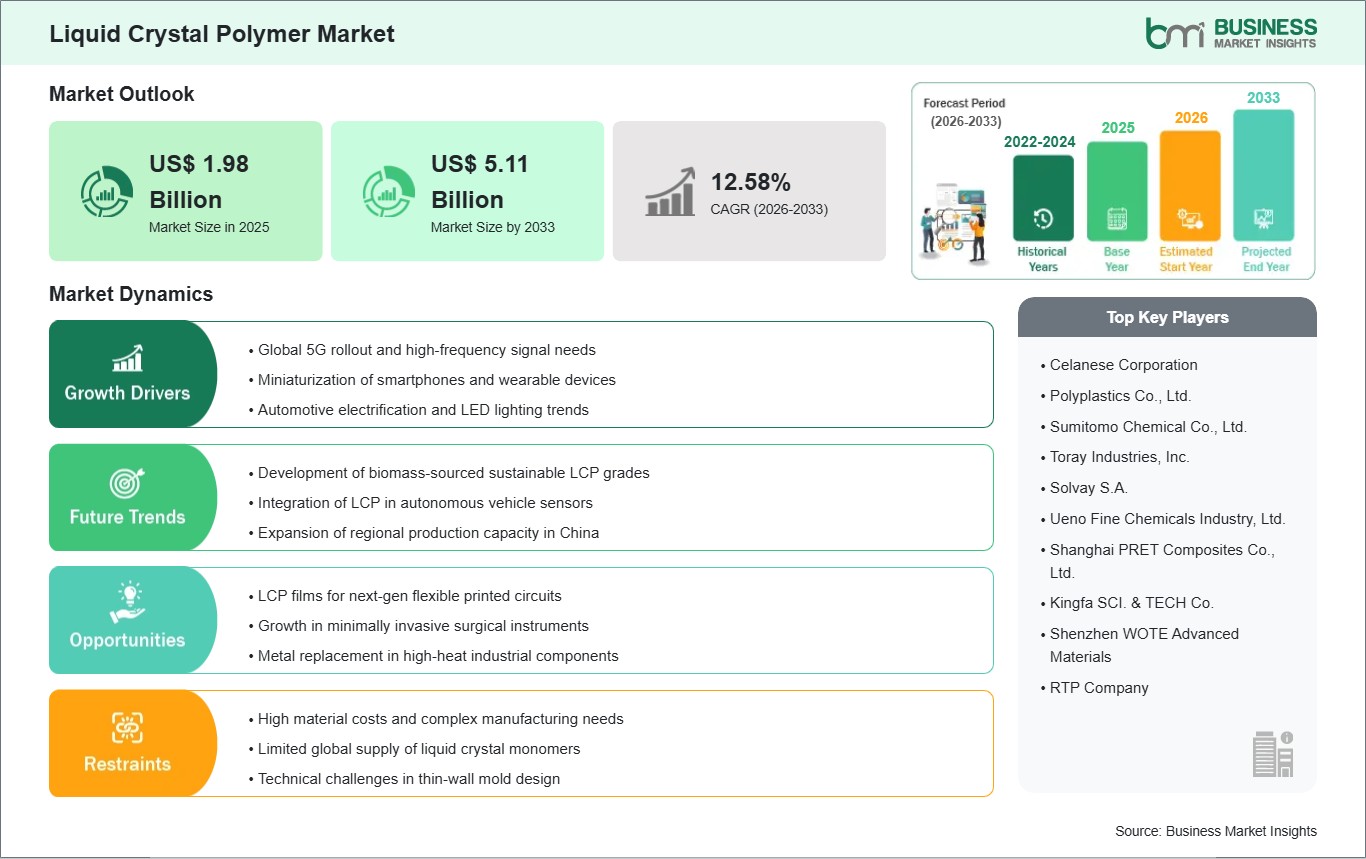
Liquid crystal polymer is a niche segment of the advanced materials market with significant value and is driven by the unrelenting pursuit of smaller, faster, and higher-temperature devices. LCPs are exclusively characterized by the ability of the materials to maintain structural integrity, chemical inertness, and electrical insulation above 200°C. Although the electronics market is the major driving force in terms of volumes, the automotive and medical markets are now gaining traction as the next major frontiers of growth. As of now, the market is characterized by thermotropic resins with the necessary molding precision for today’s micro-manufacturing and electronics packaging.
Strategic industry trends show a future for sustainable chemistry and flexible materials that can meet the needs of a circular economy. New technologies like bio-based LCP and ultra-thin LCP films are pushing the material's application frontiers to flexible electronics and sustainable consumer products. Despite the challenges of high material costs and technical skills required for processing, the future of LCP is ensured by its position as a critical material replacement for metals in high-stress applications. With global industries pushing for 5G connectivity, electrification of cars, and precision medicine, liquid crystal polymers are at the forefront of advancing materials science.
Segment Analysis
Liquid Crystal Polymer Market Segmentation
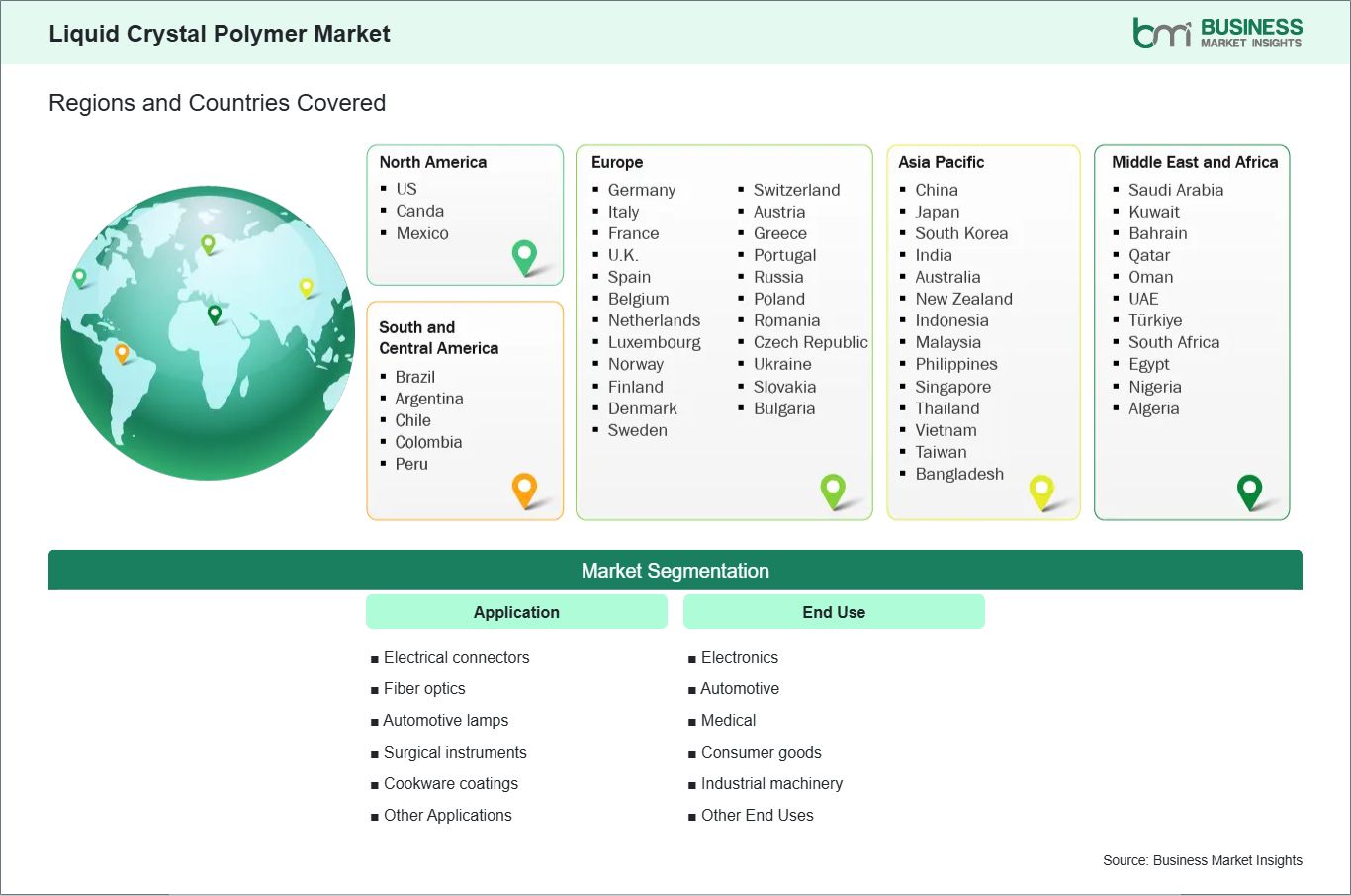
Key segments that contributed to the derivation of the Liquid Crystal Polymer market analysis are application and end use.
- By application, the liquid crystal polymer market is segmented into Electrical connectors, Fiber optics, Automotive lamps, Surgical instruments, Cookware coatings, and Other Applications. The Electrical connectors segment dominated the market in 2025.
- By end use, the liquid crystal polymer market is segmented into Electronics, Automotive, Medical, Consumer goods, Industrial machinery, and Other End Uses. The Electronics segment dominated the market in 2025.
Market Forces
Liquid Crystal Polymer Market Drivers and Opportunities
Global 5G rollout and high-frequency signal needs
The move to 5G technology is the most important driver of LCP demand, as it revolutionizes the types of materials used in telecommunications technology. Unlike the preceding generations of cellular technology, 5G technology uses much higher frequency bands, specifically in the millimeter band, where signal loss and dielectric interference are major problems with conventional materials such as polyimides. LCPs have a dielectric response that is nearly perfect, making it the only choice for signal integrity in high-speed data transmission applications. As telecommunications companies rapidly expand the number of 5G base stations and small cells, LCPs are used in the manufacture of antennas, phase shifters, and filters that must perform at the highest levels in a confined, heat-intense environment.
Beyond raw signal performance, the physical demands of 5G hardware favor LCP’s unique molecular structure. These systems often require incredibly thin, complex geometries to fit into the limited internal space of modern mobile devices and base stations. LCP’s excellent melt flow and exceptionally low thermal expansion allow for the injection molding of micro-components with a level of precision that other engineering plastics cannot match. This ensures that connectors remain vibration-resistant and dimensionally stable over a long operational life, even when exposed to the high heat generated by 5G processing power. This synergy between high-frequency electrical requirements and micro-scale mechanical needs positions LCP as the foundational material for the modern era of global connectivity.
Growth in minimally invasive surgical instruments
The medical sector is increasingly adopting liquid crystal polymers as a high-performance replacement for traditional materials like stainless steel and ceramics in surgical tools. As healthcare trends move toward minimally invasive procedures, there is a growing need for instruments that are both incredibly thin and exceptionally rigid. Because LCP can be molded into complex, ultra-thin shapes without losing its mechanical strength or stiffness, it has become the material of choice for the next generation of catheters, laparoscopic tools, and endoscopic housings. Furthermore, LCP’s inherent resistance to repeated gamma radiation and steam sterilization ensures that these devices remain reliable and safe over multiple use cycles, which is critical for cost-effective hospital operations.
The biocompatibility of LCP also opens significant opportunities in the realm of long-term implantable devices and neural probes. The material's chemical inertness ensures that it does not react with bodily fluids or cause adverse inflammatory responses, making it a safe candidate for sensitive internal medical applications. As medical technology advances toward robotic-assisted surgeries and smart implants, the demand for LCP-based sensors and high-precision structural components is creating a new, high-margin revenue stream for polymer manufacturers. By offering a material that combines the strength of metal with the design flexibility of a thermoplastic, LCP producers are enabling medical device designers to push the boundaries of what is possible in modern patient care.
Size and Share Analysis
Liquid Crystal Polymer Market Size and Share Analysis
The global Liquid Crystal Polymer market is experiencing steady growth, with market size and share analysis reflecting evolving treatment preferences and competitive dynamics among key players. The report evaluates important subsegments categorized within application and end use highlighting their respective contributions to overall market performance.
By application, the Electrical connectors subsegment dominated the market in 2025 because LCP offers exceptional thin-wall flowability and dimensional stability. This allows for high-pin-density connectors that can withstand the extreme heat of lead-free reflow soldering processes without warping.
By end use, the Electronics subsegment dominated the market in 2025 due to the massive global shift toward 5G and IoT. LCP’s low dielectric loss and high frequency performance make it the indispensable substrate for high-frequency antennas and micro-electronic packaging across the consumer tech landscape.
Report Coverage
Liquid Crystal Polymer Market Report Coverage and Deliverables
The "Liquid Crystal Polymer Market Size and Forecast (2022 - 2033)" report provides a detailed analysis of the market covering below areas:
- Liquid Crystal Polymer market size and forecast at the regional and country levels for segments covered under the scope
- Liquid Crystal Polymer market trends, as well as drivers, restraints, and opportunities
- Liquid Crystal Polymer market analysis covering key trends, regional framework, major players, regulations, and recent developments
- Industry landscape and competition analysis covering market concentration, heat map analysis, prominent players, and recent developments for the Liquid Crystal Polymer market
- Detailed company profiles, including SWOT analysis
Geographic Insights
Liquid Crystal Polymer Market Geographic Insights
The geographical scope of the Liquid Crystal Polymer market report is divided into: North America, Asia Pacific, Europe, Middle East & Africa, and South & Central America. North America held the largest share in 2025.
North America maintains a leading position in the liquid crystal polymer market, primarily due to its concentration of high-tech aerospace, defense, and medical device industries. The region is a global leader in the design and development of advanced communication satellites and military-grade electronics, both of which rely heavily on LCP for their thermal and dielectric properties. Furthermore, the presence of major medical technology clusters in the United States drives a consistent demand for LCP in surgical instruments and diagnostic equipment. North American companies often lead the way in patent filings and the commercialization of new LCP blends tailored for extreme environments.
The regional dominance is also bolstered by the rapid adoption of LCP in the automotive sector, specifically in the development of electric and autonomous vehicle systems. As North American automakers transition to electrified platforms, the need for high-temperature sensors and high-speed data connectors has increased significantly. While Asia remains a powerhouse for high-volume manufacturing, North America’s focus on high-value, R&D-intensive applications ensures it retains the highest market value. The region's strict quality standards and early integration of LCP into next-generation industrial standards provide a competitive edge that sustains its leadership in the specialty polymer space.
Industry Activity
Recent Developments
The Liquid Crystal Polymer market is evaluated by gathering qualitative and quantitative data post primary and secondary research, which includes important corporate publications, association data, and databases. A few of the key developments in the Liquid Crystal Polymer market are:
- In March 2022, Sumitomo Chemical, announced plans to expand production capacity for its SUMIKASUPER™ liquid crystal polymer by adding new production lines, aiming to meet growing demand from electronics applications.
- In October 2022, Polyplastics Co., Ltd., showcased its expanded LCP portfolio at K 2022, highlighting new grades designed for high-frequency electronics and automotive applications, along with strengthened global supply capabilities.
- In 2023, Celanese Corporation, announced continued expansion and strengthening of its Vectra® and Zenite® LCP product lines, focusing on miniaturized electronic components and high-performance automotive electrical systems.
Trust & Transparency
Research Methodology
The market analysis combines proprietary research with secondary data from government agencies, company disclosures, regulatory filings, industry databases and expert interviews. Market estimates are validated through data triangulation, cross-market benchmarking and analyst
review.
View Full Research Methodology
Key Sources Referred:
American Chemistry Council (ACC)International Council of Chemical Associations (ICCA)European Chemical Industry Council (Cefic)China National Building Materials Group (CNBM)Indian Minerals & Granite Exporters Association (IMGEA)Japan Mining Industry Association (JMIA)Brazilian Mining Association (IBRAM)Gulf Petrochemicals and Chemicals Association (GPCA)Company WebsitesCompany Annual ReportsCompany Investor Presentations