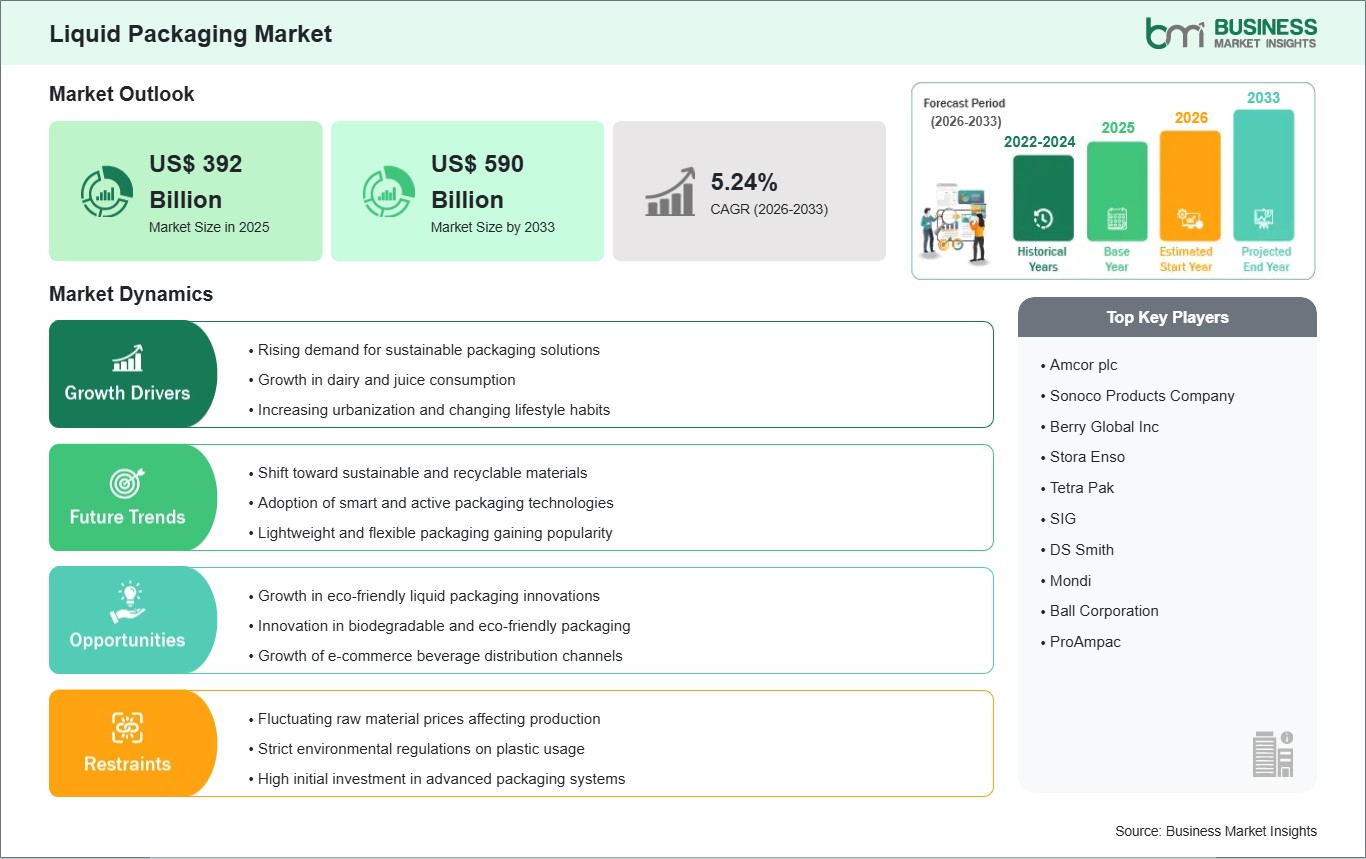
The Liquid Packaging Market size is expected to reach US$ 590 Billion by 2033 from US$ 392 Billion in 2025. The market is estimated to record a CAGR of 5.24% from 2026 to 2033.
Changes in how liquids are packaged today reflect changes in the ways that consumers are using liquids; specifically, the rise of regulations regarding packaging as well as the introduction of new materials used in packaging liquids. More consumers are trying to find convenience and on-the-go options for their liquid consumption and are becoming more aware of alternatives to rigid packaging (i.e., pouches, cartons, etc.) due to their lower weight and lower transportation costs and reduced environmental impact compared to traditional rigid packages. While rigidly packaged products will still be relevant for high-end products where durability and packaging design are very important factors; companies have a major commitment to sustainability by creating packaging that is recyclable, biodegradable, and utilizes a single type of material in an effort to meet more stringent environmental regulations as well as corporate ESG goals.
Technological innovations, such as aseptic packaging and smart labels, are extending product shelf-life and improving traceability and consumer engagement with products, resulting in greater product differentiation. Raw material volatility (plastic, paperboard, and aluminum) will continue to be a huge issue for companies in terms of supply chain management, leading them toward vertical integration and alternative sourcing methods for raw materials. The automation and digitalization of packaging processes will improve operational efficiency, thereby reducing the reliance on labor. Companies will continue to see increased competition through strategic alliances, product innovation, and geographic expansion in an effort to build their businesses.

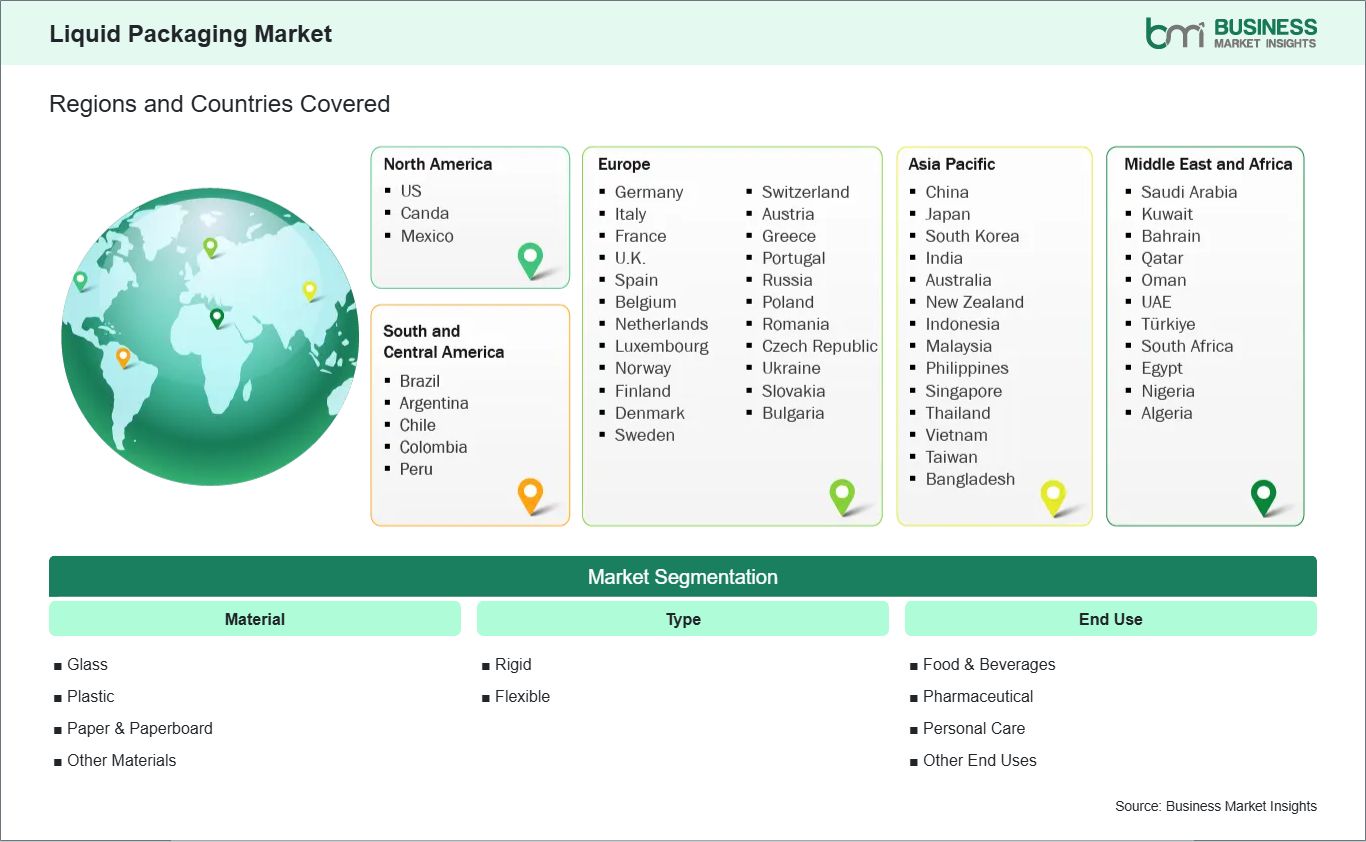
Key segments that contributed to the derivation of the liquid packaging market analysis are material, type, and end use.
The global liquid packaging market is being increasingly influenced by the focus on sustainability. The companies in this industry are increasingly adopting sustainable packaging options to cater to the ever-increasing expectations of the end-consumers. The focus on sustainability is leading to a shift from traditional packaging options to options that ensure sustainability without compromising the quality of the product. The companies in this industry are adopting sustainable packaging options by designing their packaging options to ensure sustainability, thereby reducing the pressure on resources and projecting a sense of corporate social responsibility. The focus on sustainability is one of the critical factors influencing the packaging industry. The focus on sustainability is leading to greater collaboration between players in the industry, with the focus being on exploring new options to ensure sustainability. The focus on sustainability is leading to differentiation and enhancing brand reputation in the competitive global market.
Innovation in terms of eco-friendly liquid packaging is emerging as one of the key growth drivers. Organizations are looking to incorporate different types of materials and designs that can help minimize the negative effects of their products on the environment. At the same time, they can ensure that their products remain convenient and accessible to users. The evolution of sophisticated designs in terms of packaging is helping companies to ensure that their products remain safe and can be transported efficiently. At the same time, they can adopt environmentally friendly materials. The use of such innovations is helping companies to achieve the demands of consumers and corporate social responsibility. The use of eco-friendly liquid packaging innovations is transforming the future of product display and interaction. Organizations are looking to adopt flexible and different types of materials that can help minimize the negative effects of their products on the environment. The use of such innovations is helping the global market to achieve both environmental and financial objectives.
The liquid packaging market demonstrates steady growth, with size and share analysis highlighting evolving trends and competitive dynamics among key players. The report examines subsegments categorized within material, type, and end use, offering insights into their contribution to overall market performance.
By Material, the plastic subsegment dominated the market in 2025, driven by its lightweight properties, cost-effectiveness, and versatility across various packaging applications.
Based on Type, the rigid subsegment dominated the market in 2025, owing to its durability, structural strength, and widespread use in beverage and pharmaceutical packaging.
On the basis of End Use, the food & beverages subsegment dominated the market in 2025, supported by increasing demand for packaged drinks, dairy products, and convenience foods.
| Report Attribute | Details |
|---|---|
| Market size in 2025 | US$ 392 Billion |
| Market Size by 2033 | US$ 590 Billion |
| Global CAGR (2026 - 2033) | 5.24% |
| Historical Data | 2022-2024 |
| Forecast period | 2026-2033 |
| Segments Covered | By Material
|
|
Regions and Countries Covered
| |
| North America | US, Canada, Mexico |
| Europe | Belgium, Austria, Finland, Denmark, Greece, Poland, Romania, Russia, Ukraine, Czech Republic, Slovakia, Bulgaria, Italy, Luxembourg, Germany, Switzerland, France, Netherlands, Norway, Portugal, Spain, Sweden, United Kingdom |
| Asia-Pacific | Australia, China, India, Japan, South Korea, Indonesia, Malaysia, Philippines, Singapore, Thailand, Vietnam, Bangladesh, New Zealand, Taiwan |
| South and Central America | Brazil, Argentina, Peru, Chile, Colombia |
| Middle East and Africa | Bahrain, Kuwait, Oman, Qatar, Saudi Arabia, United Arab Emirates, Turkiye, South Africa, Egypt, Algeria, Nigeria |
| Market leaders and key company profiles |
|
The "Liquid Packaging Market Size and Forecast (2022 - 2033)" report provides a detailed analysis of the market covering below areas:
The geographical scope of the Liquid Packaging Market report is divided into North America, Asia Pacific, Europe, Middle East & Africa, and South & Central America. North America held the largest share in 2025.
North America dominates the liquid packaging market, supported by a mature industrial base, advanced retail infrastructure, and high consumer demand for convenient, sustainable products. The United States and Canada are at the forefront of adopting eco-friendly solutions, including recyclable cartons, bottles, and flexible pouches, with companies investing heavily in innovative materials and smart packaging technologies to align with both regulatory requirements and consumer expectations. Europe is another significant market, driven by strict recycling regulations, high environmental awareness, and strong policy support for circular economy initiatives. Countries such as Germany, France, and the UK are leading in sustainable packaging development, while technological adoption, including automation and aseptic solutions, continues to enhance operational efficiency.
In the Asia Pacific region, rapid urbanization, rising disposable incomes, and growing demand for packaged beverages, dairy, and personal care products are fueling market growth. China, India, and Japan are key contributors, with cost-effective and scalable solutions being particularly critical for capturing this diverse and expanding consumer base. The Middle East and Africa show moderate growth, largely driven by bottled water, dairy, and ready-to-drink beverages, where packaging must ensure durability and product stability under extreme climatic conditions. Finally, South and Central America are emerging steadily, with countries such as Brazil and Mexico experiencing increasing demand for flexible and affordable packaging solutions, supported by improving retail networks and growing consumer awareness. Across all regions, the market is shaped by sustainability initiatives, technological advancements, and the need to balance cost efficiency with consumer expectations.

The Liquid Packaging Market is evaluated by gathering qualitative and quantitative data post primary and secondary research, which includes important corporate publications, association data, and databases. A few of the key developments in the liquid packaging market are:
The Liquid Packaging Market is valued at US$ 392 Billion in 2025, it is projected to reach US$ 590 Billion by 2033.
As per our report Liquid Packaging Market, the market size is valued at US$ 392 Billion in 2025, projecting it to reach US$ 590 Billion by 2033. This translates to a CAGR of approximately 5.24% during the forecast period.
The Liquid Packaging Market report typically cover these key segments-
The historic period, base year, and forecast period can vary slightly depending on the specific market research report. However, for the Liquid Packaging Market report:
The Liquid Packaging Market is populated by several key players, each contributing to its growth and innovation. Some of the major players include:
The Liquid Packaging Market report is valuable for diverse stakeholders, including:
Essentially, anyone involved in or considering involvement in the Liquid Packaging Market value chain can benefit from the information contained in a comprehensive market report.
Please tell us your area of interest
(Market Segments/ Regions and Countries/ Companies)