Market Summary
Executive Summary and Global Market Analysis
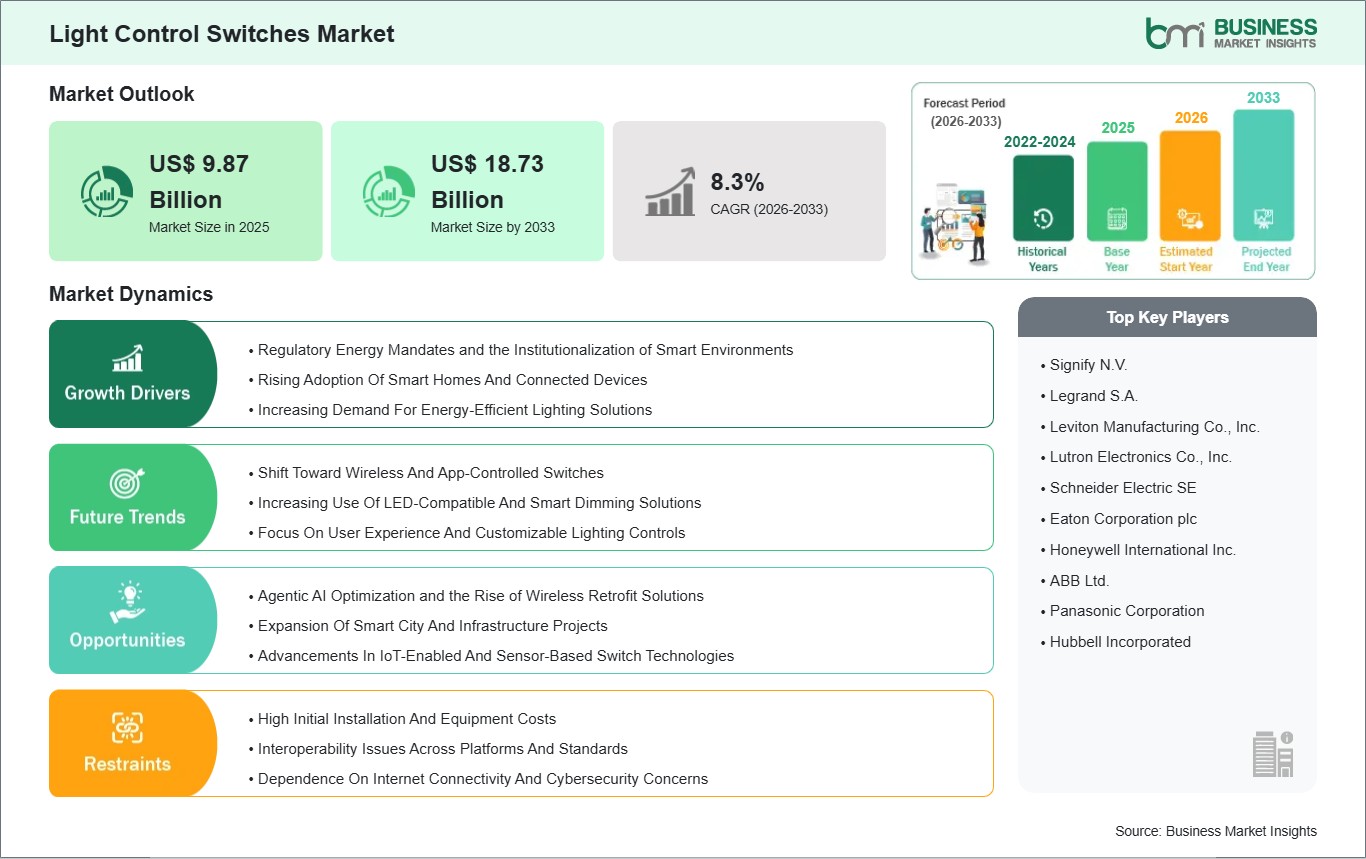
Light control switches refer to fundamental electrical interface devices designed to regulate the operation of lighting fixtures by completing or interrupting the flow of electrical current. Beyond traditional on-off functionality, modern control switches encompass a broad spectrum of hardware, including dimmers, occupancy sensors, timers, and smart integrated panels. Market expansion is fundamentally propelled by the rapid global adoption of LED lighting and the increasing integration of Internet of Things (IoT) connectivity in residential and commercial infrastructure.
However, several factors may restrain market development. The high initial cost of smart and integrated switch solutions, compared to legacy mechanical toggles, can deter adoption in budget-sensitive renovation projects. Technical challenges regarding interoperability remain a significant hurdle, as fragmented communication standards can complicate the seamless integration of switches from different manufacturers within a single building management system. Additionally, the industry faces challenges related to cybersecurity vulnerabilities in networked lighting controls, necessitating more rigorous firmware protection and encrypted data transmission to prevent unauthorized access to home or corporate networks.
Despite these hurdles, the market holds significant opportunities in the rise of AI-enabled adaptive lighting, where switches utilize machine learning to automatically adjust illumination based on user behavior and natural daylight levels. The expansion of Smart City initiatives requiring intelligent outdoor and roadway lighting controls, and the development of modular, aesthetically-driven switch designs for the luxury real-estate sector, are expected to support long-term development. Manufacturers are also finding growth potential in the healthcare and industrial sectors, where germicidal (UV) lighting controls and ruggedized, high-durability switches are increasingly required.
Segment Analysis
Light Control Switches Market Segmentation
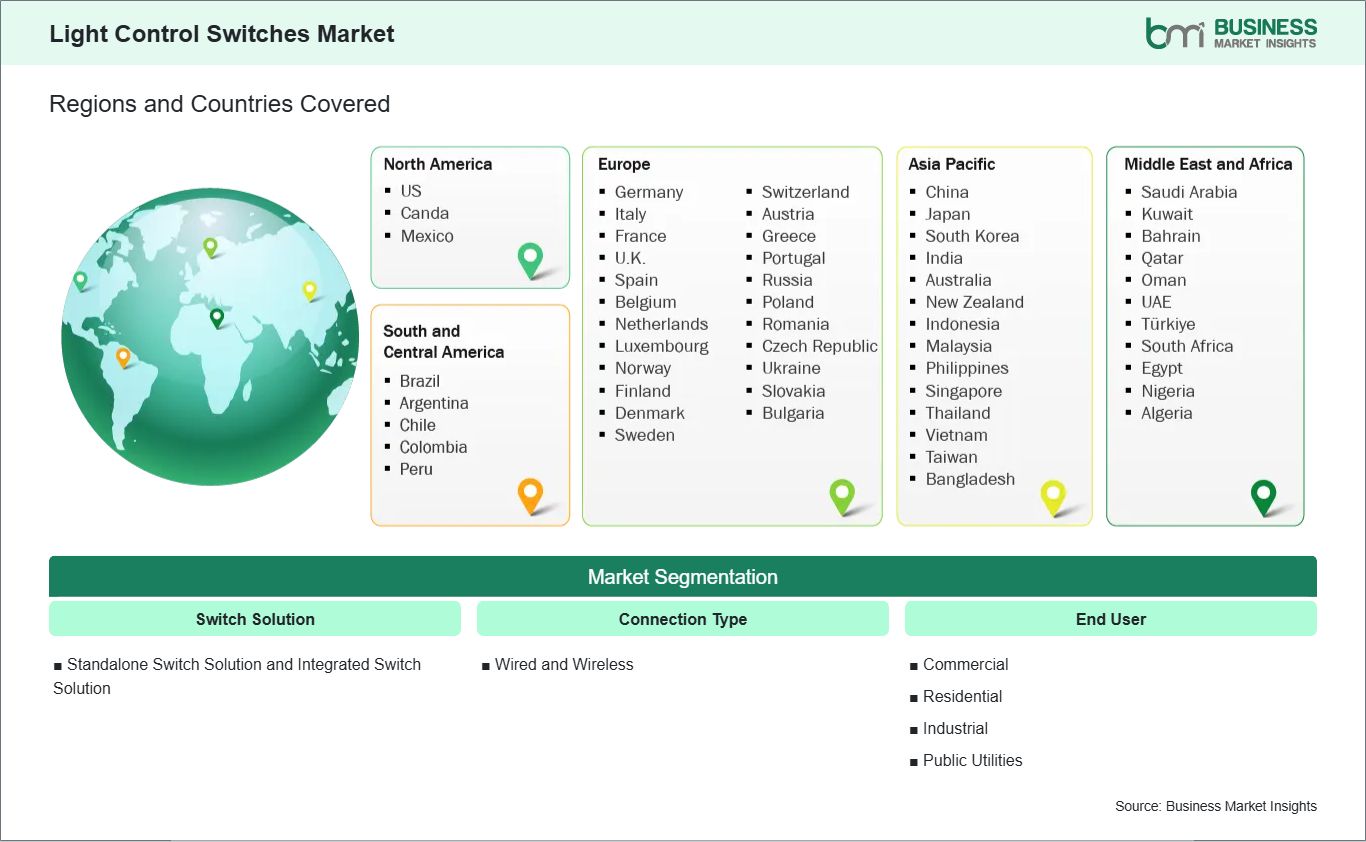
Key segments that contributed to the derivation of the Light Control Switches market analysis are switch solution, connection type, and end user.
- By Switch Solution, the market is segmented into Standalone Switch Solution and Integrated Switch Solution.
- By Connection Type, the market is divided into Wired and Wireless.
- By End User, the market is categorized into Commercial, Residential, Industrial, and Public Utilities.
Market Forces
Light Control Switches Market Drivers and Opportunities
Regulatory Energy Mandates and the Institutionalization of Smart Environments
The primary driver for the Light Control Switches Market is the systemic global requirement to minimize carbon footprints and maximize operational cost-efficiency in both the residential and commercial sectors. The Implementation of Stringent Energy Performance Directives and Building Codes acts as a foundational catalyst, as regulatory bodies, particularly in Europe and North America, mandate the use of dimmers and occupancy sensors to achieve mandatory sustainability targets. This momentum is further propelled by the Exponential Growth of LED Adoption, where the unique electronic properties of LEDs necessitate sophisticated control switches to prevent flickering and optimize the extended lifespan of the lighting source. In the technological sphere, the Rapid Proliferation of IoT-Enabled Smart Home Ecosystems serves as a vital driver, as consumers increasingly transition to plug-and-play wireless switches that offer remote access, voice-command compatibility, and seamless scheduling. Furthermore, the Surge in Global Infrastructure and High-Rise Commercial Construction is driving large-scale procurement, as developers prioritize integrated building management systems (BMS) to enhance asset valuation and attract premium tenants seeking modern, energy-efficient workspaces. Together, these factors, regulatory pressure, LED integration, and smart-building trends, ensure a robust and non-discretionary growth path for the global Light Control Switches Market.
Agentic AI Optimization and the Rise of Wireless Retrofit Solutions
A significant high-value opportunity lies in the convergence of Light Control Switches with Predictive AI and Energy Harvesting Technologies. Next-generation Agentic AI-Powered Light Switches are being developed to utilize occupancy patterns and ambient light telemetry to autonomously optimize illumination levels, providing a major growth frontier for facilities seeking to eliminate manual intervention while reducing energy consumption. There is also a significant growth frontier in the development of Kinetic-Energy and Battery-Free Wireless Switches; as organizations seek to avoid the high costs of rewiring existing buildings, the demand for peel-and-stick switches that generate their own power through mechanical action is accelerating. Furthermore, the expansion of Human-Centric and Circadian Lighting Controls presents a lucrative opportunity, as corporate and healthcare institutions invest in switches that automatically tune color temperatures to support occupant well-being and productivity. Beyond hardware, the rise of Light-as-a-Service (LaaS) and Managed Energy Platforms offers a unique frontier, where manufacturers bundle intelligent switches with cloud-based analytics to provide long-term energy savings as a subscription. Manufacturers who focus on Interoperable, Cross-Platform Compatibility (e.g., Matter and Thread) and those pioneering Sustainable, Recycled-Material Chassis are positioned to lead the global Light Control Switches Market.
Size and Share Analysis
Light Control Switches Market Size and Share Analysis
Based on connection type, the Wireless subsegment is registering significant expansion in the smart switch market. These switches are becoming essential for Agile Retrofitting and Scalable Smart Deployment, as organizations and households increasingly seek to reduce labor costs and avoid structural modifications. The adoption of Bluetooth Mesh, Zigbee, and Wi-Fi enabled controls allows for flexible installation, seamless integration with existing networks, and scalable deployment across diverse environments. By enabling remote management and adaptive control, wireless connectivity is rapidly strengthening its influence, positioning itself as a critical driver of next-generation smart infrastructure.
Report Coverage
Light Control Switches Market Report Coverage and Deliverables
The "Light Control Switches Market Size and Forecast (2022 - 2033)" report provides a detailed analysis of the market covering below areas:
- Market size and forecast at global, regional, and country levels for all market segments covered under the scope
- Market trends, as well as drivers, restraints, and opportunities
- Market analysis covering key trends, global and regional framework, major players, and recent developments
- Market concentration, heat map analysis, prominent players, and recent developments
- Detailed company profiles, including SWOT analysis
Geographic Insights
Light Control Switches Market Geographic Insights
The geographical scope of the Light Control Switches market report is divided into five regions: North America, Asia Pacific, Europe, Middle East & Africa, and South & Central America.
Asia Pacific maintains the most substantial market share, driven by rapid urbanization and extensive infrastructure projects. North America represents a significant revenue hub, characterized by a high concentration of key industry participants and a robust demand for smart home retrofitting. Europe is recognized for its stringent energy efficiency mandates and sophisticated consumer base prioritizing sustainable and automated building solutions. The Asia-Pacific Light Control Switches Market serves as the primary engine for global expansion, as emerging economies undergo massive digital and physical transformations. China remains the dominant regional force, supported by national smart city initiatives and an unparalleled manufacturing ecosystem for LED-compatible switching hardware. India is identified as one of the fastest-growing countries within this region, where the residential development boom and government-led energy conservation programs are accelerating the adoption of modular and sensor-based switches. The region's momentum is further sustained by the rising middle-class population and the widespread proliferation of smartphone-integrated home automation.
Industry Activity
Recent Developments
The Light Control Switches market is evaluated by gathering qualitative and quantitative data post primary and secondary research, which includes important corporate publications, association data, and databases. A few of the key developments in the Light Control Switches market are:
- In February 2026, Deako and Josh.ai announced a partnership integrating Deako`s modular smart switches and dimmers with Josh.ai`s AI-powered control platform. This collaboration enables builders, integrators, and homeowners to deploy premium, AI-ready lighting control systems that are flexible, reliable, and privacy-focused, expanding access to advanced smart home automation and reinforcing growth in the light control switches market.
- In January 2025, Aqara unveiled its latest lineup of smart home devices at CES 2025, including new in-wall control panels and smart switches such as the Panel Hub S1 Plus, Touchscreen Dial V1, Touchscreen Switch S100, and the next-generation Light Switch p and Dimmer Switch p for North America. These devices feature intuitive touchscreen interfaces, dual-protocol connectivity (Thread and Zigbee), and Matter interoperability, reinforcing Aqara`s leadership in the light control switches market and supporting a seamless, future-proof smart home experience.
Trust & Transparency
Research Methodology
The market analysis combines proprietary research with secondary data from government agencies, company disclosures, regulatory filings, industry databases and expert interviews. Market estimates are validated through data triangulation, cross-market benchmarking and analyst
review.
View Full Research Methodology
Key Sources Referred:
World Bank & Global Trade IndicatorsWorld Trade Organization (WTO)(International Monetary Fund )IMFInternational Trade Administration (ITA)Company websiteCompany annual reportsCompany investor presentations