Joint Pain Injections Market Regional Highlights
North America Joint Pain Injections Market
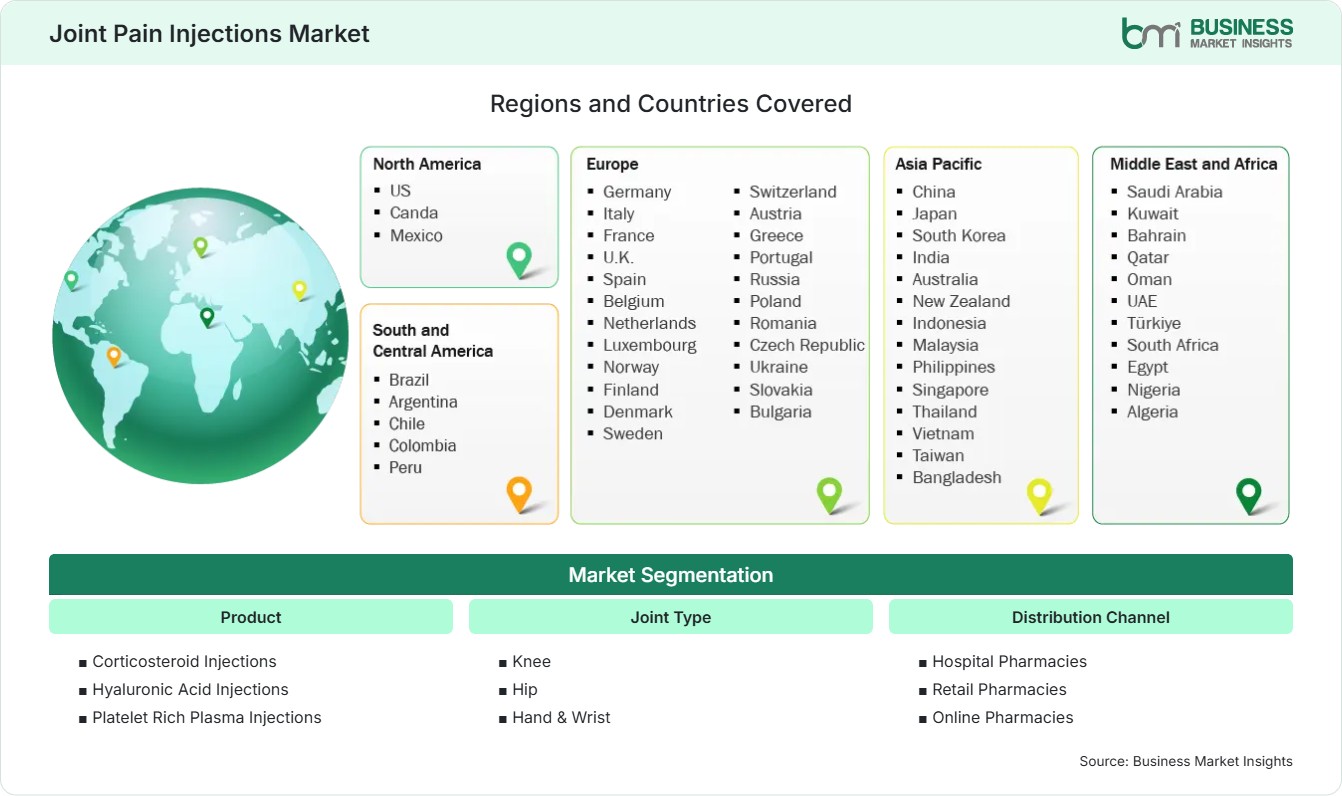
North America represents 36%–39% Joint Pain Injections Market share in 2025 and is expected to grow at a CAGR of 8.7%–9.4% during 2026–2033. The region benefits from mature orthopedic care, established specialist networks, broad product availability, advanced outpatient infrastructure, and diversified treatment options. The United States remains the dominant contributor, while Canada provides additional opportunities through specialist services and growing demand for conservative joint management. The Market is supported by established clinical workflows and strong product differentiation.
- Mature orthopedic networks support recurring injection procedures and allow manufacturers to develop strong physician relationships across hospitals, clinics, and ambulatory treatment centers.
- Reimbursement considerations influence product selection, encouraging companies to demonstrate appropriate patient selection, treatment value, administration convenience, and durable therapeutic positioning.
- Single-injection formulations can improve scheduling efficiency while reducing treatment visits, making convenience an increasingly important factor in physician and patient decisions.
- Regenerative therapies provide premium opportunities within specialist practices where patients seek individualized nonsurgical treatment and clinicians have experience with biologic procedures.
US Joint Pain Injections Market
The United States contributes an estimated 78%–82% of North American revenue and is projected to register a CAGR of 8.8%–9.5% during 2026–2033. Strong specialist density, pharmaceutical distribution infrastructure, orthopedic expertise, and established outpatient treatment pathways support adoption. The U.S. market includes corticosteroid, hyaluronic acid, and platelet-rich plasma therapies, with knee treatment remaining central. Manufacturers increasingly compete through clinical positioning, product convenience, physician education, patient support, and differentiated administration schedules.
- Orthopedic and pain-management clinics provide efficient channels for injection products that fit established outpatient treatment protocols and physician administration workflows.
- Payer requirements influence repeat utilization and encourage manufacturers to establish clear treatment criteria, evidence-based positioning, and economically defensible value propositions.
- Specialty salesforces and physician education remain important because product selection often depends on familiarity with formulation characteristics, dosing schedules, and expected treatment duration.
- Commercial adoption of regenerative approaches is creating an additional premium segment within sports medicine and private specialty-care settings.
Europe Joint Pain Injections Market
Europe accounts for 27%–30% Joint Pain Injections Market share in 2025 and is projected to grow at a CAGR of 8.9%–9.7% during 2026–2033. Germany, France, Italy, the United Kingdom, and Spain represent major commercial markets, while selected Central and Eastern European countries offer faster expansion potential. Differences in reimbursement, clinical practice, specialist purchasing, and healthcare organization create varied adoption patterns. Local pharmaceutical capabilities and established HA expertise also support product development, regional distribution, and international commercialization.
- Germany provides an attractive combination of specialist orthopedic capacity, established healthcare infrastructure, and demand for conservative treatment before surgical intervention.
- France and Spain offer opportunities through established specialist networks and healthcare systems where physician familiarity can support recurring use of injection-based therapies.
- Italy provides a strong environment for hyaluronic acid innovation and commercialization because of its established pharmaceutical manufacturing and musculoskeletal product capabilities.
- The United Kingdom places greater emphasis on healthcare value and evidence, increasing the importance of differentiated outcomes and cost-conscious commercial positioning.
Asia Pacific Joint Pain Injections Market
Asia Pacific holds 22%–25 share in 2025 and is expected to achieve the fastest 11.2%–12.0% CAGR during 2026–2033. Japan, China, South Korea, Australia, and India represent key opportunities, while selected Southeast Asian markets provide additional expansion potential. Increasing healthcare investment, orthopedic infrastructure development, specialist availability, demographic aging, and awareness of nonsurgical treatment are supporting adoption. Joint Pain Injections Market growth is particularly attractive where private healthcare systems are expanding specialist treatment capacity.
- Japan provides a structurally attractive environment because established orthopedic care and demand for mobility-preserving treatment support recurring conservative management.
- China offers scale through expanding hospital capacity, specialist development, domestic manufacturing capabilities, and growing availability of advanced orthopedic injection products.
- India presents substantial volume potential as private orthopedic clinics expand and patients increasingly consider nonsurgical approaches before surgical escalation.
- South Korea and Australia provide technologically advanced environments for premium products, specialist procedures, image-guided treatment, and regenerative medicine development.
Rest of World Joint Pain Injections Market
The Rest of World region accounts for 11%–14% market share in 2025 and is forecast to expand at a CAGR of 9.8%–10.7% during 2026–2033. South and Central America provide opportunities through Brazil, Mexico, and selected healthcare centers, while the Middle East and Africa offer growth through private hospitals, specialist clinics, medical tourism, and healthcare infrastructure investment. Joint Pain Injections Market growth depends strongly on affordability, distribution partnerships, regulatory access, and physician availability across these developing markets.
Latin American markets are increasingly supported by private healthcare and specialist orthopedic services, while Gulf countries offer premium opportunities through advanced hospitals and international patient care. Africa remains more fragmented, creating opportunities for distributors with strong local relationships and cost-sensitive portfolios.
- Brazil provides an important regional opportunity because established private healthcare and orthopedic distribution can support broader access to viscosupplementation and other injection therapies.
- Mexico benefits from developing private healthcare capacity and proximity to established North American pharmaceutical and medical technology supply chains.
- Gulf healthcare systems provide opportunities for premium joint-care products through specialist hospitals, orthopedic centers, and medical tourism-oriented treatment programs.
- South Africa can serve as a specialist-care hub, although affordability, healthcare access, and distribution coverage remain important adoption considerations.