
Indium Tin Oxide Market Outlook: Size, Share, Trends, Growth Analysis, Competitive Landscape & Forecast, 2026–2033

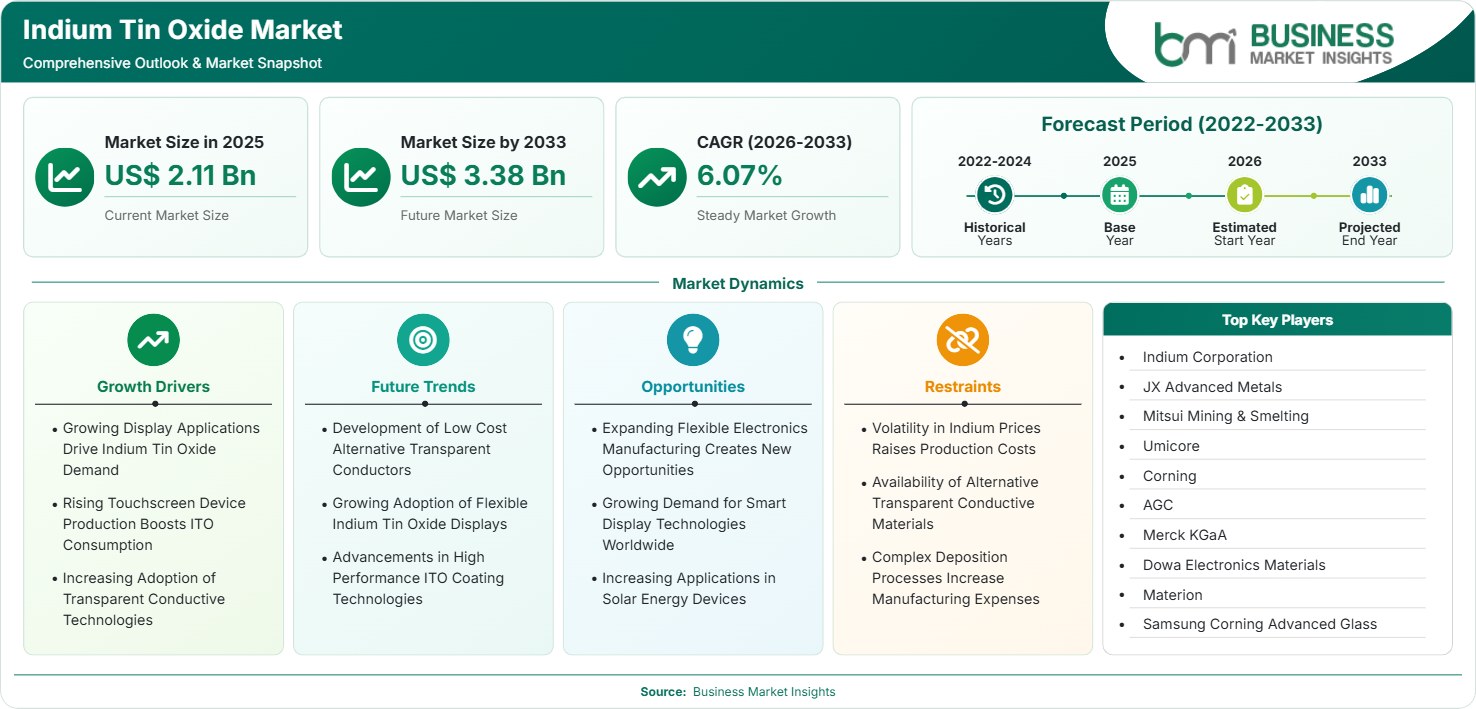
The Indium Tin Oxide Market size was valued at US$ 2.11 billion in 2025 and is projected to reach US$ 3.38 billion by 2033, growing at a CAGR of 6.07% during 2026–2033, driven by display manufacturing, touchscreen adoption, flexible electronics, transparent electrodes, and solar applications.

Report Coverage
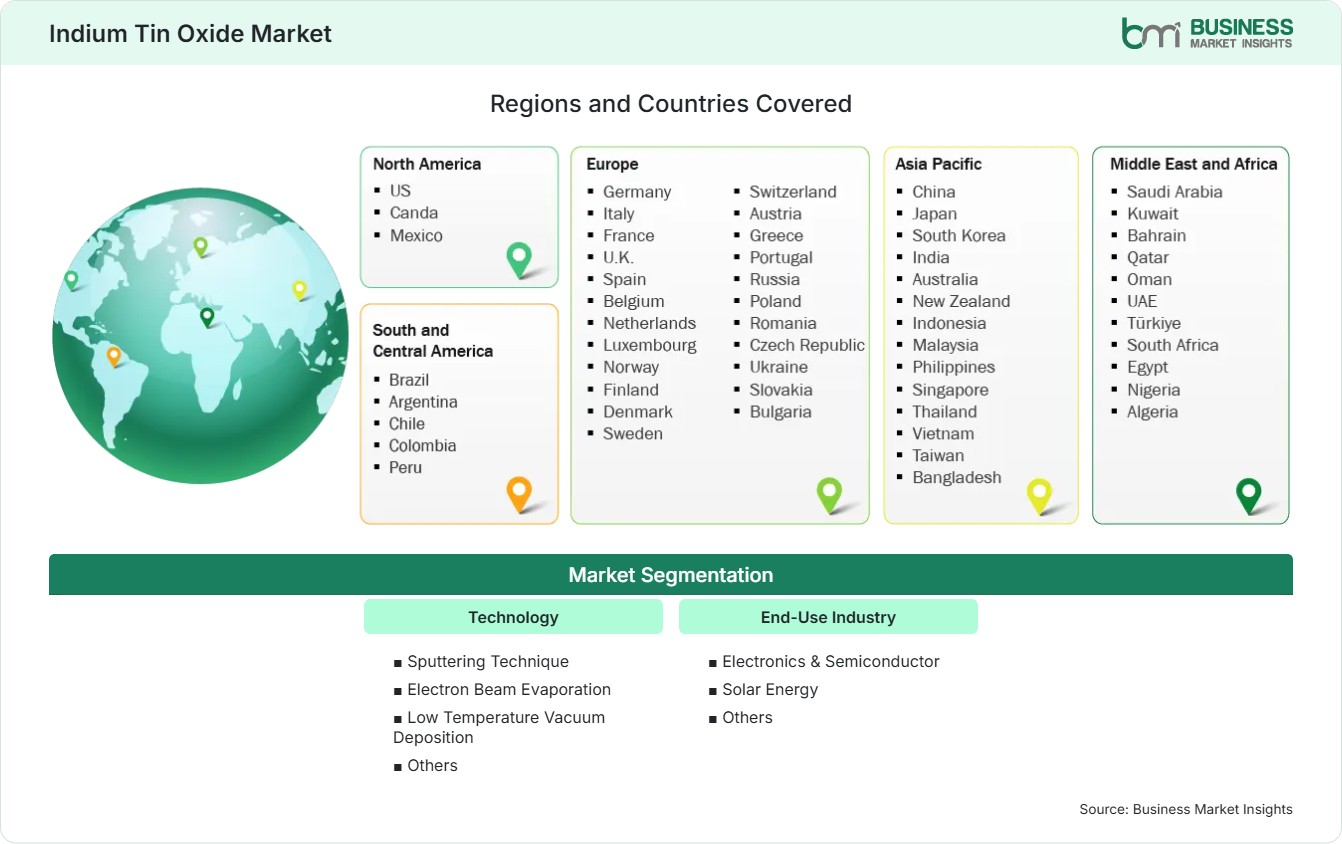
  • Technology: Sputtering Technique, Electron Beam Evaporation, Low Temperature Vacuum Deposition, Others
  • End-Use Industry: Electronics & Semiconductor, Solar Energy, Others
US$ 2.11 Bn Market size in 2025
US$ 3.38 Bn Market Size by 2033
6.07% CAGR, 2026 - 2033
2026-2033 Forecast Period

01 AI Overview

Indium Tin Oxide Market Summary

  • North America Region: North America holds a 13%–16% share in 2025, with a 5.5%–6.2% CAGR through 2033, supported by advanced electronics, semiconductor research, specialty materials, display technologies, flexible devices, renewable-energy applications, and domestic supply-chain development. The US accounts for most regional demand, with expansion supported by electronic-material innovation, specialty coatings, semiconductor applications, and advanced manufacturing capabilities.
  • Fastest Growing Region: Asia Pacific holds a 61%–65% share in 2025 and is projected to expand at a 6.4%–7.1% CAGR, supported by concentrated display production, electronics manufacturing, touchscreen devices, OLED adoption, photovoltaic development, flexible electronics, and expanding regional material-processing capabilities.
  • Leading Segment: Sputtering Technique holds a 55%–59% share in 2025 and is projected to expand at a 5.9%–6.5% CAGR, supported by established deposition infrastructure, high-volume display manufacturing, coating uniformity, process scalability, target utilization, and compatibility with large-area substrates.
  • High Growth Segment: Electron Beam Evaporation holds a 12%–16% share in 2025 and is projected to expand at a 7.2%–8.0% CAGR, supported by specialized thin-film applications, research activity, precise deposition control, optical devices, advanced electronics, and customized coating requirements.
  • Key Market Opportunity: Flexible displays, wearable electronics, smart interfaces, advanced photovoltaic devices, transparent sensors, optical systems, and smart surfaces provide opportunities for suppliers developing thinner films, improved conductivity, lower-temperature deposition, and efficient material recovery.
  • Major Market Players: Indium Corporation, JX Advanced Metals Corporation, Mitsui Mining & Smelting Co., Ltd., Umicore SA, Corning Incorporated, AGC Inc., Merck KGaA, DOWA ELECTRONICS MATERIALS CO., LTD., Materion Corporation, and Samsung Corning Advanced Glass.
02 Strategic Insights

Indium Tin Oxide Market: Strategic Insights

Indium Tin Oxide Market Strategic Framework
FREE PDF
Request your free sample
Request free sample
03 Stakeholder View

Key Takeaways

  • The value chain connects indium and tin sourcing, refining, compound preparation, target fabrication, deposition equipment, substrate manufacturing, display production, touch-module integration, and downstream electronic-device assembly, making consistency across interfaces strategically important.
  • The strongest commercial upside is shifting toward flexible electronics, automotive interfaces, smart displays, transparent sensors, specialized optical devices, and photovoltaic architectures where conductive films must satisfy demanding transparency, conductivity, adhesion, and processing requirements.
  • Product innovation is increasingly focused on thinner films, controlled oxygen conditions, target utilization, lower-temperature processing, improved surface quality, recycling, and material combinations that preserve electrical performance while addressing substrate sensitivity.
  • Asia Pacific offers the strongest investment environment because display manufacturing, electronics assembly, OLED production, semiconductor activity, and photovoltaic supply chains are concentrated within an interconnected regional ecosystem.
  • Investment priorities increasingly include high-purity material security, target manufacturing efficiency, recycling infrastructure, process optimization, and research into transparent conductive alternatives that can complement or challenge conventional ITO.
  • Suppliers with integrated materials expertise, technical support, customized target development, recycling capabilities, and relationships with display or electronics manufacturers can capture more value than commodity-oriented participants.
04 Geographic Outlook

Indium Tin Oxide Market Regional Highlights

North America Indium Tin Oxide Market

North America holds a 13%–16% Indium Tin Oxide Market share in 2025 and is projected to expand at a 5.5%–6.2% CAGR through 2033. Demand centers on electronics, semiconductor research, specialty glass, optical systems, advanced manufacturing, and renewable-energy technologies. The US represents the dominant regional demand center, while Canada contributes through research, advanced materials, and specialized industrial applications.

  • Advanced electronics and semiconductor development supports demand for high-purity materials and controlled thin-film deposition.
  • Research institutions create specialized requirements for customized conductive films, optical coatings, sensors, and experimental electronic structures.
  • Recycling provides strategic importance because unused target material and manufacturing residues can potentially return valuable indium to production.
  • Specialty display and optical applications favor suppliers capable of maintaining tight conductivity, transmission, thickness, and surface-quality specifications.

US Indium Tin Oxide Market

The US represents approximately 75%–79% of North American demand in 2025 and is projected to expand at a 5.7%–6.4% CAGR through 2033. Demand is concentrated across advanced electronics, semiconductor development, specialty materials, optical systems, defense-related technologies, and renewable-energy applications.

  • Semiconductor and photonics research supports specialized conductive-film applications requiring precise material composition and controlled deposition conditions.
  • Advanced display and interface development creates demand for transparent conductive materials compatible with glass, polymer, and emerging substrates.
  • Domestic recovery and refining capabilities can strengthen supply security by improving the utilization of indium-bearing production residues.

Europe Indium Tin Oxide Market

Europe holds a 10%–13% share in 2025 and is projected to expand at a 5.2%–5.9% CAGR through 2033. Germany, France, Italy, the Netherlands, and the UK provide important demand centers through electronics, automotive displays, specialty glass, research, photovoltaics, and industrial technologies.

  • Germany provides a strong electronics, automotive, industrial-display, and advanced-materials ecosystem supporting conductive-film applications.
  • France and the Netherlands contribute through research-intensive electronics, photonics, semiconductor, and thin-film development capabilities.
  • European circularity initiatives encourage greater attention to recovery, recycling, target utilization, and reduction of manufacturing losses.
  • Automotive displays and intelligent interfaces provide opportunities for conductive coatings requiring optical clarity and long-term reliability.

Asia Pacific Indium Tin Oxide Market

Asia Pacific holds a 61%–65% Indium Tin Oxide Market share in 2025 and is projected to achieve a 6.4%–7.1% CAGR through 2033. China, South Korea, Japan, and Taiwan provide the core manufacturing base, while India and Southeast Asia are developing broader electronics and energy manufacturing ecosystems. Concentrated display production, OLED manufacturing, electronics assembly, photovoltaic development, and sophisticated materials supply chains give the region a structural advantage in transparent conductive technologies.

  • China remains a central display-manufacturing hub and supports extensive demand for sputtering targets and related electronic materials.
  • South Korea's OLED ecosystem supports advanced transparent-electrode requirements across sophisticated display architectures and flexible-device applications.
  • Japan maintains deep capabilities in high-purity materials, sputtering targets, specialty chemicals, display technologies, and electronic manufacturing.
  • India and Southeast Asia provide emerging opportunities as electronics assembly, display-related investment, and solar manufacturing capabilities develop.

Rest of World Indium Tin Oxide Market

Rest of World holds a 7%–10% Indium Tin Oxide Market share in 2025 and is projected to expand at a 5.8%–6.6% CAGR through 2033. South and Central America, the Middle East, and Africa remain smaller consumption centers, but opportunities are emerging through solar deployment, electronics assembly, specialty glass, research, and advanced industrial technologies. Brazil, Mexico, Israel, the UAE, and South Africa provide comparatively attractive platforms for application-led expansion.

Solar development provides an additional pathway because transparent conductive layers are relevant to selected photovoltaic architectures and emerging energy devices. Suppliers can also target regional research institutions and specialty manufacturers that require customized conductive films rather than high-volume display-grade materials.

  • Brazil and Mexico offer opportunities through expanding electronics, solar, industrial technology, and specialty manufacturing ecosystems.
  • Israel provides a specialized opportunity base through semiconductor, photonics, optical, and advanced-material research.
  • The UAE and Saudi Arabia can support demand through solar investment, smart infrastructure, and technology-oriented industrial development.
  • South Africa provides selective opportunities associated with renewable energy, electronics, research, and specialized industrial applications.
Global Market Geography
FREE PDF
Request your free sample
Request free sample
05 Segment Analysis

Indium Tin Oxide Market Segmentation

Technology

Sputtering Technique remains the leading technology, holding a 55%–59% share in 2025 and projected to grow at a 5.9%–6.5% CAGR through 2033. Its established industrial infrastructure, large-area processing, coating consistency, and suitability for display production reinforce adoption. Technology selection increasingly depends on substrate sensitivity, throughput, film thickness, target utilization, and process-temperature requirements.

  • Sputtering Technique: High-volume display production favors sputtering because it provides scalable deposition, controlled film properties, uniform coating, and compatibility with established manufacturing infrastructure.
  • Electron Beam Evaporation: Precise vapor deposition supports research, optical systems, specialty electronics, and applications requiring tightly controlled composition, thickness, and localized thin-film characteristics.
  • Low Temperature Vacuum Deposition: Lower processing temperatures support heat-sensitive substrates, flexible electronics, polymer films, wearable devices, and emerging architectures requiring controlled conductive layers.
  • Others: Specialized deposition approaches address experimental, optical, photovoltaic, research, and customized applications where conventional processing may not provide the required substrate compatibility.

End-Use Industry

Electronics & Semiconductor represents the leading end-use category, holding an estimated 72%–76% share in 2025 and projected to grow at a 5.8%–6.4% CAGR through 2033. Display panels, touch sensors, electronic interfaces, and advanced components provide the principal demand base. Solar Energy provides an expanding application pathway as transparent conductive layers remain relevant to selected photovoltaic and emerging energy architectures.

  • Electronics & Semiconductor: Display panels, touch interfaces, sensors, and electronic components use transparent conductive layers that balance optical transmission, electrical performance, process compatibility, and reliability.
  • Solar Energy: Photovoltaic devices use transparent electrodes where optical transmission, conductivity, substrate compatibility, and efficient charge collection influence device performance.
06 Market Forces

Indium Tin Oxide Market Dynamics

Key Market Drivers

Growing Display Applications Drive ITO Demand

ITO-based displays still remain a key driver of demand due to ITO representing an advanced balance of transparency, conductivity, process know-how, and compatibility with proven electrode structures. Requirements for conductive films arise in the LCD, OLED, automotive, industrial, TV, monitor, and mobile interface segments. In addition, ITO is supported by existing equipment/process know-how associated with panel fabrication. The thinner, larger, and more curved display technologies and their integration with sensing capabilities lead to increased focus on film homogeneity and efficiency of deposition. This setting promotes the Indium Tin Oxide Market growth through strengthening the demand for high-quality sputter targets and materials solutions. Such differentiation can be achieved through target density, purity, utilization, recycling services, and technical expertise, assisting in achieving stable deposition.

Rising Touchscreen Device Production Boosts ITO Consumption

Touch interfaces have been adopted for use in smartphones, tablets, cars, industrial machinery, household appliances, retail solutions, and Internet of Things devices. This material is still relevant in the sense that electrodes made of transparent materials have the ability to offer sensing capabilities without sacrificing the look of the screen. For automotive and industrial purposes, there are more demands for durability, optical quality, environmental resistance, and integration with more advanced user interfaces. The Indium Tin Oxide Market trend is hence impacted not only by the volumes of devices but also by the level of sophistication of the touch interfaces. Efforts are being made to make thinner conductive films and fine-tune deposition processes for various types of glass and polymer substrates.

Increasing Adoption of Transparent Conductive Technologies

The transparent conductive market is moving into such applications as sensors, optics, solar power, intelligent surfaces, and unique electronics. ITO remains significant in terms of the application because of the high degree of development of the equipment used for its deposition, proven technology, and wide industrial experience. New applications may require a specific combination of parameters such as conductivity, transparency, flexibility, temperature resistance, and optical behavior, which motivates manufacturers to improve their materials and deposition technologies. Growth of the Indium Tin Oxide Market could, thus, continue outside of the traditional display application due to the unique opportunities that become available because of the use of transparent electrodes.

Key Market Opportunities

Expanding Flexible Electronics Manufacturing Creates New Opportunities

There is an interesting opportunity here because polymers and other temperature-sensitive substrates will require deposition parameters different from those used for standard rigid glass. ITO films may experience mechanical constraints from repeated bending, prompting innovations in film thickness, adhesion, substrates, and low-temperature deposition processes. JX Advanced Metals notes that one example of a transparent conductive oxide is IZO, which can be deposited without post-deposition annealing. This is an example of how alternatives can help in solving issues related to flexible electronics. Suppliers can respond to this trend by improving the compatibility of ITO films, making thinner layers, and folding displays,, among other measures.

Growing Demand for Smart Display Technologies Worldwide

Smart display technology is rapidly being incorporated into automobiles, consumer appliances, industrial applications, healthcare systems, retail, and consumer electronics. These types of interface systems require touch capabilities, sensors, optical performance, low power consumption, and compact design. ITO is a proven, transparent conductor that can be adapted to multiple display technologies. The automotive industry presents an especially interesting opportunity due to increasing demand for large-sized displays, multiple displays within the vehicle, and advanced human-interface systems. Value opportunities include customization of sputter target technology, purity controls, coatings, technical support, and process development. Curved and integrated interfaces provide additional incentive for differentiation.

Increasing Applications in Solar Energy Devices

Solar energy offers another opportunity, as there is a need for transparent conductive electrodes in certain photovoltaic structures and advanced energy systems. The addressable market is specifically applicable to certain thin-film, tandem, transparent, and research photovoltaic structures in which both light and electricity must be collected from a single component layer. According to the Indium Tin Oxide Market forecast, the addressable market could cover specialized solar equipment rather than displays alone. There could be ways to improve the commercial potential by reducing material use, increasing the film's conductivity, enhancing light transmission through the film, and depositing on non-conventional substrates.

Market Restraints and Challenges

Volatility in Indium Prices Raises Production Costs

Factor: Indium is primarily sourced from processing other metals, so sourcing will be affected by any costs along the value chain. Impact: Any cost changes can affect target prices, procurement, working capital, and customers’ readiness to adopt indium-based technologies. For this reason, manufacturers need to ensure efficient utilization of the target metal, reprocessing of production residues, and optimal film thickness. Recycling will help mitigate the factor by reintroducing the recyclable material into the supply chain. Umicore highlights the recycling and refining of metal-containing residues, but industrial suppliers are still working to recover materials from transparent conductive coatings.

Availability of Alternative Transparent Conductive Materials

Factor: Other types of transparent conductive oxides and newer conductive materials may offer different tradeoffs with respect to conductivity, transparency, flexibility, heat compatibility, and materials availability. Impact: Having greater technological options may restrict the use of ITO in those cases where alternative materials have better performance or cost benefits. JX Advanced Metals touts IZO as the material to use in cases where transparency and conductivity are required without post-deposition annealing, such as flexible and OLED-related devices. The response from competitors will include thinner film deposition, efficiency in the deposition process, recycling, tailored formulations, and performance improvement in specific applications.

07 Company Analysis

Competitive Landscape

Indium Tin Oxide Market analysis indicates that competitive positioning depends on high-purity materials, sputtering-target quality, thin-film expertise, recycling, customer qualification, technical support, and the ability to adapt products to changing display and electronics architectures.

Company Name

Overview

Products and Services relevant to this market

Indium Corporation

Advanced materials supplier serving electronics, semiconductor, display, and specialty-material applications.

Indium compounds, ITO materials, high-purity indium, sputtering-related materials, and recycling solutions.

JX Advanced Metals Corporation

Japanese advanced-materials producer with extensive high-purity and sputtering-target capabilities.

Transparent conductive oxide targets, ITO-related materials, optical targets, high-purity metals, and technical support.

Mitsui Mining & Smelting Co., Ltd.

Japanese materials producer with capabilities spanning metals, electronic materials, and functional products.

High-purity metals, electronic materials, sputtering targets, and functional-material solutions relevant to advanced electronics.

Umicore SA

Global materials technology group active in refining, recycling, and specialty metal applications.

Indium and tin-related materials, recycling, refining, and metal recovery solutions supporting transparent conductive supply chains.

Corning Incorporated

Materials-science company with major capabilities in specialty glass and display technologies.

Display glass, specialty substrates, optical materials, and advanced glass solutions supporting conductive-film applications.

AGC Inc.

Japanese global materials group active in glass, chemicals, electronics, and advanced display applications.

Display glass, electronic materials, specialty glass, optical solutions, and advanced coating technologies.

Merck KGaA

Science and technology company serving electronics and advanced-material markets.

Electronic materials, display technologies, specialty chemicals, semiconductor materials, and thin-film solutions.

DOWA ELECTRONICS MATERIALS CO., LTD.

Japanese electronics-materials specialist with high-purity, thin-film, powder, and semiconductor capabilities.

High-purity indium-related materials, conductive materials, semiconductor materials, thin-film technologies, and recycling-linked capabilities.

Materion Corporation

US advanced-materials company serving electronics, optics, semiconductor, and specialty applications.

Specialty metals, advanced materials, thin-film inputs, precision materials, and electronic-material solutions.

Samsung Corning Advanced Glass

Korean joint venture between Samsung Display and Corning focused on OLED display glass substrates.

OLED glass substrates and advanced display-glass solutions supporting the broader transparent-electrode ecosystem.

10 Trust & Transparency

Research Methodology

The market analysis combines proprietary research with secondary data from government agencies, company disclosures, regulatory filings, industry databases and expert interviews. Market estimates are validated through data triangulation, cross-market benchmarking and analyst review.

View Full Research Methodology

11 Questions Answered

Frequently Asked Questions

What does the Indium Tin Oxide Market report indicate about future competition?

The report indicates that competition will increasingly focus on material purity, target utilization, recycling, deposition efficiency, flexible-substrate compatibility, customized formulations, and alternatives to conventional ITO. Companies combining materials expertise, technical support, recycling, and customer-specific development should be better positioned to manage technology and supply-chain pressures.

Why are flexible electronics creating new opportunities for ITO solutions?

Flexible devices require transparent conductive layers that can be deposited under controlled thermal conditions while maintaining adhesion, conductivity, optical transmission, and mechanical reliability. Improvements in deposition and film engineering can extend ITO-related solutions into foldable displays, wearable electronics, flexible sensors, and smart surfaces.

How are advanced deposition technologies influencing ITO adoption?

Advanced deposition technologies improve film uniformity, thickness control, substrate compatibility, and material efficiency. Sputtering remains established for high-volume production, while electron-beam evaporation and low-temperature vacuum deposition support specialized applications involving sensitive substrates, research structures, optical devices, and emerging flexible electronics.

Which applications present the strongest opportunity in the market?

Displays and touchscreens remain the principal application base, while flexible electronics, automotive interfaces, smart displays, sensors, optical devices, and selected photovoltaic architectures provide attractive expansion opportunities. These applications increasingly require conductive films that balance transparency, electrical performance, mechanical compatibility, and process efficiency.

What factors are improving Indium Tin Oxide Market return on investment?

Display manufacturing, touchscreen integration, flexible electronics, smart interfaces, photovoltaic technologies, and transparent sensors support investment potential. Additional value comes from high-purity materials, customized sputtering targets, recycling, improved target utilization, and technical services that reduce process losses and improve deposition consistency.

Access the Full Indium Tin Oxide Market Report

Get segment-level forecasts, regional estimates, competitive benchmarking, company profiles and downloadable Excel datasets.

Access the full Indium Tin Oxide Market Report
350 pages PDF & Excel | 2026-08-20