
Hydrogen Infrastructure Market Outlook: Size, Share, Trends, Growth Analysis, Competitive Landscape & Forecast, 2026-2033

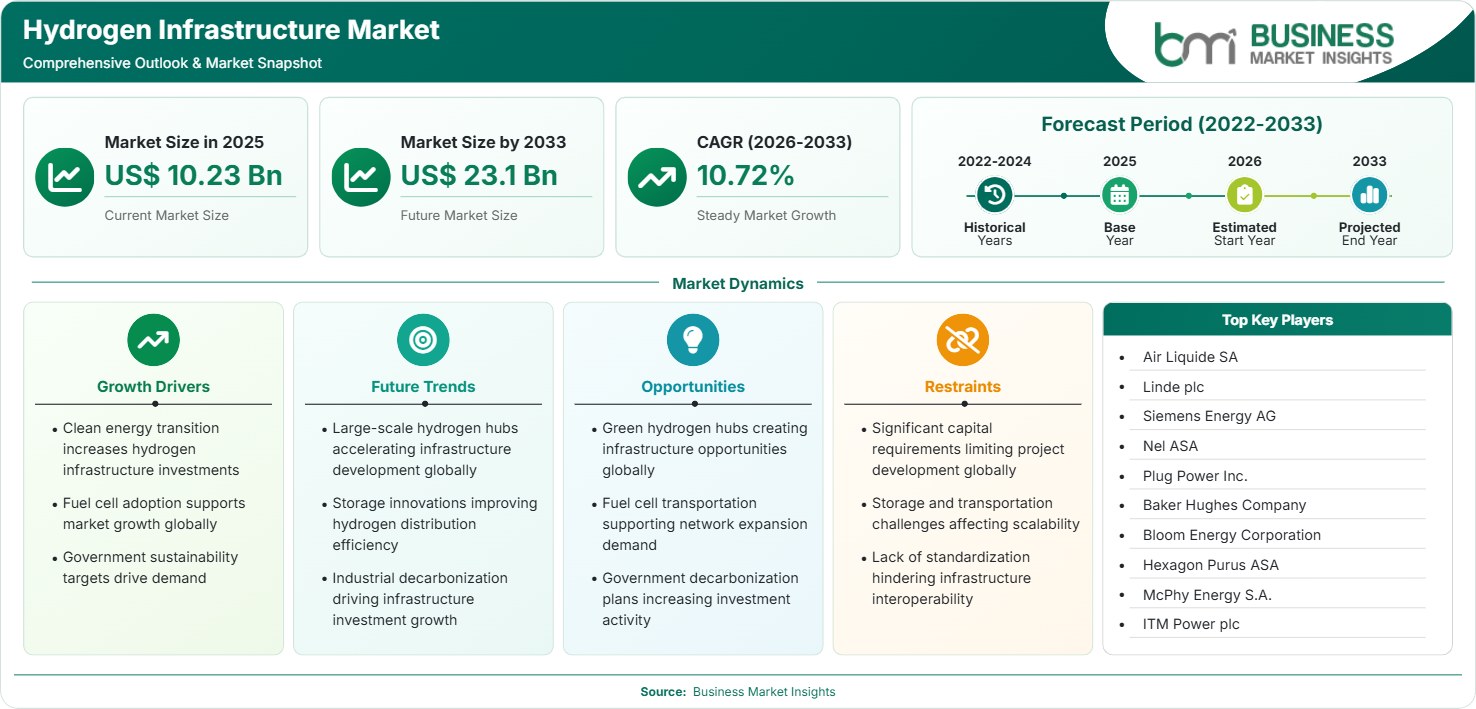
The Hydrogen Infrastructure Market size was valued at US$ 10.23 Billion in 2025 and is projected to reach US$ 23.1 Billion by 2033, growing at a CAGR of 10.72% during 2026–2033, driven by pipeline expansion, storage investment, industrial decarbonization, mobility corridors, port infrastructure, and policy-backed clean hydrogen deployment.

Report Coverage
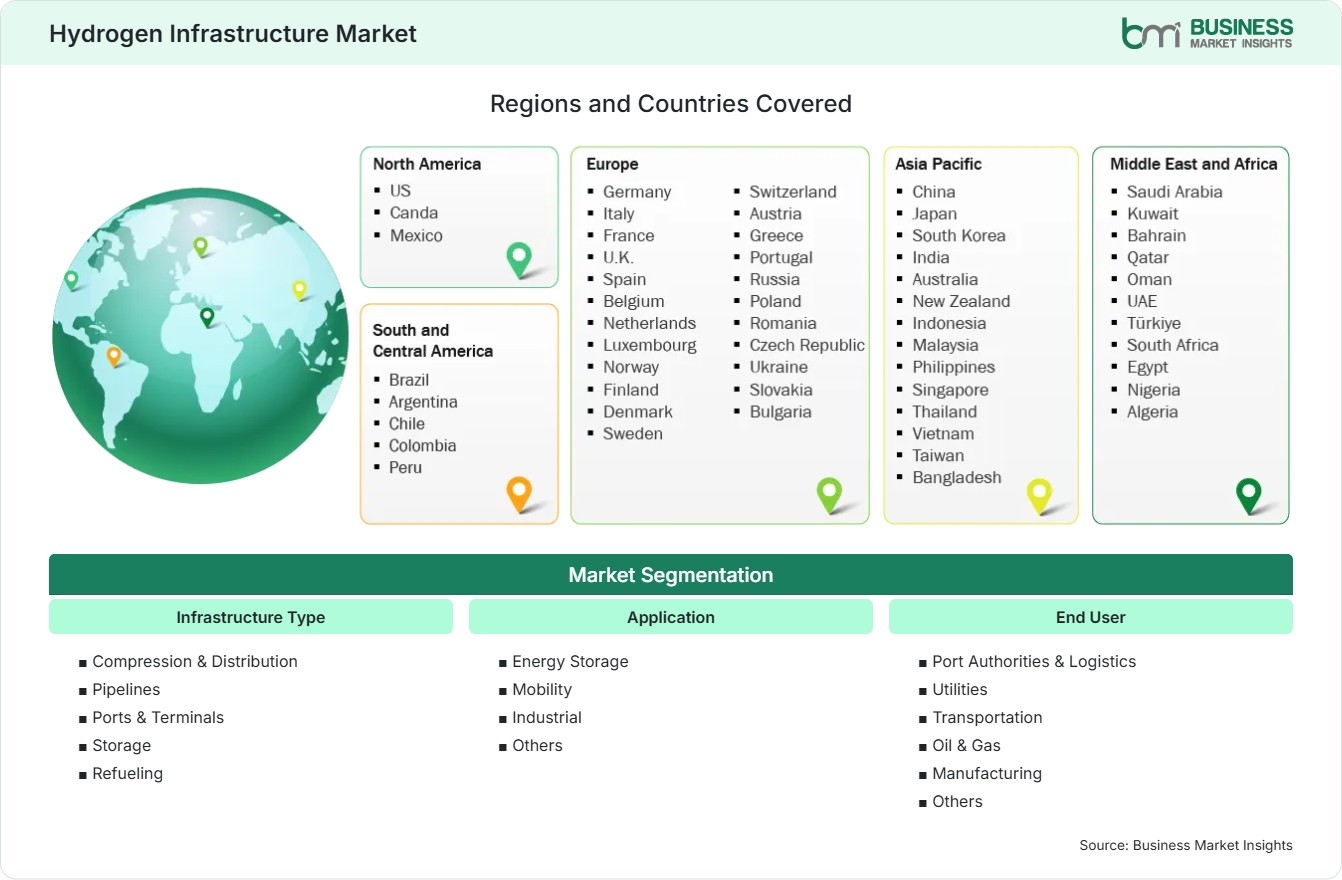
  • Infrastructure Type: Compression & Distribution, Pipelines, Ports & Terminals, Storage, Refueling
  • Application: Energy Storage, Mobility, Industrial, Others
  • End User: Port Authorities & Logistics, Utilities, Transportation, Oil & Gas, Manufacturing, Others
US$ 10.23 Bn Market size in 2025
US$ 23.1 Bn Market Size by 2033
10.72% CAGR, 2026 - 2033
2026-2033 Forecast Period

AI Overview

Hydrogen Infrastructure Market Summary

  • North America Region: North America holds a modeled 26%–30% Hydrogen Infrastructure Market share in 2025, growing at a 9.5%–11.5% CAGR through 2033, influenced by hydrogen hubs, industrial demand, pipeline conversion, storage investment, and heavy-duty mobility. The U.S. market is advancing at a 9.8%–11.2% CAGR, supported by federal hub funding and industrial applications.
  • Fastest Growing Region: Asia Pacific holds a modeled 31%–35% share in 2025 and is expanding at a 12.0%–14.0% CAGR, supported by Chinese manufacturing scale, Japanese mobility programs, Korean energy initiatives, Indian projects, port development, and industrial hydrogen demand.
  • Leading Segment: Compression & Distribution accounts for a modeled 24%–28% share in 2025 and grows at a 10.0%–12.0% CAGR, supported by centralized production, compression requirements, pipeline connectivity, industrial clusters, and movement between production and consumption centers.
  • High Growth Segment: Mobility represents a modeled 15%–19% share in 2025 and expands at a 13.0%–15.0% CAGR, driven by heavy-duty trucking, buses, fleet depots, port logistics, corridor refueling, and emissions regulations.
  • Key Market Opportunity: Developers can capture value by integrating production, compression, storage, pipelines, refueling, digital monitoring, and contracted offtake into modular hubs serving industrial clusters and transport corridors.
  • Major Market Players: Air Liquide SA, Linde plc, Siemens Energy AG, Nel ASA, Plug Power Inc., Baker Hughes Company, Bloom Energy Corporation, Hexagon Purus ASA, McPhy Energy S.A., and ITM Power plc.
Strategic Insights

Hydrogen Infrastructure Market: Strategic Insights

Hydrogen Infrastructure Market Strategic Framework
FREE PDF
Request your free sample
Request free sample
Stakeholder View

Key Takeaways

  • The creation of value is heading in the direction of integrated ecosystems that link production, compression, storage, transportation, and contracted off-take.
  • Industrial clusters offer the most solid basis for near-term demand since refineries, ammonia plants, methanol facilities, steel works, and chemical plants already use hydrogen and therefore can serve as a basis for new infrastructure.
  • The design of the infrastructure and the way it is operated are being influenced by modular electrolyzers, advanced compression technology, storage in salt caverns, ammonia cracking, digital monitoring of the pipelines, and flexible logistics.
  • Germany has a strong case for investment because of its approved hydrogen core network, which spans 9,040 kilometers and links together the centers of production, demand, storage, and import infrastructure.
  • Increasingly, capital is giving its preference to industrial companies and infrastructure specialists who have engineering capabilities, operating assets, customer relationships, and the ability to provide financing.
  • Developers ought to focus on projects that offer multiple revenue streams by combining industrial supply, mobility, energy storage, and hydrogen-derived fuels to enhance the use of their assets.
Geographic Outlook

Hydrogen Infrastructure Market Regional Highlights

North America Hydrogen Infrastructure Market

North America represented a modeled 26%–30% Hydrogen Infrastructure Market share in 2025 and is projected to expand at a 9.5%–11.5% CAGR through 2033. Industrial hydrogen demand, extensive gas networks, storage potential, energy resources, and government-backed hubs support development.

  • The presence of industrial clusters, such as refining, chemicals, ammonia production, and export facilities, means that there is already established demand, which enables developers to place pipelines, compression equipment, and storage facilities around current consumers.
  • The government's support helps to establish regional hydrogen hubs in the United States, which in turn form the basis for a coordinated system of production, delivery, storage, and end-use infrastructure.
  • With regard to the conversion of the pipeline, there are certain opportunities for conversion making use of the existing natural gas infrastructure, provided that considerations concerning metallurgy, embrittlement, pressure, safety, and compatibility with the end user are taken into account.
  • The need for mobility corridors can be met by heavy-duty trucking and fleet depots, since predictable vehicle schedules help improve the use of the stations.

US Hydrogen Infrastructure Market

The United States Hydrogen Infrastructure Market accounted for a modeled 20%–23% share of global demand in 2025 and is estimated to grow at a 9.8%–11.2% CAGR through 2033. Federal hub programs are supporting coordinated investment across production, delivery, storage, and consumption.

  • The Gulf Coast has an advantage in that Texas and the adjoining states together offer natural gas, ports, refining facilities, chemicals, opportunities in carbon management, and an existing demand for hydrogen.
  • There are opportunities in the Midwest: the states of Illinois, Indiana, Iowa, and Michigan have manufacturing, steel production, transportation, nuclear energy, renewable energy generation, and industrial demand.
  • When it comes to utility integration, electrolysis can take in excess electricity generated by renewable or hydroelectric sources, and hydrogen storage can then offer greater duration of energy flexibility.

Europe Hydrogen Infrastructure Market

Europe held a modeled 27%–31% Hydrogen Infrastructure Market share in 2025 and is projected to grow at a 10.5%–12.5% CAGR through 2033. Germany leads infrastructure planning through its approved 9,040-kilometer core network. The Netherlands, France, Spain, and the United Kingdom are developing industrial, mobility, and port projects.

  • In Germany, about 60 percent of the approved network makes use of converted gas pipelines, and the estimated investment until 2032 is €18.9 billion.
  • The Netherlands' Rotterdam incorporates port logistics, industrial customers, hydrogen imports, pipelines, heavy-duty mobility, and derivatives infrastructure.
  • In France, large electrolyzer projects are being located near industrial and logistics clusters, such as Air Liquide's 200 MW ELYgator project.
  • The regulations stipulate that, by 2030, hydrogen refueling stations must be located along the TEN-T core network at intervals of no more than 200 kilometers.

Asia Pacific Hydrogen Infrastructure Market

Asia Pacific Hydrogen Infrastructure Market represented a modeled 31%–35% share in 2025 and is forecast to achieve the highest regional growth rate at 12.0%–14.0% CAGR through 2033. China provides manufacturing scale and industrial demand, Japan has an established mobility base, while South Korea and India are expanding clean-energy programs.

  • In China, industrial clusters, the manufacture of electrolyzer systems, hydrogen mobility, and support from renewable power are all aimed at facilitating integrated projects covering production, storage, distribution, and end-use.
  • In Japan, there were 154 commercial hydrogen stations in operation by April 2025, providing support for mobility infrastructure and for the deployment of fuel-cell vehicles.
  • In India, there are opportunities for pipelines, storage facilities, and transportation infrastructure because of refining, fertilizer, renewable energy, and emerging green hydrogen projects.
  • In South Korea, mobility, power generation, industrial applications, and national hydrogen strategies all contribute to the development of infrastructure in the area of industrial corridors.

Rest of World Hydrogen Infrastructure Market

South and Central America Hydrogen Infrastructure Market represented a modeled 7%–10% share in 2025 and are estimated to grow at 9.0%–12.0% CAGR, supported by renewable resources, mining, ammonia, ports, and export projects. Brazil and Chile provide leading platforms. Middle East and Africa represented the remaining 4%–7% share, with a modeled 10.0%–13.0% CAGR. Saudi Arabia, the UAE, Egypt, Namibia, and South Africa are developing integrated projects linked to renewable power, industry, and exports.

  • In Brazil, projects involving hydrogen are being supported by renewable electricity and industrial demand, particularly those associated with the ports, ammonia, steel, refining, and exports.
  • Chile has renewable energy resources and port facilities that support projects involving green hydrogen and hydrogen-derived products.
  • In the Middle East, Saudi Arabia and the UAE have the opportunity to make use of their renewable resources, ports, hydrocarbon logistics, and industrial clusters.
  • Development finance is being attracted in Africa by South Africa, Namibia, and Egypt for the purpose of export terminals, pipelines, storage facilities, and industrial uses.
Global Market Geography
FREE PDF
Request your free sample
Request free sample
Segment Analysis

Hydrogen Infrastructure Market Segmentation

Infrastructure Type

Infrastructure Type held a modeled 24%–28% share in 2025 and is projected to grow at a 10.0%–12.0% CAGR through 2033. Compression, distribution, pipelines, ports, storage, and refueling form the physical backbone connecting production with consumers.

  • Compression & Distribution: Compression and distribution connect production with storage, pipelines, terminals, and consumers, with demand increasing as hydrogen moves between production and industrial centers.
  • Pipelines: Pipelines enable continuous high-volume supply, with investment shaped by conversion feasibility, pressure, metallurgy, permitting, and existing gas infrastructure.
  • Ports & Terminals: Ports support imports, exports, ammonia handling, liquefaction, storage, cracking, and maritime applications around international trade corridors.
  • Storage: Storage provides balancing, seasonal flexibility, inventory management, and resilience through salt caverns, depleted fields, tanks, and other technologies.
  • Refueling: Refueling supports buses, trucks, fleets, industrial vehicles, and selected passenger applications, with economics improving where utilization is predictable.

Application

Application demand is becoming more diversified as hydrogen moves beyond established refining and chemical uses into mobility, energy storage, and emerging industrial pathways. The segment held a modeled 28%–32% share in 2025 and is estimated to grow at a 11.0%–13.0% CAGR through 2033. The Hydrogen Infrastructure Market scope increasingly includes infrastructure tailored to specific end-use requirements, operating profiles, purity standards, and delivery formats.

  • Energy Storage: Hydrogen can provide longer-duration storage where renewable electricity exceeds immediate demand, requiring electrolyzers, compression, storage, and reconversion equipment.
  • Mobility: Mobility infrastructure centers increasingly on heavy-duty vehicles, requiring production, compression, storage, dispensing, and fleet-oriented logistics.
  • Industrial: Refining, ammonia, methanol, steel, and chemical applications provide established demand and support direct connections between low-emissions production and consumers.
  • Others: Maritime fuels, aviation-related fuels, power generation, synthetic fuels, and distributed energy systems create emerging infrastructure requirements.

End User

End User demand is led by sectors with established hydrogen consumption, logistics networks, or decarbonization incentives. The segment held a modeled 34%–38% share in 2025 and is projected to expand at a 10.0%–12.0% CAGR through 2033. Collaboration among utilities, ports, transport operators, industrial companies, and infrastructure developers can improve asset utilization.

  • Port Authorities & Logistics: Ports can integrate production, storage, refueling, cargo handling, and maritime fuel infrastructure as strategic hydrogen nodes.
  • Utilities: Utilities can deploy hydrogen for renewable balancing, grid flexibility, power generation, and industrial supply while leveraging energy-network expertise.
  • Transportation: Operators are evaluating hydrogen for heavy-duty fleets, buses, rail, and port vehicles where range, payload, and operating schedules favor the technology.
  • Oil & Gas: Existing pipelines, terminals, storage, engineering capabilities, and hydrogen experience position oil and gas companies for transport and storage projects.
  • Manufacturing: Steel, chemicals, glass, cement, and other manufacturers can establish anchor demand through contracted supply and hydrogen-enabled processes.
Market Forces

Hydrogen Infrastructure Market Dynamics

Key Market Drivers

Industrial Decarbonization Creates Anchor Demand

Industrial decarbonization provides the strongest near-term demand foundation because hydrogen already serves refining, ammonia, methanol, and emerging direct-reduced-iron applications. The IEA reports that almost all current hydrogen demand remains concentrated in established sectors. More than 2 Mtpa of hydrogen consumption from projects operational, under construction, or at final investment decision is expected in refineries and industrial facilities by 2030. These projects provide an identifiable demand for pipelines, storage, compression, and production infrastructure. The Hydrogen Infrastructure Market growth profile, therefore, favors projects with contracted industrial customers rather than speculative demand.

Government Support Accelerates Network Formation

Through policy backing, barriers have been reduced through financing, mandates, network planning, and demand-side policies. In the United States, the H2Hubs program offers a maximum of $8 billion worth of financial backing to support regional networks involving production, processing, transport, storage, and consumption. Europe has introduced refueling mandates and network plans, while Germany has sanctioned 9,040 kilometers of core hydrogen pipeline network infrastructure. The Hydrogen Infrastructure Market trends increasingly favor regional backbone development, public-private partnerships, and infrastructure platforms connecting multiple sources with several consumers.

Renewable Energy Expansion Supports Hydrogen Infrastructure

Renewables also provide opportunities for the electrolysis of excess power to hydrogen that can be used for industrial purposes or as a fuel source for transportation, as well as for storage over longer periods. According to the IEA, announced electrolyzer production capacity was at 25 gigawatts annually in 2023, with 60 percent of that capacity in China. The Hydrogen Infrastructure Market growth opportunity is strongest where renewable resources, grid constraints, industrial demand, and transportation infrastructure overlap.

Key Market Opportunities

Integrated Industrial Hydrogen Hubs

Industrial hubs can combine refineries, fertilizer plants, chemical facilities, steel producers, and mobility operators around shared compression, pipelines, storage, and monitoring systems. This approach reduces duplication and allows network capacity to expand as additional consumers sign contracts. The Hydrogen Infrastructure Market Report opportunity is strongest where established hydrogen demand provides a base load while new applications add volumes. Developers can phase investments around one or two anchor customers before expanding. Existing industrial clusters also provide operating expertise, transportation links, and infrastructure access.

Hydrogen Export and Port Infrastructure

Ports have the potential to develop into strategic infrastructure nodes by combining import terminals, ammonia handling, storage, cracking, pipeline connections, and maritime fueling. The IEA has estimated that export-oriented projects could result in about 16 million tonnes per year of hydrogen-equivalent production by 2030, provided that the projects move forward. This offers opportunities for ports that have access to renewable energy, industrial customers, existing gas infrastructure, and deep-water logistics capabilities. Ammonia and other derivatives can make international transport easier. When developers link terminal operations with downstream demand, they can increase utilization and lessen their exposure to fluctuating spot markets. Furthermore, infrastructure led by ports can connect domestic industrial users with international supply chains, thus generating a variety of revenue streams.

Distributed Infrastructure for Heavy-Duty Mobility

The provision of infrastructure for heavy-duty transport provides an example of a targeted approach since depots are responsible for high concentration and predictable demand. According to the International Energy Agency, fuel cell heavy trucks are the most rapidly growing category of fuel cell vehicles, and China accounts for almost 95% of the world’s stock of fuel cell trucks. Hydrogen Infrastructure Market Forecasts support projects combining on-site production, compression, storage, and dispensing, particularly where fleet contracts provide utilization visibility.

Market Restraints and Challenges

High Capital Intensity and Financing Risk

The need for hydrogen infrastructure involves making investments at the same time in production, compression, storage, pipelines, terminals, and the assets used at the end point, before there is adequate demand. This situation can lead to low levels of initial usage, longer payback periods, and uncertain off-take, all of which can hinder financing. The IEA stated that in 2024, signed hydrogen off-take deals amounted to 1.7 Mtpa, a decrease from 2.4 Mtpa in 2023, and only 20 percent of these were firm agreements. Because of project cancellations and delays, the potential pipeline for low-emissions production has been reduced from 49 Mtpa to 37 Mtpa by 2030.

Regulatory, Technical, and Infrastructure Compatibility Barriers

Hydrogen differs from conventional fuels and natural gas in terms of its material properties, pressure requirements, leakage behavior, safety aspects, and methods of transport. As a result, pipeline conversion, storage, the permitting process, and the deployment of refueling stations all involve the need for extensive technical verification. The total length of the network approved in Germany is 9,040 kilometers, about 60 percent of which makes use of converted natural gas pipelines, showing how large the conversion requirements are. Another limitation is the availability of water, since the IEA says that around 40 percent of the low-emissions hydrogen production projects planned lie in areas experiencing water stress.

Company Analysis

Competitive Landscape

The Hydrogen Infrastructure Market analysis indicates competition among industrial gas companies, electrolyzer manufacturers, energy technology providers, infrastructure specialists, engineering companies, and integrated hydrogen solution providers. Differentiation increasingly depends on technology reliability, project execution, financing, infrastructure integration, customer access, and long-term service.

Company Name

Overview

Products and Services relevant to this market

Air Liquide SA

Global industrial gas company with extensive hydrogen production, pipeline, mobility, and industrial infrastructure capabilities.

Hydrogen production, pipelines, refueling, distribution, electrolyzers, liquefaction, storage, and integrated projects.

Linde plc

Industrial gases and engineering specialist with hydrogen production, distribution, liquefaction, storage, and fueling expertise.

Hydrogen plants, pipelines, liquefaction, compression, storage, transport, fueling, and industrial supply systems.

Siemens Energy AG

Energy technology provider supplying electrolysis and system integration for renewable hydrogen projects.

PEM electrolysis, power conversion, grid integration, controls, and hydrogen plant engineering.

Nel ASA

Specialist electrolyzer and hydrogen fueling technology company serving industrial, mobility, and utility applications.

Alkaline and PEM electrolyzers, hydrogen generators, fueling stations, and production systems.

Plug Power Inc.

Vertically integrated hydrogen company combining production, electrolyzers, fueling, storage, and logistics.

PEM electrolyzers, hydrogen generation, liquid hydrogen, storage, fueling, distribution, and integrated solutions.

Baker Hughes Company

Energy technology company with compression, turbomachinery, industrial equipment, and hydrogen capabilities.

Hydrogen compression, turbomachinery, gas processing, engineering, and infrastructure technologies.

Bloom Energy Corporation

Clean-energy technology company developing solid oxide electrolyzer systems for hydrogen production.

Solid oxide electrolyzers, hydrogen production systems, energy platforms, and electricity-to-hydrogen technologies.

Hexagon Purus ASA

Hydrogen storage specialist serving mobility, distribution, and industrial applications.

High-pressure cylinders, storage systems, distribution modules, vehicle systems, and transportation solutions.

McPhy Energy S.A.

European hydrogen technology company focused on electrolyzers and refueling infrastructure.

Electrolyzers, hydrogen production systems, refueling stations, compression interfaces, and integrated infrastructure.

ITM Power plc

UK-based PEM electrolyzer manufacturer emphasizing standardized systems for industrial-scale projects.

PEM electrolyzers, modular hydrogen plants, power conversion, controls, and production packages.

Trust & Transparency

Research Methodology

The market analysis combines proprietary research with secondary data from government agencies, company disclosures, regulatory filings, industry databases and expert interviews. Market estimates are validated through data triangulation, cross-market benchmarking and analyst review.

View Full Research Methodology

Questions Answered

Frequently Asked Questions

What does the Hydrogen Infrastructure Market Report help businesses evaluate?

The Hydrogen Infrastructure Market Report helps businesses assess market sizing, regional opportunities, infrastructure types, applications, end-user demand, competition, investment drivers, technology trends, project risks, and strategic opportunities through 2033.

What is the role of digitalization in hydrogen infrastructure?

Digital systems can improve pressure management, leak detection, asset monitoring, predictive maintenance, network balancing, and operational safety. Digital twins can coordinate production, storage, pipeline flows, and renewable electricity availability.

Why are ports becoming strategic hydrogen infrastructure locations?

Ports combine shipping access, industrial customers, storage, pipelines, renewable power, and import or export terminals. They can also support ammonia handling and cracking, enabling hydrogen derivatives to move internationally before conversion or consumption.

Which infrastructure assets are most important during early hydrogen market development?

Early projects generally prioritize compression, short-distance pipelines, storage, industrial distribution, and fleet-oriented refueling because these assets can connect identifiable supply with contracted demand and achieve stronger utilization.

How does hydrogen infrastructure differ from conventional natural gas infrastructure?

Hydrogen infrastructure requires specialized consideration of material compatibility, pressure, leakage, compression, storage, purity, and safety. Some natural gas pipelines can potentially be repurposed, but suitability varies by materials, operating conditions, hydrogen concentration, and end-user requirements.

Access the Full Hydrogen Infrastructure Market Report

Get segment-level forecasts, regional estimates, competitive benchmarking, company profiles and downloadable Excel datasets.

Access the full Hydrogen Infrastructure Market Report
350 pages PDF & Excel | 2026-11-02
Similar Research

Related Market Reports