
Green Hydrogen Market Outlook: Size, Share, Trends, Growth Analysis, Competitive Landscape & Forecast, 2026-2033

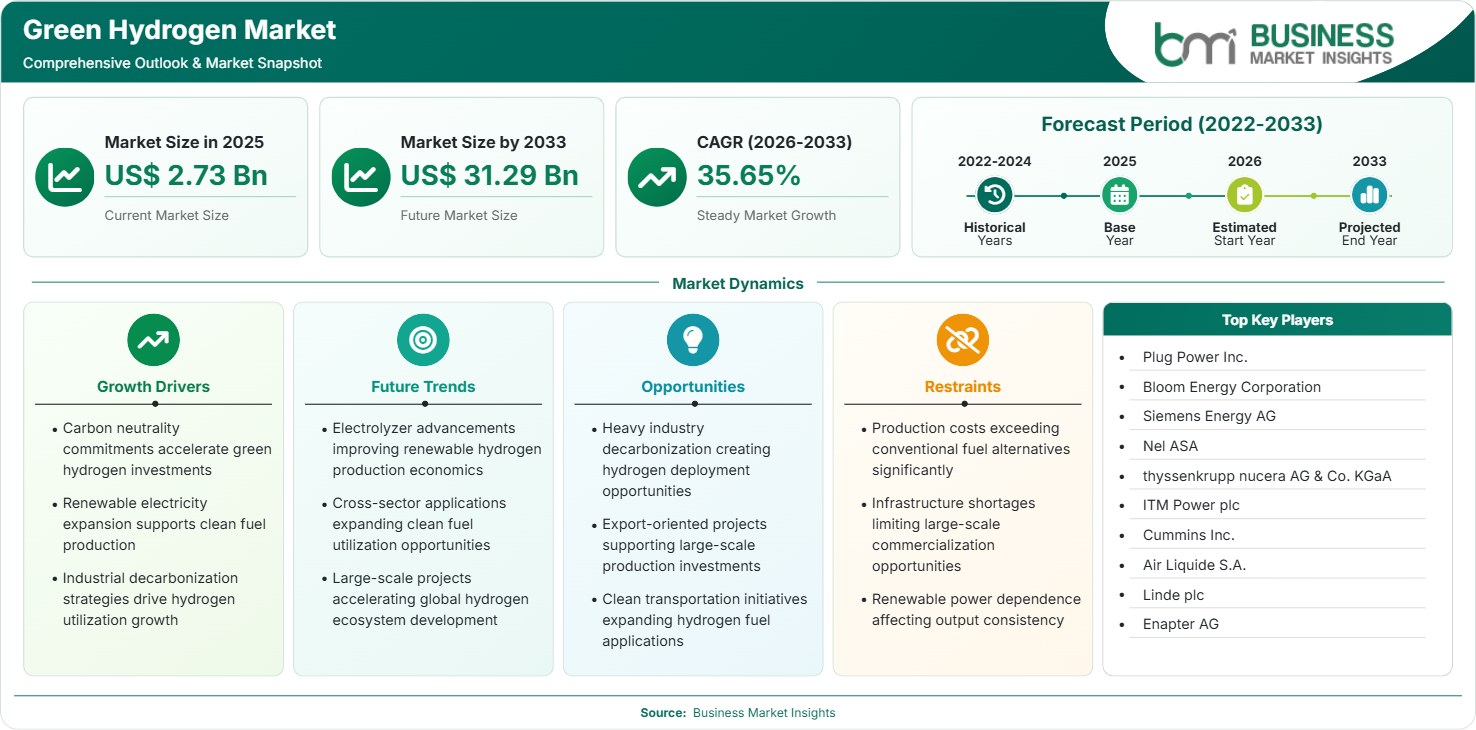
The Green Hydrogen Market size was valued at US$ 2.73 Billion in 2025 and is projected to reach US$ 31.29 Billion by 2033, growing at a CAGR of 35.65% during 2026–2033, driven by industrial decarbonization, renewable power integration, clean-fuel mandates, electrolyzer scale-up, and expanding green ammonia opportunities.

Report Coverage
  • Technology: PEM Electrolyzer, Alkaline Electrolyzer, Others
  • Power Source: Solar-Powered Electrolysis, Wind-Powered Electrolysis, Hydropower-Based Electrolysis, Others
  • Application: Transportation, Power Generation, Industrial, Others
US$ 2.73 Bn Market size in 2025
US$ 31.29 Bn Market Size by 2033
35.65% CAGR, 2026 - 2033
2026-2033 Forecast Period

AI Overview

Green Hydrogen Market Summary

  • North America Region: North America holds a 22%–26% Green Hydrogen Market share in 2025, growing at a 33%–36% CAGR, supported by clean-hydrogen hubs, renewable electricity, industrial demand, incentives, infrastructure investment, and low-carbon fuel development opportunities. The US market is projected to grow at a 32%–35% CAGR from 2026 to 2033, supported by regional hubs and industrial decarbonization demand.
  • Fastest Growing Region: Asia Pacific holds a 38%–42% share in 2025, growing at a 37%–40% CAGR, driven by large electrolyzer installations, renewable power expansion, hydrogen targets, export ambitions, industrial demand, and rapidly developing manufacturing ecosystems.
  • Leading Segment: Alkaline Electrolyzer holds a 45%–49% share in 2025, growing at a 34%–37% CAGR, supported by mature technology, large-scale deployment, competitive system economics, established supply chains, industrial integration, and expanding utility-scale hydrogen projects.
  • High Growth Segment: Transportation holds a 12%–16% share in 2025, growing at a 40%–43% CAGR, supported by heavy-duty mobility, hydrogen corridors, fuel-cell vehicles, fleet decarbonization, refueling infrastructure, and demand for low-carbon long-distance transport.
  • Key Market Opportunity: Industrial hydrogen replacement, green ammonia, renewable methanol, sustainable aviation fuels, long-duration energy storage, and cross-border hydrogen derivatives create investment opportunities across integrated renewable power and hydrogen projects.
  • Major Market Players: Plug Power Inc., Bloom Energy Corporation, Siemens Energy AG, Nel ASA, thyssenkrupp nucera AG & Co. KGaA, ITM Power plc, Cummins Inc., Air Liquide S.A., Linde plc, and Enapter AG.
Strategic Insights

Green Hydrogen Market: Strategic Insights

Green Hydrogen Market Strategic Framework
FREE PDF
Request your free sample
Request free sample
Stakeholder View

Key Takeaways

  • The value chain is changing in the direction of integrated systems rather than that of selling electrolyzers on their own; these systems combine renewable energy generation, power management, water treatment, compression, storage, transport, and long-term hydrogen off-take.
  • The strongest case for near-term demand is provided by industrial applications since the hydrogen currently used in refining, in the production of ammonia and methanol, and in direct-reduced iron can be switched over without the need to build entirely new end-use infrastructure.
  • Innovation in electrolyzers is now more concentrated on achieving higher current densities, improving dynamic performance, developing modular designs, reducing the intensity of critical materials, introducing digital monitoring, and enhancing integration with intermittent renewable electricity.
  • The Asia Pacific region has great potential in terms of manufacturing and the deployment of hydrogen because China has the largest installed electrolysis capacity, and India, Australia, Japan, and South Korea are developing complementary hydrogen supply and demand systems.
  • Investment is now being directed towards big projects that have firm off-take agreements, are supported by government revenue schemes, involve contracts for renewable power, and include partnerships for infrastructure rather than towards speculative capacity announcements.
  • Derivatives of hydrogen, such as ammonia, methanol, sustainable aviation fuels, and green iron, are able to improve the economics of a project by providing products that can be traded internationally, even though the direct transportation of hydrogen remains technically or economically difficult.
Geographic Outlook

Green Hydrogen Market Regional Highlights

North America Green Hydrogen Market

North America accounts for a 22%–26% share in 2025 and is projected to expand at a 33%–36% CAGR through the Green Hydrogen Market Forecasts. The region benefits from renewable power resources, industrial clusters, clean-hydrogen hubs, and established energy infrastructure. Demand is concentrated around refining, chemicals, mobility, power, and heavy industry.

  • Clean-hydrogen hubs are promoting integrated infrastructure for production, storage, transportation, and industrial use, so that developers can share pipelines, compression facilities, and other capital-intensive infrastructure together with renewable generation.
  • The industrial areas of the Gulf Coast have a high demand for hydrogen due to refining and chemical production, which means that renewable hydrogen has the potential to substitute for fossil-based feedstocks whenever renewable electricity can be obtained at a competitive cost.
  • Canada has a great deal of renewable electricity resources and is carrying out industrial decarbonization initiatives, which in turn create opportunities in the areas of hydrogen production, ammonia, mobility, and low-carbon export supply chains.
  • In North America, there is a growing emphasis on securing firm offtake agreements since financing is based on reliable hydrogen revenues rather than just capacity announcements.

US Green Hydrogen Market

The US represents approximately 78%–82% of the North American Green Hydrogen Market demand and investment activity, with a 32%–35% CAGR through 2033. Regional hubs, industrial clusters, renewable electricity, and clean-energy incentives support development.

  • The development of federal clean-hydrogen hubs is helping to strengthen regional ecosystems by linking up the production facilities with demand from the fertilizer, industrial, transportation, and power-generation sectors.
  • Texas and the Gulf Coast have great potential for industrial integration since the current level of hydrogen consumption, together with the well-developed energy infrastructure, can cut down the need for transporting and distributing hydrogen.
  • California offers opportunities for the deployment of hydrogen with a focus on mobility, especially in cases where heavy-duty vehicles and fleet operators need low-carbon fuels that can be refueled quickly.

Europe Green Hydrogen Market

Europe represents a 28%–32% Green Hydrogen Market share in 2025 and is projected to grow at a 34%–37% CAGR through 2033. Germany, Spain, the Netherlands, France, Denmark, and the United Kingdom remain important project centers. Spain offers strong renewable resources and industrial-port connectivity, while Germany provides substantial industrial demand.

  • Germany is still a leading market for industrial products, since demand for renewable hydrogen and its derivatives can be found in the sectors of steel, chemicals, refining, and heavy transport.
  • Spain makes use of its abundant solar and wind resources together with its ports and industrial complexes to carry out large-scale projects aimed at meeting domestic demand and at producing exports.
  • The Netherlands is carrying out major electrolyzer projects near Rotterdam and at other industrial centers, connecting renewable electricity with the needs of the refinery, chemical, and mobility sectors.
  • France is carrying out hydrogen projects in the areas of industrial decarbonization and transport, whereas the United Kingdom is progressing its projects via government-supported hydrogen allocation schemes.

Asia Pacific Green Hydrogen Market

Asia Pacific commands a 38%–42% Green Hydrogen Market share in 2025 and records a 37%–40% CAGR, making it the largest regional opportunity. China leads electrolyzer deployment and manufacturing, while India, Australia, Japan, and South Korea are developing complementary supply and demand strategies.

  • China is still in control of the deployment of electrolyzers, due to its large-scale manufacturing capacity, well-established industrial supply chains, lower equipment costs, and the high level of hydrogen demand within the country.
  • The country is aiming to develop both the production of electrolyzer equipment at home and its capacity for renewable hydrogen, with a view to using it in the areas of refining, fertilizers, steel, shipping fuels, and hydrogen derivatives.
  • Australia has a great deal of potential in terms of renewable resources and exports, especially regarding green ammonia and other hydrogen derivatives linked to demand centers in Asia.
  • Both Japan and South Korea stress the use of imported hydrogen and its byproducts together with domestic production, which provides opportunities for international supply chains, ammonia co-firing, mobility, and industrial applications.

Rest of World Green Hydrogen Market

The rest of the world represents a 7%–11% Green Hydrogen Market share in 2025 and is projected to expand at a 34%–37% CAGR. Latin America benefits from renewable resources and export potential, with Chile and Brazil developing hydrogen and derivative projects. The Middle East and Africa provide opportunities around solar resources, industrial decarbonization, ammonia, and export corridors.

  • Chile has strong resources when it comes to solar and wind power, and hydrogen projects are becoming more closely linked to opportunities in the mining sector, in ammonia production, and in exports.
  • Brazil offers opportunities due to its renewable electricity, industrial demand, the availability of ports, and the growing interest in green ammonia and sustainable fuels.
  • Saudi Arabia and the United Arab Emirates are carrying out large-scale projects involving renewable hydrogen and its by-products, which are backed by major developments in renewable energy.
  • In Namibia and Egypt, there are developing opportunities since renewable resources, industrial demand, the ports, and international partnerships can support hydrogen production aimed at exports.
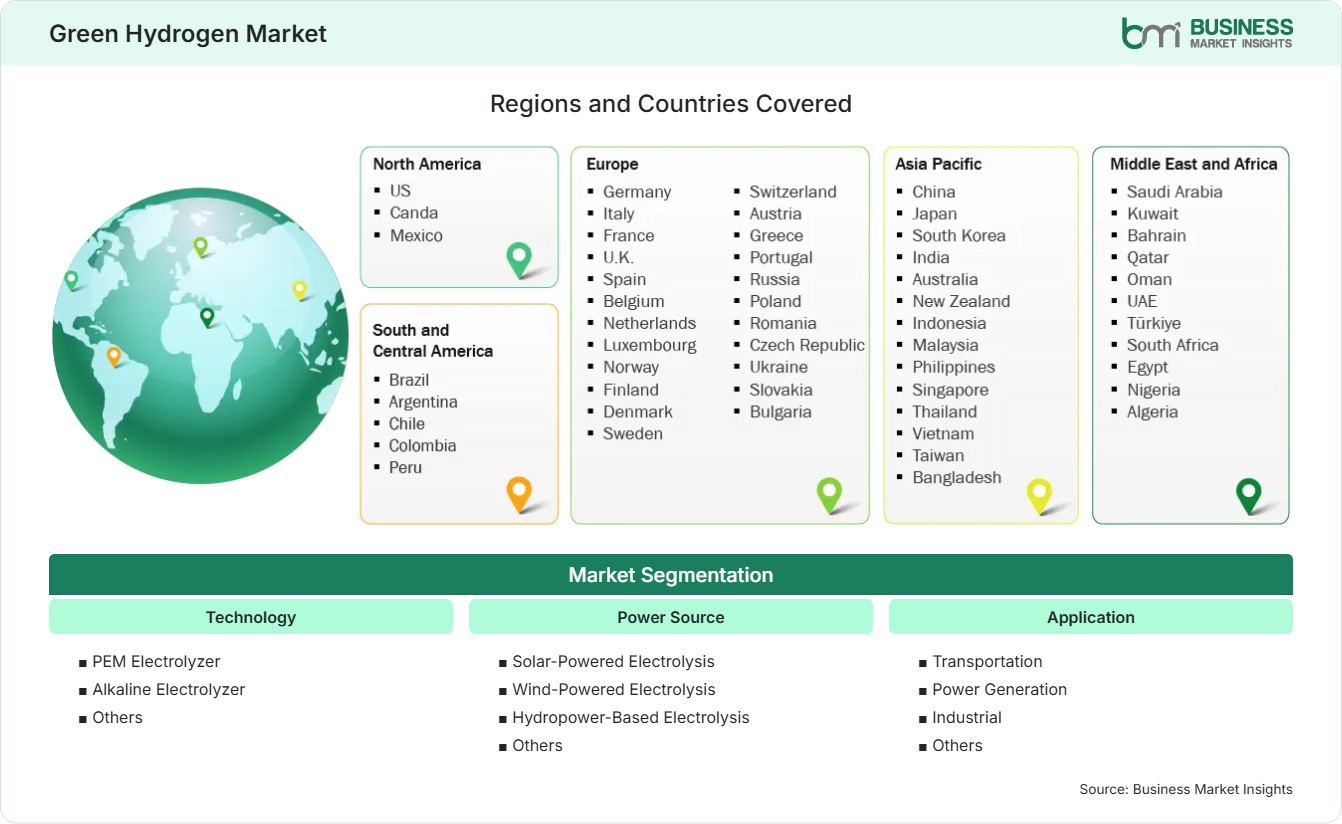
Global Market Geography
FREE PDF
Request your free sample
Request free sample
Segment Analysis

Green Hydrogen Market Segmentation

Technology

The technology segment is led by Alkaline Electrolyzer systems, representing a 45%–49% share in 2025 and expanding at a 34%–37% CAGR through 2034. Mature engineering, large-scale deployment, established supply chains, and competitive economics support adoption. PEM systems gain traction where renewable electricity is variable. The Green Hydrogen Market scope increasingly includes technology optimization for grid flexibility, industrial integration, and modular deployment.

  • PEM Electrolyzer: PEM systems provide rapid load response and compact designs, making them suitable for variable solar and wind power. Adoption benefits from flexible operation and growing renewable integration requirements.
  • Alkaline Electrolyzer: Alkaline systems remain widely deployed for large continuous-load projects because of established technology, scalable architectures, competitive economics, and extensive industrial operating experience.

Power Source

The power-source segment is being reshaped by direct coupling between electrolyzers and renewable generation. Solar-powered electrolysis benefits from declining photovoltaic costs and high irradiation regions, while wind-powered electrolysis supports higher operating hours.

  • Solar-Powered Electrolysis: Solar coupling enables hydrogen production from low-cost renewable electricity and can convert surplus daytime generation into a storable energy carrier for industrial or mobility applications.
  • Wind-Powered Electrolysis: Wind-powered electrolysis provides higher utilization in strong wind regions and supports large industrial projects where renewable electricity can be contracted through dedicated generation assets.
  • Hydropower-Based Electrolysis: Hydropower offers stable renewable electricity and high utilization potential, supporting hydrogen production in regions with established hydroelectric assets and industrial demand.

Application

The application segment is expanding beyond conventional industrial feedstock toward mobility, power generation, and synthetic-fuel production. Transportation is the fastest-growing application, while industrial users remain the largest near-term demand base. The Green Hydrogen Market trends increasingly favor applications where hydrogen can substitute existing fossil-derived hydrogen or provide energy-dense fuel for difficult-to-electrify operations.

  • Transportation: Hydrogen supports heavy-duty trucks, buses, fleets, rail, shipping, and emerging aviation applications where battery weight, range, or refueling requirements constrain direct electrification.
  • Power Generation: Hydrogen can support dispatchable generation, seasonal energy storage, and renewable balancing, particularly where existing gas infrastructure can be adapted for hydrogen or hydrogen-derived fuels.
  • Industrial: Refineries, ammonia producers, methanol plants, steelmakers, and chemical manufacturers provide established hydrogen demand, enabling substitution of fossil-derived feedstock with renewable hydrogen.
Market Forces

Green Hydrogen Market Dynamics

Key Market Drivers

Industrial Decarbonization Is Creating Anchored Hydrogen Demand

Industrial decarbonization is strengthening the Green Hydrogen Market growth because refineries, ammonia producers, methanol facilities, and steelmakers already consume hydrogen at scale. Global hydrogen demand topped 100 Mt by 2025, where almost all of the hydrogen demand is consumed in established industrial and refining processes. This would mean that replacing fossil-based hydrogen is easier through the reuse of existing process equipment and pipeline networks compared to developing a new end-use application for the hydrogen. Another upside for hydrogen is its application in steel manufacturing, as direct-reduced iron is being considered for hydrogen-based production routes.

Renewable Power Expansion Is Improving Electrolyzer Economics

The growing solar and wind capacity is improving access to renewable energy needed to produce green hydrogen through electrolysis, and at the same time, presents new chances to capitalize on curtailed production. It is possible to use electrolyzers flexibly whenever there is excess renewable production, turning electricity into hydrogen, which can then be stored or used later. This allows for the better use of renewable assets and reduces the risks of electricity price fluctuations in the case of dedicated power purchase agreements (PPAs).

Government Policies Are Increasing Commercial Visibility

Government policy is creating demand signals through production incentives, renewable-hydrogen targets, industrial quotas, infrastructure programs, and competitive allocation mechanisms. For Europe, the European Union mandates that 42% of the hydrogen consumed in industries should be renewable hydrogen by 2030. In the United States, regional clean hydrogen ecosystems are being supported through hubs and infrastructure investments. In India, local production capacity for hydrogen is being developed under the country’s hydrogen program. China is coupling its industry policies with massive electrolyzer production. All these efforts reduce market uncertainties and improve revenue visibility and infrastructure investment.

Key Market Opportunities

Green Ammonia Can Expand International Hydrogen Trade

There is a commercial potential of green ammonia in transporting renewable hydrogen through international markets, as the ammonia can be stored and transported by chemical means. The fertilizer market already has demand, and the shipping fuel market can help further develop demand. Moreover, green ammonia eliminates the need to transport hydrogen via liquefaction and pipelines. The Green Hydrogen Market opportunity depends on securing long-term offtake, competitive renewable power, ammonia-handling infrastructure, certification, and sufficient project financing.

Hydrogen Derivatives Can Unlock Hard-to-Abate Industrial Markets

Hydrogen-derived products such as green methanol, direct-reduced iron, synthetic fuels, and sustainable aviation fuel can broaden commercial opportunities beyond direct hydrogen consumption. These products embed renewable hydrogen into globally traded commodities, allowing producers to serve markets where transporting pure hydrogen is difficult. Aviation offers a particularly relevant pathway because synthetic fuels require renewable hydrogen alongside carbon sources, while maritime transport can use methanol or ammonia. Industrial buyers may accept green premiums when regulations, customer commitments, or carbon-intensity requirements create commercial value.

Integrated Renewable Hydrogen Hubs Can Improve Asset Utilization

Hydrogen integrated hubs can integrate power from renewables, electrolysis plants, storage systems, pipelines, refueling stations, industrial consumers, and derived products in a geographical cluster of facilities. This type of facility would decrease transport needs and share fixed costs between multiple customers. Industrial estates, ports, refineries, mining districts, and renewable energy generation districts are especially well-suited to this concept since there are many hydrogen uses in one system. Current Green Hydrogen Market Trends indicate that Hub development can also improve electrolyzer utilization by balancing demand profiles across customers. A refinery may provide steady demand, while mobility fleets create variable demand, and power generation provides additional flexibility.

Market Restraints and Challenges

High Project Costs and Electricity Requirements

Factor: renewable hydrogen production requires substantial electrolyzer, renewable power, grid, water treatment, compression, storage, and balance-of-plant investment. Electricity is also the dominant operating-cost consideration in many projects, making hydrogen economics highly sensitive to renewable power prices and utilization rates. Impact: projects may struggle to achieve competitive production costs where renewable electricity is expensive, electrolyzer utilization is low, or financing costs remain elevated. The IEA reports that fossil-based hydrogen remains cheaper than renewable hydrogen in many markets in the near term.

Limited Offtake Certainty and Infrastructure Readiness

Factor: many announced hydrogen projects lack firm offtake commitments, dedicated transport infrastructure, or completed regulatory frameworks. The IEA reported that only around one-fifth of new low-emissions hydrogen offtake volumes signed in 2025 were backed by firm contractual commitments. Impact: uncertain demand increases financing risk and can delay final investment decisions even when renewable resources and electrolyzer technology are available. Infrastructure gaps create additional challenges because hydrogen requires compression, storage, pipelines, refueling facilities, or conversion into transportable derivatives.

Company Analysis

Competitive Landscape

The Green Hydrogen Market analysis shows a competitive structure spanning electrolyzer manufacturers, industrial-gas companies, energy technology suppliers, integrated hydrogen developers, and specialized technology providers. Competition increasingly centers on system efficiency, project execution, stack durability, manufacturing scale, service capability, financing support, and geographic reach.

Company Name

Overview

Products and Services relevant to this market

Plug Power Inc.

Hydrogen technology company supplying production, storage, fueling, and power solutions across industrial and mobility applications.

PEM electrolyzers, hydrogen generation systems, storage, liquefaction, fueling infrastructure, integrated hydrogen projects, and service support.

Bloom Energy Corporation

Energy technology company developing solid-oxide platforms for electricity and hydrogen production with emphasis on high-efficiency distributed systems.

Solid-oxide electrolyzers, hydrogen production platforms, energy systems, and integrated solutions for industrial and energy applications.

Siemens Energy AG

Global energy technology supplier supporting renewable integration, grid systems, power generation, and hydrogen production infrastructure.

PEM electrolyzer systems, hydrogen production technology, renewable integration, power electronics, automation, and project engineering services.

Nel ASA

Specialist hydrogen technology company focused on electrolyzers and hydrogen fueling infrastructure for industrial and mobility markets.

Alkaline and PEM electrolyzers, hydrogen fueling equipment, hydrogen production systems, and related service solutions.

thyssenkrupp nucera AG & Co. KGaA

Electrolysis technology provider focused on large-scale industrial hydrogen production and established process-industry applications.

Alkaline water electrolysis, high-pressure electrolysis development, engineering, project execution, lifecycle services, and industrial hydrogen systems.

ITM Power plc

UK-based electrolyzer manufacturer specializing in PEM technology and modular systems for large industrial projects.

PEM electrolyzers, modular hydrogen plants, engineering support, system integration, maintenance, and long-term service solutions.

Cummins Inc.

Diversified power technology company with hydrogen capabilities spanning fuel cells, engines, and electrolyzer technologies.

PEM and alkaline electrolyzer solutions, hydrogen production equipment, fuel cells, controls, and integrated power applications.

Air Liquide S.A.

Industrial-gas and technology company developing hydrogen production, distribution, and industrial decarbonization projects globally.

Large-scale electrolyzers, hydrogen production, distribution, compression, storage, industrial supply, and integrated decarbonization projects.

Linde plc

Industrial-gas company providing hydrogen production, processing, storage, distribution, and industrial gas infrastructure.

Electrolyzer-integrated hydrogen plants, compression, liquefaction, storage, distribution systems, and industrial hydrogen services.

Enapter AG

Specialist electrolyzer developer focused on modular anion exchange membrane systems and digitally managed hydrogen production.

AEM electrolyzers, modular multicore systems, energy-management software, hydrogen production solutions, and system optimization services.

Trust & Transparency

Research Methodology

The market analysis combines proprietary research with secondary data from government agencies, company disclosures, regulatory filings, industry databases and expert interviews. Market estimates are validated through data triangulation, cross-market benchmarking and analyst review.

View Full Research Methodology

Questions Answered

Frequently Asked Questions

What factors will influence future electrolyzer competition?

The Green Hydrogen Market Report highlights that competition will increasingly depend on system efficiency, stack durability, dynamic operating capability, manufacturing scale, critical-material requirements, local service infrastructure, financing support, regulatory compliance, and the ability to integrate electrolyzers with renewable power.

How can hydrogen projects improve investment bankability?

Projects can improve bankability through firm offtake agreements, long-term renewable electricity contracts, government support, integrated infrastructure, diversified customers, and conversion into transportable derivatives such as ammonia or methanol.

Which applications offer the greatest commercial Green Hydrogen Market opportunity?

Industrial applications currently provide the strongest demand foundation because refineries, ammonia plants, chemical facilities, and emerging green-steel projects can directly replace fossil-derived hydrogen. Transportation and synthetic fuels provide additional long-term opportunities.

Why are alkaline electrolyzers important for large hydrogen projects?

Alkaline systems benefit from mature engineering, established manufacturing experience, scalable architectures, and suitability for continuous industrial operation. These characteristics support deployment in large projects where stable renewable electricity is available.

What is driving the rapid expansion of renewable hydrogen deployment?

Renewable hydrogen is gaining traction because industrial users need lower-carbon feedstocks, renewable electricity availability is expanding, governments are introducing demand-support mechanisms, and electrolyzer technologies are becoming increasingly scalable.

Access the Full Green Hydrogen Market Report

Get segment-level forecasts, regional estimates, competitive benchmarking, company profiles and downloadable Excel datasets.

Access the full Green Hydrogen Market Report
350 pages PDF & Excel | 2026-10-12
Similar Research

Related Market Reports