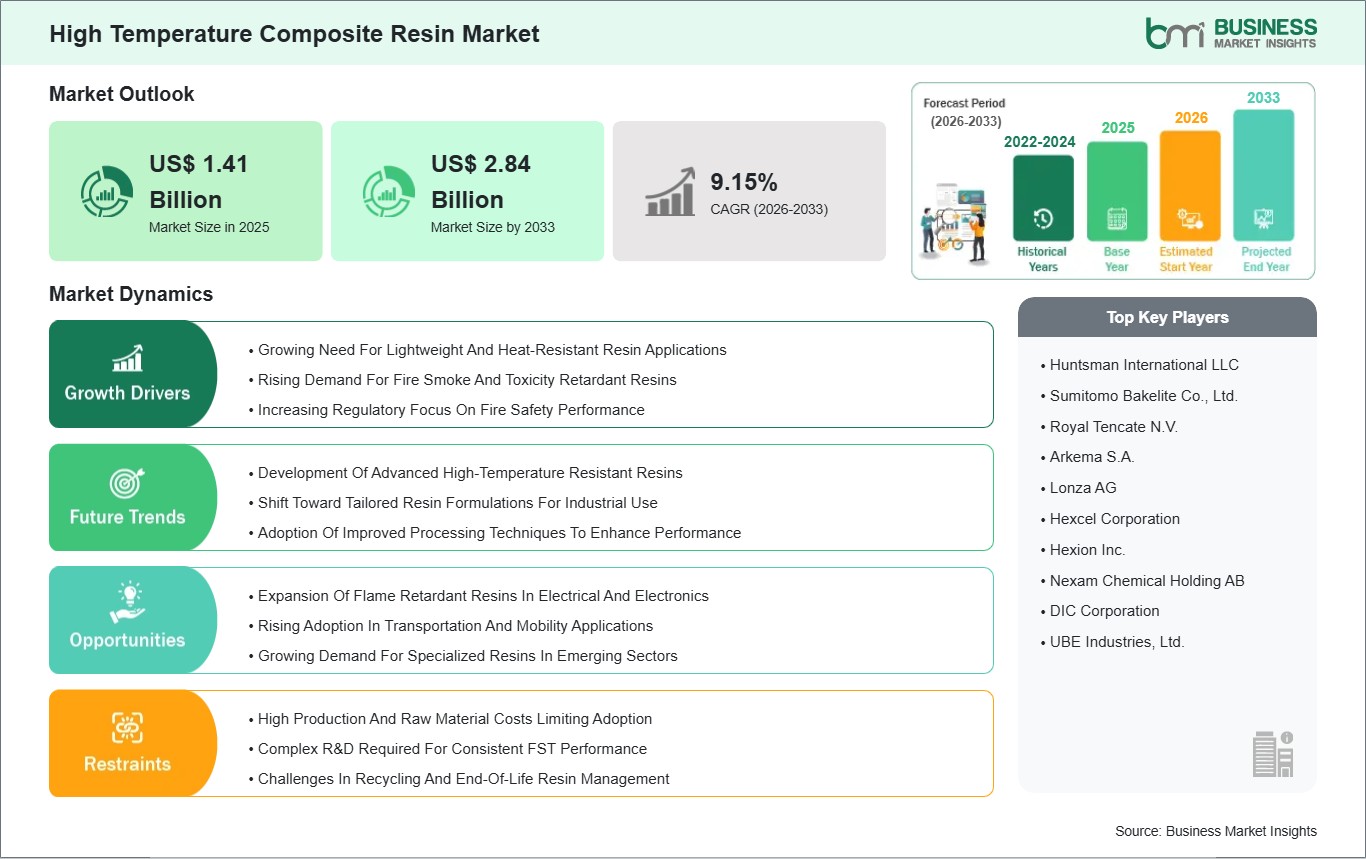
The High Temperature Composite Resin Market size is expected to reach US$ 2.84 Billion by 2033 from US$ 1.41 Billion in 2025. The market is estimated to record a CAGR of 9.15% from 2026 to 2033.
The global high temperature composite resin market encompasses advanced polymer systems engineered to withstand extreme thermal conditions while maintaining mechanical strength, chemical resistance, and dimensional stability. These resins are integral to high-performance applications in aerospace, automotive, electrical and electronics, industrial machinery, and renewable energy sectors. They offer essential properties such as heat resistance, low thermal expansion, and structural durability, enabling manufacturers to meet stringent performance standards in demanding environments. Market growth is largely driven by increasing adoption in aerospace components, lightweight automotive parts, and high-performance industrial applications where conventional resins fail under elevated temperatures.
The push for energy efficiency, durability, and miniaturization in electronics and industrial systems also fuels the demand for high temperature composite resins. Despite all these growth factors, some factors restrict the growth of the market. For example, the manufacturing of high temperature resins is a complex process, which may require expensive materials. Moreover, there are environmental concerns associated with the recycling of high temperature resins. There may be limitations in terms of performance when exposed to extremely prolonged temperature. However, ongoing research on improved materials, along with increased demand from aerospace, automotive, and industrial sectors, ensures steady growth of the global market for high temperature composite resin.

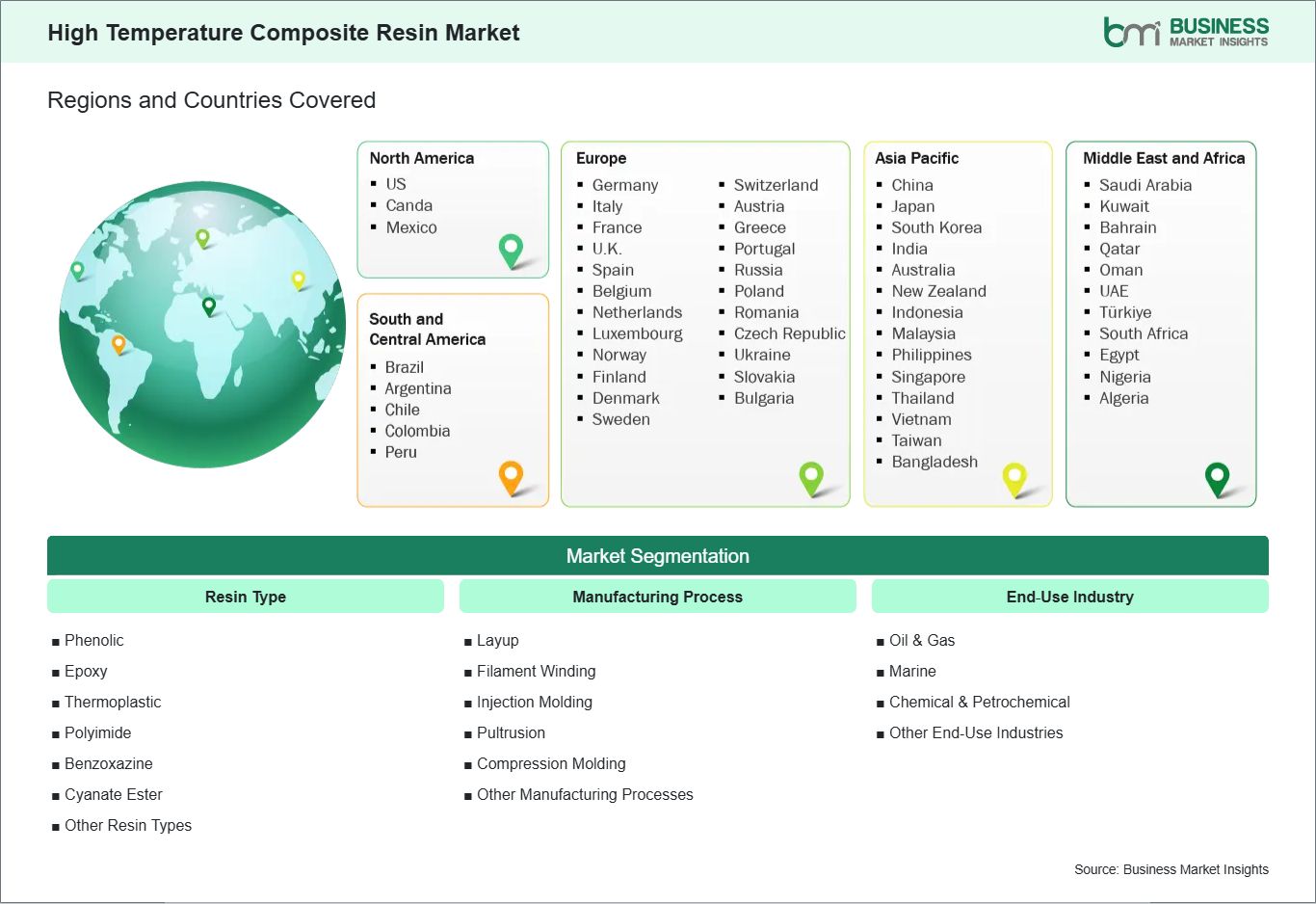
Key segments that contributed to the derivation of the high temperature composite resin market analysis are resin type, manufacturing process, and end‑use industry.
The global high temperature composite resin market is witnessing growth due to the increasing demand for materials that combine lightweight properties with superior thermal resistance. High temperature resins, including phenolic, polyimide, and bismaleimide types, are increasingly utilized in applications where structural integrity must be maintained under extreme heat. Industries such as aerospace, automotive, and industrial machinery are leveraging these resins to replace traditional metals, enabling reduced weight without compromising performance. The ability of these materials to withstand elevated temperatures while maintaining dimensional stability makes them essential for components exposed to continuous thermal stress, such as engine housings, heat shields, and turbine blades.
Regional adoption patterns are shaped by industry-specific requirements and environmental factors. In regions with advanced aerospace and automotive sectors, high temperature resins are incorporated into lightweight composite components to meet fuel efficiency and performance targets. In regions experiencing rapid industrial expansion, these resins are utilized in machinery, pressure vessels, and industrial piping where thermal resistance is critical. Coastal and high-humidity regions emphasize resins with combined heat and chemical resistance to ensure long-term durability in aggressive environments. The adaptability of high temperature composite resins to diverse manufacturing processes, including molding, filament winding, and prepreg layup, further drives adoption.
Innovation in resin chemistry is also contributing to market growth. Manufacturers are developing formulations with improved thermal endurance, flame retardancy, and mechanical strength while reducing curing times and processing complexity. These advancements enable the production of more intricate components, supporting the evolution of lightweight, high-performance designs across industries. As global sectors continue to prioritize efficiency, safety, and durability under high-temperature operating conditions, high temperature composite resins are increasingly recognized as a strategic material for engineering resilient, lightweight solutions worldwide.
The market for high temperature composite resins is also expanding due to growing adoption of flame retardant formulations in electrical and electronics applications. Flame retardant resins are essential for ensuring safety, performance, and regulatory compliance in high-power electrical systems, printed circuit boards, connectors, and insulation components. Their ability to resist combustion while maintaining mechanical and dielectric properties makes them suitable for applications ranging from consumer electronics to industrial automation, where heat generation and electrical stress are significant operational challenges.
Regional adoption trends highlight differences in application focus. In regions with mature electronics manufacturing sectors, high-performance flame retardant resins are integrated into high-voltage equipment, connectors, and circuit boards, where operational reliability and compliance with strict safety standards are critical. In regions with expanding industrial and electronics infrastructure, flame retardant resins are used in emerging applications such as energy storage systems, solar panels, and electric vehicle components, addressing both thermal management and fire safety concerns. Their adaptability to various production techniques, including injection molding, casting, and lamination, makes them ideal for diverse manufacturing environments.
Technological innovations are further driving market growth in the electrical and electronics sector. Advanced resin formulations are now being engineered for higher thermal limits, improved dielectric strength, and compatibility with automated manufacturing processes. Additionally, hybrid resins that combine flame retardancy with mechanical reinforcement are enabling the development of compact, lightweight components that meet modern miniaturization demands. As global electrification and electronics consumption expand, high temperature flame retardant composite resins are becoming a critical material for ensuring operational safety, reliability, and long-term performance across multiple end-use industries.

The high temperature composite resin market is experiencing steady growth, with market size and share analysis reflecting evolving treatment preferences and competitive dynamics among key players. The report evaluates important subsegments categorized within resin type, manufacturing process, and end‑use industry, and end‑use industry, highlighting their respective contributions to overall market performance.
By resin type, the epoxy subsegment dominated the FST Composite Resin market in 2025. Epoxy resins offer excellent mechanical strength, thermal stability, and chemical resistance, making them highly suitable for high-performance applications, which drives their widespread adoption.
Based on manufacturing process, the layup subsegment dominated the FST Composite Resin market in 2025. Layup processes provide precise control over fiber orientation and resin distribution, making them highly suitable for complex and high-strength composite components, which drives their widespread adoption.
In terms of end‑use industry, the aerospace & defense subsegment dominated the FST Composite Resin market in 2025. Aerospace and defense applications demand lightweight, durable, and high-performance materials, making this segment highly suitable for critical structural and functional components, which drives its widespread adoption.
| Report Attribute | Details |
|---|---|
| Market size in 2025 | US$ 1.41 Billion |
| Market Size by 2033 | US$ 2.84 Billion |
| Global CAGR (2026 - 2033) | 9.15% |
| Historical Data | 2022-2024 |
| Forecast period | 2026-2033 |
| Segments Covered | By Resin Type
|
|
Regions and Countries Covered
| |
| North America | US, Canada, Mexico |
| Europe | Belgium, Austria, Finland, Denmark, Greece, Poland, Romania, Russia, Ukraine, Czech Republic, Slovakia, Bulgaria, Italy, Luxembourg, Germany, Switzerland, France, Netherlands, Norway, Portugal, Spain, Sweden, United Kingdom |
| Asia-Pacific | Australia, China, India, Japan, South Korea, Indonesia, Malaysia, Philippines, Singapore, Thailand, Vietnam, Bangladesh, New Zealand, Taiwan |
| South and Central America | Brazil, Argentina, Peru, Chile, Colombia |
| Middle East and Africa | Bahrain, Kuwait, Oman, Qatar, Saudi Arabia, United Arab Emirates, Turkiye, South Africa, Egypt, Algeria, Nigeria |
| Market leaders and key company profiles |
|
The "High Temperature Composite Resin Market Size and Forecast (2022 - 2033)" report provides a detailed analysis of the market covering below areas:
The geographical scope of the High Temperature Composite Resin market report is divided into five regions: North America, Asia Pacific, Europe, Middle East & Africa, and South & Central America. The High Temperature Composite Resin market in North America is expected to grow during the forecast period.
North America dominates the global high temperature composite resin market due to its advanced aerospace, defense, automotive, and industrial manufacturing sectors. The region`s strong focus on high-performance materials, coupled with stringent quality and safety standards, drives widespread adoption of high temperature resins in critical applications such as aircraft components, automotive engine parts, and industrial machinery. North American manufacturers prioritize resins that offer superior heat resistance, structural integrity, and chemical stability to meet the operational demands of high-temperature environments.
Innovation is also a major contributor to North America`s strong position, with manufacturers developing new resin chemistry, better curing methods, and hybrid composites to provide improved thermal stability and mechanical properties. The interaction between material suppliers, research organizations, and end-use industries helps to drive the creation of tailored materials to meet the rigorous demands of the aerospace, automotive, and electronic industries. Environmental issues and regulatory requirements also play a role in the design of materials, favoring materials with improved durability and environmental performance throughout the life cycle of the final product. In spite of high production costs and processing difficulties, North America`s technological expertise, mature industry, and strong performance and safety records continue to reinforce its leading position in the high-temperature composite resin market.

The high temperature composite resin market is evaluated by gathering qualitative and quantitative data post primary and secondary research, which includes important corporate publications, association data, and databases. A few of the key developments in the high temperature composite resin market are:
The High Temperature Composite Resin Market is valued at US$ 1.41 Billion in 2025, it is projected to reach US$ 2.84 Billion by 2033.
As per our report High Temperature Composite Resin Market, the market size is valued at US$ 1.41 Billion in 2025, projecting it to reach US$ 2.84 Billion by 2033. This translates to a CAGR of approximately 9.15% during the forecast period.
The High Temperature Composite Resin Market report typically cover these key segments-
The historic period, base year, and forecast period can vary slightly depending on the specific market research report. However, for the High Temperature Composite Resin Market report:
The High Temperature Composite Resin Market is populated by several key players, each contributing to its growth and innovation. Some of the major players include:
The High Temperature Composite Resin Market report is valuable for diverse stakeholders, including:
Essentially, anyone involved in or considering involvement in the High Temperature Composite Resin Market value chain can benefit from the information contained in a comprehensive market report.
Please tell us your area of interest
(Market Segments/ Regions and Countries/ Companies)