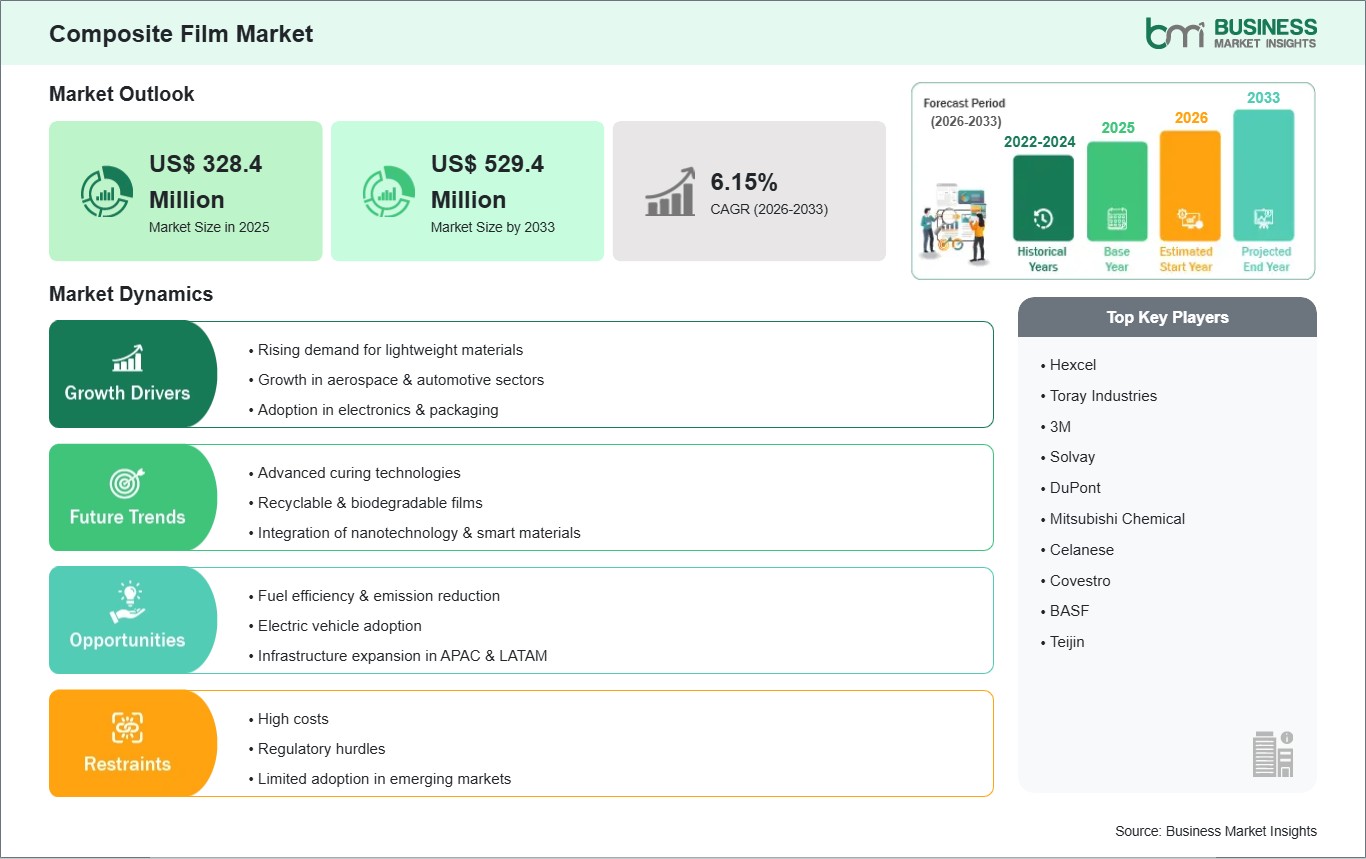
The Composite Film Market size is expected to reach US$ 529.4 Million by 2033 from US$ 328.4 Million in 2025. The market is estimated to record a CAGR of 6.15% from 2026 to 2033.
The global composite film market is witnessing robust growth, driven by the increasing demand for lightweight, high-strength, and multifunctional materials across various industries such as aerospace, automotive, electronics, and packaging. Composite films are engineered by combining multiple material layers to achieve superior properties, including high tensile strength, flexibility, thermal resistance, and barrier protection. These characteristics make them highly suitable for advanced industrial and structural applications.
A major factor contributing to market expansion is the growing need for materials that offer high strength-to-weight ratios. In industries such as aerospace and automotive, reducing weight while maintaining structural integrity is essential for improving fuel efficiency and overall performance. Composite films, particularly epoxy-based films, provide excellent mechanical and thermal properties, making them ideal for such applications.
The market is also benefiting from advancements in material science and manufacturing technologies. Innovations in curing processes, including autoclave and out-of-autoclave techniques, have improved product quality and manufacturing efficiency. Autoclave curing, in particular, enables the production of dense, void-free composite films, which are widely used in high-performance applications such as aircraft components.
Additionally, the increasing demand for high-performance materials in electronics and packaging sectors is driving adoption. Composite films offer excellent barrier properties against moisture, oxygen, and UV radiation, helping extend product lifespan and improve durability. Sustainability trends are also influencing product development, with manufacturers focusing on recyclable and eco-friendly composite film solutions.

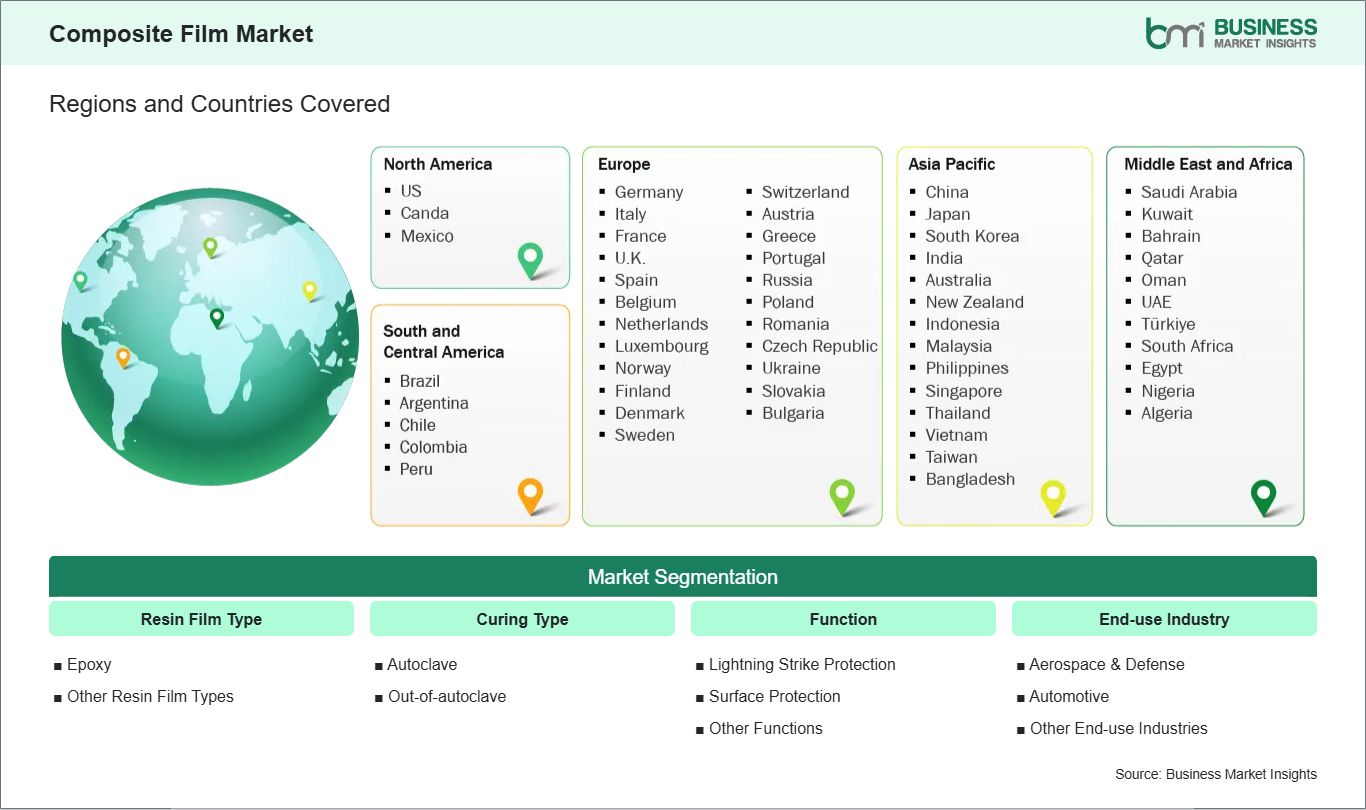
Key segments that contributed to the derivation of the composite film market analysis are resin film type, curing type, function, and end-use industry.
The rising demand for aerospace and automotive sectors which are constantly looking for lighter but higher performing materials is a major factor influencing the composite film market. Because of their superior strength-to-weight ratios, composite films are an excellent choice for those applications where reducing the weight of components and maintaining their structural integrity is critical. The aerospace industry uses composite films extensively in aircraft parts to help increase fuel efficiency and reduce emissions, meeting the global goals of sustainability.
Many manufacturers prefer epoxy based composite films because these films have superior mechanical properties and durability; as well as providing resistance to environmental conditions such as moisture and temperature variance. As composite films have these beneficial characteristics they can easily be incorporated into many different applications, including structural components or protective coatings. The automotive industry is increasingly adopting the use of composite films in order to improve the effectiveness and performance of vehicles while also complying with the government’s strict emission requirements.
The continued popularity of electric vehicles is also driving increased demand for advanced materials like composite films to reduce vehicle weight and improve the efficiency of batteries used in these vehicles. In addition, many companies involved in electronics and packaging are leveraging the excellent barrier properties associated with composite films to provide protection for their products and extend the overall shelf-life of their products.
Advancements in manufacturing processes, particularly with advancements in manufacturing technology, are enabling the composite film industry to take advantage of new functional applications. New curing techniques (like out-of-autoclave processes) are allowing for cost-effective production methods without sacrificing quality and making them available to a wider range of industries due to price reduction.
Functional applications like lightning strike protection and surface protection are becoming increasingly important in the aerospace and defense industry. The design of composite films intended for lightning strike protection provides for the dissipation of electrical energy from the structure of an aircraft and increases the safety and reliability of these structures. Applications of composite films intended for surface protection provide protection against wear and tear, corrosion, and damage from environmental sources.
There is currently an increased interest in environmentally sustainable products, so considerable opportunity exists for the development of environmentally friendly composite films. R&D investment from manufacturers is going into developing recyclable and biodegradable films that will comply with emerging environmental standards. The rapid industrialization and growing demand for advanced materials in geographic areas such as Asia Pacific and Latin America are creating significant opportunities for the growth of the composite film industry.
Innovation in composite film products will also be driven by the integration of nanotechnology into composite film products and the use of smart materials. Innovations such as this should lead to the development of composite films that have improved performance characteristics such as self-healing, conductive, and thermally efficient properties.
The Composite Film Market demonstrates steady growth, with size and share analysis highlighting evolving trends and competitive dynamics among key players. The report examines subsegments categorized within resin film type, curing type, function, and end-use industry, offering insights into their contribution to overall market performance.
By product, the epoxy subsegment dominated the market in 2025, driven by its superior mechanical properties, durability, and widespread use in high-performance applications.
By curing type, the autoclave subsegment dominated the market in 2025, driven by its ability to produce high-quality, void-free composite films for critical applications.
By function, the lightning strike protection subsegment dominated the market in 2025, driven by increasing demand in aerospace applications for enhanced safety and performance.
By end-use industry, the aerospace & defense subsegment dominated the market in 2025, driven by extensive use of composite films in aircraft structures and components.
| Report Attribute | Details |
|---|---|
| Market size in 2025 | US$ 328.4 Million |
| Market Size by 2033 | US$ 529.4 Million |
| Global CAGR (2026 - 2033) | 6.15% |
| Historical Data | 2022-2024 |
| Forecast period | 2026-2033 |
| Segments Covered | By Resin Film Type
|
|
Regions and Countries Covered
| |
| North America | US, Canada, Mexico |
| Europe | Belgium, Austria, Finland, Denmark, Greece, Poland, Romania, Russia, Ukraine, Czech Republic, Slovakia, Bulgaria, Italy, Luxembourg, Germany, Switzerland, France, Netherlands, Norway, Portugal, Spain, Sweden, United Kingdom |
| Asia-Pacific | Australia, China, India, Japan, South Korea, Indonesia, Malaysia, Philippines, Singapore, Thailand, Vietnam, Bangladesh, New Zealand, Taiwan |
| South and Central America | Brazil, Argentina, Peru, Chile, Colombia |
| Middle East and Africa | Bahrain, Kuwait, Oman, Qatar, Saudi Arabia, United Arab Emirates, Turkiye, South Africa, Egypt, Algeria, Nigeria |
| Market leaders and key company profiles |
|
The "Composite Film Market Size and Forecast (2022 - 2033)" report provides a detailed analysis of the market covering below areas:
The geographical scope of the Composite Film Market report is divided into North America, Asia Pacific, Europe, Middle East & Africa, and South & Central America. North America held the largest share in 2025.
North America dominates the global composite film market, supported by a strong aerospace and defense industry, advanced manufacturing capabilities, and high adoption of innovative materials. The United States is a key contributor, with significant investments in aircraft production, defense technologies, and research and development activities. The region’s focus on lightweight and high-performance materials is driving the adoption of composite films across multiple applications.
The presence of leading aerospace manufacturers and increasing production of commercial and military aircraft are major factors contributing to market growth in North America. Composite films are extensively used in aircraft structures for applications such as lightning strike protection and surface protection, enhancing safety and performance. Additionally, the region’s emphasis on sustainability and fuel efficiency is encouraging the use of advanced composite materials.
Europe is another significant market, characterized by strong regulatory frameworks and a focus on environmental sustainability. Countries such as Germany, France, and the UK are investing in advanced materials and technologies to improve industrial efficiency and reduce environmental impact.
Asia Pacific is the fastest-growing region, driven by rapid industrialization, expanding aerospace and automotive industries, and increasing investments in infrastructure development. Countries such as China, India, and Japan are witnessing growing demand for composite films due to rising manufacturing activities and technological advancements.
The Middle East & Africa and South & Central America are emerging markets, supported by increasing industrialization and infrastructure projects. While these regions offer growth opportunities, challenges such as cost sensitivity and limited technological adoption may impact market expansion. Overall, innovation and sustainability will remain key factors shaping regional growth.

The Composite Film Market is evaluated by gathering qualitative and quantitative data post primary and secondary research, which includes important corporate publications, association data, and databases. A few of the key developments in the composite film market are:
The Composite Film Market is valued at US$ 328.4 Million in 2025, it is projected to reach US$ 529.4 Million by 2033.
As per our report Composite Film Market, the market size is valued at US$ 328.4 Million in 2025, projecting it to reach US$ 529.4 Million by 2033. This translates to a CAGR of approximately 6.15% during the forecast period.
The Composite Film Market report typically cover these key segments-
The historic period, base year, and forecast period can vary slightly depending on the specific market research report. However, for the Composite Film Market report:
The Composite Film Market is populated by several key players, each contributing to its growth and innovation. Some of the major players include:
The Composite Film Market report is valuable for diverse stakeholders, including:
Essentially, anyone involved in or considering involvement in the Composite Film Market value chain can benefit from the information contained in a comprehensive market report.
Please tell us your area of interest
(Market Segments/ Regions and Countries/ Companies)