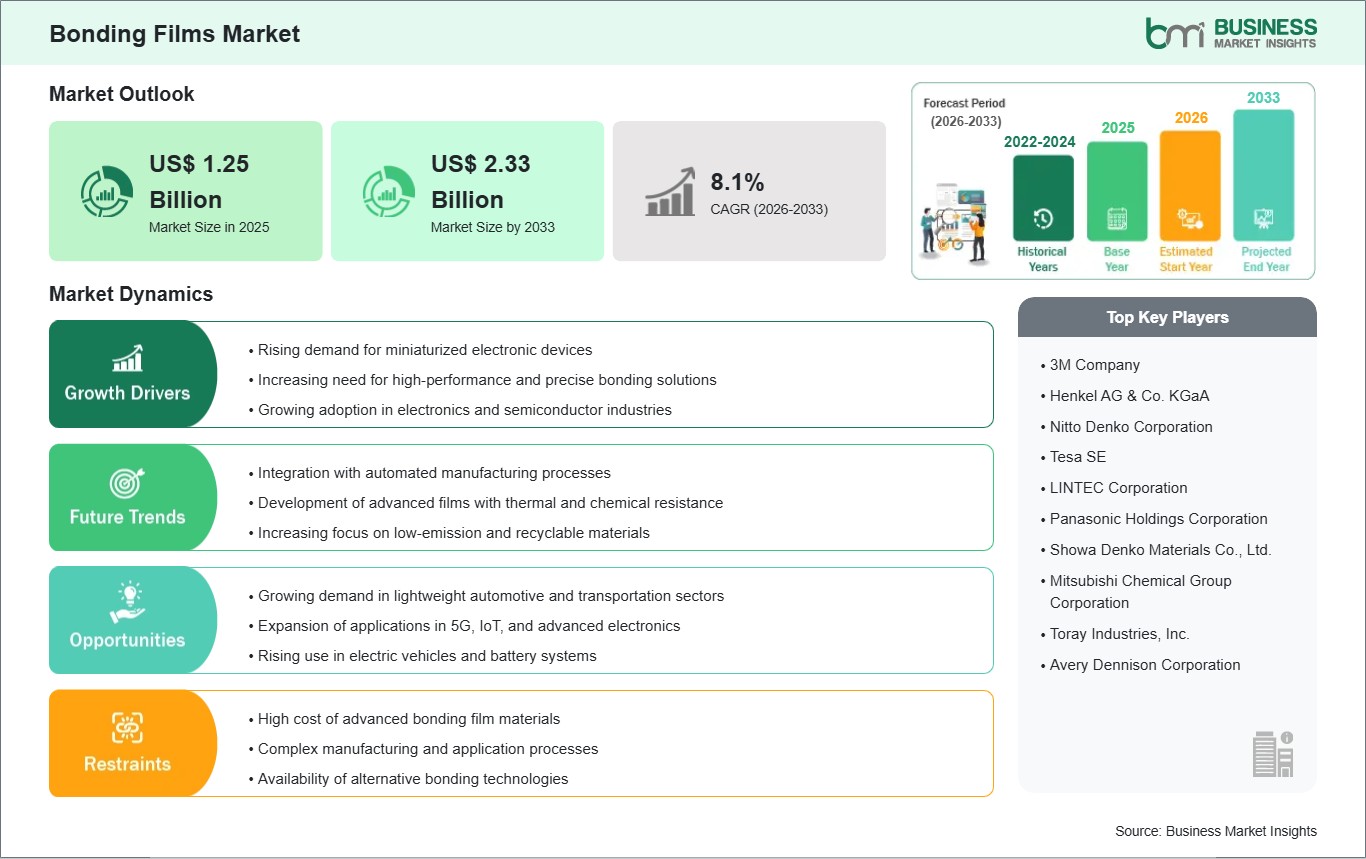
The Bonding Films Market size is expected to reach US$ 2.33 billion by 2033 from US$ 1.25 billion in 2025. The market is estimated to record a CAGR of 8.1% from 2026 to 2033.
The global bonding films market is experiencing steady growth, driven by increasing demand for lightweight, high-performance adhesive solutions across multiple industries. Bonding films are widely used as alternatives to traditional fastening and liquid adhesives, offering advantages such as uniform thickness, clean application, and improved bonding strength. These films are particularly valuable in applications requiring precision and durability, such as electronics assembly, automotive components, and advanced packaging.
Rising adoption of miniaturized electronic devices and compact components is significantly contributing to market expansion. Bonding films enable efficient heat dissipation, electrical insulation, and structural integrity in delicate assemblies. In addition, the automotive and transportation sectors are increasingly utilizing bonding films to reduce vehicle weight and improve fuel efficiency, aligning with global sustainability goals.
Competitive dynamics in the market are focused on material innovation, performance enhancement, and application-specific customization. Manufacturers are developing advanced film formulations with improved thermal stability, chemical resistance, and adhesion properties. Integration of bonding films into automated manufacturing processes is also gaining traction, enhancing production efficiency and consistency. Regulatory standards related to material safety and environmental impact are influencing product development, encouraging the use of low-emission and recyclable materials.

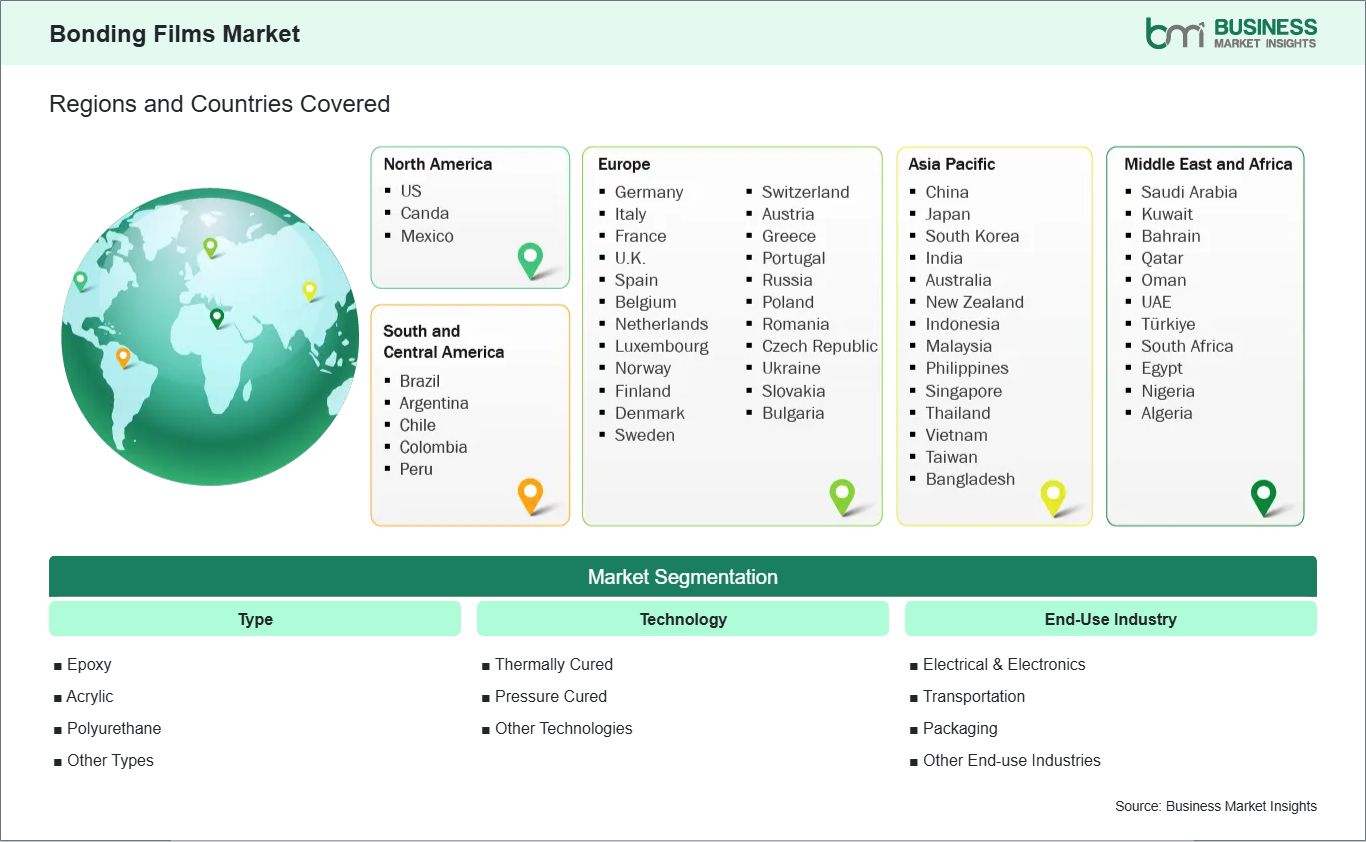
Key segments that contributed to the derivation of the bonding films market analysis are type, technology, and end-use industry.
The bonding films market is being driven by the rapid growth of smaller and better-performing electronics. Electronic devices today, such as smartphones, wearables, tablets and state-of-the-art computing systems, are moving away from traditional adhesive bonding methods to rely on engineered bonding films. Bonding films allow manufacturers to achieve exacting and consistent performances, including surface quality, adhesion and spread of adhesive, when making complex and smaller components. One of the key advantages of bonding films in electronics is that the film is uniform in thickness, has controlled adhesive characteristics and provides exacting guidance for the application of the adhesive to the component surfaces. These attributes allow bond films to be used in electronic assemblies where traditional adhesives would have less success in performance. Another unique feature of bonding films, especially in electronic applications, is that they can create a bond with both no excess adhesive and no additional spreading of the adhesive to create a high-quality bond that maintains integrity while preventing short-circuiting. Also, due to the use of engineered materials, bonding films can provide thermal conductivity or insulation, depending on the application, as well as control the temperature in densely populated electronic devices, where there is significant heat generation due to high-performance components. As electronic devices are being developed with more powerful processing capabilities, they will generate increased levels of heat, which will have an impact on the operation of circuits inside the devices.
In addition, the continued introduction of advanced technologies such as 5G, IoT, and advanced semiconductor devices will continue to generate demand for high-quality bonding solutions that provide highly-integrated and efficient devices. As the demand for these types of devices increases, it becomes more important to utilize bonding materials that can meet the additional stress and provide the durability needed for reliable performance. Bonding films provide strong adhesion and resistance to environmental stress while also being compatible with automated manufacturing processes.
The Transportation sector is experiencing changes with an emphasis on light weighting vehicles, energy usage and reduction of emissions. Bonding films represent a new solution as a strong and light weight bonding option to traditional mechanical fastening methods (i.e., screws/rivets) and providing manufacturers with the ability to use lighter materials such as composites and aluminum. Use of these lightweight materials will reduce the overall weight of vehicles resulting in improved fuel economy and performance.
Bonding films are used for bonding applications in automotive production (i.e., interior assemblies, structural components, and electronic modules) where they provide a uniform way of distributing stress over the bonded surfaces and increasing the durability of the bonded connection, while reducing potential for material fatigue. This property has become especially important for electric vehicles (EVs) since bonding films are used for battery packs and electronic systems which require a high level of reliability and thermal stability.
The Aerospace and Rail industries are starting to utilize bonding films to meet their stringent performance and safety requirements. These industries require bonding materials that can withstand high temperatures, are subjected to high levels of vibration and severe environmental conditions. Advanced bonding films are specially designed to withstand these environmental challenges while providing a high degree of adhesion and structural integrity.
Another area of opportunity is due to an increase in automation in manufacturing processes. Bonding films lend themselves very well to automated assembly lines as they are easily applied without the need for positioning or set-up time. Automation in manufacturing is expected to continue to grow resulting in increased use of bonding films in various industries.

The Bonding Films Market demonstrates steady growth, with size and share analysis highlighting evolving trends and competitive dynamics among key players. The report examines subsegments categorized within type, technology, and end-use industry, offering insights into their contribution to overall market performance.
By type, the epoxy subsegment dominated the market in 2025, driven by its superior bonding strength and thermal resistance.
Based on technology, the thermally cured subsegment dominated the market in 2025, due to its reliability and widespread industrial application.
In terms of end-use industry, the electrical & electronics subsegment dominated the market in 2025, driven by the rapid growth of consumer electronics and semiconductor industries.
| Report Attribute | Details |
|---|---|
| Market size in 2025 | US$ 1.25 Billion |
| Market Size by 2033 | US$ 2.33 Billion |
| Global CAGR (2026 - 2033) | 8.1% |
| Historical Data | 2022-2024 |
| Forecast period | 2026-2033 |
| Segments Covered | By Type
|
|
Regions and Countries Covered
| |
| North America | US, Canada, Mexico |
| Europe | Belgium, Austria, Finland, Denmark, Greece, Poland, Romania, Russia, Ukraine, Czech Republic, Slovakia, Bulgaria, Italy, Luxembourg, Germany, Switzerland, France, Netherlands, Norway, Portugal, Spain, Sweden, United Kingdom |
| Asia-Pacific | Australia, China, India, Japan, South Korea, Indonesia, Malaysia, Philippines, Singapore, Thailand, Vietnam, Bangladesh, New Zealand, Taiwan |
| South and Central America | Brazil, Argentina, Peru, Chile, Colombia |
| Middle East and Africa | Bahrain, Kuwait, Oman, Qatar, Saudi Arabia, United Arab Emirates, Turkiye, South Africa, Egypt, Algeria, Nigeria |
| Market leaders and key company profiles |
|
The "Bonding Films Market Size and Forecast (2022 - 2033)" report provides a detailed analysis of the market covering below areas:
The geographical scope of the Boiler Water Treatment Chemicals Market report is divided into North America, Asia Pacific, Europe, Middle East & Africa, and South & Central America. North America held the largest share in 2025.
North America represents a mature market characterized by advanced industrial infrastructure and strict environmental regulations. Industries in the United States and Canada are increasingly adopting high-performance and environmentally compliant treatment chemicals. The focus in this region is on sustainability, operational efficiency, and the integration of digital monitoring technologies for optimized chemical usage.
Europe also demonstrates steady growth, driven by stringent environmental policies and a strong emphasis on energy efficiency. Countries such as Germany, the UK, and France are focusing on reducing emissions and improving water management practices. This has led to increased adoption of eco-friendly and innovative boiler treatment solutions.
In Asia Pacific, countries such as China and India are witnessing strong growth in power generation, manufacturing, and infrastructure development. The increasing number of thermal power plants and industrial facilities is significantly boosting demand for boiler water treatment chemicals. Government initiatives supporting industrial expansion and energy security further contribute to market growth in this region.
In the Middle East & Africa, the market is supported by the expansion of oil & gas and desalination industries. Boiler systems are widely used in these sectors, creating demand for reliable treatment chemicals. Meanwhile, South & Central America is experiencing gradual growth due to rising industrial activities and investments in energy infrastructure.
Across all regions, factors such as regulatory compliance, water scarcity, and the need for energy-efficient operations are shaping market trends. Manufacturers are tailoring their products and strategies to meet regional requirements, ensuring sustained growth in the global market.

The Bonding Films Market is evaluated by gathering qualitative and quantitative data post primary and secondary research, which includes important corporate publications, association data, and databases. A few of the key developments in the bonding films market are:
The Bonding Films Market is valued at US$ 1.25 Billion in 2025, it is projected to reach US$ 2.33 Billion by 2033.
As per our report Bonding Films Market, the market size is valued at US$ 1.25 Billion in 2025, projecting it to reach US$ 2.33 Billion by 2033. This translates to a CAGR of approximately 8.1% during the forecast period.
The Bonding Films Market report typically cover these key segments-
The historic period, base year, and forecast period can vary slightly depending on the specific market research report. However, for the Bonding Films Market report:
The Bonding Films Market is populated by several key players, each contributing to its growth and innovation. Some of the major players include:
The Bonding Films Market report is valuable for diverse stakeholders, including:
Essentially, anyone involved in or considering involvement in the Bonding Films Market value chain can benefit from the information contained in a comprehensive market report.
Please tell us your area of interest
(Market Segments/ Regions and Countries/ Companies)